
Short Answer
The Cherokee allies at the Battle of Horseshoe Bend were warriors of the Cherokee Nation who fought alongside United States forces under Andrew Jackson against the Red Stick faction of the Upper Creeks on March 27, 1814. The battle took place at Tohopeka, a fortified bend of the Tallapoosa River in present-day Tallapoosa County, Alabama, during the Creek War of 1813–1814. Cherokee service included scouting, guiding, and a decisive river crossing and rear attack that helped break the Red Stick defense. Their participation tied the battle directly to the wider War of 1812 and to the longer struggle over Indigenous sovereignty and land in the Southeast.
Historical Context
The Creek War grew out of tensions within the Creek Confederacy and between Creek towns and the expanding United States. U.S. officials and settlers divided Creek towns into Lower Towns, generally more accommodating to American trade and diplomacy, and Upper Towns, where many leaders resisted U.S. encroachment. The Red Sticks, named for their red-painted war clubs, were a predominantly Upper Creek faction that rejected accommodation and sought to restore traditional practices and independence. The Shawnee leader Tecumseh’s 1811 visit to the Southeast encouraged some Upper Creek towns, though the degree of his direct influence remains debated.
The War of 1812 intensified these tensions. Britain and Spain had interests in the Gulf region, and Red Stick leaders sometimes sought supplies from Spanish Pensacola and British agents. In August 1813, Red Stick warriors attacked Fort Mims north of Mobile, killing hundreds of settlers, Lower Creeks, and militia. The massacre turned a Creek civil conflict into a larger U.S. military campaign. Tennessee, Georgia, and Mississippi Territory forces invaded Creek country.
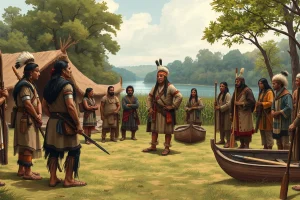
The Cherokee, whose lands bordered Creek territory, faced a strategic dilemma. Violence could spill into their towns, and U.S. officials pressured them to demonstrate loyalty. Cherokee leaders also wanted to separate themselves from the Red Sticks in American eyes. In October 1813, Cherokee men entered U.S. service under Andrew Jackson. Jackson initially used them as interpreters, guides, and scouts, but as white militia desertions increased, he relied more heavily on his Indigenous allies for security and combat.

What Happened
By March 1814, Jackson had assembled a force of about 3,300 men, including regulars of the 39th U.S. Infantry, Tennessee militia, about 500 Cherokee warriors, and about 100 Lower Creek allies. He advanced toward Tohopeka, the Red Stick stronghold at Horseshoe Bend. The Red Sticks, led by Menawa, had gathered about 1,000 warriors and at least 350 women and children. At the narrow neck of the bend, they built a log-and-dirt barricade nearly 400 yards long. The village of Tohopeka lay at the toe of the bend, protected by the Tallapoosa River.
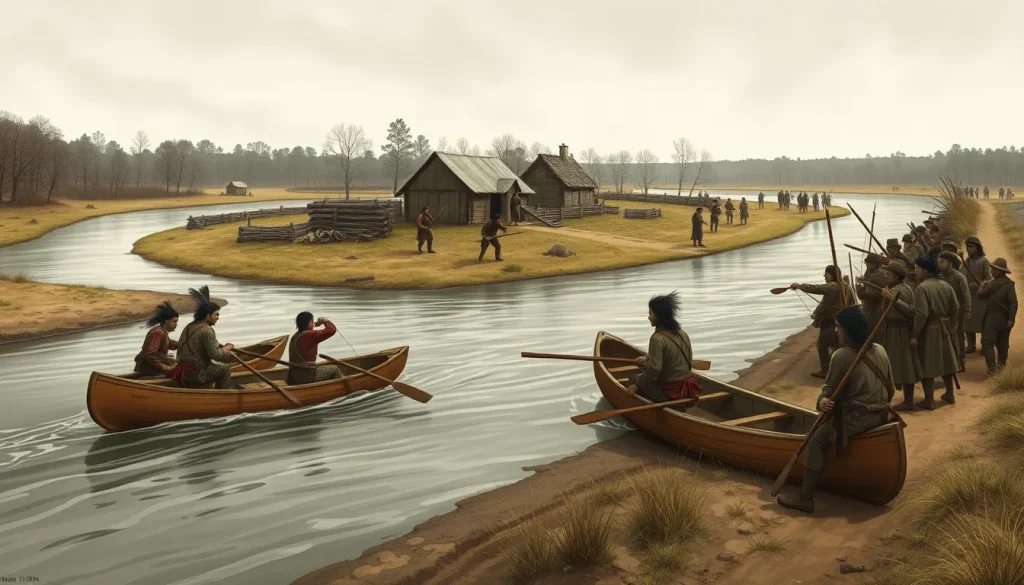
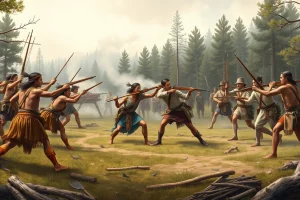
On March 27, Jackson divided his army. John Coffee took 700 mounted riflemen and 600 allied warriors, including Cherokee and Lower Creek fighters, across the Tallapoosa about two and a half miles downriver to surround the village. Jackson led the remaining 2,000 men toward the barricade. After a two-hour artillery bombardment, three Cherokee warriors swam the river, seized Red Stick canoes, and began ferrying their comrades across. The crossing force, often described as about 200 Cherokee, attacked Tohopeka from the rear and set buildings on fire. The smoke and gunfire signaled Jackson to launch a frontal assault. The Red Sticks, caught between two attacks, were overwhelmed after hours of fighting. More than 800 Red Stick warriors were killed, while many who tried to escape across the river were shot.
Why It Matters
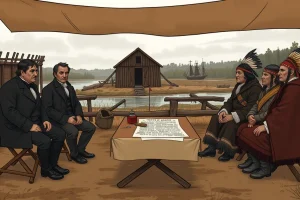
The Battle of Horseshoe Bend broke the Red Stick military power and effectively ended the Creek War. In August 1814, the Treaty of Fort Jackson forced the Creeks to cede more than 21 million acres to the United States, including land belonging to Creek allies as well as Red Sticks. The victory made Andrew Jackson a national figure and contributed to his later political career. For the Cherokee, the alliance with Jackson did not secure their sovereignty. Within a generation, the United States would force the Cherokee and other Southeastern nations from their homelands.
Historians interpret Cherokee participation in several ways. Some emphasize Cherokee strategic calculation: by fighting the Red Sticks, they hoped to protect their towns, satisfy U.S. demands, and avoid being classified as enemies. Others stress the pressures of U.S. expansion and the limits of Indigenous choice within a settler-colonial system. The Cherokee role at Horseshoe Bend also complicates older battle narratives that centered almost entirely on Jackson, showing that Indigenous allies were not simply auxiliaries but actors with their own goals, divisions, and diplomatic calculations.
Prelude
Cherokee involvement began before Horseshoe Bend. After Fort Mims, U.S. officials requested assistance from Southeastern tribes. Cherokee leaders agreed to support the United States against the Red Sticks, though the decision was not unanimous and reflected both fear of regional violence and a desire to maintain a working relationship with the United States. Cherokee warriors joined Jackson’s command in October 1813 and served through the winter campaign.
Forces and Commanders
Jackson commanded the U.S. and allied force. John Coffee led the mounted and allied wing at Horseshoe Bend. The Cherokee fought under their own leaders within the U.S. allied force; the National Park Service identifies Tuq-qua, known as The Whale, as a leader of the river crossing. Lower Creek allies also participated, though their role is sometimes conflated with the Cherokee. The Red Sticks were led by Menawa, a respected Upper Creek war leader. Numbers are approximate: about 500 Cherokee and 100 Lower Creek allies served in the campaign, with roughly 200 Cherokee in the rear attack.
Battlefield and Map Context
Horseshoe Bend is a large loop of the Tallapoosa River in what is now Tallapoosa County, Alabama. The Red Sticks fortified the narrow neck of the peninsula, making a frontal attack costly. The river protected the rear and sides, but it also trapped the defenders once allied warriors crossed. Jackson approached from the northwest, while Coffee’s force crossed downriver and moved against Tohopeka village. The Cherokee crossing converted the river from a defensive barrier into an avenue for a flank attack.
Battle Chronology
On March 26, Jackson camped about six miles northwest of Horseshoe Bend. At 6:30 a.m. on March 27, he divided his army. Coffee crossed the Tallapoosa downriver with mounted riflemen and allied warriors. Jackson advanced toward the barricade and began an artillery bombardment at about 10:30 a.m. Around midday, Cherokee swimmers crossed the river, took canoes, and ferried warriors to the rear of Tohopeka. They attacked the village, drawing Red Stick defenders away from the barricade. At about 12:30 p.m., Jackson launched the frontal assault. The fighting continued for several hours, ending in a decisive U.S. and allied victory.
Casualties and Losses
More than 800 Red Stick warriors were killed, and the Red Stick force was destroyed as a fighting body. U.S. official reports counted about 49 killed and 154 wounded among Jackson’s command, though allied casualties are not always separated in those summaries. Cherokee losses are not consistently reported separately; they are usually included in the allied total. The absence of precise Cherokee casualty figures reflects both incomplete recordkeeping and the tendency of U.S. reports to focus on American units.
Result
The battle ended major Red Stick resistance and was the decisive engagement of the Creek War. Menawa survived, but the Red Stick confederacy was broken. Jackson’s victory opened the way for the Treaty of Fort Jackson and a massive transfer of Creek land. The Cherokee had helped win the battle, but they did not receive lasting security from the United States.
Strategic Consequences
The Creek defeat removed a significant Indigenous power in the Old Southwest and strengthened U.S. control over the region during the War of 1812. It also freed Jackson to move toward the Gulf Coast, where he later defended New Orleans against the British. For the Cherokee, the battle deepened their military relationship with the United States but also exposed their vulnerability. Their alliance did not stop U.S. land pressure, and the treaty settlement ignored distinctions between Red Stick enemies and Creek allies. The longer consequence was the acceleration of removal policies that culminated in the Trail of Tears.
Primary Accounts
The most important contemporary accounts are U.S. military reports, especially Andrew Jackson’s official report to Secretary of War John Armstrong and subordinate reports such as John Coffee’s. These documents describe the Cherokee crossing, the burning of Tohopeka, and the frontal assault. They are valuable but limited: they were written by U.S. officers, emphasize American command, and often reduce Cherokee actions to a supporting role. Cherokee perspectives were recorded later in oral traditions, memoirs, and petitions, and they offer a different view of the alliance, its motives, and its costs.
Battlefield Today
Horseshoe Bend National Military Park preserves the battlefield in Tallapoosa County, Alabama. The park includes the Tallapoosa River, the site of Tohopeka, trails, monuments, and interpretive exhibits. Modern interpretation acknowledges the Cherokee and Lower Creek allies alongside U.S. and Red Stick participants. The site is a place to examine not only a military victory but also the complex alliances and consequences of the War of 1812 era.
Primary Sources
Andrew Jackson’s report to Secretary of War John Armstrong, dated March 28, 1814, is the best-known official account. It describes the battle, the allied crossing, and the destruction of the Red Stick force. Like all military reports, it was written to justify the campaign and to shape how officials in Washington understood Jackson’s leadership. John Coffee’s report provides additional detail on the mounted and allied wing.
Cherokee and Creek accounts are harder to document in the same way. Some were transmitted orally, while others appear in later testimony, petitions, and reminiscences. These sources are essential for recovering Indigenous motives and experiences, but they must be read with attention to the circumstances in which they were created and the pressures their authors faced.
Further Reading
- Ethan Moore, Spring 1814: The Battle of Horseshoe Bend, U.S. National Park Service.
- Battle of Horseshoe Bend, Encyclopedia of Alabama.
- Claudio Saunt, A New Order of Things: Property, Power, and the Transformation of the Creek Indians, 1733–1816 (1999).
- Joel W. Martin, Sacred Revolt: The Muskogees’ Struggle for a New World (1991).
- David S. Heidler and Jeanne T. Heidler, Old Hickory’s War: Andrew Jackson and the Quest for Empire (1996).
- Horseshoe Bend National Military Park, National Park Service.
References
- Ethan Moore, Spring 1814: The Battle of Horseshoe Bend, U.S. National Park Service, https://www.nps.gov/articles/behind-the-sharp-knife.htm.
- Battle of Horseshoe Bend, Encyclopedia of Alabama, https://encyclopediaofalabama.org/article/battle-of-horseshoe-bend/.
- Andrew Jackson, report to Secretary of War John Armstrong, March 28, 1814, in American State Papers: Military Affairs, vol. 1.
- Claudio Saunt, A New Order of Things: Property, Power, and the Transformation of the Creek Indians, 1733–1816 (1999).
- Joel W. Martin, Sacred Revolt: The Muskogees’ Struggle for a New World (1991).
FAQ
Did Cherokee warriors fight at the Battle of Horseshoe Bend?
Yes. About 500 Cherokee served in Andrew Jackson's campaign, with roughly 200 taking part in the river crossing and rear attack at Tohopeka.
What did the Cherokee do at Horseshoe Bend?
They served as scouts, guides, and combatants. During the battle, Cherokee swimmers crossed the Tallapoosa, seized canoes, ferried warriors, and attacked the Red Stick village from the rear, drawing defenders away from the barricade.
Why did the Cherokee ally with the United States?
Cherokee leaders sought to protect their towns from the Creek War, satisfy U.S. demands, and distinguish themselves from the Red Sticks. The decision also reflected pressure from U.S. expansion and internal Cherokee politics.
Leave a Reply