

Short Answer
Smuggling shaped the War of 1812 in the Gulf of Mexico by supplying goods, weapons, and local knowledge that neither the United States nor Britain could easily obtain, and by turning the region’s bays, bayous, and foreign-held ports into contested strategic ground. Between roughly 1813 and 1815 the most important illicit trade centered on Barataria Bay below New Orleans, where the brothers Jean and Pierre Laffite ran a network that drew the attention of British envoys, American naval officers, and Andrew Jackson’s command. This article treats “the Gulf” as the Gulf of Mexico theater: Louisiana, the Mississippi Territory, Spanish West Florida (Mobile and Pensacola), Spanish East Florida, and the coastal waters and bayous that connected them.
Historical Context
New Orleans was the only practical outlet for the produce of the trans-Appalachian interior. The Mississippi River and its tributaries carried flour, cotton, tobacco, and pork south to a port that sat between the river and the Gulf of Mexico. Before 1803, Spanish mercantile regulations restricted which ports colonial merchants could use, and a substantial black market grew up around the city as a result. The Louisiana Purchase transferred New Orleans to the United States, but it did not end illicit trade; it changed which laws were being evaded.
The United States then added restrictions of its own. The Embargo Act of December 1807, the Non-Intercourse Act of 1809, and later measures closed or limited trade with Britain, France, and their dependencies. Enforcement rested on a small Revenue Cutter Service and a thinly stretched Navy, and in a port economy built on shipping, evasion became routine commercial practice rather than an exotic crime. A further stimulus came in 1808, when Congress prohibited the further importation of enslaved Africans; the ban made human trafficking one of the most profitable forms of smuggling in the Gulf.
Geography made the coast almost impossible to police. Barrier islands, marsh, cypress swamp, and a maze of bays and bayous — Barataria Bay and Grand Terre, Lake Barataria, Lake Salvador, Bayou Lafourche, and Lake Pontchartrain — allowed shallow-draft vessels to land cargo out of sight of customs officers and move it inland by water. Foreign jurisdictions compounded the problem: Spanish West Florida (Mobile, Pensacola) and Spanish East Florida (Amelia Island and Fernandina) remained open to shipping and trade even after Spain became Britain’s ally against Napoleon in 1808.
The best-known operators were Jean and Pierre Laffite, who ran an establishment at Barataria by 1810. Their crews, which included men such as Dominique You and Renato Beluche, were drawn from French, Spanish, Caribbean, and American seafaring communities. The Laffites held letters of marque from Cartagena, in present-day Colombia — a government Washington did not recognize — which allowed them to insist that they were privateers rather than pirates.
What Happened
The United States declared war on Britain on 18 June 1812. The Gulf remained a secondary theater for the first year: American forces occupied Mobile in April 1813, ending Spanish authority there, while the British extended their blockade into the Gulf and off the Mississippi, taking American merchant vessels and privateers. The blockade raised the value of cargoes that could still be landed, and it made the Gulf’s smuggling networks more useful to merchants, privateers, and army contractors alike.
Barataria’s traffic continued through 1812 and 1813 despite indictments, proclamations by Louisiana governor W. C. C. Claiborne, and occasional seizures. American officials were divided: customs and naval officers wanted the settlement destroyed, while merchants in New Orleans bought its goods and creditors held its notes. The Laffites cultivated both roles, presenting themselves as useful citizens who could be pardoned.
In early September 1814 the British tried to turn the network to their own purposes. Officers from the squadron supporting British operations at Pensacola sent a letter to Jean Laffite offering a captain’s commission, land, and pay in return for help in guiding and supplying an attack on New Orleans; Captain Nicholas Lockyer carried it to Barataria under a flag of truce. Laffite stalled, then forwarded the correspondence to Governor Claiborne and to a friend, offering the services of himself and his men in exchange for pardons. The overture came as the British were also building a post at Prospect Bluff on the Apalachicola River, where the British officer Edward Nicolls armed refugee Red Stick Creeks and formerly enslaved Black recruits — evidence that Britain was already using Gulf networks of trade, refugees, and arms.
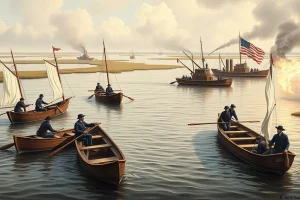
Whatever Laffite’s intentions, the American response to the British offer was swift and military. On 16 September 1814, Commodore Daniel T. Patterson, with the schooner USS Carolina, gunboats, and a detachment of the 44th U.S. Infantry under Colonel George T. Ross, attacked Grand Terre. The raiders burned or seized Baratarian vessels and stores, broke up the settlement, and arrested a number of the men, who were jailed in New Orleans. Laffite escaped.
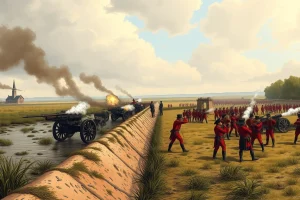
The raid paradoxically made the Baratarians available to the United States rather than to Britain. When Major General Andrew Jackson reached New Orleans on 1 December 1814, he faced a small regular force, untrained militia, and acute shortages of powder, flints, and artillery equipment. Through intermediaries that included the lawyer Edward Livingston, Jackson negotiated with the Laffites: in exchange for service, the imprisoned Baratarians were released and the crews were enrolled. They were assigned to the batteries along the Rodriguez Canal line at Chalmette, where men such as Dominique You served the guns.
Jackson’s force defeated the British assault of 8 January 1815. The Baratarians fought in the batteries and served as guides and scouts, and Jackson’s general orders afterward praised them. In February 1815, after news of the Treaty of Ghent had arrived, President James Madison pardoned the Baratarians. The war in the Gulf ended with the British withdrawal, but the trade networks did not disappear: Jean Laffite moved to Galveston and continued a similar operation, the United States occupied Amelia Island in 1817 and invaded Spanish Florida in 1818, and Spain ceded Florida in the Adams-Onís Treaty of 1819.
Why It Matters
For the United States, smuggling was simultaneously a liability and a lifeline. It eroded federal authority over the coast and made New Orleans vulnerable to foreign recruitment of local seafarers. Yet the stores, powder, flints, and pilots that the Baratarians provided became part of the improvised defense that stopped the British at Chalmette. For Britain, the failure to enlist the Baratarians removed the prospect of local pilots and guides through the delta’s waterways, and the American raid of September 1814 dispersed the settlement before the British could act on it.
The illicit trade also linked the Gulf war to the wider conflict. The same routes that moved contraband moved information, arms, and people — including enslaved people seeking freedom and Indigenous refugees displaced by the Creek War. Longer term, the difficulty of controlling smuggling and foreign-held ports along the Gulf contributed to American pressure to acquire Florida, to the growth of a peacetime naval presence in the Caribbean and Gulf, and to a durable popular memory in which the smugglers of Barataria became heroes of the battle of New Orleans.
Definition
In this context, smuggling means moving goods, people, or money across a legal or customs boundary in violation of the law in force — most often the United States’ own trade restrictions, federal customs duties at New Orleans and Mobile, or the 1808 ban on importing enslaved Africans. It overlapped with, but was legally distinct from, privateering (raiding enemy commerce under a government-issued commission) and piracy (raiding without a valid commission). The Baratarians based their defense on the claim that they were privateers holding Cartagenan commissions.
Background
Three conditions made smuggling endemic in the Gulf. First, restrictive commercial law: Spanish colonial regulations before 1803, then the American embargo and non-intercourse measures, all created goods that could be sold at a premium if landed quietly. Second, geography: the Louisiana delta and the Florida coasts offered countless unguarded landing places and inland waterways. Third, jurisdictional gaps: Spanish Florida’s neutrality, weak customs capacity, and the distance of federal authority from the bayous allowed trade to move through legal gray zones. The prohibition of the African slave trade in 1808 added a highly profitable contraband in human beings to the same routes.
How It Worked
Smuggling in the Gulf was a commercial system rather than a single act. Fast schooners and small craft brought cargoes from the Caribbean, British and Spanish ports, and captured prizes into Barataria Bay and similar anchorages. Goods were landed on Grand Terre and neighboring islands, sorted, and moved inland by way of Bayou Lafourche, Lake Salvador, and Lake Pontchartrain toward New Orleans, where sympathetic merchants received them with falsified papers or simply looked the other way. Captains claimed foreign nationality or privateering commissions to complicate seizure and prosecution. Crews were multinational, and the enterprise depended on credit, insurance-like partnerships, and the cooperation of local officials and residents. Customs officers and naval commanders could disrupt a landing, but they could not close the routes.
Competing Viewpoints
American federal officials and naval officers generally treated the Baratarians as pirates and a security threat, particularly after the British overture of 1814 showed that a foreign power could try to purchase their loyalty. New Orleans merchants and residents often saw the trade as a necessary supply of goods and credit, and juries in the city were reluctant to convict. The Laffites and their men presented themselves as lawful privateers and as useful defenders of Louisiana, a claim Jackson effectively accepted in December 1814.
British officials viewed the Gulf’s illicit networks as an opportunity: a source of pilots, provisions, and local allies for an attack on New Orleans. Historians disagree about how much weight to give the Baratarians. Older accounts, including Jane Lucas de Grummond’s study of the Baratarians, emphasized their contribution to Jackson’s victory; later work, such as William C. Davis’s study of the Laffite brothers, portrays them as opportunistic traders whose loyalty was conditional and whose wartime role has been exaggerated in popular memory. Scholars of slavery, including Adam Rothman, stress that smuggling’s largest human cost was the continuing illegal importation of enslaved Africans into Louisiana.
Role in the War of 1812
Smuggling entered the Gulf war directly at three moments. First, blockade-running and prize-taking sustained the region’s economy and supplied the privateers and merchants whose vessels operated from Louisiana and Spanish Florida. Second, in September 1814 the British attempt to recruit Jean Laffite demonstrated that the smugglers’ knowledge of the delta was a military asset; Laffite’s decision to pass the British correspondence to American authorities gave the United States warning and deprived Britain of local guides. Third, the stores and personnel seized at Barataria and later enrolled under Jackson helped equip the batteries at Chalmette during the New Orleans campaign of December 1814 and January 1815.
At the same time, British operations in the Gulf rested on comparable networks of trade and supply. The post at Prospect Bluff on the Apalachicola, the use of Pensacola before Jackson’s occupation of that town in November 1814, and the shipment of arms and provisions to Indigenous and Black allies all depended on coastal traffic that American officials regarded as illicit. Smuggling, in other words, worked both ways: it was a resource for the defenders of Louisiana and for the British forces trying to take it.
Consequences and Historical Interpretation
In the short term, smuggling made a poorly supplied American defense in Louisiana viable and complicated British planning in the Gulf. In the longer term, the persistence of illicit trade through Spanish Florida helped push the United States toward the occupation of Amelia Island in 1817, the invasion of Florida in 1818, and the Adams-Onís Treaty of 1819. Piracy and smuggling in the Gulf also helped justify the peacetime expansion of the United States Navy, including the Caribbean anti-piracy operations of the 1820s.
Historical interpretation has moved in two directions. Popular memory, shaped by nineteenth-century biographies and later films, made Jean Laffite a patriotic privateer who saved New Orleans. Academic historians more often describe him as a trafficker in goods and enslaved people who negotiated with whichever power offered the best terms, and they place the Baratarians within a broader Gulf economy in which law, trade, and warfare were entangled. Evidence for the Laffites’ motives remains thin: most surviving accounts come from later recollections, and the so-called journal attributed to Jean Laffite, published in the twentieth century, is widely regarded as of disputed authenticity.
Primary Sources
Several categories of contemporary evidence bear on Gulf smuggling, and each has limitations.
The Lockyer–Laffite correspondence, September 1814. The British letter carried to Barataria and Laffite’s reply are the central documents of the British recruitment attempt. Their wording survives through transcriptions in Louisiana repositories and through contemporary newspaper reporting rather than a single uncontested original, so quotation should be treated cautiously. They show British intent and Laffite’s posture, but not his private calculations.
American official correspondence. Commodore Daniel T. Patterson’s reports to the Secretary of the Navy on the September 1814 Barataria raid, and Governor W. C. C. Claiborne’s proclamations and letters, document the federal and territorial campaign against the trade. These are official documents written to justify action, and they consistently characterize smugglers as criminals.
Andrew Jackson’s correspondence and orders. Jackson’s letters from New Orleans in December 1814 and January 1815, and his general orders praising the Baratarians, show how quickly official attitudes changed when military necessity intervened. His description of New Orleans in a letter to his wife as a place of vice reflects the moral vocabulary contemporaries used about the city.
British records. Admiralty and Colonial Office correspondence from Vice Admiral Alexander Cochrane’s command and from officers such as Edward Nicolls documents British efforts to recruit local seafarers, arm Indigenous and Black allies, and supply operations in the Gulf.
Newspapers. Niles’ Weekly Register and New Orleans papers printed reports, letters, and advertisements relating to the Baratarians, but they relied on secondhand reports and often repeated rumor.
Later recollections. Memoirs and the disputed Journal of Jean Laffite supply colorful detail that cannot be verified against wartime records and should be used only with explicit caution.
Further Reading
- William C. Davis, The Pirates Laffite: The Treacherous World of the Corsairs of the Gulf (Harcourt, 2005).
- Jane Lucas de Grummond, The Baratarians and the Battle of New Orleans (Louisiana State University Press, 1961).
- Frank Lawrence Owsley Jr., Struggle for the Gulf Borderlands: The Creek War and the Battle of New Orleans, 1812–1815 (University Presses of Florida, 1981).
- Joseph F. Stoltz III, The Gulf Theater, 1813–1815 (U.S. Army Center of Military History, 2014).
- Robert V. Remini, The Battle of New Orleans: Andrew Jackson and America’s First Military Victory (Viking, 1999).
- Adam Rothman, Slave Country: American Expansion and the Origins of the Deep South (Harvard University Press, 2005).
- Dunbar Rowland, ed., Official Letter Books of W. C. C. Claiborne, 1801–1816 (State Department of Archives and History, 1917).
- Historic New Orleans Collection; Louisiana State Museum; Jean Lafitte National Historical Park and Preserve and Chalmette Battlefield (National Park Service).
References
- Joseph F. Stoltz III, The Gulf Theater, 1813–1815, U.S. Army Center of Military History, 2014. https://www.govinfo.gov/content/pkg/GOVPUB-D114-PURL-gpo56401/pdf/GOVPUB-D114-PURL-gpo56401.pdf
- “Great Babylon on the Gulf: New Orleans in the War of 1812,” American Battlefield Trust. https://www.battlefields.org/learn/articles/great-babylon-gulf
- William C. Davis, The Pirates Laffite: The Treacherous World of the Corsairs of the Gulf (Harcourt, 2005).
- Jane Lucas de Grummond, The Baratarians and the Battle of New Orleans (Louisiana State University Press, 1961).
- Frank Lawrence Owsley Jr., Struggle for the Gulf Borderlands: The Creek War and the Battle of New Orleans, 1812–1815 (University Presses of Florida, 1981).
- Adam Rothman, Slave Country: American Expansion and the Origins of the Deep South (Harvard University Press, 2005).
- Dunbar Rowland, ed., Official Letter Books of W. C. C. Claiborne, 1801–1816 (State Department of Archives and History, 1917).
- Niles’ Weekly Register, volumes for 1814–1815.
- Records of the Office of the Secretary of the Navy and naval officers’ correspondence, Record Group 45, National Archives and Records Administration.
- Robert V. Remini, The Battle of New Orleans: Andrew Jackson and America’s First Military Victory (Viking, 1999).
FAQ
Why was smuggling so common in the Gulf before and during the War of 1812?
Restrictive trade laws -- Spanish colonial regulations, then the American Embargo Act of 1807 and the Non-Intercourse Act of 1809 -- created high profits for goods landed quietly. The delta's bayous, barrier islands, and the neutral ports of Spanish Florida made enforcement nearly impossible, and the 1808 ban on importing enslaved Africans added an extremely profitable contraband.
Did the Baratarians help Andrew Jackson at the Battle of New Orleans?
Yes. After the American raid on Grand Terre in September 1814, Jackson negotiated with the Laffite brothers through intermediaries. Baratarians were released from jail, enrolled in the defense, served the batteries at Chalmette, and acted as guides. Jackson's general orders praised their conduct, and President Madison pardoned them in February 1815. Historians differ on how decisive their contribution was.
How did the British try to use Gulf smuggling networks?
In September 1814 British officers sent a letter to Jean Laffite offering a captain's commission, land, and pay in exchange for guiding and supplying an attack on New Orleans. Laffite forwarded the correspondence to American authorities, and the British gained no pilots or supplies from Barataria. Britain did rely on comparable coastal trade networks to supply Pensacola and the post at Prospect Bluff, where it armed Red Stick Creeks and Black recruits.


Leave a Reply