

Short Answer
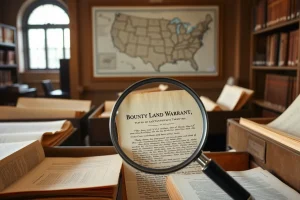
War of 1812 military bounty land warrants were certificates that entitled eligible veterans to free land in the public domain. The General Land Office (GLO), an agency of the U.S. Treasury Department, managed the issuance of patents (land titles) based on these warrants. This research guide explains the warrant system, the records created, and how to locate and use them for historical and genealogical research.
Historical Context
By the early 19th century, the United States held vast public lands. To encourage enlistment during the War of 1812, Congress passed acts in 1811, 1812, and 1814 granting land to noncommissioned officers and soldiers. The GLO, established in 1812, administered the sale and disposal of these lands. The warrants were a form of compensation beyond pay, intended to both reward service and promote settlement.
What Happened
Congress passed a series of acts authorizing bounty land warrants for War of 1812 service: December 24, 1811; January 11, 1812; May 6, 1812; and December 10, 1814. These acts provided 160 acres for those serving five years or less, with the 1814 act doubling the bounty to 320 acres for enlistments after that date. The warrants were non-assignable, and veterans received only a notification; the GLO retained the actual warrant. Land reserves were initially set aside in Michigan, Illinois, and Louisiana (present-day Arkansas). In 1816, due to unfavorable surveyor reports, Congress added land in Illinois and Missouri. The prohibition on assignment continued until 1852, when warrants became negotiable.
The War Department processed applications, with the Pension Office handling bounty land matters from 1841. In 1849, both the Pension Office and the GLO were transferred to the newly created Department of the Interior. The records of these activities are now preserved at the National Archives and Records Administration (NARA). The microfilm publication M848, War of 1812 Military Bounty Land Warrants, 1815–1858, reproduces 105 volumes of warrants and indexes.

Why It Matters
These records are vital for tracing military service and land acquisition. They often contain the veteran’s name, rank, unit, and date warrant issued. For historians, they illustrate federal land policy and westward expansion. For genealogists, they provide a wealth of information about individuals who served in the war.
Definition
A military bounty land warrant was a certificate granting a specified number of acres of public land to a veteran in exchange for military service. The General Land Office was the federal agency responsible for overseeing the disposition of public lands, including the processing of patents based on these warrants.
Background
The practice of granting land for military service predated the War of 1812, with Revolutionary War bounty warrants. The War of 1812 acts continued this tradition, using land as an incentive to enlist. The GLO itself was established in 1812, consolidating land management activities.
How It Worked
Eligible veterans and their heirs submitted applications to the War Department. After verification, a warrant was issued (though retained by the GLO). The veteran received a notification of the warrant, which could be used to select land within designated districts. The GLO then issued a patent (deed) to the veteran, conveying title. Researchers must follow several steps to trace these records, often starting with the Bureau of Land Management’s General Land Office Records website, then obtaining surrendered warrant files from NARA.
Competing Viewpoints
Historians debate the relative importance of bounty land as an enlistment incentive versus other factors. Some argue that the promise of land was a significant motivator, especially for economic opportunities. Others contend that pay and patriotism were more decisive. The records themselves do not settle this debate, but they offer evidence of the government’s intentions and the veterans’ utilization of the warrants.
Role in the War of 1812
The bounty land acts aimed to increase enlistment and strengthen the American military. They also had long-term consequences for land settlement, as veterans and their families moved to the frontier. The warrants were used throughout the public domain, shaping the development of states and territories.
Consequences and Historical Interpretation
The bounty land warrant system contributed to the expansion of the United States. The records created by this system are now essential for genealogical, military, and land-history research. Later acts, such as those of 1850 and 1855, extended benefits to more veterans, resulting in a wealth of documentation. Historians interpret these records to understand recruitment patterns, veteran demographics, and land policy.
Primary Sources
The primary sources for researching War of 1812 bounty land warrants include National Archives Microfilm Publication M848, which contains the actual warrants and indexes. Also important are the case files of bounty land warrant applications, often found in Record Group 15 (Veterans Administration). The Bureau of Land Management’s GLO Records website provides searchable patent details. Compiled military service records (M602) and pension files (M313) further supplement these sources.
Further Reading
- Kluskens, Claire. War of 1812 Military Service, Bounty Land, and Pension Records: A Step-by-Step Guide to Basic Federal Sources. National Archives and Records Administration, 2020.
- National Archives and Records Administration. “War of 1812 Military Bounty Land Warrants, 1815–1858.” Microfilm Publication M848.
- National Archives and Records Administration. “Bounty-Land Warrants for Military Service, 1775–1855.” Reference Information Paper 94.
References
- National Archives and Records Administration. “War of 1812 Military Bounty Land Warrants, 1815–1858.” Microfilm Publication M848, 1975. https://www.archives.gov/files/research/military/army/dc/m848.pdf
- Kluskens, Claire. “War of 1812 Military Service, Bounty Land, and Pension Records.” National Archives, 2020. https://twelvekey.com/wp-content/uploads/2020/05/war_of_1812_basic_guide_2020_05_19.pdf
- National Archives and Records Administration. “Bounty-Land Warrants for Military Service, 1775–1855.” Reference Information Paper 94. https://www.archives.gov/research/military/bounty-land-1775-1855.pdf
FAQ
How do I find a War of 1812 bounty land warrant?
Start by searching the Bureau of Land Management's GLO Records website for a patent under your ancestor's name. Then use the patent details to order the surrendered warrant file from the National Archives using NATF Form 84.
What information do War of 1812 bounty land warrant records contain?
They typically include the veteran's name, rank, company, regiment, branch of service, date of issue, and sometimes the land location.
Are War of 1812 bounty land warrants available online?
The patent details and images are free on the GLO Records website, but the full surrendered warrant files are not online and must be requested from the National Archives.




Leave a Reply