Short Answer
The Battle of Lake Champlain, also known as the Battle of Plattsburgh, was fought on 11 September 1814 near Plattsburgh, New York, during the War of 1812. It involved a naval engagement between a U.S. squadron under Master Commandant Thomas Macdonough and a British squadron under Captain George Downie, as well as a land assault by British forces under Governor General Sir George Prevost. The American naval victory forced Prevost to abandon his invasion, a result that helped to safeguard northern New York and influenced the peace negotiations at Ghent.
Historical Context
By 1814, the War of 1812 had entered a critical phase. Napoleon’s defeat at the Battle of Leipzig in October 1813 and his subsequent abdication in April 1814 allowed Great Britain to transfer thousands of battle-hardened veterans of the Peninsular War to North America. These reinforcements arrived in Quebec in August 1814, giving British forces the capacity to launch a major offensive along the traditional invasion corridor of Lake Champlain. The lake, stretching from Canada deep into New York, offered a direct water route to the Hudson River Valley, which the British hoped to use to sever New England from the rest of the United States. Governor General Sir George Prevost planned to march a large army south from Canada, supported by a naval squadron that would control the lake and neutralize American defenses at Plattsburgh.
What Happened
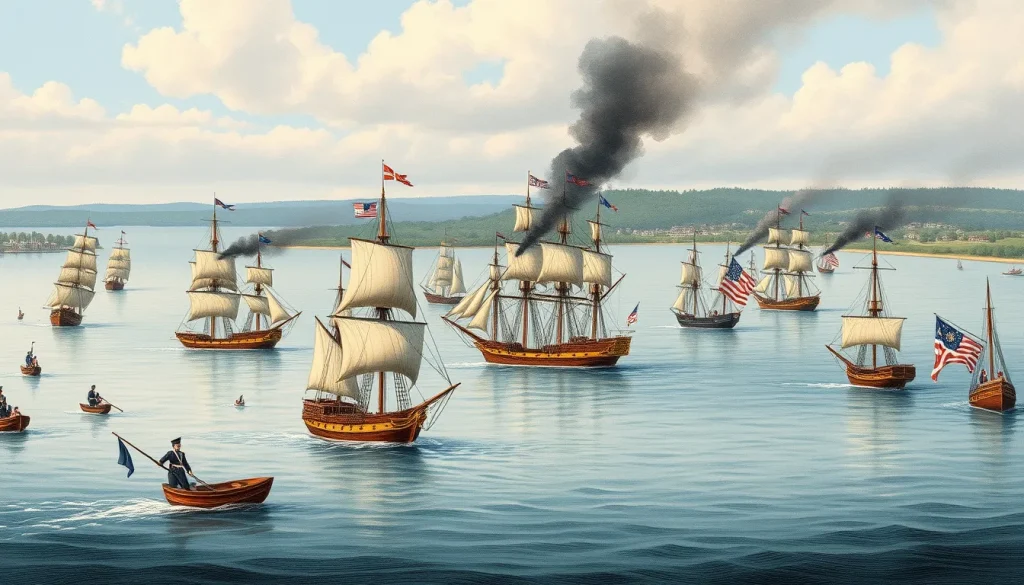
In early September 1814, Prevost’s army, about 10,000 strong, crossed the Canadian border and advanced toward Plattsburgh, where a considerably smaller American force was entrenched. Meanwhile, the British naval squadron under Captain George Downie moved to engage the American squadron, commanded by Master Commandant Thomas Macdonough, which was anchored in Plattsburgh Bay. On the morning of 11 September, Downie attacked. Macdonough had deliberately positioned his ships in a defensive line within the bay, using kedge anchors and spring lines to allow each vessel to rotate in place and present fresh broadsides without weighing anchor. As the British ships approached, they were forced to sail into the bay, giving up their long-range advantage. The ensuing artillery duel was furious. The American flagship Saratoga suffered severe damage to its starboard battery, but Macdonough, using his prepared kedge anchors, turned his ship and brought the undamaged port guns to bear. The British flagship Confiance was similarly crippled, and Captain Downie was killed early in the engagement. After intense fighting, the entire British squadron struck its colours. Prevost, watching from the shore and seeing the naval defeat, cancelled the planned land assault and ordered his army to retreat back to Canada. By nightfall, the American land and naval forces had secured a decisive victory.
Why It Matters
The Battle of Lake Champlain was one of the most strategically significant American victories of the War of 1812. Immediately, it prevented a British invasion of New York and the possible occupation of the Hudson Valley, which could have split New England from the rest of the country. The retreat of Prevost’s army, composed of elite Peninsular veterans, was a humiliating setback for British prestige. In the broader context of the war, the American success strengthened the U.S. position during the peace negotiations at Ghent, which had been underway since August 1814. While British negotiators initially demanded territorial concessions, including control of the Great Lakes, the failure at Lake Champlain undercut those claims. The Duke of Wellington, consulted by the British government, advised that Britain had no right, based on the military situation, to demand territory. The Treaty of Ghent, signed on 24 December 1814, restored the status quo ante bellum, with no territorial changes. The battle thus contributed to the preservation of American territorial integrity and helped shape the final peace agreement.
Prelude
The British plan for the 1814 campaign on Lake Champlain was ambitious. With veterans from Europe available, Sir George Prevost assembled a force of approximately 10,000 infantry, artillery, and militia, intending to march from Canada down the western shore of the lake. The objective was to capture Plattsburgh, then continue to Albany, effectively isolating New England from the rest of the United States. Control of Lake Champlain was essential for moving supplies and supporting the army. The British naval squadron, built at Isle aux Noix, was to destroy the smaller American squadron under Macdonough. At Plattsburgh, American land forces under Brigadier General Alexander Macomb numbered about 3,000 regulars and militia, with additional troops dispersed by Secretary of War John Armstrong. Macdonough anticipated the attack and spent weeks preparing his squadron and his anchorage, devising tactics to maximize his firepower.
Forces and Commanders
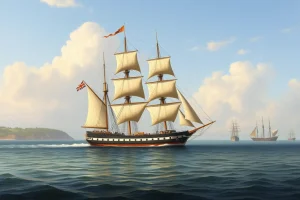
The American naval force comprised four ships and ten gunboats, with the flagship Saratoga (26 guns), a sloop called Eagle, a schooner Ticonderoga, and a sloop Preble. Macdonough served as commander, with Master Commandant Stephen Cassin aboard the Ticonderoga. The British squadron, under Captain George Downie, consisted of four major ships – the Confiance (37 guns), Linnet (16 guns), Chub (11 guns), and Finch (11 guns) – and a number of gunboats. On land, the British force was commanded by Prevost, with Major Generals de Rottenburg, Power, Brisbane, and Robinson leading brigades. The American land defenders were led by Brigadier General Alexander Macomb.
Battlefield and Map Context
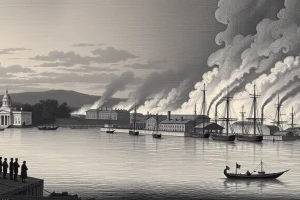
The battle took place in and around Plattsburgh Bay, a sheltered inlet on the western shore of Lake Champlain, near the mouth of the Saranac River. The bay is roughly two miles wide and offers a protected anchorage. Macdonough deliberately anchored his squadron in a north-south line just inside the bay, ensuring that any incoming British squadron would have to approach from the south, where it would be exposed to the full American broadsides. His use of kedge anchors and spring lines meant that even if one side of his ships was damaged, he could turn to present the other. The land battle was fought on the banks of the Saranac and the ridges above Plattsburgh, with American earthworks and blockhouses overlooking the approach from the north. A map of the engagement shows the British ships sailing into the bay, while the American line held firm.
Battle Chronology
At dawn on 11 September, the British squadron weighed anchor and headed south toward Plattsburgh Bay. Around nine in the morning, Downie gave the order to engage. The British ships entered the bay, but the wind was light, forcing them to maneuver slowly. The American squadron opened fire first, and the battle became a close-quarter duel. The Confiance was struck repeatedly and lost her commander within the first half-hour. The Saratoga had her starboard battery disabled, but Macdonough executed his prepared maneuver, cutting the starboard anchors and hauling on the port ones to rotate the ship. He brought his undamaged port guns to bear, while the Saratoga struck the Confiance with raking fire. At roughly 11:00, the Confiance surrendered, followed by the rest of the British squadron. On shore, Prevost watched the naval catastrophe and, despite the insistence of his brigade commanders that they could storm the American positions, ordered a withdrawal. The British army retreated north that evening, leaving behind supplies and artillery.
Casualties and Losses
Exact casualty figures for the naval battle are difficult to determine from the available record. The British squadron was effectively destroyed as a fighting unit: all its ships were captured or surrendered, with heavy losses among the crews. Captain Downie was killed. The American squadron suffered fewer casualties, but the Saratoga was badly damaged. On land, the campaign’s total casualties—including skirmishes before the main action—were relatively light for the size of the forces involved. The Canadian Encyclopedia reports total British campaign casualties of 35 killed, 47 wounded, and 72 taken prisoner, though these figures are likely incomplete and do not reflect the naval losses, which were much higher. American casualties in the land defense were modest, with only a few dozen dead and wounded.
Result
The Battle of Lake Champlain was a decisive American victory. The entire British naval squadron was captured, and the threat to Plattsburgh was removed. Prevost’s land army, despite vastly outnumbering the American defenders, retreated without ever launching a full-scale assault on the American lines. The victory was a combination of Macdonough’s tactical preparation, the positioning of his ships, and the inability of the British squadron to overcome the anchored American line. Tactically, Macdonough’s use of kedge anchors was considered a masterstroke. Strategically, the battle halted the last major British offensive of the War of 1812 in the north and contributed to the conclusion of the peace negotiations.
Strategic Consequences
The American victory at Lake Champlain had significant strategic consequences. It eliminated any prospect of a British conquest of northern New York or a severing of New England. It also gave the United States a crucial bargaining chip in the peace negotiations at Ghent. While the Treaty of Ghent, signed in December 1814, essentially restored the pre-war status quo, the American success on Lake Champlain helped prevent the British from demanding territorial concessions in the Great Lakes region. The battle also boosted American morale following the burning of Washington in August 1814 and reinforced the notion that the young republic could defend its borders successfully. For the British, the failure of Prevost’s campaign was a source of embarrassment, and Prevost was recalled to Britain to face a court martial, though he died before it convened.
Primary Accounts
Several firsthand accounts of the battle survive. J.C. Hubbell, a civilian witness, described the intensity of the artillery fire: “The firing was terrific, fairly shaking the ground, and so rapid that it seemed to be one continuous roar, intermingled with the spiteful flashing from the mouths of guns, and dense clouds of smoke soon hung over the two fleets.” A report from British sailors compared the naval engagement to Lord Nelson’s victory at Trafalgar, calling it a “mere flea bite” in comparison. Official reports were filed by Macdonough after the battle and by Prevost in his dispatches to London. These accounts provide details of the tactics and casualties, though they are often shaped by the respective commanders’ desire to justify their actions. Macdonough’s report emphasized the value of preparation, while Prevost’s dispatches stressed the failure of the navy. These primary sources remain essential to historians for reconstructing the battle.
Battlefield Today
The battle site is located in and around present-day Plattsburgh, New York. The American squadron anchored in the bay, and the land defenses were on the bluffs above the Saranac River. Today, the area is part of the city of Plattsburgh, and several memorials commemorate the battle. The Saranac River and Cumberland Head remain recognizable features. The wreck of the Saratoga and other vessels are underwater sites, but the locations are marked. The Battle of Plattsburgh Interpretive Center in Plattsburgh provides exhibits on the campaign. The site is a destination for historians and visitors interested in the War of 1812.
Primary Sources
Relevant primary sources include Macdonough’s official report to Secretary of the Navy William Jones dated September 11, 1814, which details the movements of his squadron and his tactical innovations. British sources include Prevost’s dispatches and the official report from Captain Downie’s replacement, who survived, describing the loss of the squadron. The recollection of J.C. Hubbell, quoted above, offers a civilian’s perspective. These documents are held in the U.S. National Archives and the British National Archives, among other repositories. They are valuable for understanding the battle but were written with the authors’ interests, so they must be read critically.
Further Reading
- Donald R. Hickey, The War of 1812: A Forgotten Conflict, University of Illinois Press, 1989.
- Jon Latimer, 1812: War with America, Harvard University Press, 2007.
- Pierre Berton, Flames Across the Border: 1813–1814, McClelland and Stewart, 1981.
- National Park Service, “Autumn 1814: The British Navy suffers a decisive defeat at the Battle of Lake Champlain,” available at www.nps.gov.
- Raymond K. Bluhm, “Battle of Plattsburgh,” Encyclopaedia Britannica, www.britannica.com.
References
- National Park Service, “Autumn 1814: The British Navy suffers a decisive defeat at the Battle of Lake Champlain,” accessed 2025, https://www.nps.gov/articles/battle-of-lake-champlain.htm.
- Bluhm, Raymond K. “Battle of Plattsburgh.” Encyclopaedia Britannica, https://www.britannica.com/event/Battle-of-Plattsburgh.
- Ridler, Jason. “Battle of Plattsburgh.” The Canadian Encyclopedia, https://thecanadianencyclopedia.ca/index.php/en/article/battle-of-plattsburgh.
- “The Plattsburgh & Lake Champlain Campaign.” The War of 1812, https://thewarof1812.org/campaigns/the-plattsburgh-lake-champlain-campaign/.
- “America victorious on Lake Champlain.” History.com, https://www.history.com/this-day-in-history/september-11/america-victorious-on-lake-champlain.
FAQ
Why was the Battle of Lake Champlain significant?
The American victory prevented a British invasion of New York and helped the United States secure favorable terms in the Treaty of Ghent, avoiding territorial losses. It was the last major British offensive in the north and boosted American morale after the burning of Washington.
What was Thomas Macdonough's tactical innovation?
Macdonough anchored his ships with kedge anchors and spring lines, allowing him to rotate his vessels and present fresh broadsides during battle. When the Saratoga's starboard battery was disabled, he turned the ship to use the undamaged port guns, which proved decisive.
Why did Sir George Prevost retreat after the naval defeat?
Prevost believed that without control of Lake Champlain, his army's supply line and support would be compromised. He cancelled the land assault on Plattsburgh and ordered a retreat, despite the protests of his brigade commanders, who felt they could still capture the American positions.


Leave a Reply