
Short Answer
Lake Erie was a crucial inland naval frontier during the War of 1812. The Battle of Lake Erie, fought on September 10, 1813, near Put-in-Bay, Ohio, resulted in the capture of an entire British squadron by the United States Navy, securing American control of the lake and altering the course of the war in the northwest. This victory broke British supply lines, forced the abandonment of Fort Malden, and paved the way for the American triumph at the Battle of the Thames.
Historical Context
Lake Erie served as a vital highway for both the United States and Great Britain during the War of 1812. For the British, control of the lake was essential to supply their posts on the western frontier, notably Fort Malden at Amherstburg, and to maintain the allegiance of Indigenous allies led by Tecumseh. For the Americans, the lake was the avenue to recapture Detroit and secure the Old Northwest. When the war began, the British seized Detroit and Fort Michilimackinac, gaining dominance in the upper lakes. Both sides recognized that naval supremacy on Lake Erie would determine control of the entire region. The U.S. Navy established a shipyard at Presque Isle (present-day Erie, Pennsylvania), while the British built vessels at Amherstburg. The race to construct squadrons during the spring and summer of 1813 set the stage for a confrontation.
What Happened
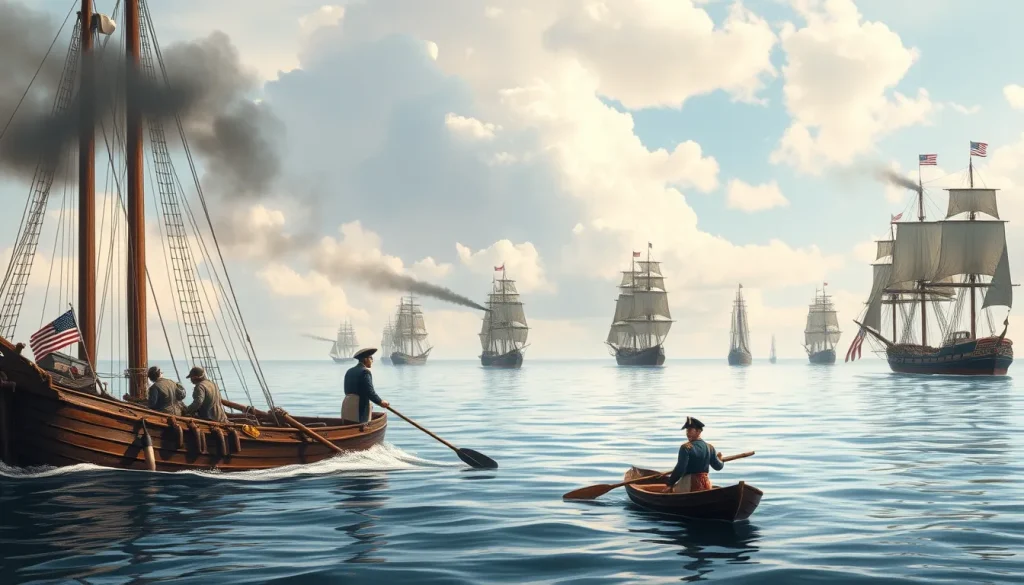
By September 1813, the American squadron under Master Commandant Oliver Hazard Perry had blockaded the British at Amherstburg, cutting off supplies. British Commander Robert Heriot Barclay, facing starvation and desertion of his Indigenous allies, sortied from his base to seek battle. On the morning of September 10, 1813, the two fleets met near Put-in-Bay in western Lake Erie. The Americans had nine vessels; the British had six. Barclay’s flagship Detroit opened fire around 11:45 a.m., and the action became a close-range slugfest. Perry’s flagship, the brig Lawrence, was heavily damaged and most of her crew became casualties. Perry transferred his flag to the brig Niagara under heavy fire, then broke the British line with fresh carronades. By 2:30 p.m., all six British ships had struck their colours—an unprecedented capture of an entire Royal Navy squadron. Perry sent his brief dispatch: “We have met the enemy and they are ours.”
Why It Matters
The American victory at Lake Erie shifted the strategic initiative in the northwest. Control of the lake forced Major General Henry Procter to abandon Fort Malden and withdraw up the Thames River. General William Henry Harrison’s army, transported by Perry’s fleet, pursued and defeated the British at the Battle of the Thames on October 5, 1813. The battle broke the Anglo-Indigenous alliance; Tecumseh was killed, and American control of the Old Northwest was secured. The victory also restored American morale and made Perry a national hero. In memory, the battle is commemorated at Perry’s Victory and International Peace Memorial, a symbol of reconciliation among the United States, Britain, and Canada.
Prelude
Throughout the summer of 1813, both sides raced to complete warships. The Americans built nine vessels at Presque Isle under the direction of shipwright Noah Brown, while the British assembled six at Amherstburg. Perry’s squadron, anchored at Put-in-Bay in the Bass Islands, effectively blocked the British supply route. Barclay’s ships were critically short of food and ammunition; his crew included soldiers from the 41st Regiment and Royal Newfoundland Fencibles, not experienced sailors. On September 9, 1813, Barclay decided to fight rather than abandon his post.
Forces and Commanders
The American fleet, commanded by Master Commandant Oliver Hazard Perry, consisted of nine vessels: the brigs Lawrence, Niagara, and Caledonia; the schooners Scorpion, Ariel, Somers, Porcupine, and Tigress; and the sloop Trippe. In total, they mounted 54 guns, many of them heavy carronades. The British force, under Commander Robert Heriot Barclay, comprised six vessels: the ships Detroit and Queen Charlotte, the brig General Hunter, the schooners Lady Prevost and Chippewa, and the sloop Little Belt, carrying 63 guns, mostly long guns with greater range but less hitting power at close range. Barclay was a veteran of Trafalgar but lacked trained seamen.
Battlefield and Map Context
The action took place in the western basin of Lake Erie, near Put-in-Bay and Rattlesnake Island, about 12 miles northwest of present-day Sandusky, Ohio. The lake there is broad and open, with few islands providing some shelter. The wind was light and variable in the morning, shifting to the southeast around 10 a.m., giving the Americans the weather gauge. Both fleets formed line of battle; the heavier vessels were positioned opposite each other. The battlefield is now part of the Lake Erie Islands region, with Perry’s Victory and International Peace Memorial on South Bass Island.
Battle Chronology
At dawn, lookouts on the American ships spotted the British squadron to the northwest. Perry ordered signals and sails; the Americans got underway by 7 a.m. The wind shifted favorably about 10 a.m., allowing Perry to close. Barclay opened fire around 11:45 a.m. from long range. The Lawrence bore the brunt, suffering heavy damage. By around 1:00 p.m., the Lawrence was nearly incapacitated. Perry transferred to the Niagara by rowboat and took command. He sailed Niagara through the British line, firing broadsides. Within 15 minutes, the British ships were dismasted and surrendered individually. The battle ended at approximately 2:30 p.m. with the capture of the entire British squadron.
Casualties and Losses
American casualties were 27 killed and 96 wounded. British losses were 41 killed, 94 wounded, and 306 captured. These figures are reported consistently in both NPS and Canadian Encyclopedia sources. The high proportion of casualties reflected the close-range engagement and the effective use of carronades. Barclay himself was severely wounded, losing the use of his remaining arm. The captured British ships were taken to the American base at Presque Isle and later refitted into the U.S. Navy.
Result
The Battle of Lake Erie was a decisive American victory. Perry captured all six British vessels, forcing the surrender of an entire Royal Navy squadron—an event without precedent. The victory gave the United States uncontested control of Lake Erie and opened the way for offensive operations against British positions in Upper Canada. Strategically, it was the turning point in the northwest theatre of the war.
Strategic Consequences
American command of Lake Erie severed the British supply line to Amherstburg and Detroit. Without supplies, Procter abandoned Fort Amherstburg and retreated up the Thames River. Perry transported Harrison’s army across the lake, enabling the pursuit that culminated in the Battle of the Thames on October 5, 1813. That battle ended the British threat to the Old Northwest and resulted in the death of Tecumseh, effectively dissolving the pan-Indian alliance. In the longer term, American naval dominance on Lake Erie lasted for the remainder of the war, and the lake became a staging ground for raids on Lake Huron in 1814. The victory also fostered a lasting sense of national pride in the United States, while British authorities court-martialed Barclay (who was honourably acquitted) for the loss.
Primary Accounts
Perry’s dispatch to General Harrison, dated September 10, 1813, is the most famous contemporary account: “We have met the enemy and they are ours: two ships, two brigs, one schooner and one sloop.” This dispatch is preserved in the National Archives. Samuel Hambleton, Perry’s purser, kept a diary detailing the flag ceremony and the battle, now in the collection of the U.S. Naval Academy Museum. Barclay’s court-martial proceedings, held in 1814, provide a British perspective; he testified to the inadequacy of his squadron and crew. The official reports, letters, and muster rolls of both fleets survive in British and American archives.
Battlefield Today
Perry’s Victory and International Peace Memorial, located on South Bass Island in Put-in-Bay, Ohio, commemorates the battle and the peace between nations. Built between 1912 and 1915, the 352-foot Doric column is the largest and most prominent monument to the engagement. Under its rotunda are buried six American and British officers. The memorial is administered by the National Park Service. The U.S. Brig Niagara, Perry’s second flagship, is reconstructed and docked in Erie, Pennsylvania, as part of the Erie Maritime Museum. Other sites include the river-based fortifications at Amherstburg and the underwater archaeology of the scattered wrecks, but the memorial is the principal visitor attraction.
Primary Sources
Key primary sources for the Battle of Lake Erie include Perry’s official dispatch to General William Henry Harrison (September 10, 1813), which is held by the National Archives and reproduced in many histories. The diary of Samuel Hambleton (published in The Perry and Hambleton Letterbooks) offers an enlisted man’s view of the flag and battle. Barclay’s court-martial testimony, documented in Naval Chronicle (1814), provides the British naval perspective. Additionally, the muster rolls and ship logs of the American squadron, preserved at the National Archives, list crew and engagements. These sources must be interpreted with awareness of the participants’ loyalties; Perry’s dispatch is celebratory, while Barclay’s court-martial seeks to justify his actions.
Further Reading
- Altoff, Gerard T. Deep Water: The Battle of Lake Erie and Its Aftermath. Maritime Museum of Lake Erie, 2000.
- Gough, Barry M. Fighting on the Great Lakes: The Navy and the War of 1812. University of Toronto Press, 2013.
- Hickey, Donald R. The War of 1812: A Forgotten Conflict. University of Illinois Press, 1989.
- Palmer, Michael A. The Battle of Lake Erie and the War of 1812. Kendall Hunt, 2013.
- National Park Service, Perry’s Victory and International Peace Memorial, official interpretive materials.
References
- National Park Service. “The Battle of Lake Erie, War of 1812.” Perry’s Victory & International Peace Memorial. https://nps.gov/pevi/learn/historyculture/battle_erie_detail.htm.
- Gough, Barry M. “Battle of Lake Erie (Battle of Put-in-Bay).” The Canadian Encyclopedia, 2011, updated 2022. https://thecanadianencyclopedia.ca/en/article/battle-of-lake-erie-battle-of-put-in-bay.
- American Battlefield Trust. “The Great Lakes in the War of 1812.” 2019, updated 2024. https://www.battlefields.org/learn/articles/great-lakes-war-1812.
- thewarof1812.org. “Battle of Lake Erie.” https://thewarof1812.org/battles/battle-of-lake-erie/.
- National Park Service. “Perry’s Victory and International Peace Memorial.” https://www.nps.gov/places/perry-s-victory.htm.
FAQ
Why was the Battle of Lake Erie significant?
It gave the United States control of Lake Erie, cut British supply lines to Amherstburg, and forced the British withdrawal that led to the Battle of the Thames, where Tecumseh was killed.
Who was Oliver Hazard Perry?
Perry was the American commondore who commanded the U.S. squadron at Lake Erie. He transferred from his disabled flagship Lawrence to Niagara, led the decisive break of the British line, and received the surrender of the entire British squadron.
What happened to the British squadron after the battle?
All six British ships were captured and taken to the American base at Presque Isle. They were later refitted and used in the U.S. Navy, while the British officers and men were prisoners of war.



Leave a Reply