
Short Answer
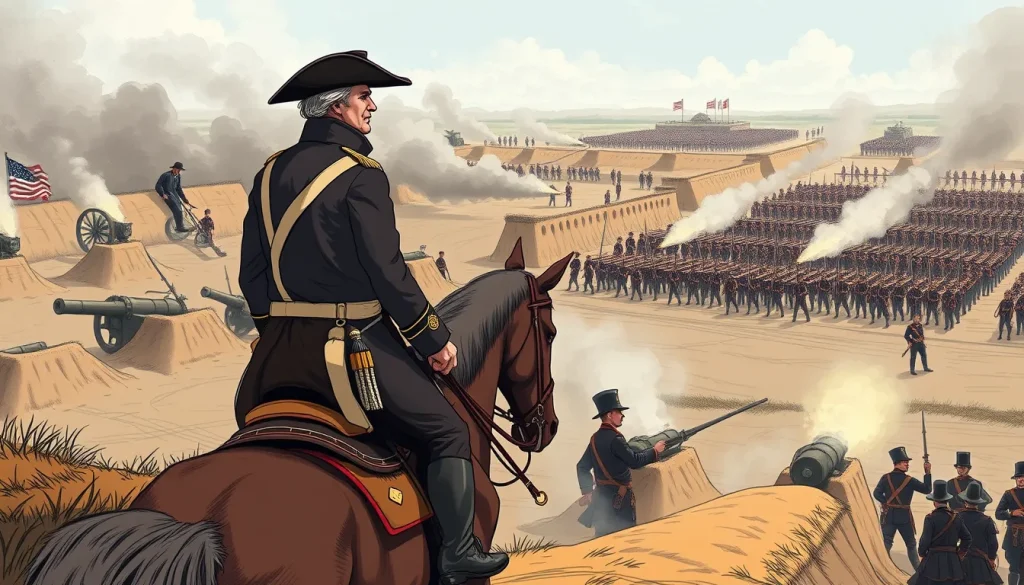
Andrew Jackson (1767–1845) served as a major general in the U.S. Army during the War of 1812, leading campaigns against the Creek Indians and British forces along the Gulf Coast. His most celebrated achievement was the decisive American victory at the Battle of New Orleans on January 8, 1815, which occurred after the Treaty of Ghent had been signed but before news reached the combatants. This victory restored American confidence and made Jackson a national hero, eventually propelling him to the presidency.
Historical Context
The War of 1812, declared by the United States against Great Britain on June 18, 1812, arose from a combination of maritime grievances, including impressment of American sailors, trade restrictions, and British support for Indigenous nations resisting American expansion. On the southern frontier, tensions were heightened by the Creek War (1813–1814), a civil conflict within the Creek Nation exacerbated by American encroachment and the influence of British agents. The Red Stick faction, aligned with the British, attacked American settlements, notably Fort Mims in present-day Alabama, on August 30, 1813. In response, Tennessee Governor Willie Blount authorized Jackson, then a major general in the state militia, to lead a punitive expedition. Meanwhile, the British planned an invasion of the Gulf Coast, targeting New Orleans as a strategic port and gateway to the Mississippi River.
What Happened
In January 1813, Jackson commanded some 2,000 Tennessee troops on a march to Natchez, in the Mississippi Territory, but was ordered to disband them by the secretary of war. He ignored the order and led his men back to Nashville, earning the nickname “Old Hickory” for his toughness. After Fort Mims, Jackson launched a campaign against the Red Sticks, winning engagements at Tallushatchee, Talladega, Emuckfaw, and Enitachopko in late 1813 and early 1814. The campaign culminated in the Battle of Horseshoe Bend (Tohopeka) on March 27, 1814, where Jackson’s forces, including Cherokee and Creek allies, decisively defeated the Red Sticks, killing about 800 warriors. Following the battle, Jackson imposed the Treaty of Fort Jackson on August 9, 1814, forcing the Creek Nation to cede over 20 million acres to the United States.
Promoted to major general in the U.S. Army, Jackson moved to the Gulf Coast to counter a British threat. He occupied Mobile, repelled a British attack, and in November 1814 captured Pensacola in Spanish Florida, which the British had used as a base. Learning that a British fleet was sailing toward New Orleans, Jackson rushed to the city, arriving on December 1, 1814. He declared martial law and assembled a diverse force of regulars, militia, free people of color, Choctaw warriors, and even Jean Lafitte’s privateers. After several skirmishes, Jackson established a defensive line along the Rodriguez Canal at Chalmette Plantation. The British launched a major assault on January 8, 1815. In about half an hour, the British suffered over 2,000 casualties, including their commander Major General Sir Edward Pakenham, while American losses were light. The battle ended the British threat to New Orleans and, for all practical purposes, closed the war.
Why It Matters
The victory at New Orleans had an immediate impact: it prevented the British from seizing a crucial American port and demonstrated that the United States could hold its own against British regulars. Although the Treaty of Ghent had been signed on December 24, 1814, word had not reached the armies, so the battle did not affect the treaty’s terms. Nevertheless, it gave Americans a sense of triumph and vindication after a war marked by defeats and the burning of Washington, D.C. Jackson’s military success catapulted him to national fame, overshadowing his controversial actions in the Creek War and his authoritarian governance of New Orleans. Historians have debated the strategic significance of the battle, noting that it was fought after the war had ended diplomatically, but its psychological and political effects were profound. Jackson’s reputation as a military hero paved the way for his later political career, but his wartime actions also foreshadowed his contentious Indian removal policies and his tendency to act aggressively against perceived enemies.
Early Life
Andrew Jackson was born on March 15, 1767, in the Waxhaws region along the border of North and South Carolina. His father died before his birth, and his mother and brothers died during the Revolutionary War, leaving him orphaned at age fourteen. During the Revolution, he served as a courier, was captured by the British, and suffered harsh treatment, developing a lifelong animosity toward Britain. After the war, he studied law and moved to Tennessee, where he became a successful lawyer, landowner, and politician. He served in the U.S. House of Representatives and the U.S. Senate briefly, and he held a commission as major general of the Tennessee militia. Before the War of 1812, he had gained military experience in frontier conflicts and had engaged in the Indian wars of the Southeast, though his command during the Creek War would define his military reputation.
Role Before the War
By 1812, Jackson was a prominent figure in Tennessee politics and society, known for his fiery temper and willingness to fight duels. He had served as a judge and had business interests in land, cotton, and enslaved labor. In the years before the war, he had participated in negotiations with Native American nations and had commanded militia troops in minor expeditions. When war with Britain was declared, Jackson was eager to serve and offered his militia force to the government. His early assignment, marching troops to Natchez in 1812–1813, ended in a frustrating order to disband, but his display of leadership during the return march solidified his troops’ loyalty and gave him the nickname “Old Hickory.” Jackson’s prewar experiences shaped his aggressive approach to dealing with both Indigenous nations and foreign powers.
Role During the War
Jackson’s role during the War of 1812 evolved from a state militia commander to a major general in the regular army. He commanded the Tennessee forces in the Creek War, leading a brutal campaign that culminated in the destruction of the Red Stick faction at Horseshoe Bend. His use of ruthless tactics, including the execution of disobedient soldiers and the adoption of an orphaned Creek child, reflected his iron will. After the Creek War, he negotiated a punitive treaty that seized millions of acres from all Creek tribes, even those who had allied with him. In the Gulf Coast theater, Jackson aggressively confronted the British, occupying Mobile and Pensacola without clear authorization and declaring martial law in New Orleans. His strategic decisions in December 1814 and January 1815, including the risky night attack on December 23 and the well-prepared defensive line at Rodriguez Canal, were pivotal in thwarting the British assault.
Major Actions
Among Jackson’s major actions were the Battle of Tallushatchee (November 3, 1813), the Battle of Talladega (November 9, 1813), the Battles of Emuckfaw and Enitachopko (January 22 and 24, 1814), and, most importantly, the Battle of Horseshoe Bend (March 27, 1814). He also led the capture of Pensacola (November 7, 1814) and organized the defense of New Orleans, including the Battle of Lake Borgne (December 14, 1814) where the British defeated the American naval force, and the Battle of New Orleans (January 8, 1815). At New Orleans, Jackson skillfully positioned his army behind the Rodriguez Canal, supported by artillery and a mixed force that included pirate Jean Lafitte’s men. The British frontal assault failed disastrously, resulting in a decisive American victory.
Contemporary Accounts
Contemporary accounts highlight Jackson’s leadership style and his popularity among his troops. Soldiers under his command nicknamed him “Old Hickory” for his toughness, a reference first recorded during the Natchez expedition in 1813. In a letter quoted by the History Channel, Jackson told his wife, “I owe to Britain a debt of retaliatory vengeance.” During the preparations at New Orleans, he declared, “Here we shall plant our stakes and not abandon them until we drive these red-coat rascals into the river, or the swamp.” British officers were shocked by the American defensive works and the discipline of the “dirty shirts.” After the battle, his actions in imposing and maintaining martial law in New Orleans drew both praise and sharp criticism, leading to a legal confrontation with a federal judge and the jailing of a Louisiana state senator. The controversy overshadowed his military victory but did not diminish his national standing.
Later Life
After the War of 1812, Jackson continued his military career, leading the First Seminole War in 1817–1818 and serving as military governor of Florida Territory. He ran for president in 1824, narrowly losing, and won the presidency in 1828 and 1832. His presidency was marked by Indian removal policies, including the Trail of Tears, and a contentious battle against the Second Bank of the United States. Jackson’s wartime fame and his image as a champion of the common man shaped his political appeal, but his legacy is deeply controversial due to his treatment of Native Americans and his pro-slavery stance. He died on June 8, 1845, at his Hermitage plantation near Nashville.
Historical Legacy
Jackson’s role in the War of 1812 established him as a national military hero and directly enabled his rise to the presidency. His decisive victory at New Orleans gave Americans a sense of national pride and is often remembered as one of the most lopsided battles in U.S. history. However, historians have reassessed his legacy, pointing to his ruthless treatment of the Creek and Seminole nations, his unauthorized attacks on Spanish territory, and his authoritarian actions in New Orleans. The Battle of New Orleans is celebrated as a triumph of American determination, but Jackson’s Indian removal policies and his expansion of executive power are now viewed with critical scrutiny. His career illustrates the complexity of America’s early military and political history, where national heroes often embodied both celebrated virtues and deeply problematic actions.
Primary Sources
Primary sources for Jackson’s War of 1812 service include his personal papers, now held at the Library of Congress, which contain letters, orders, and reports from the campaigns. The Library of Congress’s Andrew Jackson Timeline provides a chronology of events, including his movements, commissions, and key battles. Official correspondence from Jackson to Secretary of War John Armstrong and other officials document his decisions during the Creek War and the Gulf Coast defense. Accounts from soldiers and civilians, such as the memoir of James Parton, contain later recollections. The controversy over martial law in New Orleans is documented in court records and newspaper articles of the period. These sources offer insights into Jackson’s strategies and his interactions with Indigenous leaders, British officers, and local civilians, but they must be read with awareness of Jackson’s own biases and the political context of the time.
Further Reading
- Brands, H.W. Andrew Jackson: His Life and Times. New York: Doubleday, 2005.
- Heidler, David S., and Jeanne T. Heidler. The Rise of Andrew Jackson: A Biography. New York: Basic Books, 2014.
- Remini, Robert V. Andrew Jackson and His Indian Wars. New York: Viking, 2001.
- Hickey, Donald R. The War of 1812: A Forgotten Conflict. Urbana: University of Illinois Press, 1990.
- National Park Service. Chalmette Battlefield and National Cemetery. Available at: https://www.nps.gov/jela/learn/historyculture/chalmette-battlefield.htm.
References
- Library of Congress, “Anderw Jackson Papers: Timeline: The War of 1812 and Indian Wars, 1812–1821,” https://loc.gov/collections/andrew-jackson-papers/.
- American Battlefield Trust, “Andrew Jackson,” https://www.battlefields.org/learn/biographies/andrew-jackson.
- Mississippi Encyclopedia, “Andrew Jackson,” https://mississippiencyclopedia.org/entries/andrew-jackson/.
- History.com Editors, “Battle of New Orleans,” HISTORY, https://www.history.com/articles/battle-of-new-orleans.
- Chick, Sean Michael, “Andrew Jackson: Old Hickory – Adored and Despised,” American Battlefield Trust, https://www.battlefields.org/learn/articles/andrew-jackson-old-hickory-adored-and-despised.
FAQ
What was Andrew Jackson's role in the War of 1812?
Andrew Jackson commanded American forces in the Creek War (1813–1814), where he achieved a major victory at the Battle of Horseshoe Bend, and later led the defense of New Orleans, culminating in the Battle of New Orleans on January 8, 1815, a decisive American victory.
Why was Jackson nicknamed 'Old Hickory'?
Jackson earned the nickname 'Old Hickory' during the Natchez expedition in 1813, when he refused to disband his troops and led them on a difficult return march to Nashville, demonstrating his physical toughness and determination.
Did the Battle of New Orleans affect the War of 1812's outcome?
No, the Battle of New Orleans was fought after the Treaty of Ghent had been signed on December 24, 1814, but before news reached the combatants. The battle did not change the treaty terms, but it gave Americans a sense of victory and made Jackson a national hero.
Leave a Reply