

Short Answer
The Battle of Burnt Corn Creek, also known as the Battle of Burnt Corn, was fought on July 27, 1813, at a bend of Burnt Corn Creek in what is now Escambia County, Alabama, then part of Mississippi Territory. A Red Stick Muscogee force returning from Pensacola with arms and ammunition was ambushed by Mississippi Territory volunteers, local militia, and U.S.-allied Muscogee under Col. James Caller. Although the Red Sticks ultimately drove the militia from the field, the engagement was the first armed clash of the Creek War between American forces and the Red Sticks and helped transform an internal Muscogee conflict into a regional part of the War of 1812.
Historical Context
The Creek War of 1813–14 began as a civil war within the Muscogee Confederacy, whose towns and hunting grounds lay across present-day Alabama, western Georgia, and northern Florida. The Muscogee were divided between Upper Towns along the Coosa, Tallapoosa, and Alabama Rivers and Lower Towns along the Chattahoochee River. Under the influence of U.S. Indian agent Benjamin Hawkins, the Creek National Council emerged as a centralized government built from earlier regional meetings of town chiefs, or micos. The Council sold communal hunting lands to satisfy debts, a policy that angered many Muscogee and deepened divisions over land, trade, and authority.
At the same time, the traditional hunting and trading economy was giving way to a market economy based on farming and livestock. American settlers pressed into Muscogee territory, a process accelerated by the Federal Road, which cut through the Mississippi Territory. In 1811 the Shawnee leader Tecumseh traveled south to recruit Native nations for a broad resistance to American expansion. After his visit, a group of Muscogee warriors killed settlers near the Duck River in present-day Tennessee. Hawkins demanded that the National Council, led by Big Warrior, punish the killers. In January 1813 more settlers were murdered by Muscogee from the Upper Creek towns. The Council sent warriors under William McIntosh to act, but a traditionalist faction known as the Red Sticks opposed the Council’s authority and began attacking its supporters.
The Red Sticks took their name from the red-painted war clubs, or atássa, that symbolized war. They gained control of Upper Creek villages, while their opponents fled to Lower Creek towns and the Tensaw District. American settlers in the Mississippi Territory feared an attack, and volunteer regiments and militia companies formed for protection. Mixed-blood Muscogee who had adopted American practices often saw their plantations destroyed by Red Stick raiders. These tensions unfolded while the United States was already at war with Great Britain. Spanish Florida, including Pensacola, remained a neutral but important source of arms and trade goods, and the Creek conflict would soon become entangled with the larger War of 1812.
What Happened
In July 1813 a Red Stick party led by Peter McQueen and High-head Jim traveled to Pensacola to obtain weapons and supplies from the Spanish governor. On the way, the men burned the plantations of Sam Moniac and James Cornells and kidnapped Cornells’s wife, who was later ransomed in Pensacola. After negotiations with Spanish authorities, McQueen acquired about 300 pounds of gunpowder and lead shot. Word of the expedition reached Mississippi Territory militia leaders, and Col. James Caller of Washington County raised a force that eventually numbered about 180 men, including a company commanded by frontiersman Samuel Dale.
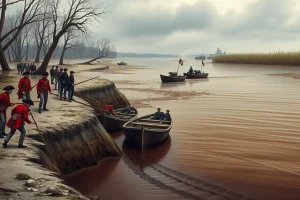
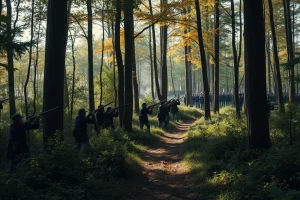
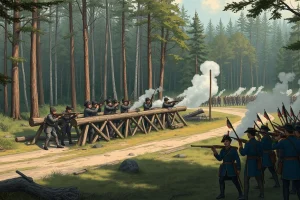
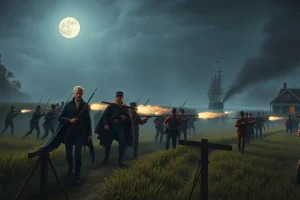
Caller’s command moved eastward from Washington County, crossed the Alabama River on July 26, and reached Burnt Corn Creek on the morning of July 27. Scouts reported that the Red Stick band was eating a midday meal at a bend in the creek and was unaware of the approaching militia. Caller ordered an attack. The militia surprised the Red Sticks and drove them from their camp into nearby brush. Believing the fight won, many of Caller’s men began looting the camp and leading away pack horses. The Red Sticks quickly regrouped and counterattacked. Caller’s surprised men fell back, and the retreat became a flight. A small band under Samuel Dale, Dixon Bailey, and Benjamin Smoot stood its ground long enough to prevent a complete rout. Caller and one of his officers became lost in swampy woods and were rescued about two weeks later, malnourished and disoriented.
Casualty reports vary. The militia suffered two killed and roughly ten to fifteen wounded. Red Stick losses were reported as perhaps ten to twelve killed and eight or nine wounded. The militia took much of the shot and powder from the Red Stick camp, but the Red Sticks held the field after the militia retreated. The engagement is therefore often described as a Red Stick tactical victory, though the supply loss blunted its value. The more immediate consequence came on August 30, 1813, when Red Stick warriors attacked Fort Mims, a settler refuge in present-day Baldwin County, Alabama. The Fort Mims attack killed about 250 people and triggered the wider Creek War.
Why It Matters
Burnt Corn Creek was small in scale, but it marked the first armed clash of the Creek War between American forces and the Red Sticks. It helped turn a Muscogee civil war into a broader conflict involving the United States, U.S.-allied Creeks, Spanish Florida, and eventually British interests in the Gulf region. The battle also set in motion the retaliatory cycle that produced the Fort Mims massacre and the subsequent U.S. campaigns that culminated at the Battle of Horseshoe Bend in 1814 and the Treaty of Fort Jackson. That treaty forced large land cessions and opened the way for the removal of most Muscogee from Alabama and Georgia.
For participants, the battle carried a lasting stigma. Contemporary satire, especially Lewis Sewall’s 1815 poem The Last Campaign of Sir John Falstaff the II; or, The Hero of the Burnt-Corn Battle, mocked Caller and the militia’s conduct. According to later accounts, many participants mustered out immediately and were subjected to public ridicule for years. Historians generally treat Burnt Corn Creek not as a decisive military event but as a catalyst. They disagree about how much weight to give local militia blundering, Red Stick supply needs, U.S. expansion, and the wider War of 1812 in explaining the escalation. What is clear is that the engagement bound together several conflicts: an internal Muscogee struggle over authority and land, American settler expansion, and the regional military contest between the United States, Britain, and Spain’s colonial holdings.
Prelude
The prelude to Burnt Corn Creek lay in the Red Stick decision to seek arms outside the Muscogee homeland. Peter McQueen and High-head Jim led a party toward Pensacola, where Spanish officials controlled a port and trading network. The Red Sticks needed ammunition to resist both the Creek National Council and American expansion. Their route took them through lands held by U.S.-allied or neutral Muscogee, and their attacks on the plantations of Sam Moniac and James Cornells signaled that the internal conflict had turned violent. When Caller learned of the expedition, he assembled volunteers and militia from Washington County and nearby settlements. His goal was to intercept the Red Sticks before they returned with supplies.
Forces and Commanders
The Red Stick force numbered roughly sixty men. Its best-known leaders were Peter McQueen, a Red Stick headman, and High-head Jim. The American force was larger, about 180 men, but it was a mixed command of Mississippi Territory volunteers, local militia, and Muscogee allies, including mixed-blood Muscogee who opposed the Red Sticks. Col. James Caller commanded the expedition. Samuel Dale led a company and later helped cover the retreat. Dixon Bailey and Benjamin Smoot were among those who stood with Dale during the counterattack. The disparity in numbers did not translate into tactical success because the militia dispersed to loot the camp after the first rush.
Battlefield and Map Context
The battle took place at a bend of Burnt Corn Creek in present-day Escambia County, Alabama, near the line that divides Escambia and Conecuh Counties. At the time, the area was part of Conecuh County in the Mississippi Territory. The exact battlefield location has not been conclusively identified. A commonly cited approximate point is 31°15′09″N 87°09′27″W, but researchers caution that the precise site remains uncertain. Caller’s force traveled eastward from Washington County and used part of the Federal Road before crossing the Alabama River. The creek and its surrounding woods and swamps shaped the fighting: the initial ambush occurred near the camp, while the militia retreat dissolved into the brush and wetland terrain.
Battle Chronology
- July 26, 1813: Caller’s militia crosses the Alabama River and moves toward Burnt Corn Creek.
- Morning, July 27, 1813: The militia reaches Burnt Corn Creek. Scouts locate the Red Stick camp at a bend in the creek.
- Midday: Caller orders an attack while the Red Sticks are eating. The militia achieves surprise and drives the Red Sticks into the brush.
- Immediately after: Many militiamen loot the camp and capture pack horses instead of consolidating their position.
- Counterattack: The Red Sticks regroup and attack. Caller’s command retreats.
- Rearguard: Samuel Dale, Dixon Bailey, Benjamin Smoot, and a small group hold long enough to prevent a total rout.
- Aftermath: Caller and an officer are lost in the woods and rescued about two weeks later. The militia takes much of the Red Stick ammunition and supplies.
Casualties and Losses
Reported casualties are imprecise and vary by account. The militia lost two killed and about ten to fifteen wounded. Red Stick losses were estimated at ten to twelve killed and eight or nine wounded. The Red Sticks also lost most of the ammunition and supplies they had obtained in Pensacola, while Caller’s men seized a significant share of the powder and lead. These figures should be treated as contemporary estimates rather than exact counts. The battle’s human cost was modest compared with the Fort Mims attack that followed, but the loss of supplies mattered for Red Stick military capacity.
Result
The immediate result was a Red Stick tactical victory. The Red Sticks recovered from the ambush, counterattacked, and forced Caller’s militia from the field. The militia retreated in disorder, and Caller himself was lost for two weeks. Yet the result was not one-sided. The militia captured much of the Red Stick ammunition and supplies, undermining the purpose of McQueen’s Pensacola expedition. In strategic terms, Burnt Corn Creek was indecisive on the battlefield but decisive in its political and psychological effects. It confirmed settler fears, hardened Red Stick resolve, and made a wider war more likely.
Strategic Consequences
The most direct consequence was the Red Stick attack on Fort Mims on August 30, 1813. Several participants in Burnt Corn Creek were also involved at Fort Mims, and the settler refuge had filled with people seeking protection after the creek fight. The massacre there killed about 250 defenders and civilians and led to U.S. military intervention in the Creek War. Over the next year, American forces and their Indigenous allies campaigned against the Red Sticks, culminating in the Battle of Horseshoe Bend in March 1814. The Treaty of Fort Jackson, signed in August 1814, forced the Muscogee to cede millions of acres and set the stage for removal. In the broader War of 1812, the Creek War became a southern front that tied down U.S. forces and intersected with British and Spanish interests in the Gulf. Burnt Corn Creek therefore helped expand a local Muscogee dispute into a conflict with regional and international dimensions.
Primary Accounts
No verbatim transcript of a battle order, after-action report, or participant diary from Burnt Corn Creek is reproduced in this article because a reliably verified text was not available. The surviving record is fragmentary and mostly from the American side. Contemporary or near-contemporary materials include local correspondence, official reports later collected in documentary editions, and Lewis Sewall’s satirical poem of 1815. Later recollections collected by H. S. Halbert and T. H. Ball preserve details about the ambush, the looting, and the retreat, but they were written decades after the event and reflect the memories and biases of survivors and their communities. Red Stick perspectives are less represented in English-language records, which limits a fully balanced reconstruction.
Battlefield Today
The exact location of the Battle of Burnt Corn Creek has not been conclusively identified. The fight occurred somewhere along Burnt Corn Creek in present-day Escambia County, Alabama, near the Conecuh County line, but no securely located battlefield park or monument marks a precise spot. The uncertainty reflects the wooded, rural terrain, the passage of time, and the absence of detailed contemporary maps. Public interpretation of the Creek War is more fully developed at Fort Mims State Historic Site in Baldwin County, Alabama, and through National Park Service materials on American Indians and the War of 1812. Researchers continue to study land records, archaeological evidence, and local accounts to narrow the battlefield location.
Primary Sources
- The Last Campaign of Sir John Falstaff the II; or, The Hero of the Burnt-Corn Battle (1815), by Lewis Sewall. Sewall, a contemporary with a personal dispute with James Caller, wrote a satirical poem comparing Caller to Shakespeare’s Falstaff and Cervantes’s Don Quixote. It is valuable for understanding how the battle was remembered and mocked, but it is not a reliable tactical narrative.
- American State Papers: Indian Affairs (Washington: Gales and Seaton, 1832–1834). This published documentary collection includes official correspondence and reports on Creek affairs and the campaigns of 1813–14. It provides access to government perspectives, but it is selective, edited, and centered on U.S. officials and military officers.
- Participant recollections and local accounts collected in H. S. Halbert and T. H. Ball, The Creek War of 1813 and 1814 (1895; later editions). These preserve details not found in official records, but they are retrospective and shaped by later sectional and local memory.
- No verified verbatim transcript of Caller’s orders or a full after-action report is available in the research context. Readers should consult the American State Papers, the National Archives, and published documentary editions for primary material.
Further Reading
- Bunn, Mike, and Clay Williams. Battle for the Southern Frontier: The Creek War and the War of 1812. Charleston, SC: History Press, 2008.
- Halbert, H. S., and T. H. Ball. The Creek War of 1813 and 1814. Tuscaloosa: University of Alabama Press, 1969.
- Waselkov, Gregory A. A Conquering Spirit: Fort Mims and the Redstick War of 1813–14. Tuscaloosa: University of Alabama Press, 2006.
- Kaetz, James P. Battle of Burnt Corn Creek. Encyclopedia of Alabama. https://encyclopediaofalabama.org/article/battle-of-burnt-corn-creek/.
- National Park Service. American Indians and the War of 1812. NPS.gov.
- Braund, Kathryn E. Holland. Deerskins and Duffels: Creek Indian Trade with Anglo-America, 1685–1815. Lincoln: University of Nebraska Press, 1993.
References
- Kaetz, James P. Battle of Burnt Corn Creek. Encyclopedia of Alabama. https://encyclopediaofalabama.org/article/battle-of-burnt-corn-creek/.
- Battle of Burnt Corn. Wikipedia. https://en.wikipedia.org/wiki/Battle_of_Burnt_Corn.
- Bunn, Mike, and Clay Williams. Battle for the Southern Frontier: The Creek War and the War of 1812. Charleston, SC: History Press, 2008.
- Halbert, H. S., and T. H. Ball. The Creek War of 1813 and 1814. Tuscaloosa: University of Alabama Press, 1969.
- Waselkov, Gregory A. A Conquering Spirit: Fort Mims and the Redstick War of 1813–14. Tuscaloosa: University of Alabama Press, 2006.
- National Park Service. American Indians and the War of 1812. NPS.gov.
- American State Papers: Indian Affairs. 2 vols. Washington: Gales and Seaton, 1832–1834.
FAQ
What was the Battle of Burnt Corn Creek?
It was the first armed clash of the Creek War between American forces and the Red Stick Muscogee, fought on July 27, 1813, at Burnt Corn Creek in present-day Escambia County, Alabama. A Mississippi Territory militia under Col. James Caller ambushed a Red Stick party returning from Pensacola with arms, but the Red Sticks regrouped and drove the militia from the field.
Why did the Battle of Burnt Corn Creek happen?
The fight grew out of the Muscogee civil war between the Red Sticks and the Creek National Council, American settler expansion, and the Red Stick need for arms. Peter McQueen and High-head Jim led a party to Spanish Pensacola to obtain gunpowder and lead, and Caller's militia set out to intercept them on their return.
Was the Battle of Burnt Corn Creek part of the War of 1812?
It was not a battle between the United States and Britain directly, but it was part of the Creek War, which became a regional theater of the War of 1812. The engagement helped escalate a Muscogee civil conflict into a broader war involving U.S. forces, Indigenous allies, Spanish Florida, and later British interests in the Gulf.
Leave a Reply