
Short Answer
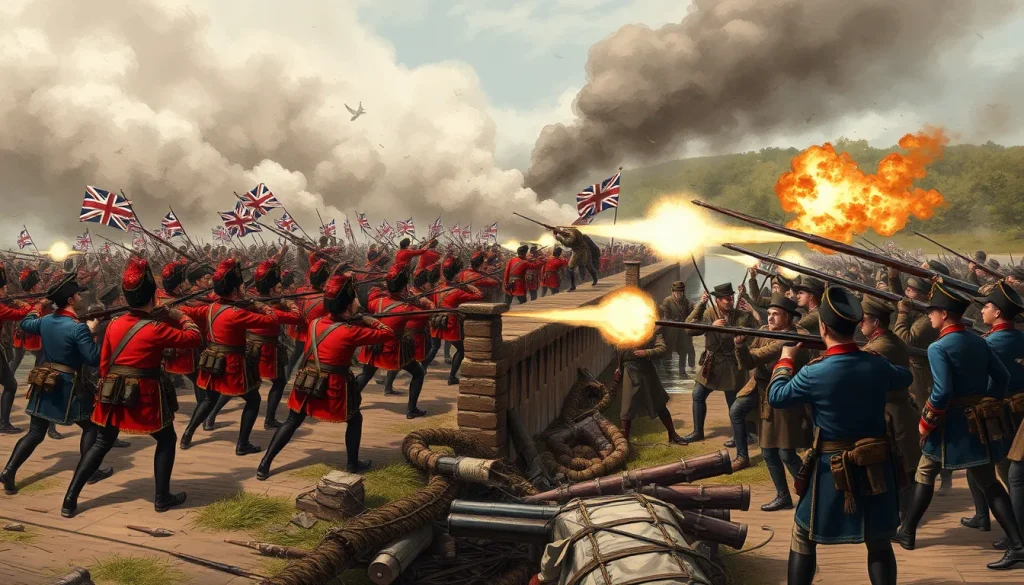
Bladensburg Battlefield, located in Prince George’s County, Maryland, was the setting for the Battle of Bladensburg on August 24, 1814, a decisive British victory during the War of 1812. This defeat opened the road to Washington, D.C., enabling British forces under Major General Robert Ross to occupy the capital and burn many public buildings, including the White House and the Capitol. The battlefield is historically significant both as a military engagement and as a catalyst for the destruction of the young nation’s capital, shaping American memory and identity.
Historical Context
By the summer of 1814, the War of 1812 had reached a stalemate. The United States had suffered setbacks in its invasions of Canada, while the British Royal Navy had blockaded American ports. However, the defeat of Napoleon in April 1814 freed thousands of experienced British regulars for service in North America. The British government adopted a strategy of coastal raids to weaken American morale and economy, with the Chesapeake Bay as a primary target. Rear Admiral George Cockburn had already conducted destructive raids in the region, advocating for a strike on Washington. The British invasion force, commanded by Major General Robert Ross, landed at Benedict, Maryland, on August 19, 1814, and advanced toward the capital. The American government, uncertain whether the target was Baltimore or Washington, responded belatedly. Brigadier General William Winder, a political appointee with limited military experience, was tasked with organizing the defense of the capital region.
What Happened
On August 24, 1814, British troops, numbering about 4,500, approached Bladensburg, a port town on the Eastern Branch of the Potomac River (now the Anacostia River). American forces, totaling around 6,000, were positioned in three defensive lines on the hills west of the river. The first line guarded the bridge over the river, and two more lines were placed further back. President James Madison, Secretary of State James Monroe, and other cabinet members observed the battle from the field. The British launched a frontal assault on the bridge, while also fording the river on the flanks. The American militia, poorly trained and lacking cohesive command, fled after the first line collapsed, and the second line soon followed. Only the third line, anchored by Commodore Joshua Barney’s flotillamen and U.S. Marines, held firm, using naval guns to inflict heavy casualties on the advancing British. However, British flanking maneuvers forced them to retreat, and Barney was wounded and captured. The American retreat turned into a rout, leaving the road to Washington open. The British marched into the city that evening and set fire to the Capitol, the White House, and other public buildings on August 24–25. The burning of Washington was a severe blow to American morale, though some historians argue that the destruction was intended to avenge the American burning of York (Toronto) in 1813.
Why It Matters
The Battle of Bladensburg had immediate and far-reaching consequences. It exposed the ineffectiveness of the American defensive system, particularly the reliance on untrained militia, and led to a reorganization of the War Department. The burning of Washington was a humiliation that galvanized American resolve, contributing to the successful defense of Baltimore at Fort McHenry weeks later, which inspired the Star-Spangled Banner. In the long term, the battle became a symbol of American unpreparedness and the dangers of political influence in military appointments. Commodore Barney’s stand is often cited as a rare moment of professional competence. The battlefield today serves as a memorial to the conflict and a reminder of the war’s impact on the Chesapeake region. Historians disagree on whether the British intended to permanently damage the United States or simply to force a negotiated peace, but the battle undeniably accelerated the end of the war.
Historical Map Context
The battlefield was located along the eastern branch of the Potomac River, near the town of Bladensburg, which was a port and road junction. The main road from Washington to Baltimore passed through the town, with a bridge spanning the river at that point. American forces occupied the high ground west of the river, commanding the approaches. The British advanced from the northeast along the road from Benedict. Historic maps show the three American defensive lines stretching roughly parallel to the river. The Anacostia River, then known as the Eastern Branch, played a central tactical role, as its bridge and fords were key to the British advance.
Modern Location
Today, the battlefield is partially preserved within Bladensburg Waterfront Park, managed by the Maryland-National Capital Park and Planning Commission (MNCPPC). The park, located along the Anacostia River in Prince George’s County, Maryland, includes interpretive signage, a visitor center, and a portion of the battle site. The park’s address is 4601 Annapolis Road, Bladensburg, MD 20710. The American Battlefield Trust has also been active in preserving additional land at the site. The park is part of the Star-Spangled Banner National Historic Trail, linking it to other War of 1812 sites in the region.
Events at the Site
The primary event at the site is the Battle of Bladensburg on August 24, 1814. The battle involved the clash between the British invasion force under Major General Robert Ross and the American defenders under Brigadier General William Winder. After the battle, the British rested briefly before marching to Washington. In the following days, the area saw British troops returning from Washington, and nearby towns experienced occupation. The battlefield also witnessed the destruction of the U.S. Chesapeake Flotilla, which was scuttled on August 22 at Mount Calvert to prevent capture, and the British encampments. Over the years, the site has become a place of remembrance and interpretation.
Associated People
Key figures at Bladensburg include Major General Robert Ross, commander of the British force; Brigadier General William Winder, the American commander; Commodore Joshua Barney, who led the flotillamen and Marines; Charles Ball, a free Black sailor who served in Barney’s flotilla; President James Madison, who witnessed the defeat; and Dolley Madison, who famously saved valuables from the White House as the British approached. Also present was Rosalie Stier Calvert, a local resident who watched the battle from her home, Riversdale Mansion, and later helped bury the dead. Surgeon’s Aide Samuel Neale, a Black man, served in the American forces and was later recognized for his service. The British force included Colonial Marines, formerly enslaved men who had joined the British in exchange for freedom.
Surviving Monuments and Site
The most prominent monument is the Battle of Bladensburg Memorial, a sculpture by Joanna C. Blake, installed in the 21st century. It depicts the wounded Commodore Barney supported by Charles Ball and an unnamed Marine, symbolizing the diverse participants. The memorial is located near the waterfront park. Additionally, the park features interpretive panels, a visitor center with artifacts from the battle, and a reconstructed bridge location. The Star-Spangled Banner National Historic Trail includes the site, and the American Battlefield Trust has helped purchase land for preservation. The grounds of the park itself serve as a living memorial, with walking trails and signage explaining the battle’s course.
Primary Sources
Several contemporary accounts illuminate the battle. Secretary of State James Monroe’s letter to President Madison on August 23, 1814, reported the enemy’s approach. British Lieutenant George Robert Gleig, who served in the campaign, wrote a memoir describing the march and the battle, including the flight of American militia. Rosalie Stier Calvert’s letters from August 24, 1814, describe seeing rockets and the burning of Washington. Commodore Joshua Barney’s own report to the Secretary of the Navy provides an account of the defense and his wounding. These sources offer perspectives from both sides, though each contains inherent biases and limitations, such as military pride or personal perspective.
Further Reading
- American Battlefield Trust. “Bladensburg Battle Facts and Summary.” Accessed [date]. https://www.battlefields.org/learn/war-1812/battles/bladensburg.
- National Park Service. “Battle of Bladensburg.” Star-Spangled Banner National Historic Trail. https://www.nps.gov/stsp/learn/historyculture/battle-of-bladensburg.htm.
- National Park Service. “Bladensburg Waterfront Park.” https://www.nps.gov/places/bladensburg-waterfront-park.htm.
- Pitch, Anthony. The Burning of Washington: The British Invasion of 1814. White House Historical Association, 1998.
- Hickey, Donald R. The War of 1812: A Forgotten Conflict. University of Illinois Press, 1989.
References
- American Battlefield Trust. “Bladensburg Battle Facts and Summary.” https://www.battlefields.org/learn/war-1812/battles/bladensburg.
- National Park Service. “Battle of Bladensburg.” Star-Spangled Banner National Historic Trail. https://www.nps.gov/stsp/learn/historyculture/battle-of-bladensburg.htm.
- National Park Service. “Bladensburg Waterfront Park.” https://www.nps.gov/places/bladensburg-waterfront-park.htm.
- National Park Service. “Bladensburg Region.” Star-Spangled Banner National Historic Trail. https://www.nps.gov/stsp/learn/historyculture/bladensburg.htm.
- American Battlefield Trust. “Visit Bladensburg Battlefield.” https://www.battlefields.org/visit/battlefields/bladensburg-battlefield.
FAQ
What happened at Bladensburg Battlefield?
The Battle of Bladensburg on August 24, 1814, was a British victory over American forces, allowing the British to march into Washington, D.C. and burn public buildings.
Why is Bladensburg Battlefield significant?
It was the last major obstacle before Washington, D.C. Its loss led to the burning of the capital and a low point in American morale during the War of 1812.
Where is Bladensburg Battlefield today?
Part of the battlefield is preserved within Bladensburg Waterfront Park, managed by the Maryland-National Capital Park and Planning Commission, and interpreted by the National Park Service as part of the Star-Spangled Banner National Historic Trail.


Leave a Reply