
Short Answer
The financing of the War of 1812 was a hurried improvisation that tested the young American republic’s fiscal capacity. When war broke out between the United States and Great Britain in June 1812, the U.S. Treasury had no comprehensive financial strategy, a depleted revenue stream, and an expired national bank charter. The government relied on a patchwork of loans, treasury notes, and later direct taxes to fund the conflict, while inflation and mounting debt threatened the war effort. This article examines the methods, challenges, and consequences of financing the War of 1812.
Historical Context
In the decade before 1812, the United States had prospered under the trade policies of the Jefferson and Madison administrations, but its public finances were fragile. Federal revenue came primarily from customs duties and public land sales, both of which collapsed when war disrupted commerce. The First Bank of the United States, which had provided a stable currency and a source of credit, had its twenty-year charter expire in 1811. Congress failed to renew it, leaving the government without a central fiscal agent. Treasury Secretary Albert Gallatin had reduced the national debt from over $85 million in 1804 to about $45 million by 1812, but his success led to complacency and little preparation for a major war. Many policymakers, echoing Thomas Jefferson’s belief that the conquest of Canada would be a “mere matter of marching,” assumed the war would be short and inexpensive. This optimism proved unfounded.
What Happened
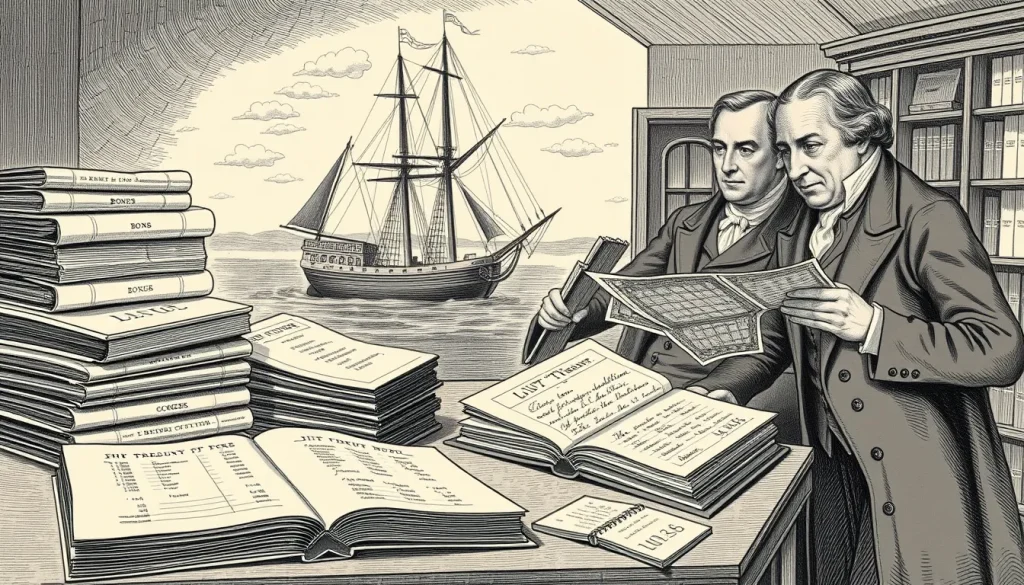
The outbreak of war immediately strained the Treasury. Customs revenue, which normally supplied about 90% of federal income, plummeted as British blockades choked off trade. The government could not rely on income taxes (which did not exist) or a national bank, so Albert Gallatin turned to state banks and wealthy individuals as lenders. In June 1812, Congress authorized the issuance of $5 million in treasury notes—interest-bearing paper money that could be used to pay taxes and government debts. These notes, along with a series of bond issues, were intended to cover early expenses. In March 1813, Congress approved a $16 million loan, but the government struggled to sell the bonds at favorable rates. By the summer of 1813, Gallatin’s efforts to borrow on the open market met with partial success, but the terms deteriorated.
Seeking additional revenue, Congress in July 1813 enacted direct taxes on land, carriages, liquor distilleries, auction sales, retail wine, and refined sugar. These were the first such internal taxes in U.S. history since the Federalist era. Yet collection was slow and often met with local resistance. By early 1814, Congress had authorized Madison to borrow up to $32.5 million, but the investment climate worsened. British raids on Washington and the Chesapeake in August 1814 shattered confidence, and the Treasury found it almost impossible to sell new bonds except at steep discounts. In October 1814, the government again issued treasury notes, but these flooded the market and contributed to inflation. By the war’s end in 1815, the national debt had risen to around $127 million, and the government had largely exhausted its financing options.
Why It Matters
The financial strain of the War of 1812 exposed the inadequacy of the United States’ early fiscal institutions. The inability to borrow effectively hampered military operations—most famously leaving Washington defenseless in 1814—and nearly drove the government to bankruptcy. Domestically, the war fueled inflation, as the overissue of treasury notes depreciated the currency. In the long term, the crisis forced a national reassessment: President Madison and his advisors, including Gallatin (who stayed on until early 1813), realized that a stable bank and regular taxation were necessary. This led directly to the chartering of the Second Bank of the United States in 1816 and to the adoption of the first peacetime internal taxes. The experience also hardened the American commitment to maintaining a credible public credit, a principle that Alexander Hamilton had championed and which the war validated. Historians such as Lisa R. Morales argue that the war marked a turning point in American economic thinking, moving the country from Jeffersonian agrarian distrust of central finance toward a more pragmatic, Hamiltonian system.
Definition
Financing the War of 1812 refers to the methods used by the United States government to raise money for the conflict: borrowing through the sale of bonds and treasury notes, levying direct and indirect taxes, and, ultimately, printing unbacked paper money. It does not include the financial measures of Great Britain or other belligerents, though British naval funding indirectly affected American trade and customs collection.
Background
The American financial system in 1812 was a product of the Jeffersonian-Republican ideology that favored minimal government, low taxes, and rapid debt repayment. The national debt was seen as a source of corruption. The expiration of the First Bank of the United States in 1811 removed a stabilizing institution. The Treasury under Albert Gallatin was efficient in peacetime but lacked the instruments for wartime mobilization. There was no income tax, no centralized note-issuing authority, and the state banking system was fragmented and often unreliable. The decision to declare war was made without a clear plan for financing it, partly because of overconfidence and partly because of ideological opposition to standing taxes and banks.
How It Worked
Initially, the Treasury financed the war through customs duties and land sales, but these declined sharply. As revenue fell, the government turned to borrowing. The key instruments were time-deposit loans—bonds sold on the open market—and treasury notes, which were short-term, interest-bearing obligations that could circulate as money. These notes were not legal tender but were receivable for taxes and public dues, giving them a quasi-monetary status. When the market for bonds deteriorated, the government also introduced direct taxes: an ad valorem tax on land and buildings, and specific excise taxes on items like carriages, sugar, and distilled spirits. These taxes were apportioned among the states and collected by federal officials, a novel and unpopular expansion of federal authority.
Competing Viewpoints
Americans debated the proper balance between borrowing and taxation. Secretary Gallatin initially favored loans and short-term notes to avoid the political fallout of direct taxes, but as war costs soared, he urged Congress to pass internal taxes to reassure lenders and fund the debt. In Congress, Jeffersonian Republicans like John C. Calhoun argued that a prosperous nation could afford war without heavy taxation, while critics such as Federalist Daniel Webster warned that excessive borrowing without tax support would ruin public credit. The government also faced a conflict over the use of paper money: Treasury notes promised to pay interest but were not legal tender for private debts, and their depreciation stirred fears of inflation. Later historians, including Hugh Rockoff, view the decision to create fiat-like treasury notes as a pragmatic step that inadvertently laid groundwork for future federal currency, though at the time it was seen as a dangerous departure.
Role in the War of 1812
Financing was not merely a side issue; it determined the war’s tempo. The scarcity of funds limited troop pay, supply purchases, and ship construction. The failure to raise loans in the summer of 1814 directly contributed to the decision to abandon Washington. On the other hand, the imposition of direct taxes in 1813 demonstrated a commitment to paying wartime debts, which helped maintain some borrowing capacity. The British, by contrast, financed the war through their established fiscal system, including the Bank of England and a heavier tax base, which gave them a distinct advantage in the long run. American financial weakness also shaped diplomatic negotiations: the near-bankrupt condition of the Treasury was a factor in the acceptance of the Treaty of Ghent in 1814.
Consequences and Historical Interpretation
The financial experience of the war produced lasting institutional changes. The immediate consequence was a debt burden that rose from $45 million to over $127 million, but the republic managed to service it, and by 1817 the economy had recovered. More importantly, the crisis discredited the Jeffersonian ideal of a bankless, tax-free state. The Second Bank of the United States was chartered in 1816 to restore a uniform currency and facilitate public credit. Direct taxes were retained in a modified form, and the precedent of internal taxation for national emergencies became accepted. Historians like Morales and Hall and Sargent see the war as a learning experience that improved the government’s ability to discriminate among creditors—rejecting wholesale repudiation while offering preferential terms to initial subscribers—thus gradually enhancing the reputation of U.S. securities. The war’s financing also foreshadowed the larger fiscal tests of the Civil War, when the federal government would successfully combine taxation, borrowing, and paper money.
Primary Sources
The most important contemporary sources include the letters and reports of Albert Gallatin, especially his correspondence with President Madison and his annual Treasury reports. Gallatin’s Report on the Finances for 1812 and 1813 lay out revenue and expenditure figures. The Annals of Congress contain full debates over tax bills and loan authorizations. The acts themselves—such as the Tariff Act of 1812, the Direct Tax Act of 1813, and the various loan and treasury-note acts—are official legal documents accessible in the U.S. Statutes at Large. The diary and papers of James Madison offer insight into executive decision-making. Additionally, the public statements of critics, such as Daniel Webster’s speeches, provide a Federalist perspective. Each source must be read with attention to political bias; Treasury reports often put a favorable gloss on fiscal conditions, while congressional debates are partisan.
Further Reading
- Morales, Lisa R. The Financial History of the War of 1812. PhD diss., University of North Texas, 2009. This is the most comprehensive modern study of the topic.
- Rockoff, Hugh. “War and Inflation in the United States from the Revolution to the First Iraq War.” NBER Working Paper 21221, 2015. Provides comparative analysis of wartime finance.
- Hall, George J., and Thomas J. Sargent. “Fiscal Discriminations in Three Wars.” Journal of Monetary Economics, 2014. Focuses on how the U.S. treated creditors across wars.
- White House Historical Association. “Funding the War of 1812.” Accessed 2024. A concise overview with primary images.
- Stagg, J.C.A. Mr. Madison’s War: Politics, Diplomacy, and Warfare in the Early American Republic, 1783–1830. Princeton University Press, 1983. Places finance within broader political context.
References
- Morales, Lisa R. “The Financial History of the War of 1812.” PhD diss., University of North Texas, 2009. https://digital.library.unt.edu/ark:/67531/metadc9922/m2/1/high_res_d/dissertation.pdf
- White House Historical Association. “Funding the War of 1812.” https://www.whitehousehistory.org/funding-the-war-of-1812
- Hall, George J., and Thomas J. Sargent. “Fiscal Discriminations in Three Wars.” Working paper, 2013. http://www.tomsargent.com/research/Hall_Sargent_CRNYU.pdf
- Rockoff, Hugh. “War and Inflation in the United States from the Revolution to the First Iraq War.” NBER Working Paper 21221, 2015. https://doi.org/10.3386/w21221
- Morales, Lisa R. “‘Such a War…is Wholly out of the Question’: Planning, Funding and Decision Making in 1812.” University of Southern Indiana 1812 Conference, 2012.
FAQ
Why was the United States so unprepared financially for the War of 1812?
The government relied on customs duties, which fell sharply with the blockade, and had allowed the First Bank of the United States to expire in 1811. Many leaders expected a short, easy war, so they did not create a comprehensive financial plan.
What were the main methods of financing the war?
The U.S. used a combination of treasury notes, bond issues (loans), and direct taxes on property, carriages, liquor, and other goods. It also briefly used unbacked paper notes that contributed to inflation.
How did the financing problems affect the outcome of the war?
Financial difficulties limited the ability to fund military operations, particularly in 1814 when the government could not sell enough bonds to defend Washington. The near-bankruptcy also pushed the U.S. toward the Treaty of Ghent.



Leave a Reply