
Short Answer
Albert Gallatin (1761–1849), a Swiss-born American statesman who served as Secretary of the Treasury from 1801 to 1814, was one of five commissioners appointed by President James Madison to negotiate peace with Great Britain. At the Ghent negotiations, held in the city of Ghent, Belgium, from July to December 1814, Gallatin emerged as the de facto leader of the American delegation and was widely credited by contemporaries with securing the Treaty of Ghent, which formally ended the War of 1812 on December 24, 1814. His calm diplomacy and readiness to compromise prevented a breakdown in talks and preserved the United States’ position in a conflict that had become increasingly costly.
Historical Context
The War of 1812 had its origins in long-standing disputes between the United States and Great Britain over maritime neutral rights, impressment of American sailors, and British support for Indigenous peoples resisting American expansion. After two years of fighting, the United States faced financial strain, inadequate military results, and growing domestic opposition. The Russian Empire, under Czar Alexander I, offered mediation in 1813. Although Britain officially declined Russian mediation, it signaled willingness to negotiate directly, and in 1814 the United States accepted an invitation to talks. President Madison appointed Gallatin—then Secretary of the Treasury—along with John Quincy Adams, Henry Clay, James A. Bayard, and Jonathan Russell. The choice of Gallatin was unusual; his domestic financial duties were immense, but his diplomatic skill and fluency in French made him a logical envoy. The American delegation met in Ghent, a neutral city in the newly independent Netherlands.
What Happened
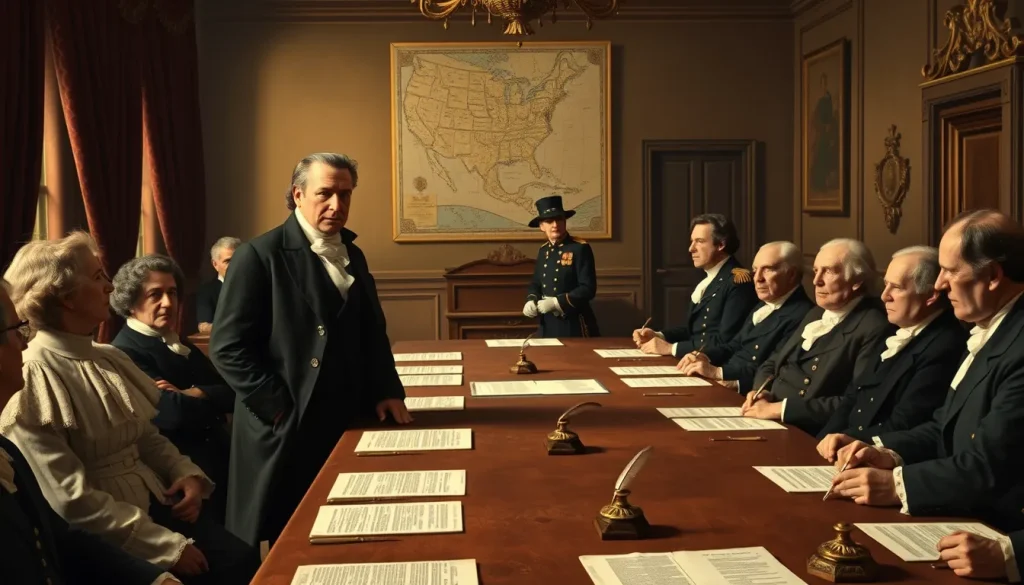
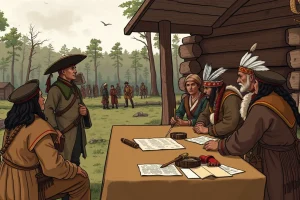
Gallatin and Senator James Bayard sailed for Europe in May 1813, joining John Quincy Adams in St. Petersburg to participate in the proposed Russian mediation, which did not materialize. After a year of waiting and exploring options, the American commissioners received word that Britain was willing to open direct negotiations. In early 1814 they moved to Ghent, where the British delegation—led by Admiral Lord Gambier, Henry Goulburn, and William Adams—arrived in July 1814. The talks began in August 1814 and proceeded through a series of written proposals and counter-proposals.
During these months, Gallatin played a crucial role in maintaining American unity. The delegation contained strong personalities: Adams was rigorous and often rigid, Clay was expansionist, and Bayard was a Federalist. Gallatin used his affable manner and his mastery of negotiation to keep the group focused. He also communicated with British envoys, informally and at formal sessions, and pressed for pragmatic solutions. Key issues included the British demand for an Indigenous buffer state in the American Northwest, American insistence on ending impressment and receiving compensation for seized ships, and disputed boundaries. Gallatin recommended that the Americans abandon the demand on impressment, arguing that peace was more important and that Britain would not yield on that point. The British, meanwhile, faced their own war weariness after Napoleon’s defeat, and their negotiators eventually agreed to a return to the prewar status quo. On December 24, 1814, the Treaty of Ghent was signed, restoring all territories and boundaries to their 1812 state. The treaty was ratified in February 1815.
Why It Matters
The Treaty of Ghent ended the War of 1812 and prevented a potentially disastrous prolongation of the conflict. For the United States, it affirmed national sovereignty and opened the way for westward expansion, though it settled none of the original maritime disputes, which faded with the end of the Napoleonic Wars. Gallatin’s role at Ghent was immediately recognized by his colleagues; John Quincy Adams, an exacting judge, wrote that Gallatin took the “largest and most important share” in the peace. Historically, Gallatin’s diplomacy has been seen as a model of how patient, pragmatic negotiation can achieve peace without surrender. His willingness to break with instructions on impressment demonstrated his understanding that preserving American independence mattered more than symbolic concessions. Scholars agree that had the talks failed, the United States might have faced military defeat and a far harsher treaty, as British resources were freeing up after Napoleon’s downfall. Gallatin’s achievement thus shaped the postwar American republic and its relationship with Great Britain.
Early Life
Albert Gallatin was born in Geneva, Switzerland, on January 29, 1761, into an aristocratic family. He graduated from the Academy of Geneva in 1779, then emigrated to the United States in 1780, settling in Pennsylvania. He became an American citizen in 1785 and built a home called Friendship Hill in Fayette County. His early career included teaching French at Harvard and working as a land surveyor. He married Hannah Nicholson in 1793 and entered politics, serving in the Pennsylvania legislature and then in the U.S. Congress as a Republican.
Role Before the War
In Congress, Gallatin became a leading Republican expert on finance, opposing Alexander Hamilton’s economic policies and helping establish the House Ways and Means Committee. In 1801, President Thomas Jefferson appointed him Secretary of the Treasury, a position he held under Madison as well. Gallatin reduced the national debt, financed the Louisiana Purchase, and modernized the federal fiscal system. When the War of 1812 broke out, he faced the daunting task of funding a conflict with limited financial resources, but he soon shifted his focus to peacemaking.
Role During the War
Despite his Treasury duties, Gallatin was chosen in 1813 as a peace commissioner because of his diplomatic capacity and linguistic skills. He remained a commissioner for the entire duration of negotiations. He traveled to St. Petersburg, then to London, and finally to Ghent, where he participated in all sessions. His role went beyond that of a delegate: he managed schedules, wrote drafts, and built relationships with British counterparts. He also advised the delegation on how to frame proposals to win British concessions.
Major Actions
Gallatin’s most notable action was his insistence that the American delegation abandon the demand for the British to renounce impressment. He argued that this issue was no longer a viable point of disagreement and that continuing to insist would cause the collapse of negotiations. He also helped craft the final wording of the treaty, which restored all territories, and he worked to settle conflicting American claims about maritime boundaries. Additionally, Gallatin personally corresponded with British delegates and with the American Secretary of State, keeping the talks on track even when they reached an impasse.
Contemporary Accounts
John Quincy Adams, who recorded the negotiations in his diary, wrote that Gallatin took “the largest and most important share to the conclusion of the peace.” James Gallatin, Albert’s son, who accompanied him and kept a diary, described his father’s tireless work and his diplomatic finesse. On the British side, Henry Goulburn reportedly expressed admiration for Gallatin’s candor and intelligence. These accounts highlight Gallatin’s unique blend of patience, intellect, and charm.
Later Life
After the war, Gallatin declined a return to the cabinet but accepted appointment as U.S. Minister to France from 1816 to 1823, where he helped resolve commercial disputes and later served as Minister to Great Britain from 1826 to 1827. He was instrumental in establishing the Second Bank of the United States in 1816. In his later years he moved to New York City, helped found New York University, and became a pioneer in American ethnology, publishing works on Native American languages. He died on August 12, 1849, in Queens, New York.
Historical Legacy
Gallatin’s negotiation of the Treaty of Ghent is widely regarded as his greatest achievement and a turning point in American diplomacy. Historians credit him with preventing a humiliating peace and preserving the United States’ territorial integrity. His ability to persuade and compromise has become a benchmark for effective negotiation. Gallatin also left a broader legacy as a public servant who combined financial expertise with a humanitarian outlook, and his memory is honored at Friendship Hill National Historic Site in Pennsylvania.
Primary Sources
The most important primary sources for Gallatin’s role at Ghent include his own letters to President Madison and Secretary of State James Monroe, which are collected in The Papers of Albert Gallatin. The diary of John Quincy Adams, published as Memoirs of John Quincy Adams, contains detailed daily accounts of the negotiations and Gallatin’s contributions. James Gallatin’s diary, A Diary of the Negotiations at Ghent, provides firsthand observations. The Treaty of Ghent itself is a primary document, available in American and British archives. The official British correspondence, edited in various documentary collections, also sheds light on how Gallatin was perceived.
Further Reading
- Nicholas Dungan, Albert Gallatin: The Political and Diplomatic Career of a Swiss-American Statesman (New York University Press, 2016).
- Raymond Walters Jr., Albert Gallatin: A Biography (University of Pennsylvania Press, 1969).
- Francis F. Beirne, The War of 1812 (E.P. Dutton, 1949), chapter 28.
- American Battlefield Trust biography of Albert Gallatin (online).
- National Park Service, Friendship Hill National Historic Site, “Albert Gallatin” (exhibit).
References
- American Battlefield Trust. “Albert Gallatin.” Accessed 2025. https://www.battlefields.org/learn/biographies/albert-gallatin.
- National Park Service. “Albert Gallatin.” Accessed 2025. http://nps.gov/people/albert-gallatin.htm.
- Nicholas Dungan. “The Debut of a Diplomatist, 1813–1815.” In Albert Gallatin, New York University Press, 2016. doi:10.18574/nyu/9780814721117.003.0007.
- Francis F. Beirne. The War of 1812. New York: E.P. Dutton, 1949. Chapter 28, “Ghent, City of Peace.”
- “Albert Gallatin and the Treaty of Ghent.” CSPAN3, October 3, 2015. Internet Archive. https://archive.org/details/CSPAN3_20151003_230500_Albert_Gallatin_and_the_Treaty_of_Ghent.
FAQ
Why was Albert Gallatin chosen as a peace commissioner?
Gallatin was Secretary of the Treasury but also a skilled diplomat and French speaker. President Madison needed negotiators who could work in Europe, and Gallatin's calm personality and intellect made him ideal.
What was Gallatin's main contribution at the Ghent negotiations?
Gallatin kept the American delegation united and persuaded his colleagues to drop the demand on impressment, which allowed the talks to conclude successfully. He also drafted key language in the treaty.
How did John Quincy Adams view Gallatin's role?
Adams wrote that Gallatin took the 'largest and most important share' in achieving the peace, acknowledging Gallatin's dominant contribution.

Leave a Reply