
Short Answer
The Andrew Jackson Papers is a major archival collection held by the Manuscript Division of the Library of Congress, comprising more than 26,000 items dating from 1767 to 1874. It is one of twenty-three presidential collections in the Library and includes correspondence, military records, journals, and other documents that directly illuminate Andrew Jackson’s role in the War of 1812, especially the Creek War, the defense of New Orleans, and the Gulf Coast campaign. The collection serves as a foundational primary source for scholars studying Jackson’s military leadership and the broader conflict, offering both his personal letters and official orders.
Historical Context
The War of 1812 (1812–1815) saw the United States fight Great Britain over maritime rights, impressment, and territorial expansion, with significant campaigns involving Indigenous nations along the frontier. Andrew Jackson, then a major general in the Tennessee militia, rose to national prominence through his military actions in the Southern and Gulf theaters. The conflict with the Creek Nation (the Creek War, 1813–1814), the British invasion of the Gulf Coast, and the Battle of New Orleans (January 8, 1815) were pivotal episodes. Understanding these events requires access to the orders, letters, and reports that commanders like Jackson produced—materials preserved in the Andrew Jackson Papers.
What Happened
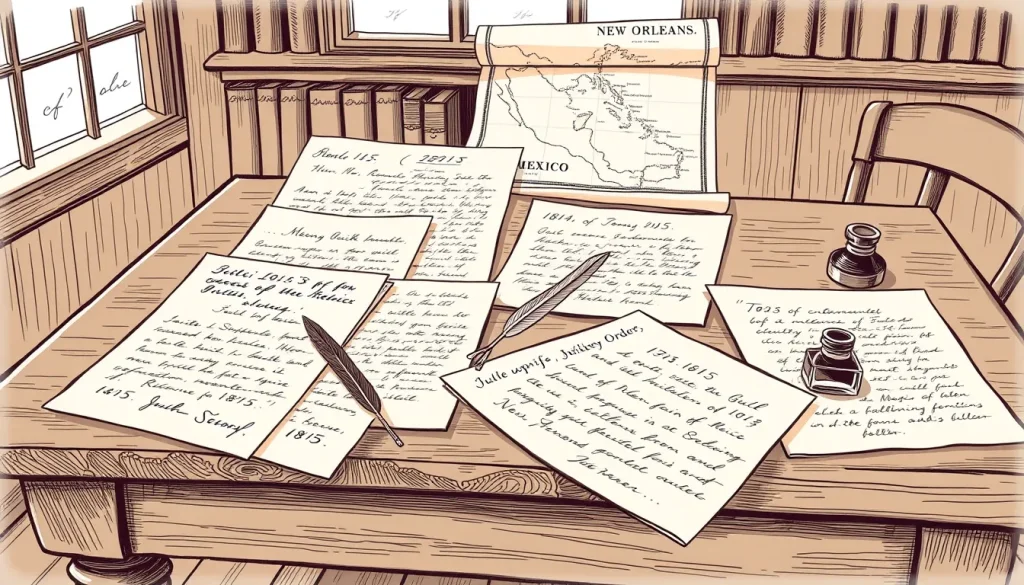
The Jackson Papers contain a rich body of material from the War of 1812, including several letterbooks and military records. Series 3, “Letters and Orders, 1813–1822,” includes fifteen volumes labeled A through O, with multiple letterbooks covering Jackson’s correspondence and orders from July 1812 through March 1816. Key examples are the Letterbook Vol. B (July 1812–March 1813), Vol. C (September 1813–January 1814), Vol. D (October 1813–January 1814), Vol. E and F (January–March 1814), Vol. G (July–September 1814), Vol. H (September 1814–January 1815), and Vol. I (February 1815–February 1816). These volumes record Jackson’s communications as he commanded troops during the Creek War and the Gulf campaign, including his controversial orders to invade Pensacola in November 1814 and his declaration of martial law in New Orleans in early 1815. Series 1 (General Correspondence) contains letters to and from Jackson, including correspondence with his wife Rachel, his subordinates, and political leaders. Series 4 includes record books and the Battle of New Orleans record book of 1815. Series 5, the Military Papers (1781–1832), is presented in thirteen volumes and includes muster rolls, military returns, and general and brigade orders, documenting the composition and movements of Jackson’s forces.
Why It Matters
The Andrew Jackson Papers are indispensable for reconstructing the southern campaigns of the War of 1812. They provide direct evidence of Jackson’s strategic decisions, logistical challenges, and interactions with U.S. and Indigenous leaders. For historians, the collection offers a counterpoint to official reports and published narratives, revealing the administrative and personal pressures of command. The documents also illuminate the role of enslaved labor, the impact of the war on the Creek Nation, and the internal politics of the early republic. Moreover, the collection’s digitization has made these sources widely accessible, fostering new scholarly interpretations and public engagement. Historians have debated Jackson’s severity in the Creek War, his imposition of martial law, and his actions at Pensacola, and the papers allow researchers to examine his own words against other accounts.
Definition
The Andrew Jackson Papers is a curated archival collection containing the personal and official documents of Andrew Jackson (1767–1845), the seventh President of the United States. The collection is held in the Manuscript Division of the Library of Congress and includes correspondence, diaries, military orders, land deeds, and other papers. It is one of the most significant primary source collections for studying Jackson’s military career, political life, and personal affairs.
Background
The original collection was acquired by the Library of Congress in 1903 as a gift from Woodbury Blair, Minna Blair Richey, Gist Blair, and Montgomery Blair, with additional acquisitions continuing from 1901 to the present. The physical collection is arranged into twelve series and oversize materials. Series 1–9 and 11 were microfilmed in 1967; this microfilm edition was later digitized for online access, with Series 12 (items acquired after the microfilm) scanned anew for the web presentation. The collection is described in a detailed online finding aid and in a published Index to the Andrew Jackson Papers.
How It Worked
The Jackson Papers are organized by document type and acquisition history. Series 1 contains general correspondence and related items, arranged chronologically and indexed by correspondent. Series 3 holds letterbooks of military orders and letters, in chronological order, labeled “A” through “O,” along with journals of treaty negotiations and documents related to West Florida. Series 5, the Military Papers, consists of muster rolls, returns, orders, and related material, presented at the volume level in the digital edition. Researchers can search Series 1 at the item level using the Index to the Andrew Jackson Papers or the online catalog, while Series 5 requires browsing volume contents. The digital presentation at the Library of Congress provides images of the manuscripts, often with searchable text.
Competing Viewpoints
Historians have interpreted Jackson’s actions during the War of 1812 in varying ways. Some emphasize his decisive and effective leadership in defeating the Creek Nation and defending New Orleans, viewing him as a military genius and founder of American expansionism. Others criticize his harsh treatment of Indigenous peoples, his unauthorized invasion of Spanish-held Pensacola, and his heavy-handed imposition of martial law after the Battle of New Orleans. The Jackson Papers themselves carry Jackson’s own perspective, so researchers must cross-reference them with British, Spanish, Indigenous, and other American accounts. The collection’s selection was shaped by Jackson’s personal archiving habits, and it contains both official and private documents, but it may omit or underrepresent opposing viewpoints. Historians therefore use the papers with an awareness of their inherent biases.
Role in the War of 1812
The Andrew Jackson Papers serve as the most direct record of Jackson’s military command during the War of 1812. They document his campaigns from the Tennessee frontier to the Gulf coast, including the Creek War (1813–1814), the occupation of Pensacola (November 1814), and the Battle of New Orleans (January 1815). The letterbooks convey his orders to subordinates, his correspondence with the War Department, and his reports to his wife and other stakeholders. The military papers, such as muster rolls and returns, provide data on troop numbers, supplies, and casualties. The collection is thus a cornerstone for understanding both Jackson’s strategic thinking and the material realities of the American war effort in the South.
Consequences and Historical Interpretation
The documentation preserved in the Andrew Jackson Papers has shaped narratives of the War of 1812, particularly concerning the Battle of New Orleans and the Gulf campaign. The collection’s digitization has facilitated wide scholarly and public use, contributing to ongoing reassessments of Jackson’s legacy, including his role in Indian removal and his views on slavery. Historians continue to use this collection to analyze military leadership, civil-military relations, and the expansion of U.S. authority. The papers also reveal the personal costs of war for Jackson and his family, offering a more intimate view that contrasts with his public heroism. The editorial project, The Papers of Andrew Jackson, publishes selected and annotated documents, making the collection even more accessible for research and teaching.
Primary Sources
The Andrew Jackson Papers include numerous contemporary documents directly related to the War of 1812. Notable items include the Journal of the march (January–March 1813), which records Jackson’s movements during the early Creek campaign; the Letterbook Vol. B (July 1812–March 1813) containing his correspondence as a Tennessee militia general; and the Letterbook Vol. H (September 1814–January 1815), covering the defense of New Orleans. The Battle of New Orleans record book (1815) lists orders and reports from the engagement. These documents were created by Jackson or his staff during the conflict. They offer first-hand insights into military decisions, but must be read critically, as they reflect Jackson’s perspective and may omit failures or critiques. The published Papers of Andrew Jackson volume III (1814–1815) provides transcriptions and annotations of many of these letters and orders, with an introduction by the editors.
Further Reading
- The Papers of Andrew Jackson, Volume III, 1814–1815, edited by Harold D. Moser, et al. (Knoxville: University of Tennessee Press, 1991).
- Index to the Andrew Jackson Papers (Washington, D.C.: Library of Congress, 1967).
- The Library of Congress, Andrew Jackson Papers digital collection, available at https://www.loc.gov/collections/andrew-jackson-papers/.
- Robert V. Remini, Andrew Jackson, 3 vols. (New York: History Book Club, 1999).
- Frank L. Owsley Jr., Struggle for the Gulf Borderlands: The Creek War and the Battle of New Orleans, 1812–1815 (Tuscaloosa: University of Alabama Press, 1981).
References
- Library of Congress, “About this Collection | Andrew Jackson Papers,” https://www.loc.gov/collections/andrew-jackson-papers/about-this-collection/.
- Library of Congress, “Collection | Andrew Jackson Papers,” https://www.loc.gov/collections/andrew-jackson-papers/.
- Library of Congress, “Guide to Using the Series 5 Military Papers,” https://www.loc.gov/collections/andrew-jackson-papers/articles-and-essays/guide-to-using-series-5-military-papers/.
- “The Papers of Andrew Jackson, Volume III, 1814–1815,” University of Tennessee Press, doi:10.7290/utp9085.
- The Papers of Andrew Jackson website, https://thepapersofandrewjackson.utk.edu/.
FAQ
Where are the Andrew Jackson Papers held?
The Andrew Jackson Papers are held in the Manuscript Division of the Library of Congress in Washington, D.C. The collection has been digitized and is available online.
What materials in the collection relate to the War of 1812?
The collection includes letterbooks, military orders, muster rolls, a campaign journal, and the Battle of New Orleans record book, all documenting Jackson's commands during the Creek War and the Gulf Coast campaign.
How can researchers access the Andrew Jackson Papers?
Researchers can access digitized images of the collection through the Library of Congress website. The published Papers of Andrew Jackson series provides annotated transcriptions for selected documents.

Leave a Reply