
Short Answer
The Battle of Fort George (25–27 May 1813) was an American amphibious operation on the Niagara frontier of Upper Canada. A combined force of U.S. regulars and naval vessels captured the British fort at the mouth of the Niagara River, but the British garrison under Brigadier General John Vincent escaped intact, ultimately undercutting the strategic value of the American victory.
Historical Context
Fort George, built between 1796 and 1799, stood on the western bank of the Niagara River near its outlet into Lake Ontario. It replaced Fort Niagara, which the British had surrendered to the United States under Jay’s Treaty. The fort served as the headquarters for the British army’s Centre Division and the Indian Department in Upper Canada. By 1812, it was a key link in British defences along the Niagara frontier, controlling the river route and providing a base for raids into New York.
During the early months of the War of 1812, the Niagara frontier saw skirmishes and artillery exchanges, notably during the Battle of Queenston Heights in October 1812, where British commander Isaac Brock was killed. In the winter of 1813, American military leaders planned a major offensive against Upper Canada. The original scheme called for attacks on Kingston, York, and Fort George, but Dearborn, fearing strong British forces at Kingston, altered it to focus on York first and then Fort George. After capturing York in late April 1813, the American army and naval squadron moved to Fort Niagara to prepare for an amphibious assault.
What Happened
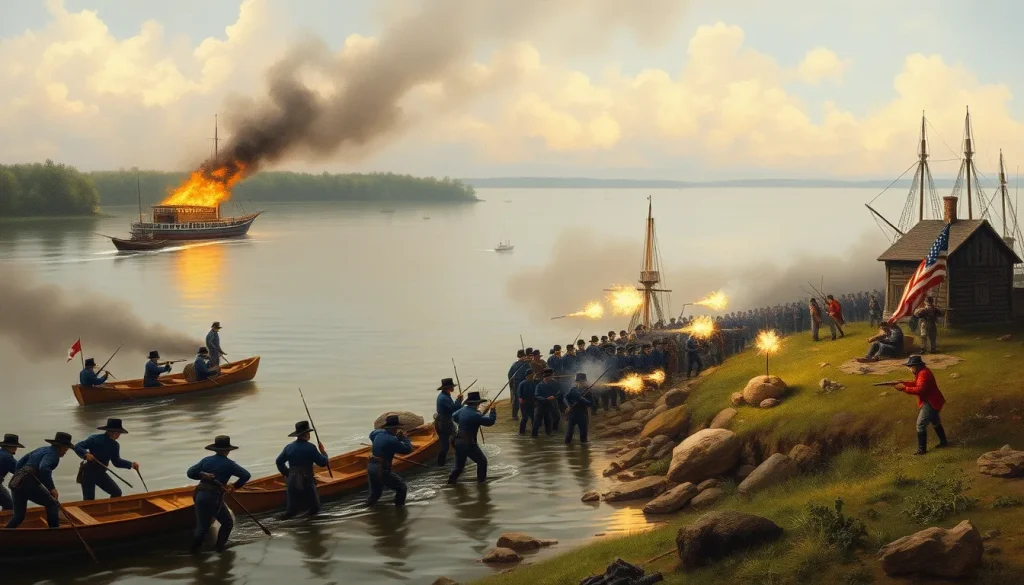
On the morning of 25 May 1813, American batteries at Fort Niagara and Commodore Isaac Chauncey’s ships on Lake Ontario began a heavy bombardment of Fort George and the nearby town of Niagara. The naval guns, using red-hot shot, set many wooden structures alight and inflicted casualties on the British garrison. The bombardment continued intermittently for two days, during which the Americans assembled a landing force of about 4,000 regulars at Fort Niagara and Four Mile Creek.
At dawn on 27 May, under a fog-covered lake, American boats carrying the first wave of troops crossed the river and landed west of the fort at Two Mile Creek. The landing was directed by Colonel Winfield Scott, who had planned the assault in detail. The British defenders—roughly 1,000 regulars of the 8th, 41st, and 49th Regiments, the Royal Newfoundland Fencibles, Glengarry Light Infantry, plus about 300 militia and some Indigenous warriors—opposed the landing but were driven back by heavy naval support and superior numbers.
Brigadier General John Vincent, the British commander, realised that his position was untenable. He had already spiked the fort’s guns and destroyed stores. Recognising the risk of being surrounded, he ordered a withdrawal. His regulars fell back along the Niagara River, while the militia and Indigenous contingents dispersed or were absorbed into the column. Vincent moved his troops westward, eventually reaching Burlington Heights at the head of Lake Ontario, where he remained a threat to American operations.
The Americans occupied Fort George and the town of Niagara, but Dearborn, who was ill, failed to pursue Vincent immediately. Days passed before an advance was ordered, and that pursuit force was defeated at the Battle of Stoney Creek on 6 June, with both American generals captured. The Americans subsequently remained bottled up in the fort for the rest of the summer, before being forced to evacuate in December 1813.
Why It Matters
The Battle of Fort George is historically significant as one of the most professionally executed American combined operations of the War of 1812. The coordination between the navy and army, the planning by Winfield Scott, and the execution of the landing demonstrated what the United States could achieve with determined leadership. Yet the failure to follow up the tactical victory allowed Vincent’s force to escape, leading to the American defeat at Stoney Creek and the eventual loss of the initiative on the Niagara frontier.
Historians view the battle as a prime example of tactical success squandered by strategic indecision. Dearborn’s inactivity after the capture, and his recall in July, stand in contrast to Scott’s rise. The battle also underscored the importance of naval supremacy on Lake Ontario and the difficulty of converting local gains into decisive results in the vast wilderness of Upper Canada. British and Canadian perspectives emphasise the disciplined retreat that preserved the regular army and set up the later recovery of the peninsula.
Prelude
In the spring of 1813, the American high command, under pressure to deliver a decisive blow, devised a campaign aimed at the British posts on Lake Ontario. The original plan targeted Kingston, York, and Fort George. After receiving intelligence overstating Kingston’s defences, Major General Henry Dearborn and Commodore Isaac Chauncey decided to first attack York, which fell on 27 April. The American army then re-embarked and moved to Fort Niagara. Meanwhile, Colonel Winfield Scott, recently exchanged as a prisoner of war, arrived and took over as adjutant general. He improved discipline, organised the landing force, and selected a beachhead west of Fort George near Two Mile Creek.
Forces and Commanders
American – Commanded overall by Major General Henry Dearborn, with Colonel Winfield Scott leading the assault troops. Naval support came from Commodore Isaac Chauncey’s Lake Ontario squadron, including a corvette, a brig-of-war, and twelve gunboats. Also present were Master Commandant Oliver Hazard Perry (temporarily assigned from Lake Erie) and Major General Morgan Lewis. The force numbered about 4,000 regulars and militia.
British/Canadian – Brigadier General John Vincent commanded the Centre Division, comprising about 1,000 regular infantry from the 8th, 41st, and 49th Regiments, the Royal Newfoundland Fencibles, and the Glengarry Light Infantry, plus around 300 militia and approximately 50 Indigenous warriors. The fort mounted five field guns and had several small cannon.
Battlefield and Map Context
Fort George stood on a low bluff overlooking the Niagara River and Lake Ontario, with open ground stretching inland. The American landing site was at Two Mile Creek, about two miles west of the fort, where a shallow beach and steep bank provided cover. The surrounding terrain consisted of orchards, fields, and scattered woods. The battlefield is now part of Niagara-on-the-Lake, Ontario, and is preserved as Battlefield of Fort George National Historic Site of Canada, encompassing the landing area, the creeks, and the plateau.
Battle Chronology
- 25 May 1813 – American naval vessels and shore batteries begin heavy bombardment of Fort George and Niagara town, setting fires and dismounting guns.
- 26 May – Bombardment continues; American troops move to staging areas.
- 27 May, early morning – Under fog cover, the first wave of American boats crosses the river and lands at Two Mile Creek.
- 27 May, morning – British troops attempt to repel the landing but are driven back by naval gunfire. Vincent orders a general retreat.
- 27 May, midday – American forces occupy Fort George and nearby town with minimal resistance.
- 28 May onward – Vincent withdraws to Burlington Heights; American pursuit begins only days later, leading to the Battle of Stoney Creek on 6 June.
Casualties and Losses
Casualty figures vary across contemporary reports and later histories. The British suffered between 52 and 107 killed, with 147–175 wounded and 276–280 captured (including many of the wounded). The Americans reported 40–111 killed and 111–192 wounded. The wide ranges reflect discrepancies in official returns and subsequent tallies. The Canadian Encyclopedia cites British losses as 52 killed and 306 wounded or missing, while American losses were about 40 killed and 120 wounded.
Result
The battle was a clear American tactical victory. They captured the fort, the town, and gained temporary control of the Niagara frontier. However, because Vincent’s regular force withdrew intact, the strategic result was indecisive. The Americans did not destroy the British field army, and their failure to pursue allowed Vincent to remain a threat.
Strategic Consequences
In the short term, the American capture of Fort George secured the western end of Lake Ontario and disrupted British communications with their western posts. Yet within ten days, a British surprise attack at Stoney Creek (6 June) compelled the American advanced force to retreat back to Fort George. The Americans remained confined to a narrow perimeter around the fort throughout the summer, unable to break out. In December 1813, as the Americans withdrew across the river, they burned Newark (Niagara-on-the-Lake) and abandoned the fort. The British reoccupied it and fortified the position, and it remained in British hands for the rest of the war. The failure to exploit the victory contributed to Dearborn’s recall and solidified the reputation of Winfield Scott as a capable commander.
Primary Accounts
Contemporary accounts include Brigadier General John Vincent’s dispatch to Governor General Sir George Prevost, describing the bombardment and the decision to retreat, and Major General Henry Dearborn’s official report. American lieutenant-colonel Winfield Scott also filed a detailed after-action report. A famous contemporary visual account is the 1817 engraving ‘Attack on Fort George’ published in Philadelphia Portfolio. These sources provide first-hand details but are coloured by each commander’s need to justify his actions to superiors.
Battlefield Today
The battlefield is preserved as part of Battlefield of Fort George National Historic Site of Canada, administered by Parks Canada. The fort itself has been reconstructed based on original plans from 1937 to 1941. Visitors can see the earthwork bastions, palisades, and the stone powder magazine that survived the 1813 bombardment. The surrounding landscape, including the beach at Two Mile Creek and the creeks, remains protected. Interpretive markers and a cairn commemorate the battle and the soldiers who fell.
Primary Sources
Key primary sources include:
- Vincent’s report to Prevost (c. 27–28 May 1813): describes the bombardment and withdrawal. Located in the British military records at Library and Archives Canada.
- Dearborn’s official report (c. June 1813): details the landing and claims of success. Published in American state papers.
- Winfield Scott’s memoir and reports (written later but based on his notes): provide insight into planning and execution.
- The 1817 engraving ‘Attack on Fort George’ – a contemporary artistic representation, available in the Archives of Ontario.
- USS Chauncey’s report to Secretary of the Navy – documents the naval side.
These sources are useful but must be read critically; commanders often exaggerated success or minimised losses. The NPS article summarises the American view, while the Canadian Encyclopedia offers British/Canadian perspective.
Further Reading
- Hickey, The War of 1812: A Forgotten Conflict
- Lambert, The Challenge: Britain Against America in the Naval War of 1812
- Latimer, 1812: War with America
- Berton, The Invasion of Canada
- Stagg, The War of 1812: Conflict for a Continent
- Parks Canada – Fort George National Historic Site (official site)
References
- James H. Marsh, “Battle of Fort George,” The Canadian Encyclopedia (Last edited 2014). https://thecanadianencyclopedia.ca/en/article/battle-of-fort-george
- U.S. National Park Service, “Immediately evacuate the fort,” (2015). https://www.nps.gov/articles/fort-george.htm
- “Battle of Fort George,” Wikipedia (accessed 2023). https://en.wikipedia.org/wiki/Battle_of_Fort_George
- “Battle of Fort George – War of 1812,” The War of 1812 Resource. https://thewarof1812.org/battles/battle-of-fort-george/
- Parks Canada, “Battlefield of Fort George National Historic Site of Canada,” (accessed 2023). https://www.pc.gc.ca/apps/dfhd/page_nhs_eng.aspx?id=1236
FAQ
What was the Battle of Fort George?
It was an American combined land-naval attack on 25–27 May 1813 that captured the British fort at the mouth of the Niagara River, but the British garrison escaped.
Why did the British evacuate Fort George?
Brigadier General John Vincent decided to withdraw because his force was outnumbered about four to one and exposed to devastating naval gunfire, making the position untenable.
What happened after the American victory?
The Americans failed to pursue immediately, allowing Vincent's force to escape. At the Battle of Stoney Creek a week later, the British turned the tables, forcing the Americans into a defensive perimeter around Fort George, which they later evacuated in December.



Leave a Reply