

Short Answer
The peace talks that produced the Treaty of Ghent—ending the War of 1812 between the United States and Great Britain—took place in the city of Ghent (modern-day Belgium) between August and December 1814. The choice of Ghent was neither accidental nor symbolic but reflected practical diplomatic calculations: it was a neutral city in a region recently freed from French control, accessible to both delegations, and acceptable to both governments after earlier mediation offers had failed. The negotiations held there would ultimately restore prewar boundaries and set the stage for a durable peace.
Historical Context
By 1814, both the United States and Great Britain had compelling reasons to seek peace. The United States had entered the war in 1812 over impressment, trade restrictions, and British support for Indigenous resistance to American expansion. After more than two years of conflict, the military situation was mixed: American forces had failed to conquer Canada, but they had also held off British invasions in several theaters. The U.S. economy suffered from the British blockade, and New England Federalists openly criticized the war. Meanwhile, Britain was exhausted after two decades of war with Revolutionary and Napoleonic France. Although Napoleon had been defeated in April 1814, British leaders faced a heavy tax burden and the need to manage European peace at the Congress of Vienna. The American war was a costly side theater.
Both governments had attempted to open peace negotiations earlier. In early 1813, Russia offered to mediate, and the American government accepted, but Britain declined. Later, the British proposed a separate meeting in Gothenburg, Sweden, but the U.S. delegation arrived only after the British had left. By mid-1814, with the war continuing and the European situation stabilizing, the two sides agreed to meet. The choice of Ghent, located in the Southern Netherlands (future Belgium), came about partly because it was in a region under provisional government and offered neutral ground. It was also geographically accessible—within a few days’ travel from London and across the Atlantic from Washington—and had good communication links.
What Happened
The American delegation consisted of John Quincy Adams, Albert Gallatin, Henry Clay, James A. Bayard, and Jonathan Russell. The British side was represented by Admiral James Gambier, Dr. William Adams (a legal expert), and Henry Goulburn, with instructions from Whitehall. The talks formally began on August 8, 1814. The British presented a list of demands, including the creation of an Indigenous buffer state between the United States and British North America, territorial concessions in northern Maine and the Minnesota region, British control over the Great Lakes, and the continuation of British maritime rights. The Americans initially refused. Over the following months, the British gradually dropped many of their demands, influenced by military setbacks such as the American victories at Baltimore and Lake Champlain in September 1814, as well as domestic pressure in Britain. By November, the British abandoned the demand for an Indian barrier state and accepted the principle of status quo ante bellum—the restoration of prewar boundaries—though disputes over fishing rights and border details would be referred to commissions. The treaty was signed on December 24, 1814, and ratified by the British government on December 27. The U.S. Senate approved it on February 16, 1815, and the war formally ended the next day.
Why It Matters
The choice of Ghent as the venue had immediate and lasting significance. It allowed the negotiations to take place on neutral territory, reducing the risk of preconditions or perceived favoritism. The location also symbolized a new era of diplomacy, as Ghent was part of the Netherlands that had recently thrown off French rule. More importantly, the Treaty of Ghent restored Anglo-American relations to their prewar state, without resolving the issues of impressment or neutral trade, which were overshadowed by later events. The treaty’s provision for a return to the status quo ante bellum meant that no territorial changes occurred—the war’s territorial gains were negligible. For historians, the Ghent negotiations illustrate the role of neutral venues in international diplomacy and the impact of domestic and European political pressures on wartime decision-making. The talks also foreshadowed the creation of an international boundary commission that would help manage the U.S.-Canada border peacefully.
Definition
Why were peace talks held in Ghent? The term refers to the diplomatic negotiations conducted in the city of Ghent between the United States and Great Britain from August to December 1814, culminating in the Treaty of Ghent. The choice of Ghent was a deliberate diplomatic expedient—a neutral, accessible location acceptable to both belligerents.
Background
To understand the choice of Ghent, one must consider the wider context of the Napoleonic Wars. By 1814, Napoleon had been defeated, removing the principal strategic reason for the British Order-in-Council restrictions on neutral trade, which had been a cause of the war. Impressment, the other major American grievance, had also become less acute because the Royal Navy no longer needed as many sailors after the French threat diminished. The United States, recognizing this, dropped its demand for an explicit end to impressment. With these issues no longer decisive, both sides could accept a simple territorial restoration. Ghent’s advantage was that it was neither British nor American, avoiding any symbolic advantage. The city was under a provisional administration following Napoleon’s fall, but it was considered neutral enough for diplomatic purposes.
How It Worked
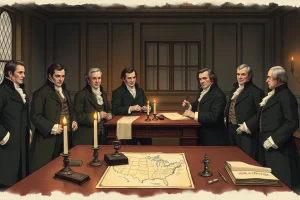
The negotiations were conducted face-to-face between the five American and three British commissioners. The Americans had broad negotiating authority, while the British commissioners frequently referred important matters to London, causing delays. The sessions took place in a townhouse on Veldstraat, and the delegates also socialized, which helped build a professional working atmosphere. Communication between the negotiators and their governments took weeks due to Atlantic crossings, which meant each side had to operate on broad instructions. The Americans initially insisted on the end of impressment, but by August they realized this was unattainable. The British at first sought territorial gains and an Indigenous buffer state, but their demands were reduced after the defeat at Lake Champlain and the failed assault on Baltimore. The turning point came when the Duke of Wellington, whom the British had asked to command in America, wrote that Britain had no right to demand territory without control of the Great Lakes. With that, the British leadership decided to settle on status quo ante bellum.
Competing Viewpoints
Contemporary and historical perspectives differ on why Ghent was chosen. The American commissioners saw Ghent as neutral and convenient, far from British influence. The British accepted Ghent partly because it was in a region they controlled indirectly and had easy communication with London. Some accounts suggest Britain initially preferred a location in Europe because the United States was more eager for peace, but the American refusal to meet in Gothenburg left Ghent as a compromise. Historians also debate the relative weight of military and financial pressures on the British decision to compromise; some emphasize the role of European politics, particularly the need to keep Russia and Austria friendly, while others stress the cost of the American war. The traditional narrative that Britain “gave up” its demands is complicated by the fact that the British army was winning some battles but facing unsustainable costs. The choice of Ghent itself was not a point of contention, but the venue was seen as a sign of Britain’s willingness to negotiate on equal terms.
Role in the War of 1812
Peace talks held in Ghent were instrumental in ending the War of 1812. Without them, the war might have continued into 1815, with unknown consequences. The talks provided a formal channel for both sides to reach a compromise—the restoration of prewar borders—which neither had achieved through battle. The treaty’s signing on Christmas Eve, 1814, and ratification in February 1815, ended the conflict, though the Battle of New Orleans occurred after the treaty was signed but before ratification. The Ghent talks also addressed the status of Indigenous peoples, though the provisions to restore their 1811 rights were largely ignored. In that sense, the talks had a direct impact on the war’s conclusion and its legacy for Indigenous nations.
Consequences and Historical Interpretation
The choice of Ghent has been interpreted by historians as a symbol of the transition from the revolutionary era to a more mature diplomatic relationship. The treaty’s failure to address impressment and trade ensured that these issues did not cause another war; they were resolved through later negotiations. The Ghent negotiations established a precedent for resolving U.S.-British disputes via arbitration and commissions, helping to create a lasting peace along the border. In historical memory, Ghent is remembered as the place where a seemingly inconclusive war ended in a return to the status quo, a result that both sides could and did claim as a victory. The site itself—now a small museum marker—testifies to the importance of neutral venue in diplomacy. Later historians have argued that the Ghent talks demonstrated the limits of military victory in determining the shape of peace, and they continue to study them as an example of how exhaustion and economic pressure can bring belligerents to negotiate.
Primary Sources
The most important primary source is the Treaty of Ghent itself, signed on December 24, 1814, which restored prewar boundaries and provided for commissions to resolve border disputes. The treaty text is available at the U.S. National Archives and Records Administration and the British National Archives. The diplomatic correspondence of the American commissioners, including John Quincy Adams’s diary and letters, offers insight into the negotiations. Adams’s diary, published in modern editions, details the daily proceedings and the American debates. British diplomatic documents, including the dispatches between the British commissioners and the Foreign Office, are housed in the National Archives, Kew. These records show how London instructed the delegation and the gradual retreat from tough demands. The NPS article “Summer 1814: Americans and British open peace negotiations at Ghent” provides a concise secondary overview, while Donald Hickey’s article “Probing for Peace” explains the strategic context. All these sources should be used with an understanding of their authors’ biases—American commissioners were seeking favorable terms, and British officials were concerned with European balance of power.
Further Reading
- Heidler, David S., and Jeanne T. Heidler, eds. Encyclopedia of the War of 1812. Santa Barbara, CA: ABC-CLIO, 1997.
- Hickey, Donald R. The War of 1812: A Forgotten Conflict. Urbana: University of Illinois Press, 1989.
- Adams, John Quincy. Memoirs of John Quincy Adams, edited by Charles Francis Adams. Philadelphia: J.B. Lippincott, 1874–77.
- Stagg, J.C.A. Mr. Madison’s War: Politics, Diplomacy, and Warfare in the Early American Republic, 1783–1830. Princeton: Princeton University Press, 1983.
References
- National Park Service. “Summer 1814: Americans and British open peace negotiations at Ghent.” Accessed [date]. https://www.nps.gov/articles/treaty-of-ghent-1.htm.
- Hickey, Donald R. “Probing for Peace: Weighing the Burdens of War on Two Continents.” National Park Service. Accessed [date]. https://www.nps.gov/articles/probing-for-peace.htm.
- American Battlefield Trust. “The Treaty of Ghent: Ending the War of 1812.” Accessed [date]. https://www.battlefields.org/learn/articles/treaty-ghent-ending-war-1812.
- National Park Service. “War’s End – Star-Spangled Banner National Historic Trail.” Accessed [date]. https://nps.gov/stsp/learn/historyculture/war-s-end.htm.
- Brussels Times. “How a Ghent parlay settled a war between the US and Britain.” Accessed [date]. https://www.brusselstimes.com/1366877/how-a-ghent-parlay-settled-a-war-between-the-us-and-britain.
FAQ
Why was Ghent chosen as the meeting place for the peace talks?
Ghent was chosen because it was a neutral city in the Southern Netherlands, newly freed from French control, and was acceptable to both the United States and Great Britain. Earlier efforts to mediate in Russia or meet in Sweden had failed, so both sides agreed to a location with no political attachments.
Did the Ghent peace talks address the main causes of the war?
The talks initially touched on impressment and maritime rights, but the Americans dropped their demand for an explicit end to impressment after recognizing it was no longer a practical issue. The final treaty did not mention impressment or neutral trade, focusing instead on territorial restoration and commissions to resolve border disputes.
What was the turning point in the Ghent negotiations?
The British ministry's decision to drop their maximum demands came after the Duke of Wellington stated that Britain could not rightfully claim territory in America without control of the Great Lakes. Combined with military setbacks at Baltimore and Lake Champlain and domestic pressure over taxes, this led Britain to accept a return to prewar borders.




Leave a Reply