
Short Answer
The clothing and uniforms worn during the War of 1812 (1812–1815) were as varied as the forces that fought them, ranging from the regulation coatees and shakos of regular infantry to the homespun hunting shirts of frontier militiamen. These garments served practical, symbolic, and tactical purposes, reflecting the young American republic’s industrial limits, British imperial standards, and the improvised nature of a conflict that stretched from the Canadian border to the Gulf of Mexico. Understanding this material culture is essential to grasping the daily experience of soldiers and sailors and the broader logistical challenges of the war.
Historical Context
At the outbreak of the War of 1812, neither the United States nor Great Britain had fully standardized military dress. The American army was small and ill-prepared, with many regiments still wearing Revolutionary-era patterns or ad hoc combinations. Britain, meanwhile, was heavily engaged in the Napoleonic Wars and had limited resources to spare for its North American garrisons, though its regulars maintained a generally consistent red-coated appearance. Canadian provincial units and Indigenous allies drew on local materials and traditions, producing a distinctive array of clothing that often blended military and civilian elements. Economic blockades, domestic textile production, and regional climate all influenced what troops wore and how they obtained it.
What Happened
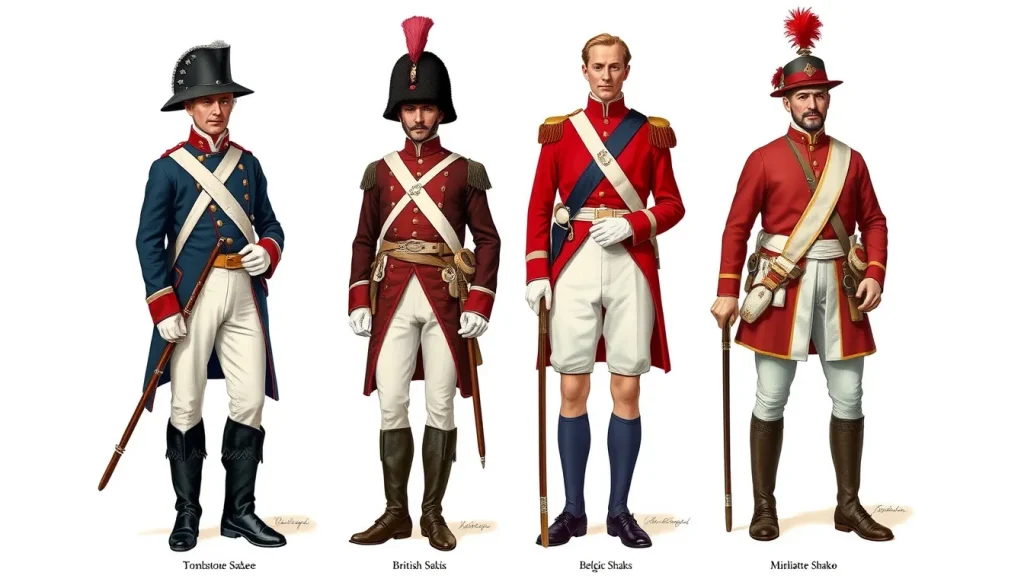
American regular infantry began the war with no uniform standard, but in 1813 the War Department issued new regulations. The typical infantryman received a tall, flat-topped “tombstone” shako made of felt or leather, a single-breasted dark blue coatee with a standing collar, white or yellow tassels, and trousers that varied seasonally—white linen in summer, gray or blue wool in winter. Shortages of blue cloth forced some regiments, such as the 15th and 16th Infantry, to adopt gray, brown, or even black coatees. Militia units often wore civilian clothes, especially the hunting shirt, which was practical and could be easily made.
British regulars in North America wore the standard red coatee, but by 1813 they received the Belgic shako, a leather cap with a distinctive plate. Highland regiments like the 93rd Sutherland Highlanders exchanged kilts for tartan trousers before deploying to America. Canadian militia, particularly French Canadian sedentary units, typically wore homespun capots (hooded coats) with colorful sashes, while select embodied battalions were issued more formal uniforms. Indigenous warriors wore a mix of traditional dress and European trade goods, including blankets, leggings, and silver ornaments.
Naval uniforms also evolved. American naval officers followed regulations from 1802, which specified blue coats with gold lace and white breaches or pantaloons. Secretary of the Navy William Jones updated these in 1813, directing short lapels and pantaloons. Enlisted sailors, though not formally uniformed, commonly wore blue jackets, scarlet waistcoats, and glazed hats. British naval dress was similarly informal for ratings, but officers adhered to a standardized pattern.
Why It Matters
The clothing and uniforms of the War of 1812 influenced troop morale, battlefield identification, and the perception of the conflict at home and abroad. Uniforms helped forge unit identity and disciplined appearance, but the frequent shortages and improvisations highlighted the logistical weaknesses of the American army and the strain of a distant overseas war on Britain. For militiamen and Indigenous allies, dress expressed local identity and autonomy. Historians have used uniform evidence to trace supply networks, technological changes, and the social composition of the forces. The ragged appearance of American soldiers in some campaigns became a point of pride, symbolizing the citizen-soldier ideal, while British red coats reinforced imperial authority.
Definition
Clothing and uniforms in the War of 1812 encompass all garments, headgear, footwear, and accoutrements worn by military personnel—including regulars, militia, volunteers, and Indigenous allies—on both land and sea. This includes regulation dress as well as practical improvisations and civilian clothing used when official items were unavailable.
Background
Before 1812, the U.S. Army had only informal guidance for uniforms, and many officers wore whatever they considered appropriate, often following European fashions. The 1812 declaration of war caught the army in a state of transition. Britain, with its established military tradition, provided its North American forces with uniforms that adhered to a centralized system, though adjustments were made for climate and supply. Canadian units, both regular and militia, drew on British patterns but also incorporated local materials. Indigenous nations had their own dress traditions, which blended with European trade goods.
How It Worked
Uniforms functioned as a system of identification, protection, and morale. A typical American infantryman’s uniform after the 1813 regulations included a shako, a coatee, waistcoat, trousers, gaiters, and a knapsack. The shako was made of felt or leather, with a brass cap plate and a wool plume—white for infantry, yellow for artillery. The coatee had high collar, ten buttons, and lace trimming; facing colors distinguished regiments. Trousers were white linen in summer and gray or blue wool in winter. Gaiters of black wool or canvas protected the lower legs. Enlisted men also received fatigue blouses and caps for work and daily drills, which were often worn to spare the uniform.
British infantry wore the classic red coatee with regimental facings, gray trousers, and a Belgic shako. Highland units substituted trews for kilts in North America. Canadian militia wore civilian clothing, often with a capot and sash, and received issued arms and accoutrements but no uniform. Indigenous warriors typically wore their traditional clothing, supplemented by trade items such as blankets, shirts, and beads.
Naval officers had specified uniforms, but sailors wore practical garments like blue jackets, white or checked shirts, and canvas trousers. The Navy uniform regulations of 1802 and 1813 formalized officer dress, but seamen’s clothing was often self-purchased or provided by the captain.
Competing Viewpoints
Historians differ on the degree of standardization and the importance of uniforms. Some emphasize the chaotic, non-uniform appearance of American forces, arguing it reflected the early republic’s aversion to standing armies and its decentralized supply system. Others note that by 1814, the U.S. Army was producing and distributing uniforms more consistently, and that the variation was often overstated in memoirs and later paintings. For the British, the red coat is seen as a symbol of discipline and imperial power, but scholars also point to the practical adaptations made for the American wilderness, such as the use of grey trousers and short coats. The role of Indigenous clothing is sometimes romanticized; modern historians stress the functional and cultural meanings of the garments.
Role in the War of 1812
Uniforms affected operational outcomes. The American attack on York in 1813 was conducted by regiments wearing non-regulation gray and black coatees because of cloth shortages, demonstrating the flexibility of the system. The British 93rd Highlanders’ trews at New Orleans were a tactical adaptation, as kilts would have been impractical in the wet, cold conditions. Militiamen’s hunting shirts provided mobility and camouflage, but also led to confusion in battle, as they lacked distinctive colors. Indigenous allies used clothing to signal their status and affiliations, and their presence was often noted by opponents for its psychological impact. The navy’s more relaxed enlisted dress reinforced a sense of shared labor and community.
Consequences and Historical Interpretation
The clothing and uniforms of the War of 1812 had lasting effects on American military dress. The 1813 regulations became the basis for later U.S. Army uniforms, and the experience of supply shortages influenced future quartermaster reforms. In Britain, the war reinforced the need for standardized “small pattern” clothing for colonial troops. For Canada, the war forged a distinct military identity that blended British and local elements. Historians interpret uniforms as a lens into broader social and economic history, revealing the limits of early American industry, the resilience of British networks, and the cultural adaptations of Indigenous peoples. The image of the “ragged but resolute” American soldier became a powerful cultural trope, while the British redcoat remained an enduring symbol of empire.
Primary Sources
Primary sources for the study of War of 1812 uniforms include the official regulations issued by the U.S. War Department in 1813, the Adjutant General’s correspondence, and the clothing returns of specific regiments. British sources include the “Clothing Board” reports and regimental records. Letters and journals of soldiers, such as those from the 15th and 16th Infantry, describe the uniforms actually worn. Paintings, such as Gilbert Stuart’s portrait of Major General Henry Dearborn (1812), provide visual evidence. The National Archives in Washington, D.C., hold the original uniform regulations, and the collections of the Smithsonian Institution and Parks Canada include surviving uniform items.
Further Reading
- René Chartrand, The United States Army 1812–15 (Osprey Men-at-Arms Series, 2000).
- René Chartrand, British Forces in North America 1793–1815 (Osprey Men-at-Arms, 1998).
- Tim Reese’s uniform plates in The War of 1812 Magazine (2006) – online.
- Pritzker Military Museum & Library, “Soldier Dress & Uniform in the War of 1812” – online exhibit.
- American Battlefield Trust, “Equipment in the War of 1812” – online article.
References
- Pritzker Military Museum & Library, “Soldier Dress & Uniform in the War of 1812,” https://www.pritzkermilitary.org/soldier-dress-uniform-war-1812
- Tim Reese, “Dressed to Kill: Uniforms, Dress and Equipment of the War of 1812,” The Napoleon Series, War of 1812 Magazine Issue 3, June 2006, https://www.napoleon-series.org/military-info/Warof1812/2006/Issue3/c_artofwar.html
- American Battlefield Trust, “Equipment in the War of 1812,” https://www.battlefields.org/learn/articles/equipment-war-1812
- Osprey Publishing, “Soldiers of the War of 1812,” September 11, 2015, https://www.ospreypublishing.com/ca/osprey-blog/2015/soldiers-of-the-war-of-1812/
- Pat Costa, “American Military Dress in the War of 1812,” PDF, https://patcosta.com/wp-content/uploads/2015/09/American-Military-Dress-in-the-War-of-1812.pdf
FAQ
What was the standard American uniform in the War of 1812?
The 1813 U.S. Army regulations prescribed a tombstone shako, dark blue coatee with a standing collar, white or yellow trim, and trousers that changed by season—white linen in summer, gray or blue wool in winter. However, cloth shortages often led to gray, brown, or black coats.
Did British soldiers wear kilts in the War of 1812?
Some Highland units, such as the 93rd Sutherland Highlanders, wore kilts in early campaigns, but before deploying to North America they were issued tartan trousers (trews) as a practical adaptation for the climate.
How did militia uniforms differ from regular uniforms?
Militiamen often wore civilian clothing, especially the hunting shirt, which was practical and easily made. Some volunteer militia units had more formal uniforms, but they were not subject to the 1813 regulations.
Leave a Reply