
Short Answer
The War of 1812 (1812–1815) involved not only professional soldiers and sailors but also the ordinary civilians of the United States, British North America (modern Canada), and Indigenous nations. These civilians—farmers, merchants, women, children, enslaved and free African Americans, and Native peoples—experienced the war through military occupation, raids, inflation, shortages, and social dislocation. Their experiences varied widely, yet they collectively shaped the war’s course and its memory.
Historical Context
Before the war, the borderlands between the United States and British North America were inhabited by a mix of settler communities, Indigenous nations, and British garrisons. The U.S. economy was heavily dependent on transatlantic trade, while Indigenous peoples sought to protect their lands from American expansion. British policies such as impressment of American sailors and support for Indigenous resistance fueled American grievances. The declaration of war in June 1812 came after decades of tension, and its prosecution would directly involve civilians as targets, refugees, and participants.
What Happened
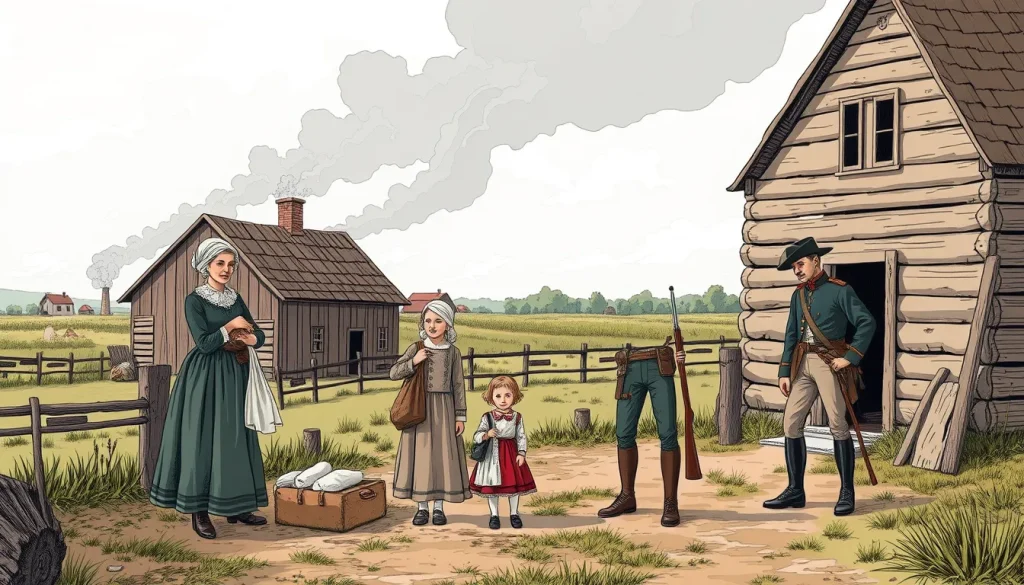
Ordinary people experienced the war in several overlapping ways. In the American countryside, recruiting drives and drafts depleted labor, while British naval blockades curtailed trade and raised prices. In the Old Northwest and Niagara frontier, American and British forces fought with Indigenous allies, leading to the destruction of farms and villages, flight of refugees, and brutal violence against settlers and Native peoples alike. The British occupation of American territory, including Washington D.C. in 1814, brought burning of public buildings and looting. In British North America, colonial militias were called up, and many families fled advancing American armies. Indigenous communities, such as the Creek and Shawnee, faced internal divisions and severe losses. African Americans, both free and enslaved, were caught amid promises of freedom and the threat of being sold back into slavery. The war also sparked economic crises: paper money depreciated, food prices rose, and trade ground to a halt. Civilian women often managed farms and households alone while their husbands and sons served, while children witnessed violence and displacement. The end of the war in 1815 brought a return to relative peace, but the social and economic scars persisted.
Why It Matters
The experiences of ordinary people during the War of 1812 shaped national memories in the United States and Canada. In the U.S., the war reinforced a sense of national identity, despite mixed outcomes. In British North America, the defense against invasion contributed to a distinct colonial identity. For Indigenous peoples, the war accelerated land loss and marginalization. Historians now examine civilian experiences to understand the war’s total impact and the ways warfare affected communities, gender roles, and race relations. The war’s legacy includes the hardening of borders and the growth of a cross-border economic system, as well as lasting narratives of loyalty and resistance.
Definition
In the context of the War of 1812, “ordinary people” refers to non-combatants: farmers, laborers, artisans, shopkeepers, women, children, the elderly, and those enslaved or legally dependent on others. It includes citizens of the United States, subjects of Great Britain in North America, and members of Indigenous nations. The term contrasts with military personnel and political leaders, but many civilians took on militia duties or provided supplies and intelligence, blurring the line.
Background
The prewar period saw rising economic interdependence between the United States and the British Empire, alongside deep resentments. The impressment of American sailors, trade restrictions, and British support for Indigenous resistance in the Northwest Territory were major causes. The outbreak of war triggered immediate economic disruption: the U.S. embargo and British blockade cut off trade, causing shortages of imported goods and inflation. Rural communities, especially in the border regions, faced the threat of raids and invasion, while urban centers like Baltimore and Washington became military targets.
How It Worked
Civilians experienced the war through direct violence, economic strain, and social upheaval. Raids by American, British, and Indigenous forces destroyed homes, livestock, and crops. For example, the 1813 burning of York (Toronto) by American troops displaced civilians and destroyed property. In retaliation, British forces burned Washington D.C. in 1814. Refugees fled battle zones, often leaving everything behind. The war also brought shortages of staples like salt, flour, and cloth, and skyrocketing prices made basic goods unaffordable. Women took on unprecedented roles, managing farms and businesses, and sometimes serving as messengers or spies. Enslaved African Americans faced a brutal dilemma: some escaped to British lines, where they were offered freedom, while others were forcibly relocated. Indigenous peoples suffered heavily as their communities were displaced and divided. The conflict also fostered community resilience, with civilians banding together to form militias, charitable organizations, and relief efforts.
Competing Viewpoints
Historians debate the degree of support for the war among civilians. Some argue that many Americans were ambivalent or opposed, particularly in New England, where trade interests suffered. Others emphasize the wave of patriotic fervor that followed early victories such as the Battle of New Orleans. Similarly, the experiences of civilians in British North America were not monolithic: some colonists remained loyal to Britain, while others had ties to the U.S. Indigenous peoples had their own varied allegiances; many fought alongside Britain, while others sought neutrality or sided with the U.S. Gender and race also shaped experiences: white women faced different threats than enslaved women, and free Black communities had distinct concerns. These differing perspectives complicate any simple narrative of “ordinary” experience.
Role in the War of 1812
Civilians were not passive victims. They supplied food, raw materials, and intelligence to military forces. Militias comprised ordinary farmers and artisans who fought alongside regulars. Women provided medical care, maintained homes, and sometimes influenced military decisions. The war effort depended on civilian labor and resources, from shipbuilding to smuggling goods past blockades. In the border regions, civilian communities often formed the front line, experiencing the brunt of raids and skirmishes. Their resilience or discontent directly affected morale and the war’s sustainability.
Consequences and Historical Interpretation
The immediate consequences for civilians included financial losses, family separation, and trauma. In the long term, the war accelerated the expansion of the U.S. into Indigenous territories, despite treaties. In Canada, the war fostered a separate identity. Historians have used diaries, letters, and court records to reconstruct civilian experiences, noting how the war disrupted traditional gender and racial hierarchies. Modern scholarship emphasizes the war’s impact on ordinary people, moving beyond a battle-focused narrative. The memory of the war, especially in Canada and the U.S., often celebrates military heroics, but the civilian experience reveals the human cost of the conflict.
Primary Sources
Relevant primary sources include the diaries and letters of civilians, such as those of Laura Secord, a Canadian loyalist who warned British forces of an American attack, and the diary of Sarah Maria Cornell, a New England woman who recorded price increases and daily hardships. Military documents like the official reports of American and British commanders also mention civilian encounters. Local newspapers provide accounts of raids and community responses. Census records and property inventories help historians assess losses. These sources reflect the biases of their writers, often literate and of European descent, and need to be read alongside oral traditions of Indigenous peoples and the limited records of enslaved individuals.
Further Reading
- Alan Taylor, The Civil War of 1812: American Citizens, British Subjects, Irish Rebels, & Indian Warriors (2010).
- Donald R. Hickey, The War of 1812: A Forgotten Conflict (1989).
- Nicole Eustace, 1812: War and the Passions of Patriotism (2012).
- John C. Fredriksen, The United States Army in the War of 1812: Concise Biographies of Commanders and Operational Histories of Regiments (2009).
- Library and Archives Canada, “War of 1812.”
References
- Taylor, Alan. The Civil War of 1812: American Citizens, British Subjects, Irish Rebels, & Indian Warriors. Alfred A. Knopf, 2010.
- Hickey, Donald R. The War of 1812: A Forgotten Conflict. University of Illinois Press, 1989.
- Eustace, Nicole. 1812: War and the Passions of Patriotism. University of Pennsylvania Press, 2012.
- Library and Archives Canada. “War of 1812.” Accessed 2023. https://www.bac-lac.gc.ca/eng/discover/military-heritage/Pages/war-1812.aspx.
FAQ
How did the War of 1812 affect American civilians?
Civilians faced economic hardship from blockades, inflation, and property destruction, especially in border regions. Many lost homes and livelihoods, and some became refugees.
What was the experience of Indigenous peoples during the war?
Indigenous peoples faced forced displacement, loss of land, and internal conflict. Some allied with Britain, others with the U.S., but all suffered severe consequences.
Did civilian women have a significant role in the war?
Yes, women managed farms and households in men's absence, provided supplies and information, and sometimes served as messengers or spies. Their labor was vital.
Leave a Reply