
Short Answer
In the War of 1812, Indigenous peoples played a decisive role in the defense of British North America—what later became Canada—against American invasion. Allied with the Crown through long-standing diplomatic and military relationships, warriors from the Great Lakes, St. Lawrence Valley, and the Grand River contributed crucial manpower, intelligence, and combat effectiveness. Their efforts helped prevent the conquest of the provinces, though the war’s end brought them neither the territorial guarantees they sought nor lasting security against expansion.
Historical Context
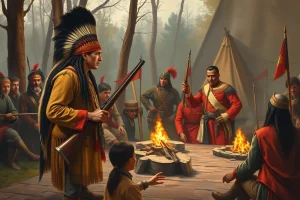
The War of 1812 arose from imperial tensions and enduring American designs on British-held territory. After the American Revolution, British colonial officials maintained alliances with Indigenous nations, who were acutely aware of American expansionist ambitions. The 1794 Jay Treaty and the 1795 Treaty of Greenville failed to settle Indigenous land claims, and by the early 1800s, Tecumseh and his brother Tenskwatawa sought to create a pan-Indigenous confederacy to resist American encroachment. Britain, facing France in Europe, saw these alliances as a means to safeguard its North American colonies without committing large regular forces. In Upper Canada (now Ontario), the Indian Department formalized ties with Indigenous communities, supplying gifts, weapons, and military cooperation. When war erupted in June 1812, Britain’s Indigenous allies were thus not mercenaries but partners in a mutual struggle against American expansion.
What Happened
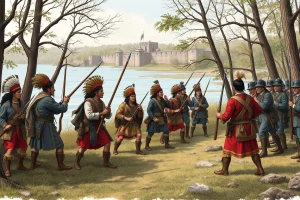
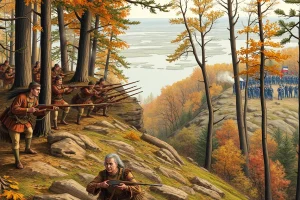
Indigenous allies joined British forces in nearly every major campaign of the war. At the Siege of Detroit in August 1812, Tecumseh’s warriors helped compel the American surrender by appearing in strength and threatening the enemy’s supply lines. At the Battle of Queenston Heights in October 1812, Mohawk and other warriors under John Norton fought alongside British regulars and Canadian militia, outflanking American positions even after General Isaac Brock’s death. On June 24, 1813, the Battle of Beaver Dams saw a combined force of British regulars and Indigenous warriors ambush an entire American column, largely through prior intelligence and the effective use of terrain. Through the campaigns on the Niagara Peninsula, the Detroit frontier, and the St. Lawrence River, Indigenous fighters conducted reconnaissance, harassed American logistics, and fought in forested conditions where their skills proved unmatched. They also participated in engagements such as the Battle of Chateauguay (October 1813) and the Battle of Crysler’s Farm (November 1813), where their skirmishing helped check American advances. Throughout the war, Indigenous warriors operated as autonomous units under their own leaders, though they coordinated with British commanders and the Indian Department.
Why It Matters
Indigenous contributions were essential to the defense of Canada. Historians widely agree that without their support, British forces, already stretched by European commitments, would have struggled to repel American invasions. The alliances, however, were fragile and based on divergent expectations. For Indigenous peoples, the war was a last attempt to protect their homelands from American encroachment; for Britain, it was a peripheral conflict. The Treaty of Ghent in 1814 included provisions to restore Indigenous territories, but these were never enforced, and Britain soon abandoned its allies. The war’s outcome accelerated American settlement and the eventual loss of Indigenous lands. The legacy of unfulfilled promises and displacement contributed to later conflicts and the systemic marginalization of Indigenous peoples in both Canada and the United States.
Definition
Indigenous contributions to the defense of Canada in the War of 1812 refer to the military and strategic assistance provided by First Nations, Métis, and other Indigenous peoples who allied with the British against American forces. This included combat service, intelligence gathering, logistical support, and the application of traditional knowledge of terrain and weather.
Background
These contributions were rooted in centuries of trade and diplomatic alliances. Since the early 17th century, Indigenous nations formed relationships with European powers, first France and later Britain, based on mutual defense and economic exchange. The Royal Proclamation of 1763 recognized Indigenous land rights and laid a foundation for treaty-making. During the American Revolution, many Indigenous nations sided with the British to resist American expansion. The post-revolutionary period saw increased pressure on Indigenous lands, culminating in the pan-Indigenous resistance led by Tecumseh and the outbreak of war in 1812.
How It Worked
British officials in the Indian Department cultivated alliances through diplomacy, gifts, and the presence of officers who respected Indigenous protocols. Indigenous warriors fought under their own leaders but integrated into British campaign plans. They excelled in skirmishing, ambushes, and reconnaissance, while European troops provided organized line infantry and artillery. The combination proved potent, as Indigenous knowledge of the forest and swift movement allowed for surprise attacks and effective harassment of enemy columns. Their presence also had a psychological impact, often causing American soldiers to surrender or become overly cautious.
Competing Viewpoints
Historians interpret Indigenous participation in several ways. Some argue that Indigenous peoples were primarily allies fighting for their own survival, not mere auxiliaries of the British. Others emphasize the coercive and manipulative aspects of British-Indigenous relations, noting that Britain sought to use them as proxies. American narratives historically portrayed Indigenous warriors as barbaric and stressed their alleged atrocities, while British and Canadian accounts often romanticized their loyalty. Modern scholarship highlights the complexity of these relationships, acknowledging both the agency of Indigenous peoples and the unequal power dynamics.
Role in the War of 1812
Indigenous allies were indispensable in securing early British victories. At Detroit, Tecumseh’s forces convinced the American commander to surrender without a fight. At Queenston Heights, Mohawk warriors fought off American reinforcements and helped turn the tide. The ambush at Beaver Dams demonstrated the value of Indigenous intelligence and mobility. In the Niagara and St. Lawrence campaigns, Indigenous warriors screened British movements, collected intelligence, and attacked American supplies. Their knowledge of the landscape and ability to fight in wooded terrain repeatedly neutralized American numerical advantages. While the precise number of Indigenous participants is uncertain, estimates range from several hundred to over 4,000 at various times, with the majority hailing from communities in the Great Lakes and Upper Canada.
Consequences and Historical Interpretation
The Treaty of Ghent included Article IX, which promised to restore lands held by Indigenous nations at the war’s start. However, the United States did not implement this, and Britain, seeking economic and political harmony with the United States, failed to press the issue. Many Indigenous communities lost their territories in the decades that followed, particularly those south of the Great Lakes. In Canada, the narrative of Indigenous contribution became part of the war’s mythology, but it was often overshadowed by British and Canadian military stories. Later historical analysis, particularly from the late 20th century onward, has sought to restore Indigenous agency, emphasizing that their participation was a deliberate strategy to protect their homelands. The war also strengthened the British Crown’s moral if not legal claim to its Indigenous allies, but the practical abandonment after the war left a lasting legacy of distrust. Indigenous contributions are now recognized as central to the outcome of the War of 1812, though the cost to Indigenous nations was disproportionate and enduring.
Primary Sources
Primary sources from the War of 1812 are overwhelmingly authored by European or American participants, limiting direct Indigenous voices. Key documents include:
- Correspondence and speeches of Major-General Isaac Brock, which frequently reference expectations of Indigenous support and demonstrate British reliance on their allies.
- The journal of John Norton, a Mohawk leader and British officer, offering a rare Indigenous perspective on the campaigns, although it was written for a European audience.
- British Indian Department records, including lists of allied nations and distributions of supplies, documenting the scale and organization of Indigenous participation.
- American official reports and memoirs, such as those of General William Hull and other officers, which often expressed alarm at the effectiveness of Indigenous warriors.
- Treaty of Ghent (1814), specifically Article IX, which acknowledged Indigenous territorial rights but lacked enforcement mechanisms.
These sources often contain biases and omit Indigenous agency. For instance, Brock’s letters sometimes frame Indigenous warriors as instruments of his strategy, while American accounts may exaggerate or demonize them. Nevertheless, read critically, they provide essential evidence of the contributions and the complex nature of the alliances.
Further Reading
- A Commemorative History of Aboriginal People in the Canadian Military, by P. Whitney Lackenbauer with John Moses, R. Scott Sheffield, and Maxime Gohier (Department of National Defence, 2009).
- “His Majesty’s Aboriginal Allies: The Contribution of the Indigenous Peoples of North America to the Defence of Canada during the War of 1812,” by Donald E. Graves, in Aboriginal Peoples and the Canadian Military: Historical Perspectives, edited by P. Whitney Lackenbauer and Craig Leslie Mantle (Canadian Defence Academy Press, 2007).
- The War of 1812: A Forgotten Conflict, by Donald R. Hickey (University of Illinois Press, 1989).
- Tecumseh and Brock: The War of 1812, by James Laxer (House of Anansi Press, 2012).
References
- Lackenbauer, P. Whitney, et al. A Commemorative History of Aboriginal People in the Canadian Military. Department of National Defence, 2009. https://publications.gc.ca/collections/collection_2010/forces/D2-250-2-2009-eng.pdf
- Graves, Donald E. “His Majesty’s Aboriginal Allies: The Contribution of the Indigenous Peoples of North America to the Defence of Canada during the War of 1812.” In Aboriginal Peoples and the Canadian Military: Historical Perspectives, edited by P. Whitney Lackenbauer and Craig Leslie Mantle. Canadian Defence Academy Press, 2007.
- Indigenous Veterans. Veterans Affairs Canada. https://www.veterans.gc.ca/en/remembrance/people-and-stories/indigenous-veterans
- “Conclusion.” Aboriginal People in the Canadian Military. Government of Canada. https://www.canada.ca/en/department-national-defence/services/military-history/history-heritage/popular-books/aboriginal-people-canadian-military/conclusion.html
- Hickey, Donald R. The War of 1812: A Forgotten Conflict. University of Illinois Press, 1989.
- Laxer, James. Tecumseh and Brock: The War of 1812. House of Anansi Press, 2012.
FAQ
What roles did Indigenous peoples play in the War of 1812?
Indigenous warriors served as scouts, skirmishers, and frontline combatants, providing crucial knowledge of terrain and effective harassment of American forces. They also participated in major battles like Detroit and Beaver Dams.
Why did Indigenous peoples ally with the British?
Many Indigenous nations saw Britain as a counterweight to American westward expansion. Shared military interests and existing trade and diplomatic ties led to alliances, though these were often based on mutual need rather than shared values.
What was the outcome for Indigenous peoples after the war?
The Treaty of Ghent promised to restore Indigenous lands, but the United States refused to implement it, and Britain abandoned its allies. This led to widespread land loss and the displacement of many communities.



Leave a Reply