
Short Answer
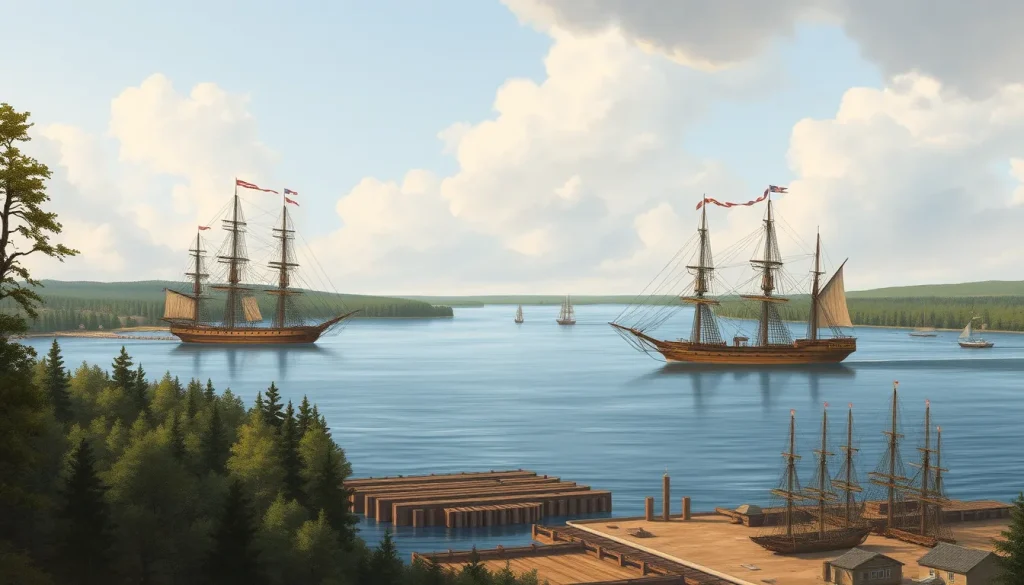
The Lake Ontario Naval Campaign (1812–1814) was a sustained naval and shipbuilding competition between the United States and Great Britain for control of Lake Ontario during the War of 1812. Centered on the rival naval bases at Sackets Harbor, New York, and Kingston, Upper Canada, the campaign involved repeated amphibious operations, small naval skirmishes, and a dramatic construction race that culminated in the launch of the 112-gun HMS St. Lawrence. Despite the massive investment, no decisive fleet action occurred, and the campaign ended in a strategic stalemate that shaped the larger land war in Upper Canada.
Historical Context
The Great Lakes formed the essential military highway of the northwestern frontier. With few roads and dense wilderness, armies and supplies moved largely by water. Lake Ontario was the most strategically important of the lakes because it linked the St. Lawrence River to the upper lakes and the Niagara frontier. Whoever controlled Lake Ontario could support or sever the British supply lines from Kingston to the western posts and could threaten Montreal or York. At the outbreak of war, the British had a small naval force known as the Provincial Marine, based at Kingston, while the Americans had only a few armed vessels at Sackets Harbor. Both sides recognized that naval supremacy on the lake was a prerequisite for offensive operations.
What Happened
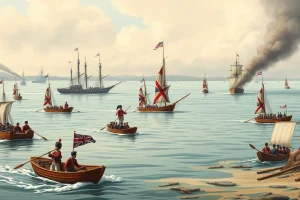
The campaign unfolded in three phases. In 1812, both sides scrambled to build up their squadrons. American Commodore Isaac Chauncey took command on Lake Ontario and established a powerful force at Sackets Harbor, while British Commodore Sir James Lucas Yeo arrived at Kingston in 1813. The first serious operations came in April 1813 with the American raid on York, followed by the capture of Fort George in May. In response, the British attacked Sackets Harbor but were repulsed. Through the summer and fall of 1813, Chauncey and Yeo maneuvered for advantage but avoided a decisive fleet engagement. In 1814, the arms race escalated: the Americans launched the USS Superior and USS Mohawk, but Yeo countered with the HMS St. Lawrence, the largest warship ever built on the lakes. After its launch in September 1814, the British gained temporary superiority, but the war ended before any major action.
Why It Matters
The naval campaign on Lake Ontario proved critical because it prevented either side from achieving the clear control needed to support a decisive invasion. The American failure to capture Kingston in 1813 has been criticized by historians as a lost opportunity that could have ended the war in Upper Canada. Conversely, British naval caution preserved their essential supply line but also prevented the Royal Navy from disrupting American operations on the lake. The expensive shipbuilding race drained resources that might have been used elsewhere, and the stalemate allowed the war on the Niagara frontier to continue without an American advantage. Later, the Rush–Bagot Agreement of 1818 demilitarized the lakes, making the campaign a final episode in large-scale naval warfare on Lake Ontario.
Prelude
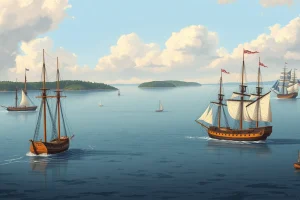
At the start of the war, the British Royal Navy dominated the Atlantic, but on the Great Lakes the Americans had a more even chance. The Provincial Marine, staffed by naval officers on temporary duty, was primarily a transport force, while the Americans had a nascent squadron at Sackets Harbor. Both sides began constructing additional vessels with feverish urgency, using abundant local timber and shipping guns and rigging overland. By 1813, Chauncey had built the corvette USS Madison and the brig USS Oneida, while Yeo commanded the ship-rigged Royal George, the brigs Wolfe and Moira, and several armed transports.
Forces and Commanders
American: Commodore Isaac Chauncey, commander of the U.S. Navy on Lake Ontario, based at Sackets Harbor. His squadron grew to include the ship-rigged USS Pike (28 guns), USS Superior, USS Mohawk, and numerous gunboats. Chauncey was experienced but cautious, favoring combined operations with the army and seeking to avoid risk.
British: Commodore Sir James Lucas Yeo, a Royal Navy officer who took command in May 1813. His force at Kingston included the Royal George (22 guns), Wolfe (20), Moira (18), Sidney Smith (14), and later the 112-gun first-rate HMS St. Lawrence. Yeo, like Chauncey, was prudent and understood the consequences of losing his fleet.
Battlefield and Map Context
Lake Ontario, roughly 190 miles long, was the central arena. Key locations included Sackets Harbor on the eastern shore, the British naval dockyard at Kingston at the head of the St. Lawrence, the town of York (Toronto) on the north shore, and Fort George and Fort Niagara at the mouth of the Niagara River. Control of these harbors allowed the projection of naval power along the lake and into the land frontier.
Battle Chronology
1812: Early skirmishes occurred as American vessels captured the British schooner Royal George in a raid near the Niagara River and burned the Prince Regent at Fort Erie. Both sides focused on construction.
April 1813: Chauncey’s fleet transported General Henry Dearborn’s army to York; the town was captured and burned after a magazine explosion.
May 1813: The Americans crossed Lake Ontario to attack Fort George, forcing British evacuation; the British then attacked Sackets Harbor but were repelled by American General Jacob Brown’s defenders.
September 1813: Two indecisive encounters off York and at the Burlington Races, where Yeo and Chauncey broke off action.
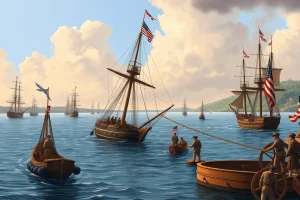
1814: Shipbuilding accelerated. Chauncey launched the Superior and Mohawk; Yeo launched the St. Lawrence on September 10, 1814, giving the British local supremacy. No major engagement followed before the war ended in early 1815.
Casualties and Losses
Naval combat on Lake Ontario resulted in remarkably few casualties because of the avoidance of close battle. The most significant losses occurred during land-based raids and the York explosion, which killed American soldiers and caused British naval stores to be destroyed. Ship losses included the American schooner Hamilton and Scourge sinking in a squall in August 1813, but these were not from enemy action. Overall, the campaign’s human toll was modest compared to the enormous expenditure of timber, ordnance, and labor.
Result
The campaign ended as a strategic stalemate. Neither Chauncey nor Yeo ever defeated the other in a decisive engagement. The British gained a brief superiority with the St. Lawrence in late 1814, but they did not exploit it. The peace treaty returned to pre-war boundaries, leaving the naval balance unresolved. Historians often label the campaign a failure of aggressive leadership, resulting in an expensive arms race that distracted both sides from more decisive theaters.
Strategic Consequences
The failure to achieve naval dominance on Lake Ontario prevented a successful American invasion of Upper Canada via the lake and left the British supply line intact. The American defeat at Crysler’s Farm in November 1813 was partly attributable to the need to move troops away from Lake Ontario to the St. Lawrence, weakening the pressure on Montreal. In contrast, the British ability to keep Kingston secure allowed them to maintain a foothold on the Niagara Peninsula. The campaign also set a precedent for joint land-naval operations, as seen at York and Fort George, which had mixed results.
Primary Accounts
Contemporary correspondence and official reports provide insight. Commodore Chauncey’s letters to Secretary of the Navy William Jones detail his strategic thinking and frustrations. Yeo’s dispatches to the Admiralty reflect his cautious approach. The memoirs of American naval surgeon James Inderwick describe daily life and the York raid. A crucial limitation is that both commanders presented their own caution as wise, while critics later accused them of timidity. The most comprehensive primary source collection is the documentary series “The Naval War of 1812” edited by William S. Dudley.
Battlefield Today
Several sites preserve the memory of the campaign. Sackets Harbor Battlefield State Historic Site in New York features restored military buildings and a visitor center. The Royal Military College in Kingston, Ontario, stands near the former dockyard; remnants of the St. Lawrence lie in the water. Fort George National Historic Site and York (Toronto) have interpretive exhibits. The United States Naval Academy and the Canadian War Museum hold artifacts and models.
Primary Sources
The most relevant primary sources include the official correspondence of Isaac Chauncey and Sir James Lucas Yeo, housed in the National Archives (Washington, D.C.) and the National Archives of Canada. The published documentary edition The Naval War of 1812: A Documentary History (edited by William S. Dudley) reproduces key orders and reports. For the British perspective, the letters of Yeo appear in the Admiralty papers (ADM 1) at The National Archives (Kew). The journal of American naval officer Joseph T. F. V. Montgomery, held by the William L. Clements Library, offers a personal view. Users must be cautious about the biases in these sources: commanders wrote to justify their actions, and casualty figures in them are often incomplete.
Further Reading
- Robert Malcomson, Lords of the Lake: The Naval War on Lake Ontario, 1812–1814 (Toronto: R. Brass Studio, 1998) — the most detailed modern account.
- William S. Dudley, ed., The Naval War of 1812: A Documentary History, vol. 2 (Washington, D.C.: Naval Historical Center, 1992).
- Charles E. Brodine Jr., “The War’s Most Challenging Theater,” Naval History, October 2013.
- The Canadian Encyclopedia, “War on the Lakes in the War of 1812,” by Barry M. Gough.
- American Battlefield Trust, “The Great Lakes in the War of 1812,” (2024).
References
- Barry M. Gough, “War on the Lakes in the War of 1812,” The Canadian Encyclopedia, accessed 2025, https://thecanadianencyclopedia.ca/en/article/war-on-the-lakes-in-the-war-of-1812.
- Charles E. Brodine Jr., “The War’s Most Challenging Theater,” Naval History Magazine 27, no. 5 (October 2013), accessed via USNI, https://www.usni.org/magazines/naval-history-magazine/2013/september/wars-most-challenging-theater.
- “The Great Lakes in the War of 1812,” American Battlefield Trust, updated September 5, 2024, https://staging.battlefields.org/learn/articles/great-lakes-war-1812.
- Robert Malcomson, Lords of the Lake: The Naval War on Lake Ontario, 1812–1814 (Toronto: R. Brass Studio, 1998), via Internet Archive.
- “The Lake Ontario Arms Race,” War of 1812 website, accessed 2025, https://thewarof1812.org/battles/the-lake-ontario-arms-race/.
FAQ
Why was control of Lake Ontario so important in the War of 1812?
Lake Ontario served as the principal water highway connecting the St. Lawrence River to the upper Great Lakes. Control of the lake allowed a force to supply armies, invade enemy territory, and cut off supplies to the opposite side. Both the United States and Britain recognized that command of Lake Ontario was essential for any sustained campaign in Upper Canada.
Who were the main commanders in the Lake Ontario naval campaign?
The American commander was Commodore Isaac Chauncey, who established and led the U.S. squadron from Sackets Harbor. The British commander was Commodore Sir James Lucas Yeo, who took charge at Kingston in 1813. Both were experienced naval officers known for their strategic caution.
Why was there no decisive naval battle on Lake Ontario?
Both Chauncey and Yeo avoided risking their fleets in a decisive engagement because the loss of a fleet would have been catastrophic for their side's position in Upper Canada. They preferred to maintain naval superiority through a shipbuilding arms race, resulting in a stalemate that lasted until the end of the war.
Leave a Reply