
Short Answer
The American campaign against Montreal in 1775–1776, part of the Continental Army’s invasion of Canada, sought to bring the Province of Quebec into the American revolutionary cause. Despite capturing Montreal in November 1775, the failure to take Quebec City and the subsequent retreat in 1776 marked a strategic disaster, rooted in logistical, financial, medical, and political factors. This article examines why this campaign failed and its consequences for the American Revolution.
Historical Context
After the battles of Lexington and Concord in April 1775, the Second Continental Congress faced the reality of armed conflict with Britain. One early strategic objective was the province of Quebec, which controlled the St. Lawrence River and served as a potential British staging ground for attacks on the northern colonies. Many American leaders, including Benjamin Franklin, believed French Canadians would welcome liberation from British rule and join the revolution. The Quebec Act of 1774, which granted religious freedom to Catholics and extended Quebec’s boundaries, had alarmed Anglo-American Protestants, who saw it as a threat to their interests and a potential tool of British military power.
The British garrison in Canada was small—roughly 700 regulars under Governor Sir Guy Carleton—supplemented by Canadian militia and Indigenous allies. American strategists hoped that a swift invasion would either capture Canada or encourage its inhabitants to rise against Britain. Congress authorized an invasion in June 1775, with forces moving along the Lake Champlain–Richelieu River corridor toward Montreal, while a second column under Benedict Arnold would strike directly at Quebec City through the Maine wilderness.
What Happened
The invasion began in August 1775. General Richard Montgomery, commanding about 1,200 men from Fort Ticonderoga, moved steadily northward, capturing Fort Saint-Jean after a month-long siege in November. Montgomery then advanced on Montreal. Governor Carleton, judging Montreal indefensible, fled to Quebec City, and Montreal surrendered without resistance on November 13, 1775. The city, however, proved difficult to hold: the Continental Army had no hard currency, enlistments were expiring, and many inhabitants remained neutral or pro-British.
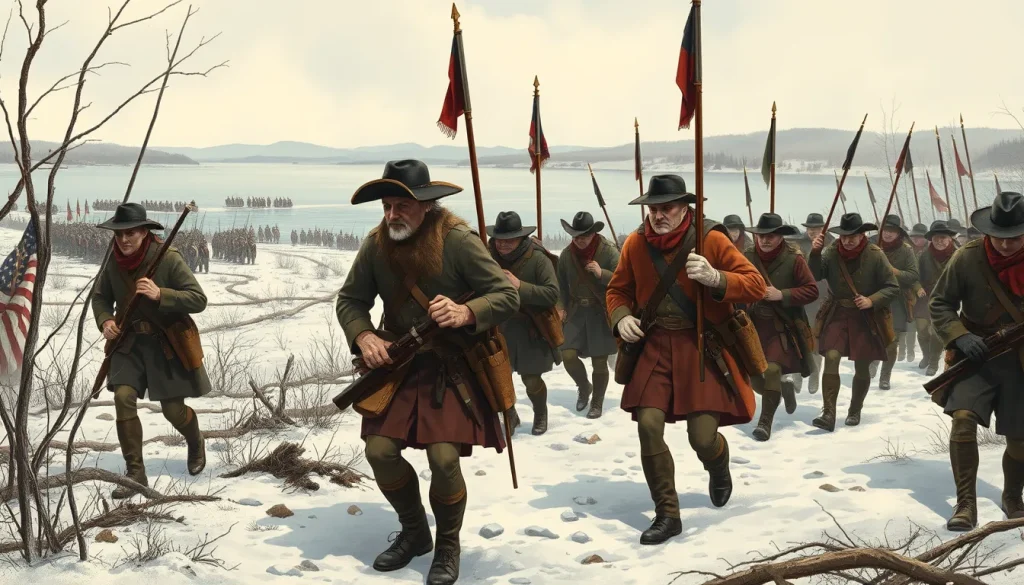
Meanwhile, Benedict Arnold led about 1,100 men on a grueling march through the Maine wilderness. After a brutal two-month trek, only about 600 soldiers reached Quebec City, exhausted and ill. Montgomery joined him on December 2, and the combined force of about 1,200 men laid siege to Quebec. Lacking heavy artillery, the Americans attempted a desperate assault on December 31, 1775, during a snowstorm. The attack was repulsed; Montgomery was killed, Arnold was wounded, and over 400 Americans were captured. The survivors, now under Arnold’s command, maintained a siege through the winter but suffered terribly from smallpox, which began spreading in December.
The arrival of British reinforcements under General John Burgoyne in May 1776 turned the situation. American forces under Major General John Thomas, who had replaced Montgomery, were too small and diseased to resist. In early May, Thomas ordered a retreat toward Lake Champlain. The British pursued, and on June 8, a rear-guard action at Trois-Rivières ended in another American defeat. By mid-June, the last Continental troops had left Canadian soil, returning to Fort Ticonderoga.
Why It Matters
The failure of the Montreal campaign had immediate and long-term consequences. It dashed hopes of bringing Canada into the American union, left the northern frontier exposed to British counterattacks, and severely sapped American confidence. The defeat at Quebec was a major blow to revolutionary morale and contributed to the growing realization that the war would be long and costly. Indeed, scholars such as Amy Noel Ellison have argued that the defeat at Quebec, even more than Thomas Paine’s Common Sense, pushed the Continental Congress toward a declaration of independence by demonstrating the futility of seeking reconciliation with Britain.
The campaign also exposed chronic weaknesses in the Continental Army: short enlistments, lack of hard money, and medical unpreparedness. These issues would plague the army for years. Moreover, the campaign revealed the strength of British–Indigenous alliances and the reluctance of most French Canadians to support the rebellion, contrary to American expectations.
Definition
This article analyzes the reasons behind the failure of the American campaign against Montreal in 1775–1776. The campaign encompassed the entire invasion of Canada, including the capture of Montreal and the failed assault on Quebec City. The question “why did it fail?” invites examination of military, financial, medical, and diplomatic factors that collectively led to the American retreat.
Background
In 1775, the American colonies were newly at war with Britain. The decision to invade Canada was driven by defensive concerns—preventing a British invasion from the north—and by revolutionary idealism that sought to expand the rebellion. Congress ordered two expeditions: one up Lake Champlain and down the Richelieu River toward Montreal, and a second through Maine to Quebec City. The initial successes, including the capture of Fort Ticonderoga and Saint-Jean, gave hope, but the campaign quickly encountered structural problems.
How It Worked
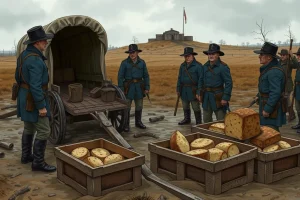
Military logic dictated that a quick, decisive blow would force Canada’s surrender. Montgomery’s capture of Montreal seemed to fulfill that promise. Yet the army’s effectiveness was undermined from the start. Enlistments for many soldiers expired at the end of 1775, forcing Montgomery to launch the Quebec assault before he was ready. The Continental currency was worthless in Canada, so the army could not purchase supplies; it resorted to requisitions, alienating locals. Most critically, smallpox devastated the troops, reducing the army’s effective strength to a fraction of its nominal size.
Competing Viewpoints
In July 1776, a Continental Congress committee reported three “great causes” for the Canadian disaster: short enlistments, want of hard money, and smallpox. While these were undoubtedly factors, historians have expanded the list. Mark R. Anderson, writing in the Journal of the American Revolution, identifies at least ten causes, including Canadian elite loyalty, Indigenous alliances, and poor intelligence. Some contemporaries, such as John Adams, blamed smallpox almost exclusively, while others pointed to the lack of support from Congress. Later historians have emphasized the difficulty of invading a vast, sparsely populated territory and the underestimation of British–Canadian resistance. The competing viewpoints reflect differing assumptions about how accountable leadership should be held for military failures.
Role in the American Revolution
The failed Montreal campaign shaped the course of the American Revolution. It prevented the creation of a fourteenth colony, but more importantly, it hardened British resolve and encouraged loyalist sentiment in Canada. The defeat at Quebec also influenced the decision to declare independence: the realization that reconciliation was impossible because the British had demonstrated their military superiority in Canada. The retreat also led to a reordering of the Continental Army, with reforms in enlistment and medical practices, though these changes came slowly.
Consequences and Historical Interpretation
The immediate consequences were the loss of American soldiers, supplies, and prestige. In the longer term, the failure contributed to the British decision to launch a major campaign from Canada in 1777, which ended at Saratoga. Historians now view the campaign as a turning point that exposed the limitations of the Continental Army and the importance of logistics, finance, and disease in eighteenth-century warfare. The official congressional explanation of “short enlistments, hard money, and smallpox” remains the classic summary, but contemporary scholarship recognizes a more complex interplay of factors, including the political loyalty of French Canadians and the effective use of Indigenous allies by the British.
Primary Sources
Primary accounts include the letters and reports of Richard Montgomery, Benedict Arnold, and George Washington, many of which are collected in the Papers of George Washington. The Continental Congress’s report “Ten Causes of the Miscarriages in Canada” (1776) offers an official explanation. Also valuable are the memoirs of soldiers such as Abner Stocking and the testimony of Montreal merchant James Price, who served as a quartermaster for the Americans. These sources provide firsthand details of the campaign, but each has biases—military officers often justified their actions, while congressional reports aimed to assign blame. Letters from diplomats such as Benjamin Franklin’s commission also illuminate financial and political problems.
Further Reading
- Anderson, Mark R. “Ten Causes of the Miscarriages in Canada: Why the 1775–1776 Invasion Failed.” Journal of the American Revolution, May 2, 2024.
- Ellison, Amy Noel. “Montgomery’s Misfortune: The American Defeat at Quebec and the March toward Independence, 1775–1776.” Early American Studies, 2017.
- de Bruin, Tabitha. “The Invasion of Canada during the American Revolution.” The Canadian Encyclopedia, 2026.
- “Quebec Campaign.” George Washington’s Mount Vernon.
- “The Canadian Campaign: The Siege of Quebec, December 1775–May 1776.” National Museum of the United States Army.
References
- “Quebec Campaign.” George Washington’s Mount Vernon. https://www.mountvernon.org/library/digitalhistory/digital-encyclopedia/article/quebec-campaign
- “The Canadian Campaign: The Siege of Quebec, December 1775-May 1776.” National Museum of the United States Army. https://www.thenmusa.org/army-trail/founding-the-nation/the-canadian-campaign-the-siege-of-quebec-december-1775-may-1776/
- Anderson, Mark R. “Ten Causes of the Miscarriages in Canada: Why the 1775–1776 Invasion Failed.” Journal of the American Revolution, May 2, 2024. https://allthingsliberty.com/2024/05/ten-causes-of-the-miscarriages-in-canada-why-the-1775-1776-invasion-failed/
- de Bruin, Tabitha. “The Invasion of Canada during the American Revolution.” The Canadian Encyclopedia, 2026. https://thecanadianencyclopedia.ca/en/article/invasion-of-canada-american-revolution
- Ellison, Amy Noel. “Montgomery’s Misfortune: The American Defeat at Quebec and the March toward Independence, 1775–1776.” Early American Studies, 2017. DOI: 10.1353/eam.2017.0021
FAQ
What were the primary reasons the American campaign against Montreal failed?
Short enlistments, lack of hard money, smallpox, and logistical failures combined to doom the campaign.
How did smallpox affect the American forces?
Smallpox swept through the siege camp, at one point disabling one-quarter of Arnold's army, and spread to reinforcements, severely reducing combat effectiveness.
Why did the Continental Congress's official explanation differ from later historical analysis?
Congress focused on three non-controversial causes (enlistments, money, smallpox) to avoid political blame, while historians have identified additional factors such as Canadian loyalty and British-Indigenous partnerships.

Leave a Reply