
Short Answer
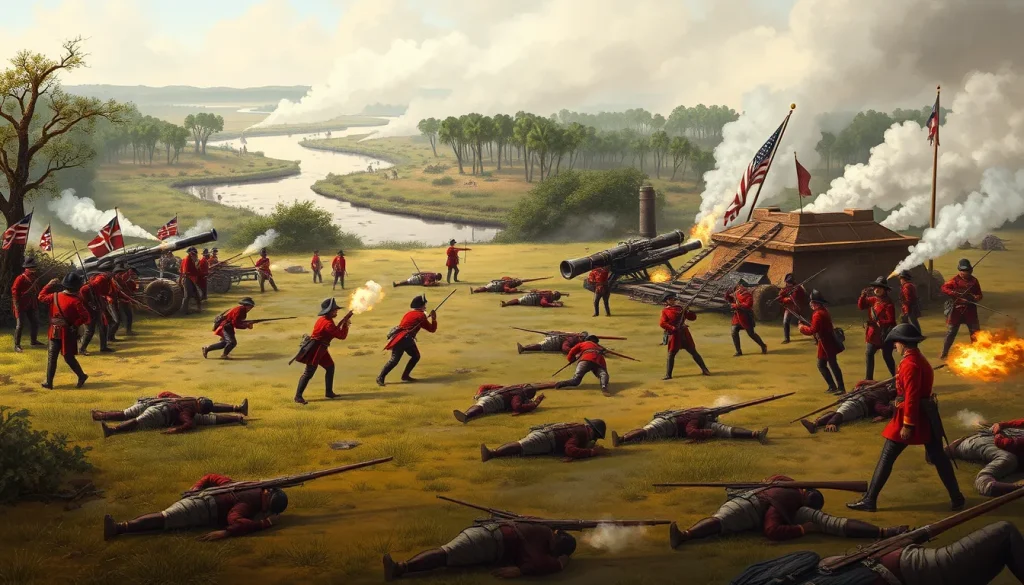
The Battle of New Orleans, fought on January 8, 1815, produced the most lopsided casualty figures of any major engagement of the War of 1812. In less than half an hour, the British army suffered over 2,000 killed, wounded, and captured, while American losses totaled only 71. The battle occurred after the Treaty of Ghent had been signed but before news reached the combatants, and its casualty toll became a defining element of American victory.
Historical Context
The War of 1812 had been raging for over two years when British forces launched a campaign to capture New Orleans, a vital port at the mouth of the Mississippi River. After the defeat of Napoleon in Europe, Britain could devote more resources to the American theater. The British aimed to control the Mississippi and potentially detach the western territories. In late 1814, a large expeditionary force sailed from Jamaica to the Gulf Coast. Major General Andrew Jackson, commanding the U.S. Seventh Military District, had recently defeated the Creek Indians and now faced a new threat. Jackson arrived in New Orleans on December 1, 1814, and hurriedly assembled a mixed force of regulars, militia, volunteers, and even privateers. The British landed below the city in December and advanced toward it. The peace treaty had been signed in Ghent on December 24, but neither side knew it.
What Happened
After a series of skirmishes, the British army under Major General Sir Edward Pakenham launched a frontal assault on January 8 against Jackson’s fortified line along the Rodriguez Canal. The attack was poorly coordinated; the 44th Foot failed to bring the fascines and ladders needed to cross the canal and scale the earthworks. As the British columns advanced across open ground, they were met by devastating artillery and musketry fire. Within minutes, Pakenham was killed and both his divisional commanders were wounded. The British retreated, leaving the field in American hands. While a secondary attack on the west bank of the Mississippi succeeded, it came too late to affect the outcome.
Why It Matters
The casualty disparity at New Orleans had profound psychological and political consequences. The British losses, more than any other battle in the war, humiliated a professional army and elevated Jackson to national hero status. The victory, coming just after the Treaty of Ghent, gave Americans a sense of triumphant vindication, even though the treaty restored the status quo ante bellum. Historians debate whether the battle had any strategic significance, but its impact on American identity was immense. The casualties became a symbol of American resilience and a foreshadowing of Jackson’s presidency.
Prelude
The British Gulf Coast expedition assembled at Jamaica and departed in December 1814, with roughly 10,000 troops under the overall command of Vice Admiral Sir Alexander Cochrane. The army force, initially led by Major General John Keane, landed at Lake Borgne and moved toward New Orleans via bayous. Jackson, having arrived on December 1, placed his forces along the Rodriguez Canal after a night attack on December 23 checked the British advance. By Christmas Day, Major General Sir Edward Pakenham arrived and took command. Over the following days, the British attempted to break Jackson’s line but were repulsed, leading to the full-scale assault on January 8.
Forces and Commanders
The British force on the east bank for the main assault numbered about 5,300 men, part of an overall army of approximately 8,000. Key commanders included Pakenham, Major General Samuel Gibbs, Major General John Keane, and Colonel William Thornton, who led the west bank attack. The American defenders comprised roughly 4,500 men on both banks, commanded by Jackson. His line included Tennessee and Kentucky militia, U.S. regulars, Louisiana militia, free men of color, and Baratarian privateers under Jean Lafitte. On the west bank, Brigadier General David Morgan commanded a smaller force.
Battlefield and Map Context
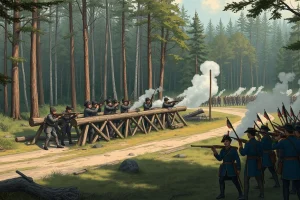
The main battlefield lay on the east bank of the Mississippi River, about five miles south of New Orleans. Jackson’s defensive line stretched from the river on the right to an impassable cypress swamp on the left, anchored by the dry Rodriguez Canal. This natural and man-made obstacle created a narrow approach for any attacker. The ground in front was open, offering little cover. The west bank, where a battery was established, was also fortified but less strongly. The geographic chokepoint funneled the British into a killing field, directly influencing the casualty figures.
Battle Chronology
At dawn on January 8, 1815, the British assault began. The east bank columns, under Gibbs and Keane, advanced toward the American line. However, the 44th Foot, responsible for carrying fascines and ladders, left them behind. As the British infantry crossed the open field, American artillery opened fire with round shot and canister, followed by devastating musketry. The 93rd Sutherland Highlanders suffered particularly heavy losses. Pakenham was killed by grapeshot; Gibbs was mortally wounded; Keane was wounded. In less than thirty minutes, the attack collapsed. On the west bank, Thornton’s force crossed the river late and succeeded in capturing the American battery, but was recalled after the east bank failure. The battle ended by mid-morning.
Casualties and Losses
The disparity in casualties on January 8 is one of the most striking in military history. According to official returns and accepted historical accounts, the British suffered 291 killed, 1,262 wounded, and 484 captured or missing, a total of 2,037 losses out of roughly 5,300 engaged in the main attack—a casualty rate of about 38%. American losses were 13 killed, 39 wounded, and 19 missing, totaling 71. The west bank action added further losses: American casualties there were about 49, while the British reported 83. Senior British officers were disproportionately hit: Pakenham and Gibbs were killed, and Keane was wounded, while no American officer of similar rank was lost. The British losses included many veterans of the Peninsular War, making the defeat even more shocking. The wounded faced difficult conditions, and many died later. The captured and missing included men taken during the chaotic retreat. These numbers are corroborated by U.S. Army Center of Military History and the American Battlefield Trust, with minor variations in reporting (e.g., some sources list 48 prisoners instead of 484 captured/missing, though the larger figure reflects the total missing and captured including stragglers). The exact count of wounded was debated even at the time, but the overall disparity is undisputed.
Result
The Battle of New Orleans was a decisive American victory. The British assault was repulsed with catastrophic losses, and the army withdrew, reembarking for Mobile on January 27. The Americans retained control of New Orleans and the lower Mississippi Valley. The victory did not affect the peace treaty, which had already been signed, but it solidified Jackson’s reputation and gave the United States a final, triumphant engagement.
Strategic Consequences
Strategically, the battle had no direct impact on the war’s outcome because the Treaty of Ghent had been signed on December 24, 1814, and was ratified by the British and American governments in February 1815. The territorial boundaries returned to the status quo ante bellum. However, the battle influenced subsequent diplomatic and political developments. It strengthened American claims to the Mississippi River region and enhanced the nation’s negotiating position in any future disputes. It also demonstrated the effectiveness of combined American forces, including militia, regulars, and privateers, and played a role in the eventual acquisition of Florida. More importantly, the victory created a sense of national pride and contributed to the “Era of Good Feelings” and the rise of Jacksonian democracy.
Primary Accounts
Several contemporary accounts describe the battle and its casualties. Andrew Jackson’s official report to Secretary of War James Monroe, dated January 9, 1815, gives the American casualty figures and lauds his troops. British officers, including Major General John Lambert (who assumed command after Pakenham’s death), submitted reports detailing the British losses and the reasons for failure. A famous letter from a Kentucky soldier, quoted by the American Battlefield Trust, describes the scene: “When the smoke had cleared and we could obtain a fair view of the field, it looked at first glance like a sea of blood.” French-born artist Jean Hyacinthe de Laclotte, a Louisiana militiaman, sketched the battle from memory, later producing a lithograph that conveys the carnage. These accounts must be read with caution; each carries the perspective of its author and the fog of war.
Battlefield Today
The battlefield at Chalmette Plantation is preserved as Chalmette Battlefield and National Cemetery, part of Jean Lafitte National Historical Park and Preserve, operated by the National Park Service. Visitors can see the grounds where the battle occurred, including the earthworks and monuments commemorating the soldiers. The site offers interpretive programs that explain the battle and its casualties. It is a National Historic Landmark and a key site for understanding the War of 1812’s Gulf Coast campaign.
Primary Sources
The most important primary sources for the casualty figures are the official battle reports. Jackson’s report, dated January 9, 1815, lists American losses at 13 killed, 39 wounded, and 19 missing. The British returns, compiled by Lambert, reported 291 killed, 1,262 wounded, and 484 missing or captured. These reports are housed in the National Archives (United States) and the British National Archives. Additional letters from officers, such as a letter from Major General Keane to his superiors, provide insight into the British perspective. The diary of a British officer, Lieutenant George Gleig of the 85th Foot, offers a narrative of the campaign and the battle. These sources should be evaluated for bias: American accounts often emphasize the disparity to praise Jackson, while British accounts attribute the disaster to tactical errors, particularly the 44th’s failure to bring scaling equipment.
Further Reading
- Remini, Robert V. The Battle of New Orleans. Viking, 1999.
- Hickey, Donald R. The War of 1812: A Forgotten Conflict. University of Illinois Press, 1989.
- Latimer, Jon. 1812: War with America. Harvard University Press, 2007.
- Smith, Gene A. The Slaves’ Gamble: Choosing Sides in the War of 1812. Palgrave Macmillan, 2013.
- National Park Service. Chalmette Battlefield: Historic Resource Study. Available online at NPS.gov.
References
- U.S. Army Center of Military History. “The Battle of New Orleans.” https://history.army.mil/news/2014/140108a_newOrleans.html
- American Battlefield Trust. “New Orleans Battle Facts and Summary.” https://www.battlefields.org/learn/war-1812/battles/new-orleans
- The War of 1812 Website. “Battle of New Orleans.” https://thewarof1812.org/battles/battle-of-new-orleans/
- Royal Marines History. “The Battle of New Orleans.” https://www.royalmarineshistory.com/post/the-battle-of-battle-of-new-orleans-final-battle-of-the-american-war-of-1812
FAQ
Why were British casualties so much higher than American casualties at the Battle of New Orleans?
The British launched a frontal assault against a well-fortified American defensive line, with open ground offering no cover. The failure to bring fascines and ladders to cross the Rodriguez Canal left the attackers exposed to concentrated artillery and musketry fire. American troops were protected behind earthworks, while the British were in the open.
Did the Battle of New Orleans affect the outcome of the War of 1812?
No, because the Treaty of Ghent had already been signed on December 24, 1814, two weeks before the battle. The war officially ended when the treaty was ratified in February 1815, but the battle had no influence on the negotiated terms, which restored pre-war boundaries.
How many soldiers were killed and wounded at the Battle of New Orleans?
The British suffered 291 killed, 1,262 wounded, and 484 captured or missing, totaling 2,037 casualties. The Americans suffered 13 killed, 39 wounded, and 19 missing, totaling 71 casualties. These figures are based on official reports and are accepted by historians.


Leave a Reply