
Short Answer
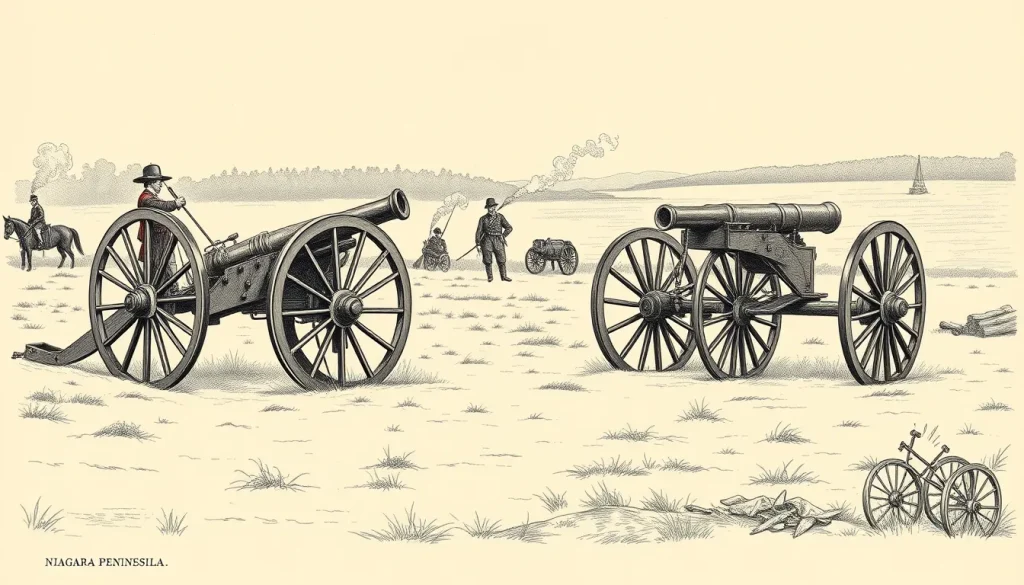
Artillery of the War of 1812 comprised smoothbore field guns, howitzers, mortars, and rockets used by the British Army, the United States Army, and allied forces during the conflict of 1812–1815. This arm, though often overshadowed by infantry and naval actions, proved critical in both siege and open-field engagements, including the battles of Lundy’s Lane, Fort McHenry, and New Orleans. Its equipment, organization, and tactics, evolved from European practice, influenced the course of the war and the later development of American artillery.
Historical Context
In 1812, artillery was an established branch of European armies, with two main types: guns (long-barreled, flat-trajectory pieces) and howitzers (short-barreled, high-trajectory pieces). The British Royal Artillery and the U.S. Army’s artillery companies shared a similar system of calibers (3-pdr., 6-pdr., 9-pdr., 12-pdr., 18-pdr., 24-pdr.), making their ammunition interchangeable. Both nations used ‘brass’ (bronze) or iron castings, with the British favoring bronze for its lighter weight while the Americans, lacking abundant copper and tin, increasingly adopted iron. The French Gribeauval system influenced carriage design and field organization. Although the war saw no major technological breakthroughs from the artillery itself, it featured the introduction of spherical case shot (shrapnel) and Congreve rockets, which added new tactical options.
What Happened
Both sides relied on regular artillery units as well as militia and volunteer gunners. The U.S. Army expanded its artillery from about 30 companies in 1812 to more than 60 by war’s end, with many West Point–trained officers leading these units. The British fielded Royal Artillery batteries in Canada, supported by Canadian militia and Indigenous allies. Artillery saw action in most major campaigns: along the Niagara frontier (Lundy’s Lane, Chippawa), in the defense of Fort McHenry (where rockets and bombs were used), at the Battle of the Thames, at New Orleans, and in numerous smaller skirmishes. In many battles, artillery played a defensive role, breaking infantry assaults, while in offensive actions it prepared the way for attacks and duels with enemy batteries.
Why It Matters
Artillery’s performance in the War of 1812 directly affected the outcome of several engagements and influenced American military reforms. The war demonstrated that trained gunners and well-served pieces could dominate battlefields, as seen at Lundy’s Lane where American artillery exchanged fire until nightfall. Conversely, inexperienced crews and unsuitable equipment limited effectiveness. After the war, the U.S. Army reorganized its artillery, adopting lighter guns and more standardized drill, leading toward the professional branch that would serve in later conflicts. Historians now recognize that the war, despite its small scale, was a testing ground for artillery tactics and technology that would mature in the mid-19th century.
Definition
In the context of the War of 1812, ‘artillery’ refers to crew-served projectile weapons and their ammunition, carriages, and support equipment. Field artillery included guns (cannon) and howitzers, while siege and garrison artillery, including mortars, were also employed, especially at forts. Rocket artillery, using Congreve rockets, appeared as a novel type at the end of the war.
Background
European armies had standardized artillery in the 18th century, with the French Gribeauval system introducing interchangeable parts and horse-drawn field carriages. The British and Americans adopted many of these principles. The U.S. Army established a professional artillery corps in the 1790s, influenced by officers like Louis de Tousard and William Stevens. By 1812, the U.S. had a small regular artillery, complemented by state militias that often lacked training. The British Royal Artillery was highly professional, having gained extensive combat experience in the Napoleonic Wars.
How It Worked
Artillery crews operated by loading the gun muzzle with a powder charge, a projectile (round shot, canister, or spherical case), and a priming charge. A gunner aimed using a quadrant and elevating screw, adjusting the carriage’s traverse. Gun types included the 3-pdr. and 6-pdr. as field guns, while 12-pdr. and 18-pdr. were used as heavy field pieces. Howitzers fired explosive shells on a curved trajectory. Carriages were either the double-bracket or block trail design; the U.S. adopted a modified Gribeauval pattern. Ammunition included solid round shot, canister (a tin cylinder of small balls), and spherical case (exploding shell filled with musket balls). Congreve rockets were fired from troughs or tubes, providing area fire but with poor accuracy.
Competing Viewpoints
Historians debate the effectiveness of artillery in the war. Some argue that, except in a few actions like Lundy’s Lane, artillery had limited impact due to rough terrain, untrained crews, and the decisive role of infantry and naval operations. Others contend that artillery was crucial in defensive positions, such as Fort McHenry, and its psychological effect on troops was significant. Another point of contention is the U.S. decision to use iron instead of bronze, which made pieces heavier but stronger; some historians claim this reduced mobility, while others note that American iron guns served well throughout the war. The introduction of rockets was viewed with skepticism by many commanders, yet they proved dramatic in siege and naval operations.
Role in the War of 1812
Artillery featured in nearly every campaign. At the Battle of Lundy’s Lane (July 25, 1814), American gunners held the heights against British attacks until nightfall. At Fort McHenry (September 1814), British naval bombardment included rockets and bombs; the fort’s own guns returned fire. At the Battle of New Orleans (January 1815), U.S. artillery under Andrew Jackson’s command fired canister into British attacking columns, inflicting heavy casualties. In the Great Lakes, artillery was mounted on ships, and in the Niagara and Detroit theaters, field batteries supported infantry operations. The British used artillery effectively in sieges, such as Fort Erie and Fort Mackinac, while American artillery often performed well when led by trained officers like Winfield Scott.
Consequences and Historical Interpretation
The war’s artillery experience prompted the U.S. Army to improve its guns, drill, and organization. In the 1820s, the adoption of the 6-pdr. as the standard field piece and the formation of a light artillery regiment reflected lessons learned. British artillery also saw minor reforms. Historians like Donald E. Graves have emphasized the professionalism of both armies’ regular artillery units, contrasting them with less effective militia artillery. The war is now seen as a transitional period where smoothbore tactics persisted, but where innovations like shrapnel and rockets foreshadowed future developments.
Primary Sources
Contemporary documentation includes official drill manuals such as the U.S. Compendious Exercise for the Garrison and Field Ordnance (1810) and the British A Handy Pocket Gunner by Adye. Officer memoirs, such as those of Winfield Scott and William Wade, describe artillery operations. Artillery returns and ordnance reports provide data on equipment and supply. Battle reports, including those from Lundy’s Lane and Fort McHenry, document artillery use. However, these sources often focus on their own nation’s forces and may contain bias. The modern works of Donald E. Graves and Janice E. McKenney analyze these primary materials thoroughly.
Further Reading
- Graves, Donald E. “Field Artillery of the War of 1812: Equipment, Organization, Tactics and Effectiveness.” Arms Collecting 30, no. 2 (1992): 39–48.
- McKenney, Janice E. The Organizational History of Field Artillery 1775–2003. Washington, D.C.: Center of Military History, 2007.
- Dastrup, Boyd L. King of Battle: A Branch History of the U.S. Army’s Field Artillery. Fort Monroe, VA: U.S. Army Training and Doctrine Command, 1992.
- Hickey, Donald R. The War of 1812: A Forgotten Conflict. Bicentennial ed. Urbana: University of Illinois Press, 2012.
- American Battlefield Trust. “Artillery Across Three Wars.” Accessed 2024. https://www.battlefields.org/learn/articles/artillery-across-three-wars.
References
- Graves, Donald E. “Field Artillery of the War of 1812: Equipment, Organization, Tactics and Effectiveness.” Arms Collecting 30, no. 2 (1992): 39–48. Reprinted on Napoleon Series. https://www.napoleon-series.org/military-info/Warof1812/2009/Issue12/c_Artillery.html.
- Graves, Donald E. “For want of this precaution so many Men lose their Arms: Official, Semi-Official and Unofficial American Artillery Texts, 1775–1815, Part 10.” The War of 1812 Magazine 15 (May 2011). https://www.napoleon-series.org/military-info/Warof1812/2011/Issue15/c_Artillery10.html.
- McKenney, Janice E. The Organizational History of Field Artillery 1775–2003. Washington, D.C.: Center of Military History, 2007.
- Dastrup, Boyd L. King of Battle: A Branch History of the U.S. Army’s Field Artillery. Fort Monroe, VA: U.S. Army Training and Doctrine Command, 1992.
- American Battlefield Trust. “Artillery Across Three Wars.” Accessed 2024. https://www.battlefields.org/learn/articles/artillery-across-three-wars.
FAQ
What were the main types of artillery used in the War of 1812?
Both sides used field guns (such as the 6-pounder and 12-pounder), howitzers (mainly 5.5-inch), and mortars. The British also used Congreve rockets.
Why did the United States use iron instead of bronze for its cannon?
Iron was cheaper and more available in the United States than copper and tin needed for bronze. While heavier, American iron guns served adequately throughout the war, with some critics noting reduced mobility.
How effective was artillery in the War of 1812?
Artillery was decisive in some battles, such as Lundy's Lane and New Orleans, but often hampered by rough terrain and poorly trained militia crews. Well-served regular batteries, especially those with West Point officers, proved highly effective.



Leave a Reply