
Short Answer
The Battle of Châteauguay, fought on 26 October 1813 along the Châteauguay River in Lower Canada, was a pivotal engagement in the War of 1812. Led by Lieutenant Colonel Charles-Michel d’Irumberry de Salaberry, a force of approximately 339 Canadian Voltigeurs, embodied militia, and Indigenous allies repelled an American army numbering over 3,000, securing the southern approach to Montreal. The victory elevated de Salaberry to hero status and became a foundational event in French-Canadian national identity.
Historical Context
By the autumn of 1813, the War of 1812 had reached a critical juncture. American forces had struggled to invade Upper Canada, but a new plan aimed to seize Montreal, the strategic center of British power in the Canadas. Major General Wade Hampton was to march north from Lake Champlain along the Châteauguay River, while Major General James Wilkinson descended the St. Lawrence from Sackets Harbor. If either column reached Montreal, the St. Lawrence supply line to Upper Canada would be severed, likely forcing the province to fall. The defense of the Châteauguay corridor fell to Lieutenant Colonel Charles de Salaberry, a French-Canadian officer of the British army. Born into a distinguished military family at Beauport, Quebec, in 1778, de Salaberry had served in the West Indies, Europe, and Ireland before returning to Canada in 1810. In 1812, he raised the Canadian Voltigeurs, a light-infantry corps composed primarily of French-Canadian volunteers, who were to prove among the most effective provincial troops of the war.
What Happened
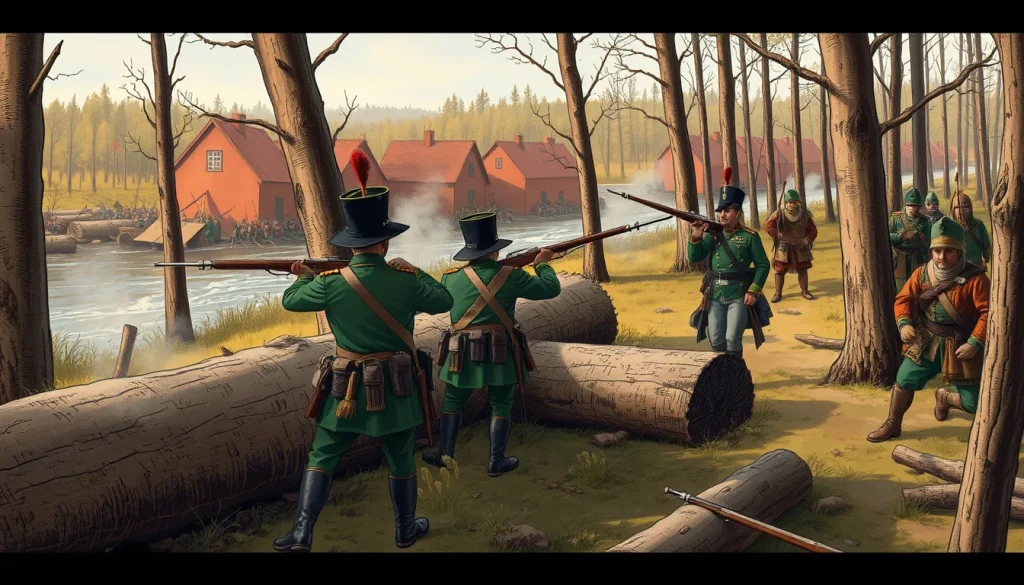
On 21 October 1813, Hampton’s 3,000-strong division crossed the border into Lower Canada. De Salaberry, forewarned of the advance, selected a defensive position near the junction of the Châteauguay River and the English River. The area was heavily wooded with ravines, ideal for the small force. De Salaberry constructed abatis (obstacles of felled trees) and concealed his troops in four lines on the west bank. He placed pickets forward and posted buglers and Indigenous warriors to create the illusion of a much larger force. On the morning of 26 October, American troops under Brigadier General George Izard attacked the main position, while a second brigade under Colonel Robert Purdy attempted to outflank by crossing the river. The attackers were met with accurate fire from the Voltigeurs and militia, while bugle calls and war cries from the forest convinced the Americans they faced a major force. Purdy’s flanking column became lost in the swamps and was eventually driven off. After heavy skirmishing, Hampton, believing he faced overwhelming numbers, ordered a withdrawal. The Americans retreated to New York, abandoning the offensive against Montreal. De Salaberry’s casualties were just five killed, sixteen wounded, and four missing; American losses were 23 killed, 33 wounded, and 29 missing.
Why It Matters
The Battle of Châteauguay was strategically decisive. Combined with the British victory at Crysler’s Farm on 11 November, it ended the American campaign against Montreal and secured the St. Lawrence corridor. The victory also had profound symbolic importance. It demonstrated that French-Canadian soldiers could and would fight effectively for the British Crown, countering American expectations of a Canadian uprising. For de Salaberry, the battle made him a celebrated hero in Lower Canada, though he was later disappointed by the lack of recognition in official dispatches. Historians have debated the scale of the American force and the effectiveness of de Salaberry’s deception, but the battle remains a landmark in Canadian military heritage and a cornerstone of French-Canadian identity.
Prelude
In the months before the battle, de Salaberry had been responsible for defending the Lower Châteauguay River. He had conducted aggressive reconnaissance, including an abortive raid on the American camp at Four Corners in early October. When he learned of Hampton’s advance, he selected a naturally strong position and prepared it with abatis and concealed firing lanes. His plan relied on terrain, surprise, and misdirection to offset the numerical superiority of the Americans.
Forces and Commanders
On the British side, Lieutenant Colonel Charles de Salaberry commanded a force of about 339 men, including the Canadian Voltigeurs, Select Embodied Militia, and a contingent of Abenaki warriors. He was nominally under the overall command of Major General Louis de Watteville, but in practice de Salaberry exercised direct control. The American force, commanded by Major General Wade Hampton, consisted of about 3,000 to 4,000 regular infantry and militia. Hampton’s division included a brigade under Brigadier General George Izard and another under Colonel Robert Purdy.
Battlefield and Map Context
The battle took place along the Châteauguay River, about 50 kilometers south of Montreal, near present-day Ormstown, Quebec. The terrain was heavily forested with swampy ground and several ravines intersecting the river. The modern battlefield is preserved as the Battle of the Châteauguay National Historic Site, with interpretive trails and a visitor center.
Battle Chronology
21 October: Hampton crosses the border. 25 October: De Salaberry finishes preparation of the defensive line. 26 October: At dawn, American pickets meet British forward parties; at about 10 a.m., Izard’s brigade attacks the main position and is repulsed. Purdy’s brigade crosses the river but becomes lost and is engaged by militia on the east bank. By mid-afternoon, Hampton orders a general withdrawal. The Americans retreat to Four Corners.
Casualties and Losses
De Salaberry’s force suffered 5 killed, 16 wounded, and 4 missing. American casualties were 23 killed, 33 wounded, and 29 missing. The Americans also abandoned equipment in their retreat.
Result
The battle was a decisive British and Canadian victory. The American force retreated to its starting positions, and the threat to Montreal from Hampton’s column was eliminated. The victory also had a significant propaganda effect, boosting morale among the Canadian population and discouraging further American attempts on the city.
Strategic Consequences
Châteauguay, together with the Battle of Crysler’s Farm on 11 November, ended the American campaign against Montreal. The British retained control of the St. Lawrence River and the vital supply line to Upper Canada. The battle also forced the American army to abandon any plans for a winter offensive, and it contributed to the overall stalemate that led to peace negotiations. Long-term, the battle became emblematic of French-Canadian military contribution and was used by later Canadian nationalists to argue for a distinct Canadian identity.
Primary Accounts
The most important primary source is de Salaberry’s own report to his superior, Major General de Watteville, written shortly after the battle. In it, he described the deployment and the actions of his troops. He also wrote a letter to his father on 29 October 1813, expressing pride in his men and frustration at the lack of recognition in the official dispatch published by Governor General George Prevost. American officer accounts, such as those from General Hampton’s report, emphasize the difficult terrain and the perceived size of the British force. Indigenous warriors who participated left no written accounts, but their presence is recorded in British and American records.
Battlefield Today
The Battle of the Châteauguay National Historic Site is located near Ormstown, Quebec. It features preserved abatis reconstructions, interpretive panels, and a monument to the defenders. A visitor center offers exhibits on the battle and de Salaberry’s life. The site is part of Parks Canada and is open seasonally.
Primary Sources
Relevant primary sources include the official reports of Major General Wade Hampton and Lieutenant Colonel Charles de Salaberry, published in the American and British military dispatches. De Salaberry’s private correspondence, including the letter to his father, is held at the Bibliothèque et Archives nationales du Québec and in the National Archives of Canada. Canadian militia records and muster rolls of the Voltigeurs are also available in the Library and Archives Canada. The American side is documented in the National Archives of the United States, including court-martial records related to the campaign.
Further Reading
- Hickey, Donald R. The War of 1812: A Forgotten Conflict. University of Illinois Press, 1989.
- Latimer, Jon. 1812: War with America. Harvard University Press, 2007.
- Grodzinski, John R. The Canadian Voltigeurs and the War of 1812. American Battlefield Trust, 2014.
- Parks Canada. Battle of the Châteauguay National Historic Site – official website.
- The Canadian Encyclopedia, “Charles-Michel d’Irumberry de Salaberry.”
References
- Grodzinski, John R. “Charles-Michel d’Irumberry de Salaberry.” The Canadian Encyclopedia, Historica Canada, 2015. link
- “Charles de Salaberry.” U.S. National Park Service, 2015. link
- “A hero for his time: Lieutenant Colonel Charles-Michel de Salaberry.” Parks Canada, Battle of the Châteauguay National Historic Site. link
- “Charles de Salaberry.” American Battlefield Trust. link
- “Battle of Chateauguay.” War of 1812 Website. link
- Hickey, Donald R. The War of 1812: A Forgotten Conflict. University of Illinois Press, 1989.
- Latimer, Jon. 1812: War with America. Harvard University Press, 2007.
FAQ
Why did de Salaberry use bugles and war cries at Châteauguay?
To deceive the Americans into thinking they faced a much larger force than the 339 defenders, encouraging a withdrawal.
What was the American plan for Montreal in 1813?
A two-pronged advance: Hampton from the south via Châteauguay and Wilkinson via the St. Lawrence, but both were defeated at Châteauguay and Crysler's Farm.
How is the Battle of Châteauguay commemorated today?
It is preserved as a national historic site operated by Parks Canada, with interpretive panels, a monument, and a visitor center.


Leave a Reply