

Short Answer
The Battle of Stoney Creek was a night engagement fought on 5–6 June 1813 near Stoney Creek, Upper Canada (present-day Stoney Creek, Ontario), during the War of 1812. A British force of about 700 regulars under Lieutenant Colonel John Harvey surprised and defeated an American army of roughly 3,400 men, capturing both American brigade commanders. The battle checked the American advance after the capture of Fort George and is considered a turning point that saved Burlington Heights and the western half of Upper Canada from invasion.
Historical Context
In late May 1813, American forces under Major General Henry Dearborn had captured Fort George at the mouth of the Niagara River, driving the British under Brigadier General John Vincent to retreat westward to Burlington Heights at the head of Lake Ontario. The Americans, though holding Fort George, were slow to pursue. By early June, an American advance force under Brigadier Generals John Chandler and William Winder moved westward along the lake road to press the retreating British. The Americans camped at Stoney Creek on the evening of 5 June, about ten miles from Vincent’s fortified position at Burlington Heights. The success of the American campaign depended on driving the British from Burlington Heights and securing the entire Niagara Peninsula, which would effectively cut off British supply lines to the west and potentially end the war in Upper Canada.
What Happened
On the night of 5–6 June, Lieutenant Colonel John Harvey, Vincent’s deputy adjutant general, personally reconnoitred the American camp and found it poorly secured. Sentries were negligent, and the camp was spread over a wide area with inadequate outposts. Harvey obtained the American password and, with information gathered by a local youth named Billy Green, convinced Vincent to authorize a night attack. About 700 men from the 8th and 49th Regiments of Foot, with bayonets fixed and flints removed to prevent accidental discharges, marched silently to the American camp.
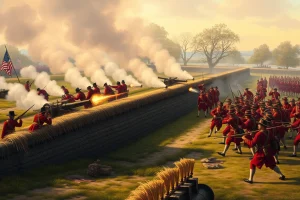
At roughly 2 a.m. on 6 June, the British struck. They bayoneted sentries and burst into the sleeping camp. In the darkness and confusion, some British troops fired prematurely, and the Americans scrambled to respond. Despite the chaos, Major Charles Plenderleath led a charge that captured the American field guns. In the melee, both American generals were taken prisoner: Chandler, wounded, attempted to rally troops he mistakenly thought were his own; Winder was captured in separate confusion. With their commanders gone, command devolved to Colonel James Burn of the 2nd Light Dragoons, who decided to retreat at dawn rather than risk a renewed attack against an unknown enemy.
The Americans withdrew eastward, harassed by British troops and Indigenous allies, and were further demoralized by the appearance of Captain Sir James Yeo’s naval squadron on Lake Ontario. They fell back to Fort George, effectively ending their offensive for the season.
Why It Matters
The Battle of Stoney Creek halted the American invasion that threatened to overrun Upper Canada. The capture of both American brigadier generals in a single action was a stunning blow to American morale and command. The battle restored British control over the Niagara Peninsula, confining the Americans to a narrow perimeter around Fort George. Combined with the later Battle of Beaver Dams on 24 June, Stoney Creek turned the strategic tide, saving Burlington Heights and the western regions of the province. Historians generally regard it as a pivotal moment in the defense of Upper Canada. The battle also boosted the career of John Harvey, who later distinguished himself at Crysler’s Farm and Lundy’s Lane.
Prelude
Following the American capture of Fort George on 27 May 1813, British forces under Brigadier General John Vincent retired to Burlington Heights. The American army, under Major General Henry Dearborn, was slow to organize pursuit. On 2 June, a force of about 1,400 men under Brigadier General William Winder advanced from Fort George toward Forty Mile Creek (Grimsby). It was reinforced by a second brigade under Brigadier General John Chandler, giving the Americans a combined strength of about 3,400. The two brigades met and moved to Stoney Creek on 5 June, where they encamped. Vincent and Harvey, aware of the American approach, decided to strike first with a night raid.
Forces and Commanders
British and Allied: Brigadier General John Vincent (present but largely a bystander), Lieutenant Colonel John Harvey (effective tactician), Major Charles Plenderleath (led charge on guns). Force consisted of about 700 men from the 8th (King’s) and 49th Regiments of Foot.
American: Brigadier General John Chandler (overall commander of the field force), Brigadier General William Winder (brigade commander), Colonel James Burn (2nd Light Dragoons, assumed command after captures). Force numbered about 3,400, comprising regular infantry, artillery, and some militia, drawn from the Fort George garrison.
Battlefield and Map Context
The battle occurred on the eastern bank of Stoney Creek, a small stream near the shore of Lake Ontario, about ten miles east of Burlington Heights. The American camp lay beside a road leading west, with fields and scattered woods. The terrain afforded covered approaches for the British, who advanced through forest from the west. The modern site is in Stoney Creek, a community now part of Hamilton, Ontario, centred on the Battlefield House Museum and Monument.
Battle Chronology
- 2 June: American brigades under Winder and Chandler march from Fort George.
- 5 June, afternoon: American forces arrive at Stoney Creek and encamp.
- 5 June, evening: Billy Green brings intelligence to Vincent; Harvey reconnoitres American camp.
- 5 June, late night: British column of 700 men leaves Burlington Heights.
- 6 June, ~2 a.m.: British attack; sentries bayoneted; capture of American artillery; both American generals captured.
- 6 June, dawn: Colonel Burn orders American withdrawal; retreat to Fort George.
Casualties and Losses
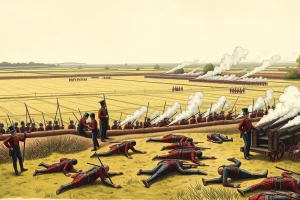
British casualties are commonly reported as 23 killed, 136 wounded, and 52 missing. American losses were approximately 17 killed and 38 wounded, with about 100 captured, including both commanding generals and 18 other officers. The British also captured two field guns. Casualty figures vary slightly across primary accounts and secondary works.
Result
The Battle of Stoney Creek was a decisive British victory. It halted the American advance, resulted in the capture of the two senior American commanders on the field, and forced the American army to retreat to Fort George. The strategic initiative shifted back to the British, and the American conquest of Upper Canada’s Niagara frontier was never resumed in 1813.
Strategic Consequences
The battle prevented the American capture of Burlington Heights and the possible loss of the entire western half of Upper Canada. It also secured British communication lines to the west and, together with the Battle of Beaver Dams, confined American forces to a narrow coastal strip around Fort George for the remainder of the season. The American failure at Stoney Creek undermined Dearborn’s credibility and contributed to his later replacement. For the British, the victory restored morale and demonstrated the effectiveness of a bold night action.
Primary Accounts
Important contemporary sources include the official dispatches of Lieutenant Colonel John Harvey to Brigadier General John Vincent describing the attack, and Vincent’s report to Sir George Prevost. American accounts include the report of Colonel James Burn to Major General Dearborn and Dearborn’s subsequent correspondence. Also notable is the later written statement of Billy Green, which detailed his role in gathering intelligence and guiding the British column. The casualty returns and court-martial records of the period provide additional detail, though care must be taken regarding partisan bias.
Battlefield Today
The battlefield site is preserved as the Battlefield House Museum and National Historic Site in Stoney Creek, Hamilton, Ontario. The property includes the Gage family farmhouse, which stood at the time of the battle, and a monument erected in 1913 to commemorate the centennial. The site features period artifacts, interpretive panels, and an annual re-enactment of the battle. The landscape remains partly wooded, though urban development surrounds the core battlefield area.
Primary Sources
The following contemporary documents are critical to understanding the battle:
- Lieutenant Colonel John Harvey’s dispatch to Brigadier General John Vincent, 6–7 June 1813 – describes the attack and its immediate results.
- Brigadier General John Vincent’s report to Sir George Prevost, June 1813 – provides official British account and casualty list.
- Colonel James Burn’s report to Major General Henry Dearborn, June 1813 – gives American perspective, including command confusion and retreat.
- Dearborn’s official correspondence to the U.S. War Department – acknowledges the defeat and its impact.
- Billy Green’s later testimony (recorded in 19th century) – offers local intelligence details.
Many of these documents are held in national archives, including Library and Archives Canada and the U.S. National Archives. Researchers should be aware that each side’s reports emphasize favorable aspects and may understate losses or confusion.
Further Reading
- Berton, Pierre. The Invasion of Canada, 1812–1813. Toronto: McClelland & Stewart, 1980.
- Hickey, Donald R. The War of 1812: A Forgotten Conflict. Urbana: University of Illinois Press, 1989.
- Latimer, Jon. 1812: War with America. Cambridge: Harvard University Press, 2007.
- Lambert, Andrew. The Challenge: Britain Against America in the Naval War of 1812. London: Faber and Faber, 2012.
- Stagg, J.C.A. The War of 1812: Conflict for a Continent. Cambridge: Cambridge University Press, 2012.
- Battlefield House Museum & National Historic Site (Hamilton, Ontario) – official site and interpretive resources.
References
- Ridler, Jason. “Battle of Stoney Creek.” The Canadian Encyclopedia, 2011/2015. https://thecanadianencyclopedia.ca/en/article/battle-of-stoney-creek.
- “Battle of Stoney Creek – War of 1812.” The War of 1812 Resource. https://thewarof1812.org/battles/battle-of-stoney-creek/.
- Jefferys, Charles W. “Battle of Stoney Creek.” Library and Archives Canada, Acc. No. 1972-26-596. https://www.cwjefferys.ca/battle-of-stoney-creek.
- “Canadian Parks Movement: Hamilton Experience – The Battle of Stoney Creek (1813).” Library and Archives Canada. https://epe.lac-bac.gc.ca/100/205/301/ic/cdc/hamilton/battle.html.
- “Stoney Creek, Battle of.” Encyclopedia.com. https://www.encyclopedia.com/history/dictionaries-thesauruses-pictures-and-press-releases/stoney-creek-battle.
- Babcock, Louis L. The War of 1812 on the Niagara Frontier. Buffalo Historical Society, 1927.
- Berton, Pierre. The Invasion of Canada. Boston: Little, Brown, 1980.
FAQ
Why was the Battle of Stoney Creek a turning point in the War of 1812?
The battle stopped a major American advance that threatened to capture Burlington Heights and the western half of Upper Canada. Combined with the Battle of Beaver Dams, it confined American forces to a narrow perimeter around Fort George, preserving British and Canadian control over the Niagara frontier.
Who were the American generals captured at Stoney Creek?
Brigadier General John Chandler and Brigadier General William Winder were both captured during the chaotic night fighting. Their loss decapitated the American command and contributed to the army's hurried retreat.
How did the British achieve surprise at Stoney Creek?
Harvey reconnoitred the American camp, learned the password, and received local intelligence from Billy Green. The British column moved in silence with flintlocks unloaded to avoid accidental shots, and overwhelmed the lax sentries.



Leave a Reply