

Short Answer
The Battle of Wild Cat Creek, also known as Spur’s Defeat, was a skirmish fought on November 21–22, 1812, along Wildcat Creek in present-day Carroll County, Indiana, during the War of 1812. It occurred during an American punitive expedition led by Major General Samuel Hopkins against Native American villages in the Northwest Territory. The battle resulted in a Native American victory and the American withdrawal, marking the culmination of an unsuccessful campaign that had been launched in response to earlier frontier attacks.
Historical Context
In the summer and autumn of 1812, the United States suffered a series of setbacks on its northwestern frontier, including the Fort Dearborn Massacre (August 15, 1812) and the Pigeon Roost Massacre (September 3, 1812). These raids intensified American fears of a coordinated Indian uprising supported by British forces in Canada. To retaliate, Major General Samuel Hopkins and Colonel William Russell were ordered to conduct a joint expedition into Illinois Territory and the Wabash Valley. Russell’s column destroyed a Kickapoo village near Peoria Lake but was forced to retreat, while Hopkins’s Kentucky militia was repulsed by a prairie fire set by the Kickapoos. Humiliated, Hopkins discharged his militia and raised a new force, determined to strike at Prophetstown and other villages.
What Happened
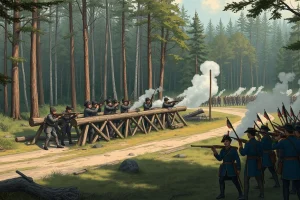
Hopkins left Vincennes on November 11, 1812, with about 1,250 men, including three regiments of Kentucky Infantry, a company of the 7th U.S. Infantry under Major Zachary Taylor, a troop of Indiana Rangers, and a company of scouts. Marching along the same route taken by William Henry Harrison in 1811, the army passed the site of the Battle of Tippecanoe, where they discovered that the graves of American dead had been desecrated. They reached Prophetstown on November 19, but found it largely abandoned and burned it along with a nearby Kickapoo village. A Winnebago village on Wildcat Creek was also destroyed. On November 21, a scouting party was ambushed, and one soldier named Dunn was killed. The next day, a force of sixty Indiana Rangers under Captain Beckes, accompanied by Colonels Miller and Wilcox, rode out to recover Dunn’s body. They were lured by a decoy into a narrow ravine, where Kickapoo, Winnebago, and Shawnee warriors ambushed them. Within minutes, twelve Rangers were killed and the rest fled, giving the engagement its nickname “Spur’s Defeat” after the soldiers’ hasty retreat. The Americans lost a total of seventeen killed and three wounded over the two days. The expedition then turned back, and by the time it reached Fort Knox, two hundred men were suffering from frostbite or illness.
Why It Matters
The battle was a humiliating defeat for the United States and effectively ended Hopkins’s military career. It demonstrated the effectiveness of Native American mounted warfare and the challenges of campaigning in the northwest during winter. While the engagement itself was small, it was part of the broader effort to suppress Native resistance and secure the frontier. The failure contributed to a shift in American strategy toward the use of regular troops and more cautious expeditions. Historians debate its significance: some dismiss it as a minor skirmish, while others point to its role in shaping the territorial command structure and the eventual American victory at the Battle of the Thames in 1813.
Prelude
The campaign that culminated at Wildcat Creek was a response to the raids of 1812 and the strategic need to break the Native American confederacy allied with Britain. After his initial failure, Hopkins reorganized his forces at Vincennes and set out on November 11, 1812, with the dual objective of pushing hostile tribes toward Canada and destroying Prophetstown again. The army marched through hostile territory, encountering only abandoned villages and desecrated burial sites until it reached the vicinity of Wildcat Creek.
Forces and Commanders
The American expedition numbered approximately 1,250 men, commanded by Major General Samuel Hopkins. Key subordinates included Major Zachary Taylor, who led a company of the 7th Infantry, Colonel Miller and Colonel Wilcox, and Captain Joseph Beckes of the Indiana Rangers. The Native American coalition, estimated at around 1,200 warriors, was composed primarily of Kickapoo, Winnebago, and Shawnee fighters. The overall leadership is unclear, but some accounts identify a Shawnee war chief named Kumakskau, a brother of Tecumseh, as a central figure.
Battlefield and Map Context
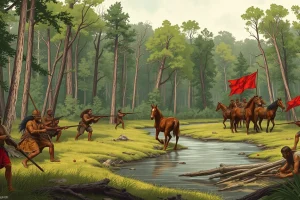
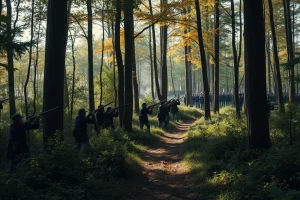
The engagement took place along Wildcat Creek, a tributary of the Wabash River, in what is now Carroll County, Indiana. The exact location of the ambush remains unknown, but a historical marker placed by the Carroll County Historical Association near Pyrmont indicates the site “in a nearby ravine.” The terrain consisted of wooded ravines and creek bottoms, ideal for an ambush. The American force entered the area after destroying neighboring villages, and the narrow canyon where the Rangers were lured was a bottleneck that favored the defending warriors.
Battle Chronology
On November 21, a scouting party from Hopkins’s army was fired upon while exploring Wildcat Creek, and they retreated, leaving behind the body of Private Dunn. On November 22, a rescue party of sixty Indiana Rangers and several officers rode out to retrieve Dunn’s remains. They encountered a warrior who taunted them and led them into a ravine, where an estimated 200 to 400 warriors were waiting. The Americans were overwhelmed in a sudden volley and hand-to-hand fight. Twelve Rangers were killed on the spot; the rest fled, and the expedition abandoned the attempt. One captive, Benoit Besayon, a trader accused of aiding the enemy, was burned at the stake, though a friend shot him to end his suffering.
Casualties and Losses
American losses were seventeen killed and three wounded for the two-day engagement, with most casualties occurring during the ambush on November 22. The number of Native American casualties is unknown; contemporary accounts reported none, though this is likely an underestimate. The expedition also lost a significant number of horses and equipment.
Result
The battle was a decisive Native American victory. The American expedition, unable to engage the enemy in a decisive battle, withdrew and never achieved its goal of destroying Native villages or driving the population into Canada. Hopkins ordered a retreat after learning of a large gathering of warriors, but the onset of a snowstorm made the withdrawal even more difficult.
Strategic Consequences
The failure of the campaign exposed the inadequacy of American militia forces in frontier warfare and prompted a change in strategy. The American high command, led by William Henry Harrison, turned toward building a more disciplined regular force. Hopkins was brought before a court of inquiry, which cleared him, but he resigned shortly thereafter. The battle also reinforced Native American confidence and demonstrated that the coalition could effectively counter American expeditions. The area remained contested until the American victory at the Battle of the Thames in 1813, which broke the Native confederacy.
Primary Accounts
Official reports from Major General Hopkins and his subordinates, including Major Taylor, are preserved in the records of the U.S. War Department and in the correspondence of Governor William Henry Harrison. These documents, however, are often terse and focus on logistics rather than tactical details. The court of inquiry’s proceedings also provide an official narrative. A later account from Benjamin Drake’s “Tales and Sketches of the Illinois Country” (1839) includes details of the ambush, but it is a secondary source. The lack of detailed primary sources from the Native American side limits a full reconstruction of the battle.
Battlefield Today
Today, the site lies in rural Carroll County, Indiana. A historical marker at the intersection of W 550 S Road and S 800 W Road in Pyrmont commemorates the battle, noting that the engagement took place “in a nearby ravine.” The marker, erected by the Carroll County Historical Association, is the only public recognition of the event. Archaeologists from Purdue University and the Indiana Department of Natural Resources have shown little interest due to the battle’s perceived insignificance, though local reenactment groups have taken an interest in preserving its memory.
Primary Sources
The most relevant contemporary documents include Hopkins’s official report to the Secretary of War, dated December 1812, and his correspondence with General Harrison. These are held in the National Archives and are recorded in published collections, such as the “Messages and Papers of the Presidents.” Also important are the letters of Zachary Taylor, who later became president, which describe the hardships of the campaign. The court of inquiry records are in the U.S. Army Court of Inquiry files. For the Native perspective, we have little direct evidence; historians rely on later oral traditions or accounts from traders. The journal of John Tipton, an American scout, is another useful source, but it is limited to the American side.
Further Reading
- Alec R. Gilpin, The War of 1812 in the Old Northwest (Michigan State University Press, 1958).
- John K. Mahon, The War of 1812 (University of Florida Press, 1972).
- Donald R. Hickey, The War of 1812: A Forgotten Conflict (University of Illinois Press, 1989).
- Carroll County Historical Association, local historical marker interpretation.
References
- Wikipedia, “Battle of Wild Cat Creek,” https://en.wikipedia.org/wiki/Battle_of_Wild_Cat_Creek.
- HistoryMaps, “Battle of Wild Cat Creek,” https://history-maps.com/warmap/war-of-1812/event/battle-of-wild-cat-creek.
- Kiddle Encyclopedia, “Battle of Wild Cat Creek Facts for Kids,” https://kids.kiddle.co/Battle_of_Wild_Cat_Creek.
- War of 1812 Chronicles, “Battle of Wild Cat Creek,” http://warof1812chronicles.blogspot.com/2013/11/battle-of-wild-cat-creek.html.
FAQ
Why is the Battle of Wild Cat Creek called 'Spur's Defeat'?
The nickname comes from the soldiers' use of spurs to gallop away from the ambush. Some accounts suggest it refers to the hasty retreat of the mounted rangers.
What were the U.S. casualties at the Battle of Wild Cat Creek?
Over two days (November 21–22, 1812), the American force suffered 17 killed and 3 wounded. Most casualties occurred during the ambush on November 22.
Where did the Battle of Wild Cat Creek take place?
The battle occurred along Wildcat Creek in what is now Carroll County, Indiana. A historical marker near Pyrmont indicates the likely site in a ravine.
Leave a Reply