Short Answer
Major General Robert Ross (1766–1814) was the British officer who commanded the expedition that captured and burned Washington, D.C., in August 1814, an event that marked a low point in the American War of 1812. Ross, a seasoned Napoleonic veteran, led a combined force of British regulars and marines from the Chesapeake Bay to the American capital, achieving a decisive victory at Bladensburg and then deliberately destroying the city’s public buildings. His death at the Battle of North Point a few weeks later cut short a career that had already left a lasting imprint on Anglo-American relations and the course of the war.
Historical Context
By 1814, the War of 1812 had reached a stalemate along the Canadian border, but the British, having defeated Napoleon, turned their attention to the United States with a strategy of coastal raids and punitive expeditions. Vice Admiral Sir Alexander Cochrane and Rear Admiral George Cockburn advocated for aggressive strikes against American coastal cities to divert U.S. forces from Canada and to retaliate for American devastation of British-held towns, particularly the burning of York (present-day Toronto) in 1813 and the destruction of Niagara-area settlements. The Chesapeake Bay, close to the U.S. capital and relatively undefended, offered an ideal target. In July 1814, the British government authorized an expeditionary force under Ross, who was recovering from a wound received in the Peninsular War, to undertake an “enterprise” against American coastal targets. Ross arrived in Bermuda in July and took command of approximately 4,500 troops, sailing with Cochrane’s fleet to the Chesapeake.
What Happened
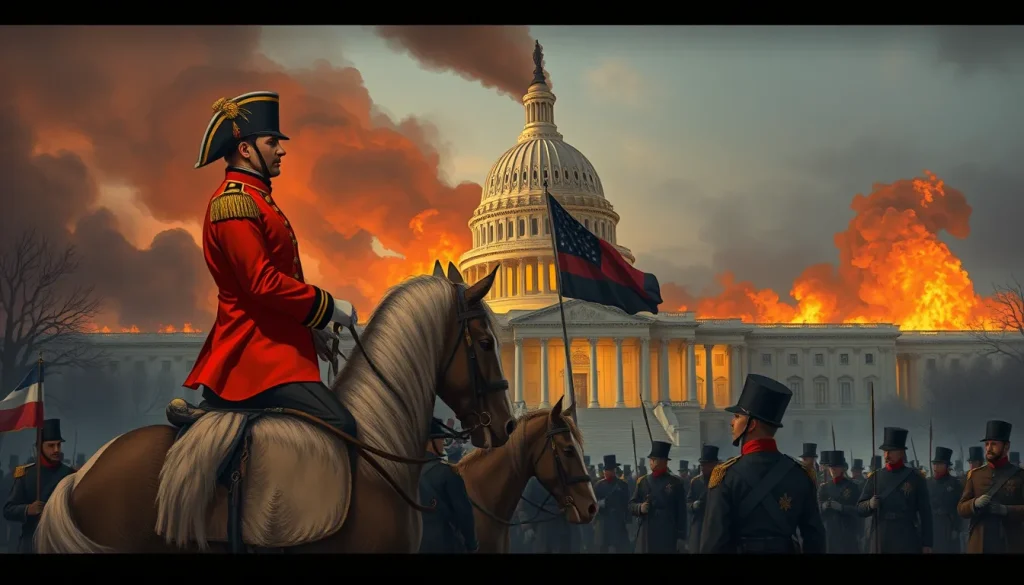
Ross’s force landed at Benedict on the Patuxent River on August 19, 1814, and marched overland toward Washington. On August 24, at Bladensburg, Maryland, Ross’s troops defeated a larger American army composed mainly of militia in a series of actions that became known as the Battle of Bladensburg. The victory opened the road to Washington, and by evening the British entered the capital. Ross, following orders from Cochrane and Cockburn, ordered the burning of all public buildings—the Capitol, the White House (then the President’s House), the Treasury, and other government offices—to destroy the city as a military target. However, Ross issued strict instructions to spare private property, and he ordered his men to respect homes and businesses. The destruction lasted into August 25, and the British withdrew on the night of August 25–26, re-embarking by August 30. The expedition then turned to Baltimore, a major port and privateering base. Ross’s force landed at North Point on September 12, but a few miles into the march toward the city, Ross was struck by a bullet from an American sharpshooter. He died almost immediately, and his command devolved to Colonel Francis Brooke, who subsequently withdrew after the failure of the naval bombardment of Fort McHenry.
Why It Matters
The burning of Washington was a psychological blow to the young American republic, exposing its vulnerability and leading to temporary panic. For the British, it was a successful punitive raid that demonstrated their ability to strike at the American heartland, but it also stiffened American resolve and galvanized public opinion against the British. The defense of Baltimore, where Ross was killed, inspired the writing of “The Star-Spangled Banner.” For Ross personally, his death elevated him to a martyr-like status in British memory, while Americans sometimes conflated his actions with barbarity, despite his orders to protect private property. Historians debate the strategic wisdom of the raid: some argue it was a wasteful diversion, while others see it as a necessary retaliation that influenced peace negotiations. Ross’s decision to limit destruction to public buildings became a point of comparison in later discussions of the rules of war. His legacy remains contested, but his name is forever linked to one of the most dramatic episodes of the War of 1812.
Early Life
Robert Ross was born in 1766 in Rostrevor, County Down, Ireland, to Elizabeth Adderley and Major David Ross, a British officer who had served in the Seven Years’ War. Educated at Trinity College Dublin, Ross graduated in 1784 but chose a military career, receiving an ensigncy in the 25th Regiment of Foot in 1789. His early service included duty in Ireland and the Mediterranean, but his first significant combat came during the 1799 Anglo-Russian invasion of Holland, where he was severely wounded at Krabbendam. That service earned him promotion and a reputation for courage.
Role Before the War
Before the War of 1812, Ross had compiled a distinguished record in the Napoleonic Wars. He served in Egypt, where he distinguished himself at the Battle of Alexandria in 1801, and he commanded the 20th Regiment of Foot through campaigns in Italy, Spain, and Portugal. He fought at Maida in 1806 and the Peninsular War, where the Duke of Wellington praised his brigade’s conduct. By 1813 he had reached the rank of major general and was wounded at the Battle of Orthez in February 1814, which left him temporarily disabled. When the British sought an experienced commander for the American expedition, Ross was a natural choice.
Role During the War
Ross arrived in the Chesapeake in August 1814 with a brigade of veterans from Europe. His role was to lead a punitive expedition against American coastal cities, with the immediate objective of capturing or destroying Washington. He initially expressed reluctance about the destruction of public property, but he carried out his orders. After the raid on Washington, he moved his forces to Baltimore, where his death occurred on September 12, 1814, during the Battle of North Point.
Major Actions
Ross’s most significant action was the Battle of Bladensburg, where his disciplined regulars defeated a larger American force, enabling the capture of Washington. His decision to burn public buildings, while sparing private property, was a major and controversial act. He also led the initial advance at North Point, where his own death was a turning point. His short campaign in the Chesapeake lasted less than a month but achieved a symbolic victory that resonated across both nations.
Contemporary Accounts
Contemporary American accounts, such as the famous letter from First Lady Dolley Madison saving the Gilbert Stuart portrait of George Washington, vividly describe the chaos of the evacuation. British officers, including Ross himself in his reports, emphasized the disciplined conduct of the troops and the protection of private property. Some British participants criticized the burning as unjustified, while others saw it as just retaliation for American destruction in Canada. American observers often blamed Ross specifically, though orders came from Cochrane.
Later Life
Ross died on September 12, 1814, after being shot at North Point. His body was preserved and taken to Halifax, Nova Scotia, where he was buried with military honors. A monument was later erected there. His death was widely mourned in Britain, and he was honored with a memorial in St. Paul’s Cathedral and a statue in his hometown in Ireland.
Historical Legacy
Ross is remembered primarily as the man who burned Washington, but historians like John McCavitt and Christopher T. George have argued that his broader military career and his restraint in sparing private property deserve more attention. His death made him a hero in Britain, while in the United States his name became a symbol of British aggression. The burning of Washington was a key event that shaped American national identity and military policy, influencing the construction of fortifications and the development of a permanent standing army. Ross’s legacy is thus intertwined with two national narratives: British pride in a skilled commander and American memory of a humiliating loss.
Primary Sources
Primary sources for the campaign include Ross’s own correspondence with Cochrane and the Admiralty, which detail his orders and actions. British military reports from Bladensburg and Baltimore survive in the National Archives in London. On the American side, letters from Dolley Madison, President James Madison, and eyewitness accounts from residents of Washington provide vivid descriptions of the burning. The official British account of the expedition was published in the London Gazette. These sources must be read with awareness of each author’s bias—British officers justified their actions, while Americans emphasized victimhood.
Further Reading
- McCavitt, John, and Christopher T. George. The Man Who Captured Washington: Major General Robert Ross and the War of 1812. University of Oklahoma Press, 2016.
- George, Christopher T. Terror on the Chesapeake: The War of 1812 on the Bay. White Mane Books, 2001.
- Hickey, Donald R. The War of 1812: A Forgotten Conflict. University of Illinois Press, 1989.
- Pitch, Anthony S. The Burning of Washington: The British Invasion of 1814. Naval Institute Press, 1998.
References
- National Park Service, “Robert Ross,” https://nps.gov/people/robert-ross.htm (accessed September 2026).
- American Battlefield Trust, “Robert Ross,” https://www.battlefields.org/learn/biographies/robert-ross (accessed September 2026).
- The Canadian Encyclopedia, “Robert Ross,” https://thecanadianencyclopedia.ca/en/article/robert-ross (accessed September 2026).
- University of Oklahoma Press, “The Man Who Captured Washington,” https://www.oupress.com/9780806151649/the-man-who-captured-washington/ (accessed September 2026).
- C-SPAN, “Major General Robert Ross and the Burning of the Capitol,” https://www.c-span.org/program/american-history-tv/major-general-robert-ross-and-the-burning-of-the-capitol/283484 (accessed September 2026).
FAQ
Why did the British burn Washington, D.C.?
The British government ordered retaliation for American destruction of public property in Upper Canada, especially the burning of York in 1813. Admiral Cochrane’s orders specifically targeted Washington as a symbol.
Did Robert Ross order the burning of the White House?
Yes, Ross, under orders from Vice Admiral Cochrane, ordered the burning of all public buildings, including the White House, Capitol, and other government structures. However, he strictly forbade damage to private residences and businesses.
How did Robert Ross die?
Ross was killed by an American sharpshooter on September 12, 1814, at the Battle of North Point, while leading his troops toward Baltimore.
Leave a Reply