
Short Answer
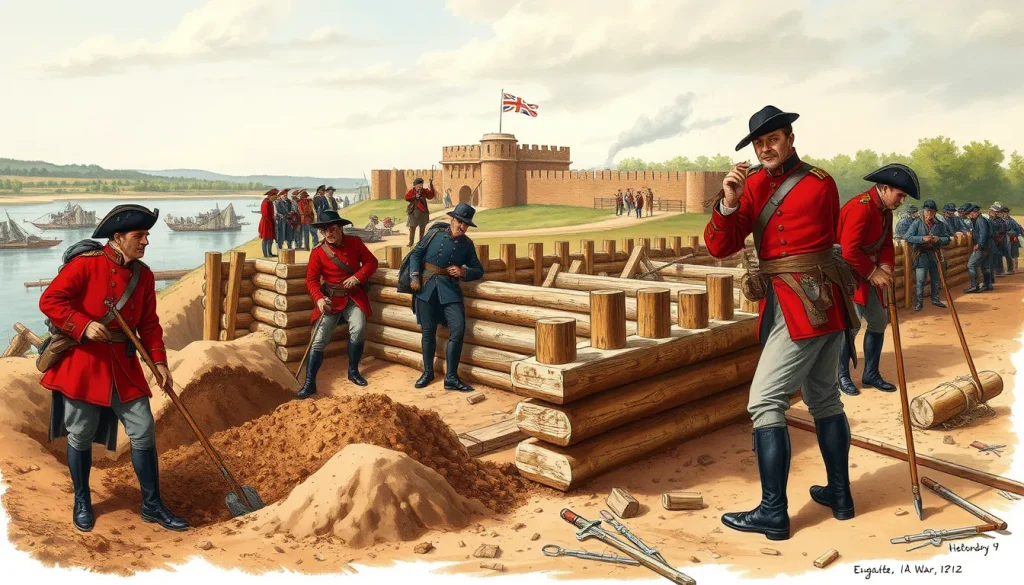
During the War of 1812 (1812–1815), military engineering was an essential component of warfare on the North American continent. From the design and construction of permanent fortifications to hasty field works and critical transportation infrastructure, engineers and soldiers applied practical science to strengthen defensive positions and facilitate offensive maneuvers. This article examines the scope, methods, and consequences of military engineering during the conflict, emphasizing both American and British perspectives and the enduring legacy of their efforts.
Historical Context
At the outbreak of the War of 1812, the United States possessed a small, understaffed Corps of Engineers established at West Point in 1802, while the British relied on the Royal Engineers and the resources of the Canadian provinces. Coastal fortifications, especially along the Atlantic seaboard and the Great Lakes, were often outdated or unfinished, reflecting decades of neglect after the American Revolution. The vast frontier, including the Niagara Peninsula, Lake Ontario, and the St. Lawrence River, required extensive defensive works to protect supply lines and settlements. The war also demanded rapid construction of field fortifications during campaigns, as well as the ability to besiege fortified positions. Both sides faced shortages of trained engineers, heavy equipment, and construction materials, forcing them to rely on local labor, militia, and improvisation. The geography of North America—dense forests, rivers, and rugged terrain—further increased the importance of military engineering in enabling movement and controlling territory.
What Happened
Military engineering during the War of 1812 took several forms: the construction of permanent fortifications, the creation of temporary field works, siege operations, and the building of roads and bridges. In the early months of the war, American forces attempted offensive operations into Upper Canada, but faced formidable barriers such as the rapids of the St. Lawrence and the fortified positions at Queenston and Fort George. Conversely, the British and Canadian forces constructed a network of defensive works, including Fort York and Fort Wellington, to protect the provincial capitals and key posts.
Among the most significant engineering achievements were the fortifications that defended American cities and harbors. The defense of Baltimore in September 1814 relied heavily on Fort McHenry, whose masonry walls and earthen ramparts were designed and upgraded under the supervision of American military engineer Lieutenant Colonel Joseph Totten. Totten, a graduate of West Point, also played a key role in reinforcing the defenses at Sackets Harbor and Plattsburgh. At Plattsburgh, American forces constructed blockhouses, artillery batteries, and a fortified camp on Lake Champlain, which contributed to the American victory in September 1814. The British, meanwhile, employed engineers to build fortified positions during their invasions, such as the earthworks at Fort Erie, which they captured and then defended against an American siege in 1814. The American siege of Fort Erie, led by Brigadier General Edmund Gaines, involved parallel approaches, trenches, and countermining—textbook applications of military engineering.
Field fortifications were often hastily constructed during campaigns. At the Battle of Châteauguay in October 1813, Canadian troops under Charles-Michel de Salaberry used abatis and breastworks to obstruct an advancing American column. Similarly, at the Battle of Lundy’s Lane in July 1814, both sides fought over strategic ground partly shaped by temporary earthworks. Roads and bridges also fell under military engineering. The building of the Military Road connecting Kingston to the Rideau River improved British communications. American engineers improved supply routes through the wilderness, such as the road from Buffalo to the Niagara frontier. Bridge construction was crucial in numerous operations, notably during the capture of Fort George, when American forces constructed a pontoon bridge to cross the Niagara River.
Engineers on both sides were often officers who had received formal training in mathematics, hydraulics, and military architecture. The American Corps of Engineers provided leadership and expertise, while the Royal Engineers were supplemented by provincial engineers and surveyors. Indigenous allies also contributed specialized knowledge of local terrain, which supported engineering decisions.
The war’s major siege operations demonstrated the importance of engineering in both offense and defense. The American defense of Fort Erie on the Niagara frontier in 1814 withstood a British siege due to strong earthworks and well-directed countermeasures. At the Siege of Fort Meigs in 1813, American engineers constructed a formidable defensive line. Conversely, the British capture of Fort Detroit in August 1812 was aided by the rapid construction of artillery positions that intimidated the American garrison.
Throughout the conflict, military engineering was not limited to land fortifications. Engineers also assisted with naval infrastructure, including the construction of naval yards, dry docks, and the defensive batteries that protected harbors. The Battle of Plattsburgh involved both a naval engagement and land fortifications, where engineers prepared the defensive line that disrupted the British advance.
Why It Matters
Military engineering directly influenced the outcome of the War of 1812 in several critical instances. The fortifications at Baltimore prevented the British from capturing the city and contributed to the successful defense that inspired the national anthem. The American defensive works at Plattsburgh repelled a much larger British force, leading to the end of the northern campaign. Conversely, poor engineering and weak fortifications contributed to American defeats at Detroit and Queenston Heights. The war demonstrated that trained military engineers were indispensable for both coastal defense and frontier operations.
The conflict also spurred the development of American military engineering. The U.S. Corps of Engineers gained valuable experience and institutional prestige. The construction of fortifications during the war laid the groundwork for the Third System of American coastal defenses in the 1820s. For the British, the war highlighted the necessity of maintaining a skilled engineering corps in North America, leading to improvements in Canadian fortifications, including the Kingston and Quebec defenses.
Later historians have interpreted military engineering as a force multiplier that enabled numerically smaller forces to hold strategic positions. The successes at Fort McHenry and Fort Erie are often cited as examples of the effectiveness of well-designed fortifications, while the challenges of wilderness operations underscored the need for flexible engineering responses.
Definition
Military engineering is the practice of applying engineering principles to support military operations. During the War of 1812, it encompassed the design and construction of permanent and temporary fortifications, the improvement of roads and bridges, the conduct of siege works, and the execution of demolitions and obstacles. It also included the surveying and mapping of terrain for tactical planning.
Background
The formal practice of military engineering grew from the European tradition of siege warfare and fortification in the seventeenth and eighteenth centuries. By the early nineteenth century, the leading world powers maintained professional engineer corps. In the United States, the Corps of Engineers was permanently established in 1802 at West Point, which also served as the nation’s first engineering school. The British Royal Engineers had a long history and were supported by the Royal Military Academy at Woolwich. The war in North America tested these institutions in a challenging environment, requiring adaptation to forests, lakes, and sparse infrastructure.
How It Worked
Military engineers worked closely with commanding generals, conducting reconnaissance of ground, designing defensive positions, and supervising the labor of soldiers, militia, and civilians. They used instruments such as theodolites, chains, and levels to survey terrain. Construction tasks included digging trenches, building earthworks and ramparts, constructing abatis (intertwined sharpened trees), and creating obstacles such as ditches and palisades. For siege operations, engineers directed the excavation of approach trenches, the establishment of gun batteries, and the construction of mines and counter-mines. In the field, engineers improved roads, built bridges—including pontoon and trestle bridges—and ensured that supply lines remained passable.
Competing Viewpoints
Within military thought of the era, there was debate over the relative value of permanent fortifications versus field armies. Some officers, including American generals like William Hull, doubted the efficacy of fixed defenses and favored aggressive offensive operations. Others, such as British officers in Canada, emphasized fortifications as force multipliers that allowed small garrisons to hold key points. The effectiveness of engineering in the war was demonstrated by the defensive victories at Fort McHenry and Plattsburgh, but also challenged by the failures at Fort Detroit, where weak works and poor morale led to surrender. Historians have debated whether these outcomes were more attributable to engineering quality or to leadership and morale.
Role in the War of 1812
Military engineering influenced nearly every campaign. On the Great Lakes frontier, forts and batteries controlled access to waterways. The American fortification of Sackets Harbor protected the new naval squadron. The British fortifications at Kingston defended the St. Lawrence. The Niagara frontier saw repeated fortifications and sieges, including Fort George, Fort Erie, and Chippawa. In the Chesapeake, the fortifications at Baltimore were decisive. Engineers also built the road networks that allowed troop movements, such as the Great Warrior Road in the West and the military roads in Upper Canada. Indigenous allies contributed knowledge of terrain, which supplemented engineer efforts.
Consequences and Historical Interpretation
The War of 1812 highlighted the necessity of military engineering and led to long-term improvements. The U.S. government initiated a systematic program of coastal fortifications, the Third System, which lasted through the mid-nineteenth century. The Royal Engineers played a key role in the construction of the Rideau Canal, a military waterway designed to avoid vulnerable St. Lawrence routes. The war also influenced the development of military education; the United States Military Academy at West Point produced engineers who would later serve in the Mexican War and the Civil War. Historians now view military engineering as a critical factor in the war’s outcome, noting that well-prepared defenses often compensated for numerical inferiority, while neglect of engineering could prove disastrous.
Primary Sources
Contemporary sources documenting military engineering during the War of 1812 include official correspondence, engineer reports, and letters of officers. The papers of Joseph Totten at the United States Military Academy Library contain detailed plans and reports on fortifications. The correspondence of the British Royal Engineers in Canada, available in the National Archives (Kew), and in Library and Archives Canada, includes engineer returns and orders. Another primary source is the autobiography of George Washington Cushing, an American engineer who served on the Niagara frontier. These documents illuminate the decision-making, construction methods, and challenges faced by engineers. Limitations include the incomplete record of field fortifications and the fact that many reports emphasize successes over failures.
Further Reading
- Chartrand, René. The Forts of the War of 1812. Oxford: Osprey Publishing, 2012.
- Hickey, Donald R. The War of 1812: A Forgotten Conflict. Urbana: University of Illinois Press, 1989.
- Stanley, George F.G. The War of 1812: Land Operations. Toronto: Macmillan of Canada, 1983.
- Gough, Barry M. Fighting Sail on Lake Huron and Georgian Bay. Annapolis: Naval Institute Press, 2002.
- United States Military Academy Library. “The Papers of Joseph G. Totten, 1812-1815.” West Point, NY.
References
- Chartrand, René. The Forts of the War of 1812. Osprey Publishing, 2012.
- Hickey, Donald R. The War of 1812: A Forgotten Conflict. University of Illinois Press, 1989.
- Stanley, George F.G. The War of 1812: Land Operations. Macmillan of Canada, 1983.
- Nelson, Paul David. “The American Military Establishment and the Corps of Engineers, 1812-1815.” Military Affairs 43, no. 3 (1979): 121–126.
- Royal Engineers. “Correspondence and Reports, War of 1812.” National Archives, Kew, WO 55 series.
- Totten, Joseph G. Papers. United States Military Academy Library, West Point, NY.
FAQ
What was the role of military engineers in the War of 1812?
Military engineers designed and built fortifications, roads, bridges, and conducted siege operations. Key examples include the defense of Fort McHenry, Plattsburgh, and the siege of Fort Erie, where engineering directly influenced the outcome.
Who were the primary engineers of the War of 1812?
American Joseph Totten and the U.S. Corps of Engineers were prominent, as were British Royal Engineers and Canadian militia engineers. Indigenous allies provided terrain knowledge.
How did military engineering affect the war's outcome?
Well-designed fortifications allowed smaller forces to hold strategic points, as seen at Baltimore and Plattsburgh. Conversely, weak engineering contributed to American defeats at Detroit and Queenston Heights.

Leave a Reply