
Short Answer
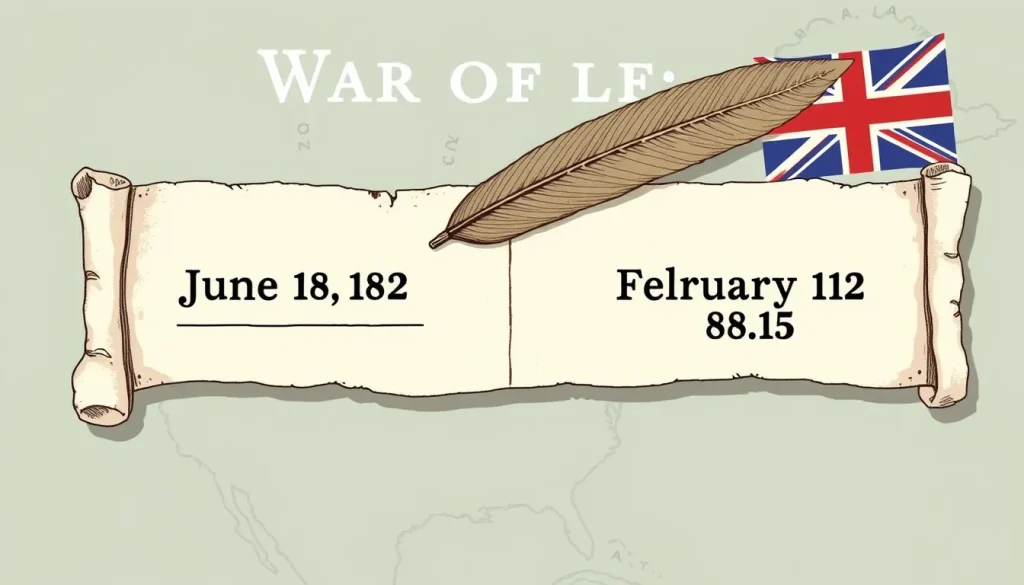
The War of 1812, fought between the United States and Great Britain, began with the American declaration of war on June 18, 1812, and ended when the Treaty of Ghent was ratified by the U.S. Senate on February 17, 1815. This period of two years and eight months included major campaigns on land and sea across North America and the Atlantic. The official duration is often measured from the declaration to ratification, though the treaty had been signed weeks earlier, and some fighting continued afterward.
Historical Context
The war emerged from long-standing tensions between the United States and Great Britain during the Napoleonic Wars (1803–1815). Britain, fighting France, imposed trade restrictions that hurt American commerce, impressed American sailors into the Royal Navy, and supported Indigenous nations resisting U.S. expansion into the Northwest Territory. The United States, seeking to uphold its maritime rights and territorial ambitions, declared war in June 1812. The conflict unfolded across several theaters: the Canada–U.S. border, the Great Lakes, the Atlantic coast, the Chesapeake Bay, and the Gulf Coast. It involved American, British, Canadian, and Indigenous participants, each with distinct objectives.
What Happened
The formal start came on June 18, 1812, when President James Madison signed the declaration of war passed by Congress. The war’s first major engagements occurred in July and August, including the American surrender at Fort Detroit and the naval victory of USS Constitution over HMS Guerriere. Over the next two years, fighting continued across the continent. In 1814, with Napoleon’s defeat in Europe, Britain sent additional troops to North America. British forces burned Washington, D.C., in August 1814, but were repelled at Baltimore and Plattsburgh. Peace negotiations began in Ghent, Belgium, in mid-1814. The Treaty of Ghent was signed on December 24, 1814, but the war did not officially end until both nations ratified it. Britain ratified on December 27, 1814. The U.S. Senate unanimously ratified on February 17, 1815. The Battle of New Orleans, the last major engagement, was fought on January 8, 1815, after the treaty’s signing but before U.S. ratification.
Why It Matters
The two-year-and-eight-month duration shaped how the war is remembered. The conflict ended in a strategic draw, with the Treaty of Ghent restoring the pre-war status quo. The timing of the Battle of New Orleans, which occurred after the treaty was signed but before it took effect, created a perception of American victory and contributed to nationalist sentiment. The length of the war also tested American national unity and highlighted the challenges of fighting a global power at the end of extended supply lines. Historians interpret the duration as a measure of the war’s inconclusive nature, as neither side achieved its stated war aims.
Definition
The duration of the War of 1812 is conventionally defined from the U.S. declaration of war on June 18, 1812, to the date the Treaty of Ghent was ratified by the United States, February 17, 1815. This yields a total of two years and eight months. The treaty itself was signed on December 24, 1814, but the peace did not take effect until ratification by both belligerents.
Background
The war was rooted in the broader conflict between Britain and France. The United States declared war because of British maritime policies—specifically the Orders in Council, which restricted trade, and impressment, the forced recruitment of sailors. Additionally, British support for Indigenous resistance in the Northwest fed American desires to expand and secure the frontier. The war began with American invasions of Canada, which failed, and then developed into a series of campaigns across the continent and at sea.
How It Worked
The official duration is determined by the formal legal instruments. The declaration of war, signed by President Madison, set the start date. The Treaty of Ghent, negotiated between British and American commissioners, set out terms of peace but was not in effect until both governments ratified it. The treaty specified that hostilities would cease upon ratification. Because ratification took time due to transportation across the Atlantic, the war continued technically until February 17, 1815, even though the treaty had been signed nearly two months earlier. The delay in communication also meant that some battles, such as New Orleans, occurred after the treaty signing.
Competing Viewpoints
Historians generally agree on the dates, but they differ on which event should mark the war’s end. Some point to the signing of the Treaty of Ghent on December 24, 1814, as the diplomatic conclusion. Others emphasize the ratification date as the official end, while a few argue that the war truly ended when the last shot was fired—which could be as late as mid-1815 in remote areas where news of peace arrived slowly. The U.S. government and most reference works use the ratification of February 17, 1815, as the date the war officially ended.
Role in the War of 1812
The duration itself played a role in shaping the war’s outcome. The length allowed for multiple shifts in momentum: initial American failures, naval successes, a turning point in 1813 with the Battle of Lake Erie, and then a British counteroffensive in 1814. The prolonged conflict strained American resources and morale but also allowed the United States to field a larger, more experienced army by the war’s end. The eventual treaty, signed after lengthy negotiations, reflected the exhaustion of both sides.
Consequences and Historical Interpretation
The two-year-eight-month span left a complex legacy. For the United States, the ambiguous end was celebrated as a successful ‘second war of independence’ despite not achieving key war aims. For Britain, the war was a side conflict against Napoleon, and its conclusion freed resources for other priorities. For Indigenous nations, the war’s end was catastrophic, as British negotiators abandoned their interests, leading to further land cessions. Later historians have emphasized these varied perspectives, and the duration is often cited to underscore the war’s inconclusive nature.
Primary Sources
The most direct primary sources include the U.S. declaration of war, June 18, 1812, which is preserved in the National Archives. The Treaty of Ghent, signed December 24, 1814, exists in multiple copies, including the U.S. ratified copy at the National Archives. The Senate ratification record from February 17, 1815, documents the official end. Contemporary letters and diaries, such as those of John Quincy Adams, a treaty negotiator, provide insight into the peace process and the delays. Each source offers a specific view: the declaration shows U.S. grievances; the treaty shows negotiated terms; the ratification record shows the formal legal end; and personal accounts reveal the human experience of waiting for news.
Further Reading
- Hickey, Donald R. The War of 1812: A Forgotten Conflict. University of Illinois Press, 1989.
- Stagg, J.C.A. The War of 1812: Conflict for a Continent. Cambridge University Press, 2012.
- Borneman, Walter R. 1812: The War That Forged a Nation. HarperCollins, 2004.
- Benn, Carl. The War of 1812. Osprey Publishing, 2002.
- American Battlefield Trust, “War of 1812 Quick Facts.” [https://www.battlefields.org/learn/articles/war-of-1812-faqs](https://www.battlefields.org/learn/articles/war-of-1812-faqs)
- USS Constitution Museum, “War of 1812 Overview.” [https://ussconstitutionmuseum.org/major-events/war-of-1812-overview/](https://ussconstitutionmuseum.org/major-events/war-of-1812-overview/)
References
- American Battlefield Trust. “War of 1812 Quick Facts.” Accessed 2026. https://www.battlefields.org/learn/articles/war-of-1812-faqs.
- American Battlefield Trust. “10 Facts: The War of 1812.” Accessed 2026. https://www.battlefields.org/learn/articles/10-facts-war-1812.
- American Battlefield Trust. “A Numerical Sketch of the War of 1812.” Accessed 2026. https://www.battlefields.org/learn/articles/numerical-sketch-war-1812.
- USS Constitution Museum. “War of 1812 Overview (1812-1815).” Accessed 2026. https://ussconstitutionmuseum.org/major-events/war-of-1812-overview/.
- USS Constitution Museum. “War of 1812 Chronology (1812-1815).” Accessed 2026. https://ussconstitutionmuseum.org/major-events/war-of-1812-chronology/.
FAQ
Why did the War of 1812 last two years and eight months?
The war lasted from June 18, 1812, to February 17, 1815, because peace negotiations at Ghent were prolonged, and the treaty required ratification by both sides. Slow transatlantic communication delayed the official end.
Was the Battle of New Orleans fought after the war ended?
The Battle of New Orleans was fought on January 8, 1815, after the Treaty of Ghent was signed on December 24, 1814, but before the treaty was ratified by the U.S. Senate on February 17, 1815. Thus, it occurred during the period when the war was technically still ongoing.
When did the War of 1812 officially end?
The war officially ended when the U.S. Senate ratified the Treaty of Ghent on February 17, 1815. Britain had ratified on December 27, 1814, but the treaty required both sides, so the official end for the United States was that date.



Leave a Reply