

Short Answer
The War of 1812 (1812–1815) witnessed the extensive employment of smoothbore muzzle-loading cannon on both land and sea. These weapons—ranging from light field guns to heavy ship-smashing carronades—shaped the course of battles and naval engagements across North America. This article examines the principal types of cannons used by American and British forces, their technical characteristics, tactical roles, and historical significance.
Historical Context
By 1812, the major powers of Europe had developed standardized artillery systems. Britain, the world’s leading naval power, relied on a combination of long guns and carronades for its warships. The United States, a young republic with a small but professional navy, adopted similar weaponry while also developing its own iron-founding industry. On land, both the British Royal Artillery and the U.S. Army employed field guns and howitzers based on French and British designs. The Napoleonic Wars had driven rapid advances in ordnance, and the War of 1812 served as a testing ground for these technologies in North American conditions.
What Happened
During the War of 1812, cannons were used in several distinct contexts: field artillery on battlefields, naval guns aboard warships, and heavy seacoast ordnance in fortifications. Field artillery typically consisted of 6-pounder and 12-pounder guns, with some 18-pounder guns and 5½-inch howitzers. The U.S. Army favored iron guns, while the British used brass (bronze) pieces. In naval service, frigates carried a mix of long guns and carronades; the U.S. frigate Constitution famously mounted 24-pounder long guns and 32-pounder carronades. Coastal defenses in both countries began to experiment with columbiads, heavy guns able to fire shells at high trajectories. These weapons played key roles in battles such as Lundy’s Lane, the bombardment of Fort McHenry, and the great naval duels on the Atlantic and the Great Lakes.
Why It Matters
The cannons of the War of 1812 influenced tactical thinking and technological development. Carronades proved devastating at close range but vulnerable at long range, a lesson absorbed by naval designers. The columbiad foreshadowed later shell guns. Field artillery, though often overlooked, supported infantry and cavalry in ways that became standard for decades. The war also stimulated American iron manufacturing and standardised artillery patterns. Historians have debated the effectiveness of American versus British gunnery, but the conflict undeniably accelerated advances in gun founding and carriage design.
Definition
In the context of the War of 1812, a “cannon” referred to any smoothbore muzzle-loading artillery piece, including guns, howitzers, carronades, and columbiads. Guns were long-barrelled weapons designed for flat trajectories and high muzzle velocity, classified by the weight of their solid shot (e.g., 6-pounder, 12-pounder, 24-pounder). Howitzers had shorter barrels and fired shells on a curved trajectory, often at lower velocities. Carronades were short, lightweight guns developed by the Carron Company of Scotland, designed for close-range broadsides. Columbiads were a U.S. invention, combining features of guns and howitzers for seacoast defense.
Background
Artillery in the early 19th century followed European models. The British Royal Artillery used brass guns (a bronze alloy) for field service, while the United States, with abundant iron ore, cast its field guns in iron. Both nations shared the same calibre system—3, 6, 9, 12, 18, and 24-pounders—making ammunition interchangeable. Naval cannon were typically iron, though some lighter brass pieces were used. The carronade, introduced in the 1770s, was widely adopted by Britain and copied by the United States from the late 1790s onward. The first American carronades were cast at Henry Foxall’s Eagle Foundry in Philadelphia.
How It Worked
All cannons depended on the expansion of gunpowder to propel a projectile. A charge of powder was packed behind a wad, and the projectile rammed home from the muzzle. The vent was primed with powder and ignited by a match. Recoil was managed by the carriage—field pieces on two-wheeled carriages, naval guns on wheeled trucks or slides. Guns used trunnions to mount on the carriage; carronades used a loop and slide system. Calibres were measured in bore diameter (for howitzers) or shot weight (for guns). Windage—the gap between shot and bore—reduced efficiency but allowed quicker loading. Iron guns were heavier and longer-lasting; brass guns were lighter but wore out. Carronades required half the crew of long guns, fired one-third the powder charge, and produced devastating splintering at close quarters.
Competing Viewpoints
Contemporaries and historians have debated the merits of different cannon types. British naval officers initially underestimated American gunnery, but victories such as Constitution vs. Guerriere proved the effectiveness of American long guns and carronades. Some argued that carronades were unsuited for engagements at long range, as demonstrated when British frigates armed largely with carronades suffered defeats. On land, American iron guns were praised for sturdiness, while British brass guns were valued for mobility. Later historians have noted that both sides made tactical errors, and that the war was won by combined-arms operations rather than artillery alone.
Role in the War of 1812
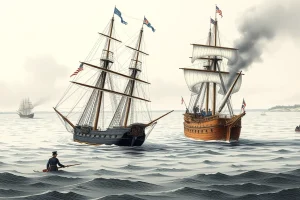
Field artillery accompanied every major campaign. At the Battle of Lundy’s Lane (1814), American and British gunners duelled for hours with 6- and 12-pounders. Naval cannon decided single-ship actions: Essex, armed largely with carronades, captured Alert in 1812; Constitution used a mix of long guns and carronades to defeat Java and later Cyane and Levant. On the Great Lakes, squadrons mounted heavy guns that controlled inland waterways. Coastal forts were equipped with columbiads and large-calibre guns, such as those that defended Baltimore in 1814. The war saw cannons used in sieges, bombardments, and naval blockades, making them indispensable to both sides.
Consequences and Historical Interpretation
The War of 1812 marked the end of the naval carronade era; post-war navies reverted to larger long guns and shell guns. The columbiad evolved into the famous American seacoast guns of the mid-century. Field artillery remained central to land warfare until the advent of rifled artillery in the 1850s. Historians have interpreted the conflict as a proving ground for American ordnance industry, particularly the iron industry that later armed the Union and Confederacy. The war also reinforced the importance of professional artillery training, leading to the establishment of institutions like the U.S. Artillery School at Fort Monroe.
Primary Sources
Contemporary records include naval armament lists, ordnance reports, and letters from officers. The American State Papers contain naval and military correspondence, such as the 1807 letter from Secretary of the Navy Robert Smith to Colonel Samuel Hughes concerning the casting of 24-pounder guns for Constitution. Naval captains’ after-action reports describe the performance of specific guns. For field artillery, the writings of British artillery officers like Sir George Wood and American ordnance officials provide details. These sources, while invaluable, often contain bias—commanders may overstate damage or understate losses. Cross-referencing multiple sources is essential.
Further Reading
- Napoleon Series: War of 1812 Issue 12, Donald E. Graves, “Field Artillery of the War of 1812” (online reprint).
- Spencer C. Tucker, “Armaments and Innovations: The U.S. Navy’s ‘Smashers’,” Naval History Magazine, Vol. 28, No. 6 (2014).
- Tyrone G. Martin, “Constitution’s Wartime Gun Batteries,” Napoleon Series: War of 1812 Issue 3 (2006).
- Francis F. Beirne, The War of 1812 (New York: E.P. Dutton, 1949), esp. ch. 12.
- Wikipedia, “Columbiad” (accessed 2025).
References
- Donald E. Graves, “Field Artillery of the War of 1812,” Napoleon Series: War of 1812 Issue 12, https://www.napoleon-series.org/military-info/Warof1812/2009/Issue12/c_Artillery.html.
- Spencer C. Tucker, “Armaments and Innovations: The U.S. Navy’s ‘Smashers’,” Naval History Magazine, Vol. 28, No. 6 (2014), https://www.usni.org/magazines/naval-history-magazine/2014/december/armaments-and-innovations-us-navys-smashers.
- Tyrone G. Martin, “Constitution’s Wartime Gun Batteries,” Napoleon Series: War of 1812 Issue 3, https://www.napoleon-series.org/military-info/Warof1812/2006/Issue3/c_ussconstitutionguns.html.
- Francis F. Beirne, The War of 1812 (New York: E.P. Dutton, 1949).
- “Columbiad,” Wikipedia, https://en.wikipedia.org/wiki/Columbiad.
FAQ
What was the most common field gun in the War of 1812?
The 6-pounder gun was the most common field gun used by both the British and American armies during the War of 1812.
Why were carronades nicknamed 'smashers'?
Carronades at close range produced large irregular holes and extensive splintering, causing casualties from wooden splinters; hence the nickname 'smashers'.
Did the U.S. use columbiads in the War of 1812?
Yes, early columbiads were built for coastal defense in the years before the war, and a few were emplaced in forts, though they were not widely adopted until later.

Leave a Reply