
Short Answer
The Battle of Emuckfaw and Enotachopo Creek (also spelled Emuckfau and Enitachopco) comprised a series of engagements fought from January 22 to 24, 1814, during the Creek War, a theater of the War of 1812. Located approximately 20–50 miles northeast of the Horseshoe Bend on the Tallapoosa River in present-day Alabama, the clashes pitted American forces under Major General Andrew Jackson, supported by allied Lower Creek and Cherokee warriors, against Red Stick Creek warriors. Although tactically inconclusive, the fighting marked a critical moment in Jackson’s campaign, as the Red Sticks missed their best opportunity to destroy his army, and Jackson withdrew to Fort Strother to regroup.
Historical Context
The Creek War (1813–1814) erupted as a civil conflict within the Creek Confederacy, with the Red Stick faction—influenced by British agents and the Prophet Tenskwatawa—opposing the accommodationist policies of the Lower Creeks and Cherokees. American expansion, trade disputes, and the War of 1812 exacerbated tensions. After the Battle of Talladega in November 1813, Jackson’s Tennessee militia faced severe supply shortages and disciplinary problems as short-term enlistments expired. By late 1813, Jackson’s force had dwindled to a single regiment, and he was desperate for reinforcements. When a draft of 900 raw recruits arrived unexpectedly on January 14, 1814, Jackson resolved to use them before their sixty-day enlistments expired, marching toward the Creek village of Emuckfaw to cooperate with the Georgia Militia.
What Happened
Jackson departed Fort Strother on January 17, 1814, with approximately 175 militia, 30 artillerymen, and about 200 Lower Creek and Cherokee allies. The force advanced through difficult terrain toward Emuckfaw. On January 22, while encamped about 12 miles from the village, Jackson’s camp was attacked at dawn by a strong Red Stick force. After about thirty minutes, the attackers were driven off. Jackson ordered General John Coffee with 400 men to burn the nearby Red Stick camp, but Coffee, seeing the strength of the enemy position, withdrew. The Red Sticks then attacked again, and Coffee was seriously wounded while leading a flanking party. The Americans drove off the Creeks, but with losses and dwindling supplies, Jackson decided to retreat to Fort Strother.
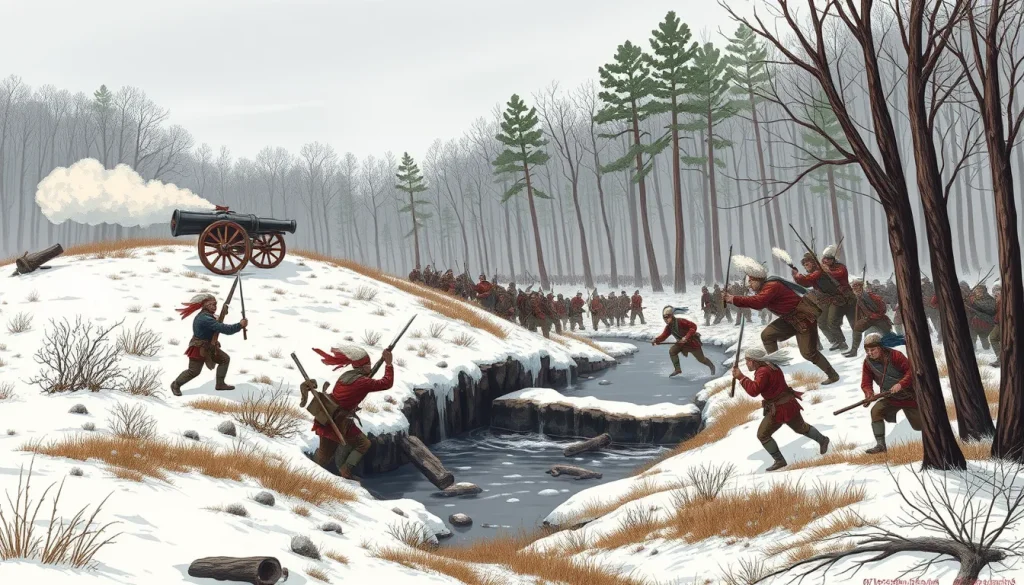
On January 24, while re-crossing Enotachopo Creek, the rear guard panicked under a Red Stick ambush. Many fled across the stream, leaving only about 100 men—including Captain Russell’s company of spies, a detachment under Colonel William Carroll, and Lieutenant Armstrong’s artillery—to hold the ford. Armstrong’s cannon, loaded with grapeshot, helped repel the attackers despite the loss of rammer and pricker. Jackson and Coffee rallied the fugitives, and the Red Sticks were eventually driven off. Jackson then completed his withdrawal, reaching Fort Strother on January 27.
Why It Matters
The engagements at Emuckfaw and Enotachopo Creek, though tactically inconclusive, had strategic significance. The Red Sticks, despite their numerical superiority and the momentary panic they caused, failed to destroy Jackson’s army, which would prolong the war and allow Jackson to resupply and reinforce. Jackson’s leadership during the crisis, including his ability to rally panicked troops, bolstered his reputation. The battles demonstrated the fragility of the American forces—raw militia, short enlistments, and supply problems—while also showing the resilience of the Red Sticks. Historians interpret the result as a missed opportunity for the Red Sticks, one that paved the way for Jackson’s decisive victory at the Battle of Horseshoe Bend in March 1814.
Prelude
After the Battle of Talladega, Jackson’s army was plagued by desertion and expiring enlistments. General John Coffee, sent to Tennessee for remounts, reported that his cavalry had deserted. By the end of 1813, Jackson had only a single regiment, with enlistments due to expire in mid-January. Governor Willie Blount had ordered a new levy of 2,500 troops, but they would not arrive until late February. When 900 raw recruits arrived on January 14, Jackson had only 103 seasoned troops. Facing sixty-day enlistments, Jackson decided to strike immediately, hoping to cooperate with the Georgia Militia and prevent the Red Sticks from consolidating.
Forces and Commanders
The American force consisted of about 175 militia and 30 artillerymen, supplemented by roughly 200 Lower Creek and Cherokee warriors. Commanders included Major General Andrew Jackson, Brigadier General John Coffee, and field officers such as Colonel William Carroll, Colonel Nicholas T. Stump, and Colonel Perkins. The Red Stick force numbered between 400 and 500 warriors, led by Red Eagle (William Weatherford) according to some accounts, though the command structure is not fully documented. The Red Sticks were fighting to resist American encroachment and maintain their independence.
Battlefield and Map Context
The engagements occurred near the headwaters of Emuckfaw Creek and Enotachopo Creek, tributaries of the Tallapoosa River, in what is now Tallapoosa and Clay counties, Alabama. The terrain was rugged, with dense woods and deep ravines. The fords across these creeks offered natural ambush points. The sites lay roughly 20–50 miles northeast of the Horseshoe Bend, where the decisive battle would occur in March 1814. Modern roads and markers near Goodwater, Alabama, identify the locations.
Battle Chronology
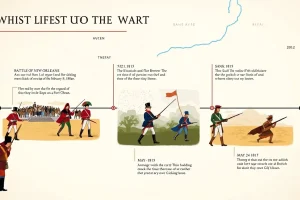
January 22, 1814: Jackson’s camp, about 12 miles from Emuckfaw, is attacked at dawn by Red Sticks. The attack is repelled after thirty minutes. Coffee’s counterattack fails to engage the enemy camp. The Red Sticks attack again, and Coffee is wounded. The Creeks are driven off with heavy losses.
January 23–24: Jackson decides to retreat. The army moves slowly with wounded, crossing Enotachopo Creek on January 24. During the crossing, a Red Stick ambush causes the rear guard to panic. A small force under Carroll and Armstrong, with artillery support, holds the ford until Jackson restores order. The Creeks are driven off and pursued for two miles.
Casualties and Losses
Casualty figures vary by source. American losses are commonly reported as 24 killed and 71 wounded, though some accounts give 20 killed and 75 wounded. Red Stick losses are even more disputed: Wikipedia’s summary cites 54 killed, while other accounts, such as that from Alabama Pioneers, report 189 killed and more than 200 wounded, citing statements from Jackson and later estimates from prisoners. Jackson’s own report claimed 189 bodies found. The discrepancy likely reflects different counting methods and possibly the combined losses of both engagements.
Result
The battle is generally considered indecisive. Jackson withdrew to Fort Strother, which the Red Sticks interpreted as a victory, boasting that they had “whipped Capt. Jackson and drove him to the Coosa River.” Jackson, however, preserved his army and avoided destruction. Both sides claimed success, but the strategic advantage lay with Jackson, who regrouped and resumed the offensive in March.
Strategic Consequences
The Red Sticks missed their best opportunity to annihilate Jackson’s small, inexperienced army. If they had pressed their advantage during the panic at Enotachopo Creek, the American campaign might have collapsed, potentially prolonging the war and altering the balance in the Southeast. Instead, Jackson returned to Fort Strother, received reinforcements, and in late March 1814 delivered a crushing defeat at the Battle of Horseshoe Bend, effectively ending the Creek War and leading to the cession of large tracts of Creek land.
Primary Accounts
Several contemporary accounts exist. Andrew Jackson’s official report to Governor Willie Blount described the battles and his losses. Benson J. Lossing’s Pictorial Field-Book of the War of 1812 (1869) provides a detailed narrative, likely based on Jackson’s papers. The Alabama Pioneers article quotes from later works, including John H. Eaton’s Life of Andrew Jackson and Albert J. Pickett’s History of Alabama. The Clio marker summarizes the battle for a modern audience.
Battlefield Today
The battle site is not a major battlefield park, but a historical marker erected by the Alabama Historical Association in 1953 stands at the intersection of Shady Grove Road (Alabama Route 9) and Alabama Route 63 near Goodwater, Alabama. The marker commemorates the Battle of Enitachopko. The surrounding landscape remains largely rural, with creeks and woodlands. Visitors can access the marker and reflect on the events that occurred there.
Primary Sources
The most relevant primary sources are Andrew Jackson’s official correspondence and reports to Tennessee officials, including his report of February 1814, which detailed the battles and casualties. John Coffee’s letters also provide insight into the campaign. Benson Lossing’s field book, though written decades later, quotes from veterans and official documents. The Alabama Pioneers article compiles excerpts from Eaton and Pickett, which are based on interviews and contemporary records. The Clio marker text provides a concise summary but is not a primary source.
Further Reading
- Adams, Henry. History of the United States of America During the Administrations of James Madison. Library of America, 1986.
- Mahon, John K. The War of 1812. University of Florida Press, 1972.
- Lossing, Benson J. Pictorial Field-Book of the War of 1812. 1869.
- Eaton, John H. Life of Andrew Jackson. 1824.
- Pickett, Albert J. History of Alabama. 1851.
References
- Wikipedia: Battles of Emuckfaw and Enotachopo Creek
- MyWarOf1812.com: Battle of Emuckfaw and Enotachopo Creeks
- Lossing’s Field Book, Chapter XXXIV
- Alabama Pioneers: A major battle took place here Jan. 23
- Clio: Battle of Enitachopko Historical Marker
FAQ
What was the Battle of Emuckfaw and Enotachopo Creek?
It was a series of engagements in January 1814 during the Creek War, between American forces under Andrew Jackson and Red Stick Creek warriors, resulting in an indecisive outcome and Jackson's retreat to Fort Strother.
Why is the Battle of Emuckfaw and Enotachopo Creek significant?
It marked a critical moment where the Red Sticks missed their best chance to destroy Jackson's army, allowing Jackson to regroup and later win the decisive Battle of Horseshoe Bend.
What were the casualties at the Battle of Emuckfaw and Enotachopo Creek?
American losses are commonly given as 24 killed and 71 wounded, while Red Stick losses are disputed, with estimates ranging from 54 killed to 189 killed depending on the source.
Leave a Reply