
Short Answer
The United States Navy achieved remarkable victories in the opening months of the War of 1812, despite being overwhelmingly smaller than the Royal Navy. Between August 1812 and September 1813, American frigates and lake squadrons defeated British warships in a series of single-ship actions and fleet engagements. These successes were not accidental but resulted from careful ship design, experienced officers and crews, and Britain’s strategic commitment to the Napoleonic Wars in Europe.
Historical Context
After the American Revolution, the United States briefly disbanded its navy, only to recreate it in the 1790s to protect commerce from Barbary corsairs and French privateers. The Navy that fought the War of 1812 was small but professional, consisting of about sixteen seagoing warships, including some of the most powerful frigates ever built. These frigates, such as the USS Constitution, were heavily constructed with thicker planking and carried long 24-pounders, giving them an advantage over standard British frigates. Meanwhile, the Royal Navy, engaged in a global conflict with Napoleonic France, had to allocate most of its fleet to European and West Indian stations, leaving only a modest force along the American coast. The American declaration of war in June 1812 was motivated by British impressment of American sailors, trade restrictions, and British support for Indigenous resistance in the Northwest, all of which heightened tensions that had built over two decades.
What Happened
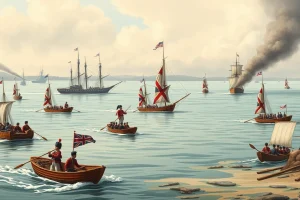
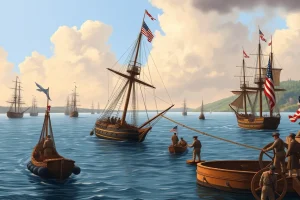
The U.S. Navy’s early success followed a deliberate strategy of escaping from port into the open Atlantic to raid British commerce and challenge individual warships. In August 1812, Captain Isaac Hull in the USS Constitution defeated HMS Guerriere off Nova Scotia, forcing the British frigate to strike after a heavy cannonade. In October, Captain Stephen Decatur in the USS United States captured HMS Macedonian near the Azores, and in December, Captain William Bainbridge in Constitution sank HMS Java off Brazil. These duels were celebrated in the American press and demonstrated that the small U.S. Navy could fight the foremost sea power on equal terms. On freshwater, Commander Oliver Hazard Perry’s victory at the Battle of Lake Erie in September 1813 secured control of that lake and forced the British to evacuate Detroit and the western part of Upper Canada. The U.S. Navy also sent out numerous privateers, which captured hundreds of British merchant ships, disrupting trade and raising insurance rates.
Why It Matters
The early naval victories had immediate psychological and strategic effects. They boosted American morale at a time when land campaigns were faltering, discouraged potential British invasion plans, and persuaded European powers that the United States was a credible maritime nation. Diplomatically, the victories gave American negotiators leverage in peace talks, as the British had to account for losses to a perceived inferior navy. In the long term, these successes established a professional identity for the U.S. Navy and influenced naval architecture and tactics for decades. Historians have debated the significance, with some arguing that the victories were symbolic rather than decisive, since Britain maintained blockade and control of the sea. Others contend that the victories forced the British to allocate more resources to North America, indirectly affecting the course of the war.
Definition
The question of why the U.S. Navy was successful early in the War of 1812 refers to the period from 1812 to 1813, when American men-of-war won a series of frigate duels and the pivotal Battle of Lake Erie against the Royal Navy. Success here means tactical victories in single-ship and lake engagements, as well as the strategic morale boost they provided.
Background
The U.S. Navy’s origins lay in the Quasi-War with France (1798–1800) and the Barbary Wars (1801–1805), which gave officers and crews practical combat experience. The Navy’s ships were built under the Naval Act of 1794, which authorized six frigates specifically designed to be stronger and faster than comparable European frigates. However, by 1812, the Navy had only three heavy frigates operational, and the Marine Corps and naval militia were small. The Royal Navy, with over 600 ships, was the world’s dominant force, but it was stretched thin by the French Revolutionary and Napoleonic Wars. It maintained only about twenty warships on the American station, many of which were old, undermanned, or in poor condition.
How It Worked
The American success rested on several interconnected elements. First, ship construction: the heavy frigates had thicker live-oak hulls and longer scantlings, allowing them to mount heavier cannon and withstand punishment. Constitution’s hull was so strong that British shot reportedly bounced off her sides, earning her the nickname “Old Ironsides.” Second, officers and crews were experienced and well-drilled, often having served in the Barbary War and merchant service. They practiced gunnery and seamanship, achieving faster reload times and more accurate broadsides. Third, British naval forces were scattered and often under-crewed; many British frigates on the American station were crewed by pressed men and had been at sea for years, reducing their effectiveness. Fourth, American strategy avoided fleet actions, instead targeting isolated British warships and commerce, which played to American strengths and avoided overwhelming odds.
Competing Viewpoints
Historians have offered divergent explanations for the American victories. Traditional accounts, such as Theodore Roosevelt’s The Naval War of 1812 (1882), emphasized American technological and tactical superiority, arguing that better-built ships and superior gunnery won the day. Revisionist scholars note that British ships were often undermanned and in need of refit, and that the Americans had the advantage of fighting closer to their own bases, enabling better maintenance and logistics. Some historians also stress the element of luck: the early duels were fought against individually encountered British frigates, none of which were from the elite squadrons. Furthermore, the British public and Admiralty initially treated the losses as minor and blamed them on poor fortune rather than systemic weakness. These competing views reflect the difficulty of isolating a single cause, and modern scholarship tends to combine factors of material quality, personnel experience, and strategic distraction.
Role in the War of 1812
The U.S. Navy’s early successes shaped the military and political landscape of the war. Each frigate victory forced the British to detach additional warships to protect their trade and hunt American raiders, thereby reducing pressure on American maritime commerce in some regions. The Battle of Lake Erie was strategically decisive, as it gave the United States control over the Great Lakes waterway, enabling the recovery of Detroit and the invasion of Canada in 1813. These successes also encouraged the American public and government, which had been divided over the war, and helped justify the existence of a standing navy. On the other hand, the British blockade tightened after 1813, eventually strangling American trade, so the early successes did not prevent long-term economic damage.
Consequences and Historical Interpretation
The early naval victories left a lasting legacy. They established heroic figures like Hull, Decatur, and Perry, and the Constitution became a symbol of national pride. In naval doctrine, the duels demonstrated the value of heavy frigates and the effectiveness of individual ship actions, influencing U.S. Navy shipbuilding into the 1820s. Historians have reinterpreted the victories as part of a broader narrative of American assertiveness at sea, while also noting that they did not change the fundamental balance of sea power. The War of 1812 itself ended in a stalemate, but the early naval successes contributed to a sense of national achievement and set the stage for the later expansion of the U.S. Navy in the mid-19th century.
Primary Sources
Primary accounts include official dispatches from American captains to the Secretary of the Navy, such as Isaac Hull’s report on the action with HMS Guerriere, published in the National Intelligencer in 1812. Captain Stephen Decatur’s letter to the Navy Department detailing the capture of HMS Macedonian is also published in naval records. For the Battle of Lake Erie, Oliver Hazard Perry’s concise report to General William Henry Harrison (“We have met the enemy and they are ours”) is well known, though its complete text is preserved in the National Archives. British records, including court-martial transcripts of British captains who lost ships, provide an enemy perspective, though these are often defensive in tone. Newspapers on both sides reprinted these reports with patriotic commentary, so readers must account for bias.
Further Reading
- Roosevelt, Theodore. The Naval War of 1812. New York: G.P. Putnam’s Sons, 1882.
- Toll, Ian W. Six Frigates: The Epic History of the Founding of the U.S. Navy. New York: W.W. Norton, 2006.
- Hickey, Donald R. The War of 1812: A Forgotten Conflict. Urbana: University of Illinois Press, 1989.
- Dudley, William S., ed. The Naval War of 1812: A Documentary History. 3 vols. Washington: Naval Historical Center, 1985–2002.
References
- Cutler, Thomas J. “Maritime Resurrection: The Rebirth of the American Navy.” Naval History Magazine 38, no. 2 (April 2024). https://www.usni.org/magazines/naval-history-magazine/2024/april/maritime-resurrection-rebirth-american-navy.
- O’Hara, Vincent P. “The Greatest Naval War Ever Fought.” Naval History Magazine 34, no. 5 (October 2020). https://www.usni.org/magazines/naval-history-magazine/2020/october/greatest-naval-war-ever-fought.
- Symonds, Craig L. “The Navy’s Evolutionary War.” Naval History Magazine 25, no. 2 (April 2011). https://www.usni.org/magazines/naval-history-magazine/2011/march/navys-evolutionary-war.
FAQ
What were the key reasons for the U.S. Navy's early victories?
The U.S. Navy benefited from better-built and more heavily armed frigates, experienced officers and crews, and the British Navy's reduced presence in North America due to the Napoleonic Wars.
How did the Battle of Lake Erie affect the war?
The American victory at Lake Erie in September 1813 gave the U.S. control of the lake, allowing recapture of Detroit and strengthening the American position in the West.
Why did the U.S. Navy not maintain its success later in the war?
After 1813, the British reinforced their blockade and squadrons, eventually restricting American naval movements and commerce, though American privateers continued to operate.

Leave a Reply