
Short Answer
On 1 June 1813, the British frigate HMS Shannon defeated the American frigate USS Chesapeake in a single-ship action off Boston, Massachusetts. The victory, which occurred in less than fifteen minutes, was the result of superior British gunnery, training, and command, and it ended the string of American frigate victories that had marked the early naval war. The battle is historically significant for its dramatic reversal of fortunes, its impact on naval morale, and the iconic American cry “Don’t give up the ship.”
Historical Context
By June 1813, the United States Navy had scored a series of stunning single-ship victories over the Royal Navy, including USS Constitution’s defeats of HMS Guerriere and HMS Java, USS United States’s capture of HMS Macedonian, and USS Hornet’s sinking of HMS Peacock. These losses were a profound embarrassment to the British, who prided themselves on naval supremacy. To counter this, the Royal Navy tightened its blockade of American ports, and individual captains sought opportunities to restore honor. One such captain was Philip Bowes Vere Broke, who had commanded HMS Shannon since 1806 and had devoted his long commission to perfecting his crew’s gunnery. Meanwhile, USS Chesapeake had a checkered history, including the 1807 Leopard affair, and had recently returned from a commerce-raiding cruise. In May 1813, Captain James Lawrence, fresh from his victory over HMS Peacock, took command of Chesapeake, but he found a crew that was largely new and insufficiently trained.
What Happened
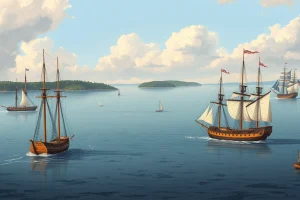
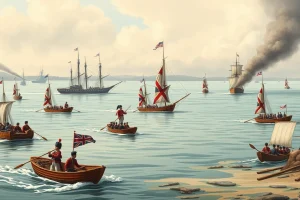
On the afternoon of 1 June 1813, Chesapeake sailed out of Boston Harbor to meet Shannon, which was blockading the port. Broke had sent Lawrence a written challenge, but it never reached him; Lawrence was eager to fight anyway. The two ships, of roughly equal armament, converged off Cape Ann. At about 5:50 p.m., they opened fire at point-blank range. Shannon’s gunnery proved devastatingly accurate, targeting Chesapeake’s command structure. Within minutes, Lawrence was mortally wounded and most of the senior officers were casualties. The American ship lost control and drifted into Shannon, allowing Broke to lead a boarding party onto Chesapeake’s deck. After a brief but fierce hand-to-hand struggle, the British gained control. The battle lasted only about fifteen minutes. Chesapeake suffered over 60 killed and many wounded, while Shannon lost 23 killed and 56 wounded. Broke himself was severely wounded but survived.
Why It Matters
The capture of Chesapeake was a turning point in the naval war. It demonstrated that the American victories were not invincible and restored British confidence. Strategically, it reinforced the effectiveness of the Royal Navy’s blockade and contributed to the eventual British naval supremacy in the Atlantic. For Americans, the defeat was a shock, leading to widespread blame and recrimination. Lawrence’s reported words, “Don’t give up the ship,” became a rallying cry and a symbol of American defiance, even in defeat. The battle also highlighted the importance of training and discipline in naval warfare, a lesson that influenced both navies.
Definition
The question “Why did HMS Shannon defeat USS Chesapeake?” seeks to explain the factors that led to the British victory in the single-ship action of 1 June 1813. The answers involve a combination of superior gunnery, rigorous training, effective command, and the deficiencies of the American ship’s crew and officers.
Background
The background to the battle includes the series of American frigate victories that preceded it, which had created an atmosphere of overconfidence in the United States and a sense of urgency among British captains to restore their service’s reputation. Shannon’s captain, Philip Broke, had spent seven years honing his crew’s gunnery, using innovative aiming techniques and constant drill. In contrast, Chesapeake had recently been refitted, and its crew contained many new and inexperienced sailors. Lawrence, though a capable commander, had not had time to train his men or his officers to the same standard.
How It Worked
Broke’s training regimen was extraordinarily thorough. He introduced notched gun sights, chalked deck markings for angle estimation, and frequent live-fire and dry-fire drills. His gun crews could deliver aimed broadsides rapidly, focusing on the enemy’s quarterdeck and command personnel. In the battle, Shannon’s first broadsides swept Chesapeake’s decks, killing or wounding most of the American officers, including Lawrence. This decapitated the American command structure, leaving the crew disorganized and unable to resist. The British boarding party, well-drilled in small arms, swiftly overwhelmed the remaining resistance. While Chesapeake had a larger crew, numbers alone could not compensate for the loss of leadership and the devastating effect of targeted cannon fire.
Competing Viewpoints
Historians have debated the relative importance of these factors. Some emphasize British superiority in training and gunnery, pointing to Broke’s innovative methods as the decisive element. Others stress American deficiencies: Lawrence’s overconfidence in engaging a well-prepared enemy without sufficient time to train his crew, and the presence of many new officers and sailors. Contemporary American sources sought a scapegoat, with some accounts blaming a black bugler or a junior officer for allegedly failing to carry out orders. Modern scholarship, however, generally agrees that the battle was decided by the professionalism and preparation of Shannon’s crew versus the unpreparedness of Chesapeake’s.
Role in the War of 1812
The defeat of Chesapeake had significant consequences for the War of 1812. It ended the run of American frigate victories and restored British naval prestige. The Royal Navy’s blockade of the American coast was already tightening, and this victory further demonstrated its effectiveness. The battle also influenced the American Navy’s training and doctrine, though the impact was limited by the small size of the force. Ultimately, the action reinforced British naval supremacy and contributed to the strategic stalemate that led to the Treaty of Ghent.
Consequences and Historical Interpretation
The immediate consequence was the loss of a frigate and the death of a popular captain. Lawrence’s martyrdom, memorialized by his dying order “Don’t give up the ship,” became a lasting symbol of American naval honor. Broke, though invalided home, was celebrated as a hero and later knighted. In historical memory, the battle is often cited as a classic example of the importance of training and discipline in naval warfare. It has been the subject of numerous works, from contemporary accounts to modern analyses. The defeat also prompted American introspection about naval preparedness, but it did not fundamentally change the strategic balance, as the war ended in a status quo ante bellum.
Primary Sources
Key primary sources include Broke’s formal challenge letter to Lawrence, which the American captain never received, though it survives in British records. Lawrence’s official report was never completed, but his dying words were reported by survivors. Captain Broke provided a detailed account in his dispatch to the Admiralty. Contemporary newspaper reports and illustrated engravings, such as those by James Webster and others, shaped public memory. These sources offer vivid detail but often reflect national biases and must be evaluated critically.
Further Reading
- Padfield, Peter. Broke and the Shannon. London: Hodder and Stoughton, 1968.
- Hickey, Donald R. The War of 1812: A Forgotten Conflict. Urbana: University of Illinois Press, 1989.
- Lambert, Andrew. The Challenge: Britain Against America in the Naval War of 1812. London: Faber and Faber, 2012.
- Marsh, James H. “HMS Shannon versus USS Chesapeake, War of 1812.” The Canadian Encyclopedia, 2011.
References
- Cray, Robert E. Jr., and J. M. Caiella. “Explaining Defeat: The Loss of the USS Chesapeake.” Naval History Magazine 21, no. 4 (August 2007). usni.org.
- Marsh, James H. “HMS Shannon versus USS Chesapeake, War of 1812.” The Canadian Encyclopedia, 2011. thecanadianencyclopedia.ca.
- Naval Historical Center. “HMS Shannon captures USS Chesapeake, 1 June 1813.” ibiblio.org.
- “Battle between the ‘Shannon’ and the ‘Chesapeake’ 1 June 1813.” navalmarinearchive.com.
- “HMS Shannon vs USS Chesapeake – War of 1812.” thewarof1812.org.
FAQ
Did Captain Lawrence receive Broke's challenge?
No. Broke sent a formal letter of challenge, but it never reached Lawrence before the battle. Lawrence sailed anyway, unaware of the challenge.
How long did the battle last?
The engagement lasted about 15 minutes from the first broadside to the British boarding and capture, though some accounts say as little as 11 minutes.
What was the significance of the defeat?
The loss of Chesapeake ended the string of American frigate victories, boosted British morale, and reinforced the effectiveness of the Royal Navy's blockade, influencing the later course of the naval war.
Leave a Reply