
Short Answer
Naval warfare in the War of 1812 involved the United States Navy and the Royal Navy in a contest that ranged from the Atlantic Ocean to the Great Lakes, the Gulf Coast, and the Pacific. Although Britain dominated the world’s oceans, the conflict was shaped by localized American successes, especially on the Great Lakes, and by the strategic pressure of a sweeping British blockade. Control of water routes directly influenced military campaigns, territorial security, and the final peace negotiations.
Historical Context
The War of 1812 emerged from long-standing grievances over impressment of American sailors, trade restrictions, and British support for Indigenous resistance in the Northwest. The United States, with a navy of fewer than twenty seagoing vessels, faced the Royal Navy, which possessed over six hundred warships. American heavy frigates—such as the USS Constitution, United States, and President—had been designed to outgun and outrun European frigates, offering the new republic a limited but powerful offensive tool.
Naval operations before the war had been shaped by the Quasi-War with France and the Barbary Wars, which produced experienced officers like Stephen Decatur and Isaac Hull. The Royal Navy, meanwhile, was the world’s most powerful maritime force but was spread thin across a global empire. In North America, the principal theatres were the Atlantic coast, the Great Lakes, and the Gulf of Mexico, each with different strategic demands and ship types.
What Happened
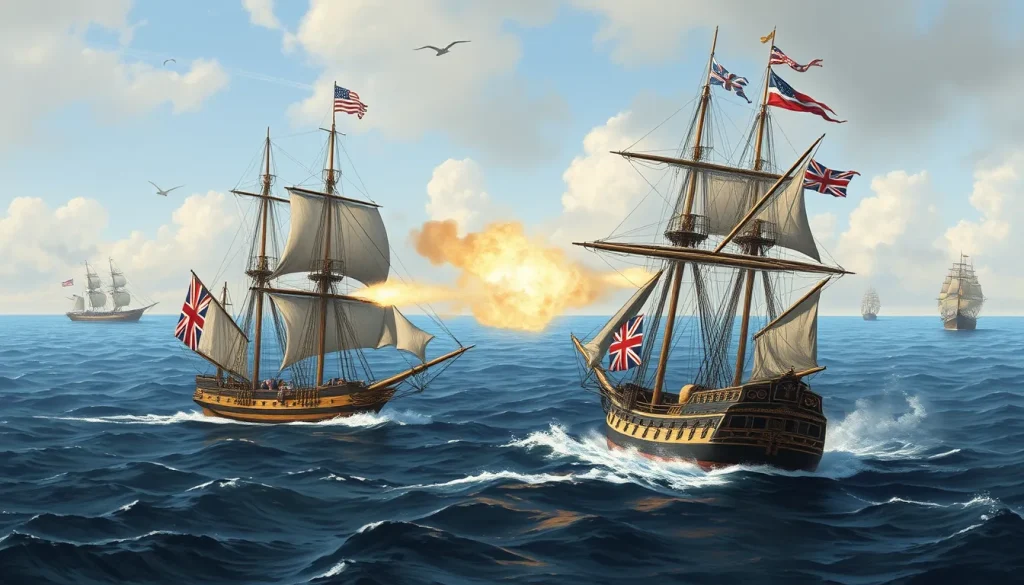
The naval war began with dramatic single-ship victories for the United States. Between August and December 1812, American frigates defeated several Royal Navy frigates in duels that shattered assumptions of British naval invincibility. On 19 August 1812, USS Constitution, under Captain Isaac Hull, fought HMS Guerriere southeast of Halifax. After a close-range exchange, Guerriere was dismasted and burned. The victory gave Constitution the nickname “Old Ironsides” and cost the British fifteen killed and seventy-eight wounded, while American casualties were light.
On 25 October 1812, USS United States, commanded by Stephen Decatur, captured HMS Macedonian off Madeira, bringing the British frigate into an American port. Two months later, USS Constitution, now under William Bainbridge, defeated and destroyed HMS Java off Brazil. Other American warships, including the USS Essex and USS Wasp, also captured British sloops and brigs. These actions demonstrated the quality of American ships and crews, but they did not alter the strategic balance.
British retaliation came in the form of a progressively tightened blockade. Starting with the Chesapeake and Delaware Bays in December 1812, the blockade expanded to the coasts of Virginia, South Carolina, Georgia, and eventually New England (which was initially exempt to exploit anti-war sentiment). The blockade strangled American commerce: exports fell from $61 million in 1811 to about $7 million in 1814. By late 1814, the U.S. Treasury was nearly insolvent.
In 1813, the naval contest shifted to the Chesapeake Bay and the Great Lakes. The Chesapeake became a theatre of British raids and cutting-out expeditions. On 1 June 1813, the British frigate HMS Shannon, under Captain Philip Broke, captured USS Chesapeake after a short and brutal action outside Boston Harbor. This victory ended the American run of frigate successes. Meanwhile, on Lake Erie, an American squadron under Oliver Hazard Perry defeated a British squadron on 10 September 1813 at the Battle of Lake Erie, a pivotal victory that secured American control of the lake and enabled land operations. On Lake Ontario, naval competition continued, with both sides building fleets of brigs, schooners, and sloops.
The Pacific theatre saw the USS Essex, under Captain David Porter, conduct a raiding campaign against British whaling interests. In March 1814, Essex was trapped and captured by a British squadron at Valparaiso, Chile. In January 1815, USS President, commanded by Stephen Decatur, was captured by a British squadron after a running fight. These losses, combined with the blockade, ended American offensive naval operations on the high seas.
Why It Matters
Naval warfare in the War of 1812 had immediate and lasting effects. The early frigate victories boosted American national morale during otherwise unsuccessful land campaigns and gave the U.S. Navy a lasting reputation for professionalism and combat ability. The British blockade, however, was the decisive strategic factor, causing severe economic hardship and forcing the United States to accept peace terms that recognized the status quo ante bellum. On the Great Lakes, American control at the Battle of Lake Erie and later at the Battle of Lake Champlain (September 1814) helped block British invasions from Canada and influenced the peace negotiations.
Historians increasingly view the naval war as regional rather than global. The Atlantic battles were strategic side-show victories that did not undermine British command of the sea, but they had outsize importance for American identity. In contrast, the Great Lakes and Lake Champlain victories were strategically decisive for the defense of the American heartland and for securing territorial integrity in the Treaty of Ghent.
Definition
Naval warfare in the War of 1812 included open-ocean ship duels, commerce raiding, blockades, amphibious operations, and freshwater squadron battles on the Great Lakes. It involved a wide range of vessels, from massive ships of the line to small gunboats and privateers, and served both military and economic purposes.
Background
The United States entered the war with a navy of frigates, sloops, brigs, and gunboats. American frigates were designed as super-frigates, heavier than standard European frigates. The Royal Navy relied on its global fleet of ships of the line and frigates, using them to enforce the blockade and protect trade. Prior to the war, both navies had gained experience in the French Revolutionary and Napoleonic Wars, and the U.S. Navy in the Barbary Wars.
How It Worked
Naval tactics in the Age of Sail emphasized seamanship and gunnery. Single-ship actions often involved maneuvering for favorable firing positions, closing to point-blank range, and delivering heavy broadsides. The British blockade was a fleet-level operation that rotated ships along the American coast, intercepting merchant vessels and imposing economic pressure. On the Great Lakes, naval squadrons used brigs, schooners, and sloops, and battles were fought close to shore, often with calm winds and limited room to maneuver.
Competing Viewpoints
American and British interpretations of the naval war differ. American historians stress the skill and success of the U.S. Navy, while British accounts emphasize the Royal Navy’s overall dominance and the blockade’s decisive role. Some modern historians, like Andrew Lambert, argue that American victories were overrated and that the blockade won the war. Others, like Donald R. Hickey, acknowledge the strategic importance of the blockade but also note that American naval victories helped sustain political will during the conflict.
Role in the War of 1812
Naval warfare shaped every phase of the War of 1812. The early victory at Lake Erie enabled American forces to retake the Northwest and secure the frontier. The Battle of Lake Champlain in September 1814 prevented a British invasion from Canada and forced a British withdrawal. The Atlantic blockade undermined the American economy, made trade impossible, and contributed to financial crisis. Privateers also played a role, capturing over 1,000 British merchant ships but failing to offset the damage of the blockade.
Consequences and Historical Interpretation
The naval war’s major consequences include the growth of the U.S. Navy as a professional force, the emergence of a distinct naval tradition, and the solidification of American maritime identity. It also contributed to the British decision to avoid further naval conflict with the United States and to the long-term improvement of Anglo-American relations after 1815. Historical interpretation has evolved: while 19th-century writers celebrated American frigate victories, modern scholarship emphasizes the strategic importance of the blockade and the inland freshwater campaigns.
Primary Sources
Key primary sources include the multi-volume Naval War of 1812: A Documentary History (Washington: Naval Historical Center, 1985-2015), edited by William S. Dudley and others, which collects official reports, letters, and orders. Theodore Roosevelt’s The Naval War of 1812 (1882) is a foundational secondary study but also draws heavily on primary logs and records. Contemporary newspapers such as Niles’ Weekly Register provide public reactions and casualty lists. Ship logs and captains’ official after-action reports, available at the U.S. National Archives and the U.K. National Archives, are essential firsthand accounts.
Further Reading
- Dudley, William S., and Michael J. Crawford, eds. The Naval War of 1812: A Documentary History. 3 vols. Washington: Naval Historical Center, 1985-2015.
- Roosevelt, Theodore. The Naval War of 1812. New York: G.P. Putnam’s Sons, 1882.
- Hickey, Donald R. The War of 1812: A Forgotten Conflict. Urbana: University of Illinois Press, 1989.
- Lambert, Andrew. The Challenge: Britain Against America in the Naval War of 1812. London: Faber and Faber, 2012.
- American Battlefield Trust. “Naval Engagements in the War of 1812.” Accessed 2025. https://www.battlefields.org/learn/articles/naval-engagements-war-1812.
References
- American Battlefield Trust. “Naval Engagements in the War of 1812.” https://www.battlefields.org/learn/articles/naval-engagements-war-1812.
- “Naval warfare during the War of 1812.” Wikipedia. https://en.wikipedia.org/wiki/Naval_warfare_during_the_War_of_1812.
- American Naval Records Society. “The Naval War of 1812: A Documentary History.” https://www.ibiblio.org/anrs/1812.html.
- Roosevelt, Theodore. The Naval War of 1812. Project Gutenberg. https://www.gutenberg.org/cache/epub/9104/pg9104-images.html.
- “The Atlantic Naval War – War of 1812.” https://thewarof1812.org/campaigns/the-atlantic-naval-war/.
FAQ
What were the most important naval battles of the War of 1812?
Key battles included the USS Constitution's victories over HMS Guerriere and HMS Java, the capture of HMS Macedonian, the Battle of Lake Erie, the Shannon-Chesapeake duel, and the Battle of Lake Champlain.
Why did the British blockade have such a severe economic impact?
The blockade prevented American merchant ships from trading, causing exports to collapse from $61 million in 1811 to roughly $7 million in 1814, which damaged the federal revenue and economy.
How did naval warfare affect the outcome of the war?
American victories on the Great Lakes and Lake Champlain helped defend the northern frontier and influenced peace negotiations, while the British blockade undermined American finances and pressured the United States to negotiate.


Leave a Reply