
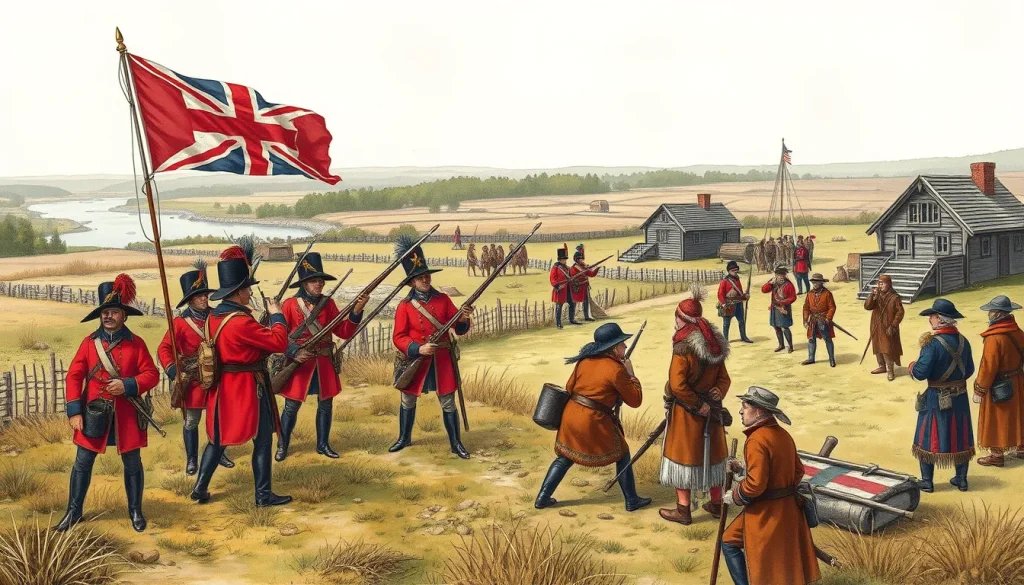
Short Answer
The War of 1812 helped preserve the British North American colonies that later formed part of Canada. American armies repeatedly invaded Upper and Lower Canada, occupied towns, and won several important battles. They nevertheless failed to achieve a lasting conquest. British regulars, colonial troops, militia, naval forces, and Indigenous allies sustained the defense. [^1]
That outcome became central to Canadian historical memory. Yet the familiar account of a small country defeating a larger neighbor needs qualification. Canada was not an independent nation in 1812, the defenders were a coalition, and the preservation of British rule did not secure the long-term objectives of Indigenous nations.
The war’s Canadian story is therefore about military survival, divided communities, alliance, destruction, and the later interpretation of victory.
What Did “Canada” Mean in 1812?
Upper Canada and Lower Canada
The Canada of 1812 differed greatly from the modern country. The Constitutional Act of 1791 divided the former Province of Quebec into Upper Canada and Lower Canada.
“Upper” and “Lower” referred to position along the St. Lawrence water system. Upper Canada lay farther upstream. Lower Canada included the lower river valley, with Montreal and Quebec City as major centers.
Upper Canada contained Loyalist settlements, immigrants from Britain and Ireland, and many settlers who had arrived from the United States. Lower Canada had a predominantly French-speaking population alongside English-speaking communities and imperial institutions. [^3]
Modern provincial boundaries should not simply be projected backward. The people living in these colonies also did not share a single uniform national identity.
British North America Was Larger Than the Canadas
Other British colonies and territories occupied what is now Canada. Nova Scotia and New Brunswick contributed to the wider war effort, while Newfoundland was then a separate British territory.
The Atlantic region supplied ports, soldiers, transportation routes, and maritime infrastructure. Its experiences were connected to the conflict without duplicating the invasions along the Niagara or St. Lawrence.
Calling the conflict a war between the United States and “Canada” is convenient shorthand. More precisely, the United States fought Britain and its allies, including forces recruited in British North America.
Indigenous Homelands Crossed Colonial Boundaries
Indigenous nations occupied territories extending across boundaries claimed by Britain and the United States. Those borders did not erase their political independence, kinship connections, or relationships with the land.
For Indigenous participants, defending Upper Canada might coincide with protecting their own communities, but the two objectives were not identical. An alliance with Britain did not make them ordinary colonial subjects or replace their interests with those of British officials. [^4]
Why Did the United States Invade Canada?
The United States declared war on Britain on June 18, 1812. American grievances included restrictions on neutral trade, impressment of sailors, and British relationships with Indigenous resistance to American expansion. [^5]
Canada became a principal land target because it was accessible. The United States could not easily force a decision by invading Britain, but it could attack neighboring British colonies.
Military Pressure and Territorial Ambition
Conquest might weaken Britain’s position in North America, disrupt its alliance networks, and give American negotiators territory to exchange for concessions.
Some Americans also favored permanent territorial expansion. These motives overlapped: taking a colony could be imagined both as a bargaining instrument and as a future addition to the United States.
American policymakers and military leaders did not all hold the same priorities. Explaining the invasions entirely as an attempt at annexation, or entirely as temporary leverage, simplifies a more varied set of objectives. [^6]
Expectations of an Easy Campaign
Some Americans expected little resistance. They assumed Britain’s European commitments would leave its colonies vulnerable and believed American-born settlers might welcome invading forces.
Those expectations underestimated the difficulty of campaigning across rivers, forests, and weak transportation networks. They also misjudged the ability of British forces and local allies to organize resistance.
The United States possessed a much larger population, but population alone did not produce trained armies, effective command, reliable transport, or control of the lakes. [^7]
Who Defended Canada?
British Regular Soldiers
British regulars supplied much of the defense’s professional military strength. Infantry regiments, artillerymen, engineers, and other specialists were essential to sustained operations.
Their role is sometimes diminished in accounts that emphasize citizen soldiers. The defense was not carried out by local militia alone. British and colonial regular units did much of the fighting. [^8]
Colonial Troops and Militia
Locally raised forces varied substantially. Fencible regiments were regular troops raised for restricted service. Provincial formations and embodied militia could receive sustained training and perform duties quite different from those of part-time local militia.
Militia also supported transport, guarding, labor, and local defense. These tasks were indispensable even when they did not produce famous battlefield stories.
“Militia” should therefore not be treated as a single category of equally trained soldiers. Organization, service obligations, experience, and equipment differed. [^9]
French-Speaking Defenders
French-speaking Lower Canadians were important participants. The Canadian Voltigeurs, Canadian Fencibles, and militia helped defend approaches to Montreal.
Charles-Michel de Salaberry became closely associated with this contribution through the Battle of Châteauguay. His forces used terrain and prepared defenses to stop a larger American advance.
Their service demonstrates cooperation within the defensive coalition. It should not be interpreted as proof that linguistic or political tensions disappeared during the war. [^10]
Indigenous Allies
Indigenous warriors contributed reconnaissance, intelligence, battlefield fighting, and knowledge of local routes.
Tecumseh’s alliance with Britain was particularly important in the western theater. Haudenosaunee warriors, including those associated with the Grand River and Kahnawà:ke, played important roles on the Niagara frontier.
Different Indigenous communities made different decisions. Some supported Britain, some supported the United States, and some sought to avoid involvement. Shared labels such as “Indigenous allies” should not obscure those choices. [^11]
Black Defenders
Black men served in the defense of Upper Canada, including in the segregated unit commonly called the Coloured Corps.
They fought at Queenston Heights and during the Niagara campaigns and later helped construct fortifications. Their contribution combined combat with demanding military labor.
Service did not remove racial inequality. After the unit was disbanded in 1815, its members encountered difficulties and delays in obtaining benefits offered to militia veterans. [^12]
The Campaigns of 1812: Early Survival
Mackinac and the Western Frontier
The capture of the American post at Mackinac in July 1812 strengthened Britain’s position in the upper Great Lakes region.
This theater connected military operations to Indigenous alliances, the fur trade, and communications across enormous distances. Control of a small post could influence relationships and movement far beyond its walls.
The early western successes also challenged American assumptions that British North America would collapse quickly. [^13]
Detroit: August 16, 1812
American general William Hull invaded western Upper Canada from Detroit in July.
British resistance developed under Isaac Brock, with Indigenous forces led by Tecumseh forming an important part of the coalition. Hull withdrew across the river, and Brock’s forces carried the campaign onto American territory.
Hull surrendered Detroit on August 16. The result removed an immediate threat to western Upper Canada and gave the defenders valuable supplies and confidence.
Detroit also shows why “defending Canada” sometimes involved offensive action beyond the colonial boundary. Brock sought to eliminate a base from which another invasion could develop. [^14]
Queenston Heights: October 13, 1812
American forces crossed the Niagara River and gained positions above Queenston.
Brock rushed to the scene and was killed while attempting to recover the heights. Indigenous warriors under John Norton helped contain the Americans until additional forces arrived.
British regulars, militia, and Indigenous allies subsequently forced the invading force to surrender. Brock’s death became a powerful symbol, but the victory depended on the actions of many others after he fell.
Queenston Heights ended this major American attempt on the Niagara frontier and reinforced confidence that the colony could be defended. [^15]
The Campaigns of 1813: Invasion, Recovery, and Loss
York: April 27, 1813
American forces attacked York, the capital of Upper Canada and the settlement that later became Toronto.
The defenders withdrew, and the British destruction of their own powder magazine caused a massive explosion. American general Zebulon Pike was among those fatally injured.
The Americans occupied the town, and public buildings were burned. York’s capture exposed the vulnerability of colonial settlements to attacks supported by naval transport.
It was a significant American success, although occupying the capital did not amount to conquering Upper Canada. The colony’s military defense depended on a wider network of positions and transportation routes. [^16]
Fort George: May 27, 1813
An American amphibious attack captured Fort George near the mouth of the Niagara River.
British forces withdrew toward Burlington Heights, and the Americans gained a substantial foothold from which to advance.
This episode is important because the war did not consist of uninterrupted defensive victories. American forces could conduct successful combined operations and hold territory.
The problem was converting a foothold into a sustained conquest. Supplies, command decisions, naval support, and resistance beyond the landing area continued to matter. [^17]
Stoney Creek: June 6, 1813
British troops launched a night attack against an American force advancing from the Niagara region.
The engagement disrupted the American advance and resulted in the capture of two American generals. The attackers’ success helped prevent the retreat from Fort George from turning into a broader collapse.
Stoney Creek illustrates the importance of timing and surprise. A force with fewer men could influence a campaign by striking before its opponent consolidated its position. [^18]
Beaver Dams: June 24, 1813
An American detachment left the occupied Niagara positions to attack a British outpost.
Indigenous warriors ambushed the force and carried out the fighting that compelled its surrender. Lieutenant James FitzGibbon received the capitulation.
Laura Secord’s warning became a celebrated part of the story, but she was not the only source of intelligence. Indigenous scouts and warriors were fundamental to the outcome.
Remembering Secord and recognizing Indigenous military achievement are compatible. The mistake is allowing the famous civilian journey to replace the history of the people who fought the battle. [^19]
Lake Erie and the Thames
The American naval victory on Lake Erie on September 10, 1813, undermined British supply arrangements in the western theater.
British and Indigenous forces withdrew from the Detroit–Amherstburg area. William Henry Harrison’s army pursued them into Upper Canada.
At the Battle of the Thames on October 5, the Americans defeated the opposing force, and Tecumseh was killed.
This was a serious loss for Britain’s western position and a devastating blow to Tecumseh’s coalition. Its significance cannot be measured only by changes in territory: it damaged an Indigenous political project aimed at resisting dispossession. [^20]
Châteauguay: October 26, 1813
An American army under Wade Hampton advanced toward Montreal through the Châteauguay region.
De Salaberry’s defenders used the river, woods, obstacles made from felled trees, and prepared positions to restrict the attackers. Canadian units and Indigenous allies defeated the attempted advance.
Châteauguay became especially prominent in French Canadian memory because locally recruited forces played a central role.
Accounts that compare army strengths need care. The total troops available, men in reserve, and soldiers actually engaged at particular points were different quantities. [^21]
Crysler’s Farm: November 11, 1813
Another American army moved toward Montreal along the St. Lawrence.
A smaller British-led force, including regulars, colonial units, militia, and Indigenous warriors, fought the Americans near John Crysler’s farm.
The American force withdrew from the battlefield. Together with the failure at Châteauguay, the result helped end the 1813 attempt to capture Montreal.
The strategic importance was considerable. Montreal linked the lower St. Lawrence to the supply system supporting Upper Canada. Losing it could have isolated the colony’s defenses farther west. [^22]
The Campaigns of 1814: A Harder-Fought War
Chippawa: July 5, 1814
A renewed American invasion crossed the Niagara frontier and captured Fort Erie.
At Chippawa, American regulars defeated a British-led force. The performance of troops trained under Winfield Scott demonstrated improvement in the American army.
Chippawa challenges any suggestion that the invaders remained uniformly ineffective. American tactical competence had grown, even though sustained strategic success remained difficult. [^23]
Lundy’s Lane: July 25, 1814
The armies fought a costly battle near Niagara Falls.
Fighting continued into darkness, with repeated attacks around British artillery positions. Both sides suffered heavy casualties and later claimed success.
The Americans withdrew, and the British held the field. The larger result was the interruption of the American advance deeper into Upper Canada.
Lundy’s Lane is best understood as a brutal engagement with disputed claims of victory and clearer consequences for the campaign. A simple triumphal account conceals the scale of suffering on both sides. [^24]
Fort Erie and the End of the Niagara Campaign
The Americans fell back on Fort Erie and resisted a British siege during August and September.
The siege failed, showing that the defenders of British North America did not win every operation. American forces also conducted further movements northward later in the season.
They ultimately abandoned and destroyed Fort Erie in November. The invasion had produced battlefield successes, but no lasting conquest.
Distinguishing the failed British siege from the later American withdrawal is essential. They were separate events, and the second should not be used to erase the first. [^25]
Plattsburgh and Lake Champlain
In 1814, Britain could send additional troops to North America after Napoleon’s first defeat.
Governor-general George Prévost led an invasion into northern New York. Its success depended partly on naval support on Lake Champlain.
The British squadron lost the battle on September 11, and Prévost withdrew his army.
Although fought in the United States, this campaign was closely connected to the defense and strategic position of British North America. It demonstrated that Britain’s larger resources did not guarantee successful operations. [^26]
Canada’s War of 1812 Timeline
| Date | Event | Importance |
|---|---|---|
| June 18, 1812 | United States declares war on Britain | British North American colonies become targets |
| July 1812 | American invasion from Detroit | Western Upper Canada threatened |
| July 17, 1812 | Capture of Mackinac | British position in the upper Great Lakes strengthened |
| August 16, 1812 | Surrender of Detroit | Major early defensive success |
| October 13, 1812 | Queenston Heights | American invasion defeated; Brock killed |
| April 27, 1813 | Capture of York | Upper Canada’s capital occupied |
| May 27, 1813 | Capture of Fort George | Americans establish a Niagara foothold |
| June 6, 1813 | Stoney Creek | American advance checked |
| June 24, 1813 | Beaver Dams | American detachment defeated by Indigenous warriors |
| September 10, 1813 | Lake Erie | British western supply position undermined |
| October 5, 1813 | Thames | American victory; Tecumseh killed |
| October 26, 1813 | Châteauguay | Advance toward Montreal stopped |
| November 11, 1813 | Crysler’s Farm | Second Montreal campaign checked |
| December 1813 | Burning of Newark | Severe civilian destruction |
| July 5, 1814 | Chippawa | American tactical victory |
| July 25, 1814 | Lundy’s Lane | Costly battle interrupts American advance |
| August–September 1814 | Siege of Fort Erie | British siege unsuccessful |
| September 11, 1814 | Lake Champlain | British offensive from Canada collapses |
| November 1814 | Americans abandon Fort Erie | Niagara occupation ends |
| December 24, 1814 | Treaty of Ghent signed | Peace terms agreed |
| February 1815 | Ratifications exchanged | Treaty takes effect |
Why Rivers, Lakes, and Supply Lines Mattered
The defense of Canada depended on transportation as much as battlefield courage.
Supplies arriving from Britain had to move through Atlantic ports and inland routes. The St. Lawrence connected Montreal with positions farther west, but exposed stretches lay close to American territory.
Control of a waterway could determine whether an army received food, ammunition, reinforcements, and equipment. That made Montreal, Kingston, the Niagara corridor, and the western lakes strategically important. [^27]
Lake fleets also required local shipyards. Britain could not simply sail its largest ocean warships past the rapids and waterfalls separating inland theaters.
On Lake Ontario, British commander James Lucas Yeo and American commander Isaac Chauncey combined naval maneuver with shipbuilding competition. Britain’s construction of HMS St. Lawrence in 1814 helped secure a late-war advantage without the ship fighting a battle. [^28]
The Atlantic Colonies and the Wider War
The Canadian story extends beyond Ontario and Quebec.
Halifax served as a British naval base and a center for handling captured ships. The Vice Admiralty Court processed prizes taken during maritime operations. [^29]
New Brunswick provided an overland connection to the interior. In the winter of 1813, soldiers of the 104th Regiment marched from Fredericton toward Kingston to reinforce the defense. [^30]
Local concerns could differ from imperial strategy. Residents of St. Andrews feared raids by privateers and raised money for defensive works, even while maintaining close relationships with neighboring American communities.
War did not automatically sever every cross-border connection. Families, merchants, and settlements could remain linked while their governments fought. [^31]
Civilians: Occupation, Destruction, and Divided Loyalties
The war was unevenly experienced. Many people lived far from major operations; others saw their homes occupied, livelihoods disrupted, or settlements destroyed.
Military demand for food, transport, accommodation, and labor placed pressure on communities near the fighting. Families also bore the consequences of injury, death, absence, and imprisonment.
Women sustained farms, households, and businesses, cared for relatives, and navigated shortages and occupation. Laura Secord became the best-known female participant, but her prominence should not make other women’s experiences invisible. [^32]
The Burning of Newark
In December 1813, withdrawing American forces ordered the destruction of Newark, now Niagara-on-the-Lake.
Residents lost their homes in winter. The burning involved the Canadian Volunteers, men from the colony who had joined the American side.
That detail complicates the image of a completely united population. Colonial politics, personal grievances, and questions of loyalty could divide communities.
British forces subsequently carried destructive operations across the Niagara frontier. The escalation demonstrates how military objectives and retaliation could expose civilians on both sides to severe harm. [^33]
Indigenous Alliances and the Limits of Victory
Indigenous participation was not a supporting subplot. It was central to several campaigns and to the political struggle over the continent’s future.
Tecumseh sought wider cooperation among Indigenous nations against American expansion. British assistance offered weapons and a powerful ally, but British and Indigenous objectives never fully coincided.
Britain wanted to protect its colonies and its wider strategic interests. Indigenous leaders sought security for their communities, autonomy, and homelands. [^34]
The Treaty of Ghent did not establish the Indigenous buffer state Britain had raised during negotiations. Article IX instead addressed ending hostilities and restoring specified prewar rights and possessions.
Those provisions did not stop subsequent dispossession. As the military need for Indigenous alliances declined, colonial governments increasingly pursued Indigenous land for settlement. [^35]
The survival of British Canada and the security of Indigenous peoples were therefore different outcomes. Celebrating the first without examining the second gives an incomplete account of the war.
The Treaty of Ghent: What Changed?
British and American negotiators signed the Treaty of Ghent on December 24, 1814. It took effect after the exchange of ratifications in February 1815.
Its central territorial principle was restoration: occupied places were to be returned rather than retained as permanent wartime conquests.
The Canadas remained under British rule. The United States did not annex them, and Britain did not permanently keep the American territory it had occupied.
The treaty also provided mechanisms for resolving boundary questions. It did not draw every part of the modern Canada–United States border in one step. [^36]
Nor did peace instantly produce mutual trust. Defense planning continued, and later diplomacy was needed to reduce tensions.
Did Canada Win the War of 1812?
From the perspective of defending the colonies against lasting conquest, the war was a success. American invasions did not permanently remove British authority from Upper or Lower Canada.
That is the strongest basis for describing a Canadian victory.
The phrase becomes misleading if it implies that an independent Canadian state fought alone, won every battle, conquered the United States, or secured equal benefits for every participant.
The broader Anglo-American war ended without a decisive overall territorial victory. Canadian defensive success and a wider military stalemate can both be accurate descriptions. [^37]
Did Canadians Burn the White House?
British forces burned public buildings in Washington in August 1814, including the President’s House.
The troops responsible were British forces, not an army of an independent Canada. The popular statement “Canada burned the White House” projects a modern national identity onto an imperial campaign.
British accounts connected the destruction with earlier American attacks in Canada, but a claimed relationship between campaigns does not change the identity of the force that carried out the burning. [^38]
How the War Shaped Later Canada
Survival Without Immediate Nationhood
The defense preserved a separate political development from that of the United States.
It did not make Confederation inevitable. Political reform, economic change, migration, intercolonial negotiation, and imperial decisions shaped the decades between the war and 1867.
The war preserved possibilities; it did not determine every later outcome.
Defense Infrastructure
Wartime experience exposed the vulnerability of supply routes along the St. Lawrence.
The Rideau Canal, opened in 1832, was designed to provide a more defensible connection between the Ottawa River and Lake Ontario, supporting movement toward Kingston.
Its construction was a consequence of continuing security concerns after the war, not a canal project completed during the fighting. [^39]
Diplomacy and Reduced Naval Competition
The Rush–Bagot Agreement of 1817 limited naval armaments on the Great Lakes and Lake Champlain.
The Convention of 1818 addressed additional boundary and diplomatic questions, including the boundary along the 49th parallel from the Lake of the Woods to the Rocky Mountains.
These agreements helped reduce tensions, but peaceful relations developed over time rather than appearing automatically in 1815. [^40]
National Memory and the Militia Legend
Later writers and commemorations presented the war as a foundational national struggle.
Brock, Secord, de Salaberry, and Tecumseh became enduring figures. Monuments and battlefield preservation helped turn particular events into shared public history.
Some narratives overstated the militia’s role and understated the contribution of British regulars. Others included Indigenous allies as symbols of unity while paying less attention to their independent objectives and postwar treatment.
A careful account recognizes local achievement without replacing a coalition war with a simpler national legend. [^41]
Common Misconceptions
Canada Was Already an Independent Country
Upper and Lower Canada were British colonies. Confederation occurred in 1867, and Canada’s autonomy developed through later constitutional changes.
The Canadian Militia Defeated the United States Alone
British regulars, colonial formations, naval personnel, and Indigenous allies were indispensable.
Every Canadian Supported Britain
Many defended the colonies, but loyalty varied. Some inhabitants supported the Americans or sought to avoid the conflict.
The Americans Never Won Battles in Canada
They won important engagements and occupied significant positions. Their failure was to turn those successes into lasting conquest.
Indigenous Allies Fought Only to Create Modern Canada
Their objectives included protecting their own lands, communities, and political independence.
The Treaty Created the Entire Modern Border
It restored occupied territory and established procedures for unresolved boundaries. Other agreements followed.
References
[^1]: Canadian War Museum, The Canadian War: https://www.warmuseum.ca/war-of-1812/explore-history/the-canadian-war/ [^2]: Canadian War Museum, Canadian Outcomes & Legacy: https://www.warmuseum.ca/war-of-1812/explore-history/the-canadian-war/outcomes-legacy/ [^3]: Government of Canada, Discover Canada—Canada’s History: https://www.canada.ca/en/immigration-refugees-citizenship/corporate/publications-manuals/discover-canada/read-online/canadas-history.html [^4]: Canadian War Museum, War Experience: https://www.warmuseum.ca/war-of-1812/explore-history/the-canadian-war/war-experience/ [^5]: National Archives, Treaty of Ghent: https://www.archives.gov/milestone-documents/treaty-of-ghent [^6]: U.S. Army Center of Military History, War of 1812 Campaigns: https://history.army.mil/Research/Reference-Topics/Army-Campaigns/Brief-Summaries/War-of-1812-Campaigns/ [^7]: National Park Service, A Mere Matter of Marching: https://www.nps.gov/articles/a-mere-matter-of-marching-stalemate-at-the-canadian-border.htm [^8]: Department of National Defence, Regiments—Historical Overview: https://www.canada.ca/en/department-national-defence/services/military-history/history-heritage/official-military-history-lineages/lineages/regiments.html [^9]: Parks Canada, Châteauguay Illustrated Glossary: https://parks.canada.ca/lhn-nhs/qc/chateauguay/culture/histoire-history/documentation/natcul1a [^10]: Parks Canada, Châteauguay—Culture and History: https://www.parcs.canada.ca/lhn-nhs/qc/chateauguay/culture [^11]: National Park Service, Indigenous Peoples: https://www.nps.gov/subjects/warof1812/indigenous-peoples.htm [^12]: Parks Canada, Black Militia Units in Upper Canada: https://www.canada.ca/en/parks-canada/news/2016/02/black-militia-units-in-upper-canada-1812-to-1850.html [^13]: Library and Archives Canada, Faces of 1812: https://www.canada.ca/en/library-archives/collection/engage-learn/podcasts/discover/episode-005.html [^14]: Department of National Defence, Detroit: https://www.canada.ca/en/department-national-defence/services/military-history/history-heritage/battle-honours-honorary-distinctions/detroit.html [^15]: Parks Canada, Queenston Heights—Culture and History: https://www.parcs.canada.ca/lhn-nhs/on/queenston/culture [^16]: City of Toronto, Fort York National Historic Site: https://www.toronto.ca/explore-enjoy/history-art-culture/museums/fort-york-national-historic-site/ [^17]: Parks Canada, Battlefield of Fort George: https://www.pc.gc.ca/apps/dfhd/page_nhs_eng.aspx?id=1236 [^18]: Parks Canada, Battle of Stoney Creek: https://www.pc.gc.ca/apps/dfhd/page_nhs_eng.aspx?id=521 [^19]: Parks Canada, Battle of Beaver Dams: https://www.pc.gc.ca/apps/DFHD/page_nhs_eng.aspx?id=524 [^20]: National Park Service, Tecumseh: https://www.nps.gov/people/tecumseh.htm [^21]: Parks Canada, Châteauguay Battle Chronology: https://www.parks.canada.ca/lhn-nhs/qc/chateauguay/culture/histoire-history/evenements-events/natcul1c [^22]: Department of National Defence, Crysler’s Farm: https://www.canada.ca/en/department-national-defence/services/military-history/history-heritage/battle-honours-honorary-distinctions/cryslers-farm.html [^23]: National Park Service, Battle of Chippawa: https://www.nps.gov/articles/battle-of-chippawa.htm [^24]: Parks Canada, Battle of Lundy’s Lane: https://www.pc.gc.ca/apps/dfhd/page_nhs_eng.aspx?id=428 [^25]: Parks Canada, Fort Erie: https://www.pc.gc.ca/apps/dfhd/page_nhs_eng.aspx?id=371 [^26]: National Park Service, Battle of Lake Champlain: https://www.nps.gov/articles/battle-of-lake-champlain.htm [^27]: Parks Canada, Coteau-du-Lac—Events of Historical Significance: https://parks.canada.ca/lhn-nhs/qc/coteaudulac/culture/histoire-history/evenements-events [^28]: Royal Military College of Canada, Launch of HMS St. Lawrence: https://www.rmc-cmr.ca/en/college-commandants-office/launch-hms-st-lawrence [^29]: Parks Canada, Vice Admiralty Court of Halifax: https://parks.canada.ca/culture/designation/evenement-event/cour-halifax-court [^30]: Department of Veterans Affairs, March of the 104th Regiment: https://www.canada.ca/en/news/archive/2013/03/minister-blaney-walks-footsteps-104th-regiment.html [^31]: Parks Canada, St. Andrews—The War of 1812: https://www.parcs.canada.ca/lhn-nhs/nb/standrews/culture/guerre-1812-war [^32]: Canada’s History, Women of 1812: https://canadashistory.ca/explore/women/women-of-1812 [^33]: National Park Service, Newark Burns and Ravages of War: https://www.nps.gov/articles/newark-burns.htm ; https://www.nps.gov/articles/ravages-of-war.htm [^34]: Canadian War Museum, The Native American War: https://www.warmuseum.ca/war-of-1812/explore-history/the-native-american-war/ [^35]: Department of National Defence, In Defence of Their Homelands: https://www.canada.ca/en/department-national-defence/services/military-history/history-heritage/popular-books/aboriginal-people-canadian-military/defence-homelands.html [^36]: National Archives, The Treaty of Ghent: https://www.archives.gov/publications/prologue/2014/winter/poh-treaty-of-ghent ; treaty transcript: https://www.archives.gov/milestone-documents/treaty-of-ghent [^37]: Canadian War Museum, The Canadian War, and National Park Service, Legacies: https://www.warmuseum.ca/war-of-1812/explore-history/the-canadian-war/ ; https://www.nps.gov/subjects/warof1812/legacies-of-the-war-of-1812.htm [^38]: National Park Service, The Ravages of War: https://www.nps.gov/articles/ravages-of-war.htm [^39]: Parks Canada, Rideau Canal: https://www.parks.canada.ca/culture/spm-whs/sites-canada/sec02n [^40]: Office of the Historian, Rush–Bagot Pact and Convention of 1818: https://history.state.gov/milestones/1801-1829/rush-bagot [^41]: C. P. Stacey, The War of 1812 in Canadian History, reproduced in Canadian Military Journal: https://publications.gc.ca/collections/collection_2024/mdn-dnd/d12/D12-11-12-4-eng.pdf
Suggested URL slug: war-of-1812-and-canada
SEO title: The War of 1812 and Canada: Battles, People, and Legacy
Meta description: Explore Canada’s role in the War of 1812, including American invasions, Indigenous allies, major battles, and its lasting legacy.
FAQ
Did Canada win the War of 1812?
Canada was not an independent state in 1812. Its British provinces, defended by British regulars, Canadian militia and fencibles, provincial naval forces, and Indigenous allies, repelled every major American invasion. The Treaty of Ghent restored the pre-war boundary, a result Canadians later commemorated as a successful national defence.
Why did the United States try to invade Canada?
American leaders hoped conquest would end British influence over Indigenous nations on the frontier, provide leverage over maritime grievances, and be quick and cheap. Upper Canada's small population, partly of American birth, led strategists like Thomas Jefferson to expect that taking Canada would be 'a mere matter of marching.'
How large was the Canadian militia's contribution to the defence?
It is debated. Embodied militia flank companies and the Incorporated Militia fought at Detroit, Queenston, Crysler's Farm, and Chateauguay, but most military historians credit British regulars, lake naval forces, and Indigenous warriors with the decisive share of the defence, cautioning against commemoratively inflated militia narratives.
What happened to Canada after the war?
Borders were left unchanged, and the Rush–Bagot agreement of 1817 limited armed vessels on the Great Lakes. Britain's Indigenous allies lost their bargaining position, accelerating American expansion in the Old Northwest, while commemoration of the war became central to English-Canadian identity.

Leave a Reply