
Short Answer
The United States declared war on Great Britain on June 18, 1812. Britain’s struggle against Napoleonic France provided the international setting, while American party politics and competing ambitions in North America shaped the decision. No single incident explains the conflict: grievances at sea and struggles over land reinforced one another. [^1]
The Background: A Neutral Country in a European War
The War of 1812 grew partly out of a conflict thousands of miles from the United States.
Britain and France resumed war in 1803. Their struggle under Napoleon increasingly reached beyond European battlefields into the Atlantic economy. The United States sought to remain neutral, but its ships carried goods through a commercial world dominated by the competing powers.
Neutrality created opportunities for American merchants, yet it could not guarantee their security. Britain and France each wanted to deny resources and trade to the other. American vessels therefore encountered restrictions imposed by governments that treated neutral commerce as part of the enemy’s war effort.
The central problem was that the United States claimed trading rights that the European powers would not consistently respect. It lacked the military strength to make those claims effective everywhere its merchants sailed.
European war did not make an Anglo-American war inevitable. It did, however, create the circumstances in which repeated disputes over ships, cargoes, and sailors became harder to resolve. [^24]
1. British Impressment of Sailors
Impressment was the compulsory recruitment of people into naval service. Before the War of 1812, the Royal Navy boarded American merchant vessels and removed men it identified as British subjects or deserters.
Britain’s war against France demanded large numbers of sailors. Voluntary recruitment could not reliably meet that demand, especially given the danger and harsh conditions of naval service. British authorities defended impressment as necessary to maintain the fleet.
American complaints concerned both the searches themselves and the men taken. British officers did not always distinguish accurately between deserters, British-born residents of the United States, and American-born sailors. Men who regarded themselves as American could be forced to serve a foreign navy.
For those affected, the issue meant lost freedom and separation from home. For the American government, it raised another question: could a foreign officer remove someone from an American vessel without an acceptable legal process? That made impressment a dispute over sovereignty as well as manpower. [^4]
Why Citizenship Made the Dispute Harder to Settle
Britain and the United States disagreed about whether a British subject could change nationality.
British authorities generally treated allegiance to the Crown as enduring. Americans placed greater weight on a person’s ability to become a citizen of another country. Consequently, someone accepted as American in the United States could still be treated as British by a Royal Navy officer.
The later experience of sailor Ned Myers illustrates the disagreement. Born in British North America, Myers considered America his chosen country. British captors during the war regarded his birth allegiance as decisive.
This conflict could not be solved simply by checking a birthplace. It involved rival ideas about citizenship, migration, and the power of governments over individuals. [^5]
How Many Sailors Were Impressed?
Thousands of men described as American were caught in British impressment, but estimates differ by period and definition. The National Park Service presents an estimate of around 6,000 Americans between 1803 and 1812 in one account.
An exact total should therefore be treated cautiously. The historical significance is clearer than the precise number: repeated seizures made impressment a substantial diplomatic grievance and a powerful argument for defending American rights. [^6]
2. British Restrictions on American Trade
Impressment affected crews; trade restrictions threatened ships, cargoes, and commercial livelihoods.
Britain’s Orders in Council regulated neutral commerce connected with France and territories under French influence. These measures operated within a wider system of economic warfare that also included Napoleon’s restrictions on trade with Britain.
American merchants could find themselves exposed to punishment from either side. A trading arrangement acceptable to one belligerent might violate the rules imposed by the other. Remaining officially neutral did not free a ship from those conflicting demands.
Britain’s naval strength made its interference especially consequential. The Royal Navy could enforce restrictions across major ocean routes, giving British policy a direct reach into American commerce.
The issue was therefore more than lost profit. American officials argued that an independent nation should be able to conduct lawful neutral trade without having another power dictate its commercial relationships. The difference between British wartime priorities and American neutral rights became one of the central disputes behind the war. [^21]
3. The Failure of Economic Pressure and Diplomacy
The United States did not immediately answer maritime grievances with war.
President Thomas Jefferson attempted negotiation. The Monroe–Pinkney Treaty, negotiated in 1806, failed to secure the concessions Jefferson wanted on impressment, and he declined to submit it to the Senate. [^3]
The administration then turned toward economic coercion. The Embargo Act of 1807 restricted American overseas trade in the hope that withholding commerce would force Britain and France to change their behavior. Instead, it imposed severe costs on Americans whose livelihoods depended on exports and shipping. [^20]
Congress replaced the embargo with more selective restrictions. The Non-Intercourse Act of 1809 targeted Britain and France, and Macon’s Bill No. 2 in 1810 offered a new arrangement: commerce could resume, with restrictions potentially restored against the power that continued violating American neutral rights.
France’s assurances of a change in policy helped turn American pressure toward Britain, although French interference did not simply disappear. [^3]
The sequence matters because it explains the timing of war. By 1812, supporters of military action could point to years of attempted negotiation and commercial pressure. They argued that these measures had inflicted pain at home without securing dependable respect abroad. Opponents drew a different lesson: economic experiments had already caused damage, and war could make the situation worse. [^20]
4. The Chesapeake–Leopard Affair
One of the most inflammatory incidents occurred five years before the declaration of war.
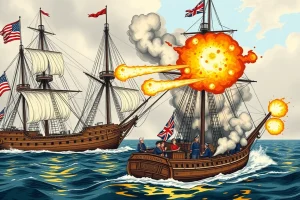
On June 22, 1807, HMS Leopard confronted USS Chesapeake off the Virginia coast. British officers demanded the surrender of alleged Royal Navy deserters. When the demand was resisted, Leopard fired on the American frigate.
Three members of Chesapeake’s crew were killed and eighteen wounded. British personnel boarded the ship and removed four men.
The encounter made the maritime dispute unusually visible. A foreign warship had attacked a vessel of the United States Navy near the American coast. The humiliation strengthened arguments that Britain did not respect American independence.
Nevertheless, the Chesapeake–Leopard affair did not immediately start the War of 1812. The United States continued trying measures short of war. Its importance lay in the anger and distrust it added to an already difficult relationship. [^7]
5. American Expansion and Indigenous Resistance
The conflict’s landward causes developed around the Great Lakes and in the region Americans called the Old Northwest.
American settlers and officials sought land in territories that were Indigenous homelands. Native communities faced pressure through settlement, treaty negotiations, and military force. Their resistance arose from their own interests in land, political autonomy, and survival.
Two important leaders were the Shawnee brothers Tecumseh and Tenskwatawa, also known as the Prophet. They helped build a movement that connected political resistance with religious and cultural renewal.
Tecumseh sought cooperation among Native nations to resist further dispossession. Prophetstown became an important center of the movement.
This perspective changes the explanation of the war. Indigenous resistance was not simply an extension of Britain’s quarrel with the United States. It was a struggle with its own origins and objectives. Native leaders considered alliances with European powers as possible ways to defend their communities against American expansion. [^8]
What Role Did Britain Play?
British traders and officials in Canada maintained relationships with Native peoples, including the provision of supplies and weapons. Britain valued these connections partly because Indigenous allies could help defend British North America.
Many Americans interpreted frontier resistance as evidence that Britain was directing attacks against them. That belief joined local struggles over land to the larger dispute with London.
British assistance was real, but it does not follow that Britain created Indigenous opposition to American settlement. The underlying conflict over homelands existed independently.
The distinction is essential: American accusations reveal why some Americans supported war, while Indigenous aims explain why Native communities resisted expansion. Treating every Native action as a British instruction obscures an important part of the conflict. [^9]
6. The Battle of Tippecanoe and the Escalation of Tensions
The Battle of Tippecanoe, fought on November 7, 1811, intensified the frontier crisis. [^22]
William Henry Harrison advanced against the movement centered at Prophetstown while Tecumseh was away. Fighting followed, and American forces subsequently destroyed the settlement.
Supporters of Harrison presented the confrontation as a victory over a dangerous threat. The battle also strengthened American denunciations of British connections with Native resistance.
Yet its political effects were more complicated than a straightforward American success. The attack deepened Indigenous hostility and helped push Tecumseh’s movement toward closer cooperation with Britain.
Tippecanoe thus illustrates a cycle of escalation: American action intended to weaken resistance helped reinforce the alliance that Americans already feared. The frontier struggle and the approaching Anglo-American war became increasingly intertwined. [^10]
7. The War Hawks and the Politics of National Honor
Grievances did not declare war by themselves. Political leaders had to decide that fighting was preferable to continued negotiation.
The War Hawks were congressional supporters of a stronger response to Britain. Prominent figures included Henry Clay of Kentucky and John C. Calhoun of South Carolina. They called for the defense of American interests and honor. [^17]
Their appeal reached beyond merchants and sailors. Interference at sea could be presented as a test of whether the United States possessed meaningful independence. Frontier concerns gave western supporters additional reasons to favor confrontation.
National honor was therefore a practical political language. It connected separate complaints to a common claim: Britain was treating the United States as a country whose rights could be disregarded.
Domestic party interests also mattered. Madison’s Democratic-Republicans faced internal divisions and Federalist opposition. The possibility of war intersected with debates about leadership, public confidence, and the approaching presidential election.
These political calculations help explain the decision, but they should not replace the underlying disputes. The government had documented complaints about sailors and commerce; politicians differed over what those grievances justified. [^11]
Why Did the United States Attack Canada?
At first glance, invading Canada seems an unusual response to the seizure of sailors on the Atlantic.
The connection was strategic. The United States could not easily invade Britain itself or defeat the Royal Navy in a direct contest for global naval supremacy. British North America was much closer and appeared more vulnerable.
American leaders hoped that capturing Canadian territory would provide leverage to obtain concessions from Britain. Removing British bases near the Great Lakes might also reduce assistance to Indigenous resistance.
Territorial ambition added another incentive. Some supporters saw land as a possible reward of victory. However, expectations varied: conquest could be imagined as permanent expansion, temporary occupation, or a bargaining instrument.
Attacking Canada was therefore both a military strategy and, for some supporters, an expansionist opportunity. It should not be assumed that everyone who voted for war shared the same intention for Canadian territory. [^12]
Was Conquering Canada the Main Cause?
Canada’s prominence as a battlefield does not by itself prove that annexation was the principal cause of the declaration.
A useful distinction is between a grievance, an objective, and a strategy. Impressment was a grievance. Securing maritime rights was an objective. Attacking Canada was a strategy that might also serve territorial ambitions.
The categories overlapped, but they were not interchangeable. Explaining the war entirely as an attempt to acquire Canada loses the importance of the maritime dispute. Explaining it entirely as a defense of sailors loses the significance of land and expansion. [^24]
Why War Against Britain Instead of France?
France also interfered with American shipping, and Madison acknowledged French misconduct in his June 1, 1812, message.
Britain nevertheless became the immediate target. Its navy gave British restrictions extensive practical effect, and impressment created a grievance closely associated with British policy. British connections with Indigenous resistance further widened the dispute beyond commerce.
Madison’s war message outlined a case against Britain while leaving further action concerning France for later consideration. It should be read as a document intended to justify a particular policy, rather than as a neutral summary of every cause.
Its value is substantial: it shows how the president connected the treatment of sailors, commercial restrictions, and alleged frontier interference to the rights of an independent nation. It also shows that declaring war on Britain did not mean the administration considered French conduct acceptable. [^13]
The Decision to Declare War
Madison submitted his message to Congress on June 1, 1812. Under the Constitution, Congress possessed the power to declare war.
The House approved a declaration on June 4, by 79 votes to 49. The Senate approved the measure with amendments on June 17, by 19 votes to 13. Madison signed it on June 18.
These votes demonstrate substantial opposition. War was a decision made by a governing majority, not a response supported by the entire country. [^14]
Federalists opposed the declaration, and some Democratic-Republicans also resisted it. Opponents questioned American military readiness, anticipated commercial losses, and doubted that an invasion of Canada would solve maritime problems.
The partisan division was pronounced: no Federalist in Congress voted for the declaration. Concerns about trade made opposition especially strong in parts of the Northeast, although region and party did not account for every individual position.
Both supporters and opponents recognized costs. They differed over which risk was greater: fighting Britain or accepting continued interference with American rights. [^15]
Did Britain Repeal Its Trade Restrictions Too Late?
On June 23, 1812, five days after the American declaration, Britain announced the revocation of important Orders in Council affecting American commerce.
The order provided for their removal as applied to American vessels and American-owned cargoes from August 1, subject to conditions involving the restoration of relations. The timing is more precise than the familiar statement that Britain simply lifted all restrictions before war began.
News traveled slowly across the Atlantic, and American decision-makers did not have this announcement when they declared war.
Repeal created a possible opening for compromise, but it did not automatically resolve the separate dispute over impressment. Nor did it eliminate frontier grievances and the political commitments already made.
The timing supports a limited conclusion: a major commercial grievance was changing just as war began. Whether faster communication would have prevented the conflict remains a counterfactual question, not an established historical fact. [^16]
Timeline: How the Causes Developed
| Date | Development | Connection to war |
|---|---|---|
| 1803 | Britain and France resume war | European conflict increases pressure on neutral shipping |
| 1806–1807 | French decrees and British Orders in Council intensify economic warfare | American commerce faces competing restrictions |
| June 22, 1807 | Chesapeake–Leopard affair | An attack on an American warship deepens anger |
| December 1807 | Embargo Act | The United States attempts economic coercion |
| 1809 | Non-Intercourse Act | Commercial restrictions become more selective |
| 1810 | Macon’s Bill No. 2 | Congress tries another approach to protecting neutral trade |
| November 7, 1811 | Battle of Tippecanoe | Frontier conflict grows more closely connected to Britain |
| June 1, 1812 | Madison sends his war message | The president presents the case for confrontation |
| June 18, 1812 | Declaration becomes law | Political disagreement produces a decision for war |
| June 23, 1812 | Britain announces revocation of relevant Orders in Council | A possible concession comes after the American declaration |
The sequence distinguishes the long development of grievances from the final political decision. [^3][^7][^10][^14][^16]
Common Misconceptions About the Causes
The Burning of Washington Started the War
British forces burned public buildings in Washington in August 1814, more than two years after the declaration. The destruction belongs to the history of the fighting, not the causes of its outbreak. [^17]
Indigenous Peoples Fought Only Because Britain Told Them To
Native communities had independent reasons to resist American expansion. British alliances were a means of pursuing their own objectives. Different Indigenous nations and leaders also made different choices; they should not be treated as a single political group. [^23]
All Americans Wanted War
The congressional votes and party divisions show the opposite. Disagreement concerned strategy, trade, military readiness, and whether war would protect the republic or endanger it. [^14][^15]
The Peace Treaty Explicitly Ended Impressment
The Treaty of Ghent, signed on December 24, 1814, did not contain an explicit settlement of impressment. It primarily restored peace and provided for the return of conquered territory and the handling of boundary questions.
The absence of an impressment provision reminds readers that a war’s causes and its peace terms need not match. [^17][^19]
Why the Causes Still Matter
The origins of the War of 1812 reveal several conflicts operating together.
For American sailors, the dispute concerned freedom and protection. For merchants, it concerned commerce. For government leaders, it concerned sovereignty and political credibility. For Indigenous nations, it concerned the defense of homelands. For Britain, policy in North America remained connected to the struggle against Napoleon.
Reading these perspectives together makes the war easier to understand. A policy intended to defeat France could provoke the United States; an American campaign intended to secure the frontier could strengthen a British-Indigenous alliance; a proposed defense of maritime rights could become an invasion of Canada.
The strongest explanation therefore connects international pressures, local conflicts, and political decisions. It recognizes that the participants entered the same war with different interests and expectations. [^23][^18]
References and Further Reading
- National Park Service: Causes of War
- Office of the Historian: Napoleonic Wars and the United States, 1803–1815
- National Park Service: Impressment and the War of 1812
- Naval History and Heritage Command: USS Chesapeake–HMS Leopard Affair
- National Park Service: Tecumseh
- National Archives: Congress’s First Declaration of War Under the Constitution
- James Madison: War Message to Congress, June 1, 1812
- UK Parliament: Revocation of the Orders in Council, June 23, 1812
- National Archives: Treaty of Ghent
FAQ
Was the War of 1812 fought only over impressment and maritime rights?
No. President Madison's June 1, 1812, war message emphasized impressment, the blockades, and the Orders in Council, but congressional support also drew on frontier conflicts involving British-allied Indigenous nations, national honor, and expansionist aims. Historians disagree on the relative weight of these causes.
Did Britain try to avoid the war?
Britain revoked the Orders in Council on June 23, 1812, five days after the United States declared war, but the news had not yet crossed the Atlantic. The revocation came too late to prevent the conflict, though it removed the principal trade grievance.
Did the United States go to war to conquer Canada?
Some War Hawks spoke openly of annexing Canada, and invasions of Canada were the main American offensive strategy. Historians disagree over whether annexation was a genuine war aim, a strategic lever against Britain, or primarily political rhetoric.

Leave a Reply