
Short Answer
The Embargo Act of 1807 was a general ban on American foreign trade, enacted by the Tenth United States Congress and signed into law by President Thomas Jefferson on December 22, 1807. It prohibited vessels under United States jurisdiction from clearing for foreign ports, an experiment in “peaceable coercion” intended to force Great Britain and Napoleonic France to respect neutral rights without war. The measure failed to change European policy, inflicted severe damage on the American economy, and was widely evaded; it was replaced in March 1809 and contributed directly to the diplomatic impasse that produced the American declaration of war on Britain in June 1812.
Historical Context
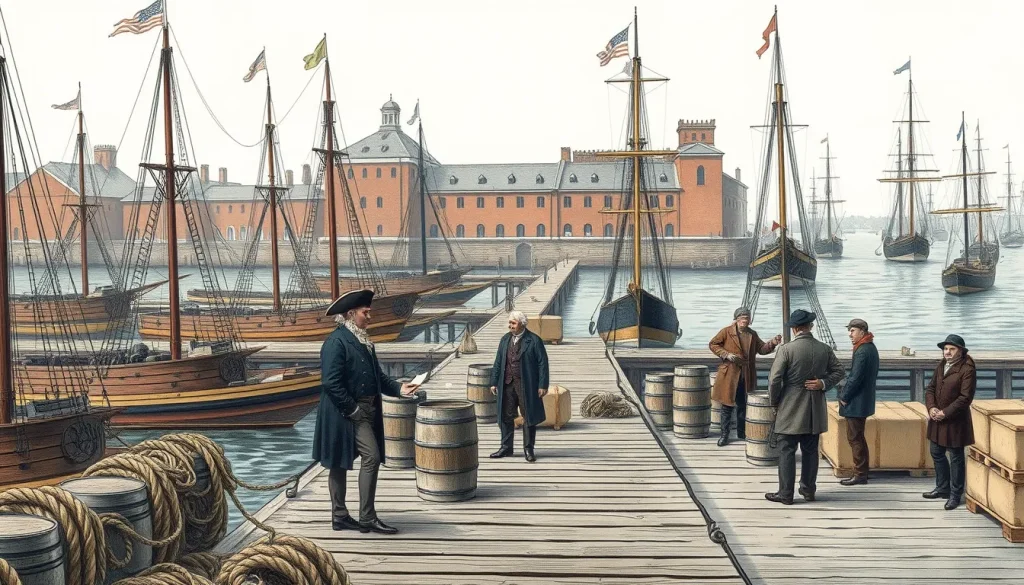
When the war between Britain and France resumed in 1803 after the collapse of the Peace of Amiens, the United States was the world’s principal neutral carrier. American merchants carried French and Spanish colonial produce to Europe and British manufactures to the Americas, and American shipping tonnage expanded rapidly. Both belligerents moved to close this trade. The Royal Navy blockaded much of the European coast; British Orders in Council of 1807 required neutral vessels bound for the Continent to stop in a British port and pay duties, while Napoleon’s Berlin Decree of November 21, 1806, and Milan Decree of December 17, 1807, declared that ships submitting to British regulation were liable to seizure. Neutral commerce was thus exposed to confiscation by whichever power it tried to satisfy.
A second grievance was manpower. The Royal Navy, short of seamen, stopped American merchantmen and removed men it claimed were British subjects, including naturalized American citizens and native-born Americans. The practice had roused American opinion since the 1790s, and the number of impressments rose sharply after 1803. On June 22, 1807, the British frigate HMS Leopard fired on the United States frigate Chesapeake off Norfolk, Virginia, after Chesapeake refused to be searched, killing and wounding a number of men and removing four alleged deserters. Coming after years of seizures and impressments, the affair produced an outcry that pressed Jefferson toward retaliation.
Jefferson believed the country was militarily far weaker than either belligerent and preferred commercial pressure to war. The Non-importation Act of 1806, which restricted certain British imports, had proved ineffective. An embargo offered a broader instrument, and it also promised to bear hardest on the New England mercantile interests that generally opposed Jefferson’s Republican party. Treasury Secretary Albert Gallatin, who would administer the measure, warned that effective enforcement would require a degree of coercion Americans might not tolerate.
What Happened
On December 18, 1807, Jefferson sent Congress a confidential message recommending that American vessels be held in port. That same day the Senate passed a bill introduced by Senator Samuel Smith of Maryland by a vote of 22 to 6. The House amended and passed it on December 21 by 82 to 44, the Senate concurred the following day, and Jefferson signed the Embargo Act on December 22, 1807 (2 Stat. 451). The law laid an embargo on all ships and vessels under United States jurisdiction, barred them from obtaining clearances for foreign ports, allowed the president to make exceptions for vessels under his immediate direction, and directed revenue officers and the Navy to enforce it.
The original statute contained no penalties, and enforcement rested initially on instructions Gallatin issued to customs collectors on December 24, 1807. Congress added supplementary acts in January, March, and April 1808, tightening bonds and restricting coastal and fishing voyages that had become cover for illegal trade, and passed a further Enforcement Act on January 9, 1809, authorizing collectors to seize suspect cargoes and to call on the militia and naval forces. Smuggling nonetheless persisted along the Canadian boundary, through Lake Champlain and the St. Lawrence, across the Georgia and Florida frontier, and by coastal transshipment. Treasury returns showed reported exports falling from about $108 million in 1807 to roughly $22 million in 1808, with imports declining almost as steeply and customs revenue collapsing with them. Because official figures did not capture evasions, the true volume of trade is uncertain, but contemporaries on both sides agreed that enforcement was incomplete.
Economic distress in port cities and in the shipping and export trades provoked bitter opposition, especially in New England. Town meetings, petitions to Congress, and press campaigns denounced the measure; a well-known 1808 caricature showed a snapping turtle labeled Ograbme — “Embargo” spelled backward — biting a merchant. Federalists gained seats in Congress and in state legislatures in 1808, and their presidential candidate, Charles Cotesworth Pinckney, won 47 electoral votes against 14 four years earlier. Jefferson’s own party divided over enforcement. With his presidency ending, Jefferson signed the Non-Intercourse Act on March 1, 1809, which repealed the embargo and substituted a prohibition on trade with Britain and France alone, with a clause promising that trade with either power would resume if that power withdrew its restrictions.
Why It Matters
In the short term the embargo imposed real hardship on American merchants, farmers, and seamen while leaving British and French policy essentially unchanged. It shifted the balance of domestic politics, revived the Federalist party temporarily, and raised hard questions about how far the federal government could go in regulating commerce and policing its own citizens. In the longer term it discredited peaceful economic coercion as a substitute for war. The Non-Intercourse Act of 1809 failed to secure concessions, and Macon’s Bill No. 2 of 1810, combined with Napoleon’s misleading indications that he would relax his decrees, led President James Madison to revive restrictions against Britain. In June 1812 the United States declared war. The embargo is therefore best understood not as a cause of the war in itself but as the first and largest of the failed commercial experiments that narrowed American options before it.
Historians disagree about how completely the embargo failed and why. Jeffrey A. Frankel argued in 1982 that the standard explanations — ineffective enforcement and a greater capacity to damage Britain than to damage the United States — are both questionable, because the embargo did drastically reduce trade in both countries and, in the resulting autarky, the relative price of imported agricultural staples rose more sharply in Britain than the relative price of imported manufactures rose in the United States. Other scholars, including Louis Martin Sears, Burton Spivak, Leonard Levy, and Donald Hickey, have emphasized evasion, the political and constitutional costs of enforcement, and the plain fact that neither belligerent changed its policy. The disagreement turns partly on data — smuggling is inherently hard to measure — and partly on how success is defined: as economic pressure, as diplomatic leverage, or as domestic political viability.
Definition
An embargo is a government order detaining ships in port; it restricts sales abroad rather than purchases from abroad, which distinguishes it from a boycott. The Embargo Act of 1807 was a general embargo on foreign commerce: every vessel under United States jurisdiction was barred from clearing for a foreign port, with presidential discretion to except ships under his immediate direction and enforcement assigned to the customs service and the Navy. It was not a declaration of war but an assertion of commercial sovereignty by a neutral state that could not defend its shipping by force.
Background
The embargo rested on the doctrine often called “peaceable coercion”: the proposition that Britain, dependent on American cotton, grain, timber, and tobacco and on the American market for its manufactures, would suffer enough from the loss of that trade to relax its Orders in Council and stop impressing seamen. Republican leaders, including Jefferson and Madison, had long argued that the United States possessed commercial leverage in place of military strength. The measure also had a domestic political dimension, since the trade most affected was concentrated in Federalist New England. Some historians accordingly read the embargo primarily as an instrument of diplomacy, others as a diplomatic instrument shaped by domestic advantage, and the debate remains unsettled.
How It Worked
Enforcement depended on customs collectors who issued clearances, took bonds, and could refuse permission to sail, supported by revenue cutters and by naval vessels stationed along the coast. The system’s weaknesses appeared immediately. The original act prescribed no penalties, coastal and fishing voyages were permitted and could be used to move goods toward foreign buyers, and Congress allowed merchants to import goods they had purchased abroad before the law took effect. Later statutes narrowed these openings, and the Enforcement Act of January 1809 armed officials with seizure powers and access to the militia, but enforcement became increasingly intrusive and unpopular. Gallatin concluded that only severe measures could make the embargo effective, and he doubted the public would accept them.
Competing Viewpoints
Contemporary opinion divided sharply. Federalists and New England merchants called the embargo ruinous, unconstitutional in its enforcement provisions, and a pretext for partisan advantage; some New England towns discussed resistance, and a few voices raised ideas later associated with nullification. Republicans defended it as a moral alternative to war and as a necessary defense of neutral rights. British officials largely treated it as an inconvenience rather than a crisis, and British shipping adapted by seeking new markets, particularly in Spanish and Portuguese America.
Modern interpretations divide along similar lines. Frankel’s quantitative study challenges the conventional account of enforcement failure and asymmetric damage. Sears, Spivak, Levy, and Hickey stress that the embargo’s domestic costs, the constitutional strain of enforcement, and the absence of any European concession made it a failure by any diplomatic standard, whatever its measurable economic effects on Britain. Part of the disagreement is empirical and part definitional.
Role in the War of 1812
The embargo belongs to the sequence of measures that preceded the war rather than to the war itself. Its repeal in March 1809 opened the way to the Non-Intercourse Act, which restricted trade only with Britain and France; when that too failed, Macon’s Bill No. 2 reopened trade with both powers while promising to exclude the other’s enemy if either lifted its restrictions. Napoleon’s response in 1810 encouraged Madison to revive non-intercourse against Britain, and the failure of every commercial lever left war as the remaining instrument. The embargo also shaped the politics of the war: opposition in New England to the conflict of 1812 drew on grievances formed during the embargo years, and the memory of federal enforcement measures fed later arguments about state resistance to federal power.
Consequences and Historical Interpretation
Economically, the embargo devastated the export trade, ruined many merchants and seamen, and depressed the prices of staple crops, while also encouraging domestic manufacturing, particularly textiles, as Americans substituted home production for imported goods. Politically, it produced a Federalist revival in 1808 and a durable New England grievance, though the party’s association with the Hartford Convention later accelerated its decline. Constitutionally, it expanded federal enforcement powers over commerce and persons. Diplomatically, it failed, and its failure made war more likely.
Interpretations of the episode range from the view that it was a principled attempt at peaceful statecraft undermined by evasion and foreign indifference, to the view that it was a self-inflicted economic wound driven partly by domestic political calculation. Most historians agree that the embargo did not achieve its diplomatic purpose; they disagree about how much real damage it inflicted on Britain, how far enforcement could realistically have succeeded, and whether any American policy short of war could have altered British conduct.
Primary Sources
The central document is the statute itself, An Act laying an Embargo on all ships and vessels in the ports and harbors of the United States, 2 Stat. 451, approved December 22, 1807, together with its supplementary acts, printed in the United States Statutes at Large. Jefferson’s confidential message to Congress of December 18, 1807, states the executive rationale and is available with his other papers through the National Archives’ Founders Online and the published Jefferson papers. Albert Gallatin’s correspondence with Jefferson, including his December 24, 1807, circular to customs collectors and his letter of September 16, 1808, documents the administrative difficulties and the extent of smuggling; these letters survive in the Gallatin and Jefferson papers.
The European side of the dispute is documented by the British Orders in Council of November 11, 1807, and by Napoleon’s Berlin Decree of 1806 and Milan Decree of 1807. On the American response, town meeting resolutions, merchants’ memorials, and petitions to Congress from New England ports during 1808 record the opposition, and partisan newspapers such as the Boston Gazette and the National Intelligencer tracked shipping, prices, and enforcement. The 1808 caricature of the Ograbme snapping turtle, and the young William Cullen Bryant’s satirical poem The Embargo of the same year, show how quickly the policy became a target of popular ridicule. These sources must be used with care: Treasury trade returns understate smuggling, British trade statistics record official values that require adjustment, the press was openly partisan, and Jefferson’s and Gallatin’s letters were written by officials defending their own decisions.
Further Reading
- Henry Adams, History of the United States of America during the Administrations of Thomas Jefferson (1889; multiple modern editions).
- Louis Martin Sears, Jefferson and the Embargo (1927; reprinted 1966).
- Burton Spivak, Jefferson’s English Crisis: Commerce, Embargo, and the Republican Revolution (1979).
- Leonard W. Levy, Jefferson and Civil Liberties: The Darker Side (1963).
- Drew R. McCoy, The Elusive Republic: Political Economy in Jeffersonian America (1980).
- Jeffrey A. Frankel, “The 1807–1809 Embargo Against Great Britain,” Journal of Economic History 42, no. 2 (1982): 291–308.
- Donald R. Hickey, The War of 1812: A Forgotten Conflict (1989; revised editions).
- J. C. A. Stagg, Mr. Madison’s War: Politics, Diplomacy, and Warfare in the Early American Republic, 1783–1830 (1983).
- Founders Online, National Archives, for the Jefferson, Madison, and Gallatin papers; Library of Congress for the United States Statutes at Large.
References
- Frankel, Jeffrey A. “The 1807–1809 Embargo Against Great Britain.” The Journal of Economic History 42, no. 2 (1982): 291–308. https://www.cambridge.org/core/journals/journal-of-economic-history/article/abs/18071809-embargo-against-great-britain/797FA6710692AF3E7E8A9820092757CB
- “Embargo Act of 1807.” Wikipedia. https://en.wikipedia.org/wiki/Embargo_Act_of_1807
- United States Congress. An Act laying an Embargo on all ships and vessels in the ports and harbors of the United States, 2 Stat. 451 (December 22, 1807).
- Sears, Louis Martin. Jefferson and the Embargo. Durham, N.C.: Duke University Press, 1927.
- Spivak, Burton. Jefferson’s English Crisis: Commerce, Embargo, and the Republican Revolution. Charlottesville: University Press of Virginia, 1979.
- Hickey, Donald R. The War of 1812: A Forgotten Conflict. Urbana: University of Illinois Press, 1989.
FAQ
Why did the Embargo Act of 1807 fail?
It failed for several connected reasons: enforcement was incomplete, with smuggling across the Canadian and Florida frontiers and through coastal transshipment; British and French policy did not change; the economic damage to the United States was severe and politically divisive; and the measure's own legal loopholes and weak initial penalties limited its effect. Historians debate how much weight to give each factor; Jeffrey A. Frankel has argued that enforcement was more effective and the economic pressure on Britain greater than the conventional account allows.
Did the Embargo Act cause the War of 1812?
It did not cause the war by itself, but it belongs to the chain of events leading to it. When the embargo and then the Non-Intercourse Act and Macon's Bill No. 2 all failed to secure British concessions on neutral rights and impressment, commercial pressure was exhausted as a policy instrument. The United States declared war on Britain on June 18, 1812, after other long-standing disputes over impressment, blockades, and frontier and Indigenous relations remained unresolved.
Was the Embargo Act popular in the United States?
It was deeply unpopular in New England and other commercial centers whose trade it destroyed, where it was attacked as ruinous, partisan, and constitutionally overreaching. It had more support in the agrarian South and West, where Republicans presented it as a principled alternative to war. Federalists gained seats in Congress and state legislatures in the 1808 elections, and opposition newspapers and public meetings kept up sustained protest.
How much did American trade fall during the embargo?
Reported exports fell from roughly $108 million in 1807 to about $22 million in 1808, and imports and customs revenue declined sharply as well. These Treasury figures are not a complete measure, because they do not capture smuggling and other evasions, and historians differ on the size of the unreported trade.

Leave a Reply