Short Answer
The Battle of the Thames, fought on October 5, 1813, near the Lenape village of Moraviantown along the Thames River in present-day southwestern Ontario, was a decisive American victory in the War of 1812. For many Indigenous nations, however, the battle is remembered less as a single military event than as the moment when Shawnee leader Tecumseh was killed and his intertribal confederacy suffered a blow from which it never recovered. “The Battle of the Thames in Indigenous Memory” therefore refers to the oral traditions, commemorative practices, family histories, and scholarly interpretations through which Shawnee, Lenape, Ojibwe/Chippewa, Wyandot, Potawatomi, Miami, and other Indigenous communities have remembered the battle and its aftermath. Those memories are not monolithic; they reflect different alliances, experiences, and post-war fates.
Historical Context
By 1813, the War of 1812 in the Old Northwest had become entangled with long-running disputes over Indigenous land, sovereignty, and American expansion. Tecumseh and his brother Tenskwatawa, the Shawnee Prophet, had built a confederacy that rejected U.S. land cessions and sought to defend Indigenous territories. When the United States declared war on Britain in June 1812, many Indigenous nations in the Great Lakes region allied with Britain, hoping to check American settlement. Others remained neutral or sided with the United States.
The British post at Amherstburg and the nearby American fort at Detroit made the Detroit frontier a central theater. In 1812, British and Indigenous forces captured Detroit, but the U.S. regained the initiative in 1813. On September 10, 1813, Oliver Hazard Perry’s American fleet won the Battle of Lake Erie, cutting British supply lines to Amherstburg and Detroit. Major-General Henry Procter, commanding British forces in the region, concluded that he could not hold his position. He began a retreat up the Thames River toward Burlington Heights. Tecumseh and his warriors opposed the retreat because it abandoned their homelands west of the Detroit River to possible American attack. The resulting tension between Procter and Tecumseh shaped both the battle and later memory.
What Happened
Procter’s column moved slowly up the Thames with regulars, militia, and Indigenous allies. On October 5, 1813, near Moraviantown, Procter chose to make a stand. He placed his British regulars in a thin line along the road, with the Thames River protecting one flank and a swamp on the other. Tecumseh and several hundred Indigenous warriors took positions in the woods and swamp to the British right.
Major-General William Henry Harrison, commanding the American force, ordered about 1,000 mounted Kentucky volunteers to charge the British line. The British fired a volley, but the line broke under the mounted attack. Procter and a portion of his men fled; many British regulars were captured. In the swamp, Tecumseh’s warriors fought on and inflicted casualties on the American horsemen. During this fighting, Tecumseh was killed. His body was not recovered. American forces subsequently burned Moraviantown, displacing the Christian Lenape community there.
Casualty figures are incomplete and vary among accounts. Commonly cited estimates place American losses at roughly 15 killed and 30 wounded; British losses at about 12 killed, 22 wounded, and several hundred captured. Indigenous losses, including Tecumseh, are not reliably documented. The uncertainty reflects both the chaos of the battle and the fact that Indigenous participants often left no written casualty returns.
Why It Matters
Militarily, the Battle of the Thames ended the British-Indigenous threat along the Detroit frontier for the remainder of the war. The United States regained control of Michigan and the Old Northwest, and Harrison became a national hero. For Britain and Canada, the defeat contributed to Procter’s later court-martial and to a broader reassessment of British strategy in Upper Canada.
For Indigenous nations, the consequences were more profound. Tecumseh’s death deprived the confederacy of its most effective leader and symbol. The alliance that had been built to protect Indigenous lands fractured. In the peace settlement at Ghent in 1814, Britain did not secure a permanent Indigenous homeland, and after the war the United States pressed treaties that forced further land cessions. Many Indigenous communities in the Old Northwest were displaced, while those in Upper Canada increasingly settled on reserves under British colonial supervision.
Memory, however, did not simply record defeat. Tecumseh became a figure of resistance, diplomacy, and pan-Indigenous unity. For some communities, the battle is remembered as a story of betrayal by British commanders. For others, it is a family history of loss, survival, and the secret burial of a leader. Later historians have debated whether the confederacy was already fragile, whether the battle was truly decisive, and how to weigh American, British, Canadian, and Indigenous accounts.
Definition
In this article, “Indigenous memory” means the ways Indigenous peoples have recalled the Battle of the Thames through oral tradition, ceremony, language, place-based knowledge, family stories, and public commemoration. It is not a single archive or a single viewpoint. Shawnee, Lenape, Ojibwe/Chippewa, Wyandot, Potawatomi, Miami, and other nations experienced the battle differently, depending on whether they fought with Tecumseh, remained neutral, or were already displaced. The memory also includes the battle’s aftermath: the burning of Moraviantown, the loss of leaders and relatives, land dispossession, and the long struggle to preserve sovereignty and culture.
Background
Before the battle, Tecumseh’s confederacy was an ambitious but fragile coalition. It drew on grievances shared by many nations, but it also depended on local decisions by chiefs, councils, and warriors. The British alliance provided supplies and military support, yet British priorities did not always match Indigenous goals. When Procter retreated, he prioritized his regulars and the survival of his army; Tecumseh and his allies saw the move as a betrayal of their homelands. This tension is central to Indigenous memory because it explains why the battle was fought where it was and why the aftermath felt like abandonment.
The disruption of memory transmission in the nineteenth and twentieth centuries is also part of the background. Colonial policies, reserve systems, residential schools, and the Sixties Scoop separated generations and suppressed Indigenous languages and ceremonies. As Chippewas of the Thames First Nation members have noted in recent commemorations, these policies broke the chain of teaching that had carried histories from grandparents to grandchildren. Contemporary memory work is therefore also a project of cultural revitalization.
How Memory Has Been Transmitted
Indigenous memory of the Battle of the Thames has been carried through several overlapping channels. Oral histories tell of Tecumseh’s leadership, his speeches, and his death. Some accounts say his body was recovered by his warriors and buried in a secret grave; others say American militiamen mutilated the body. No verified recovery exists, and the uncertainty itself has become part of the story. Songs, dances, and ceremonies in some communities keep alive the names of ancestors and the obligations of alliance.
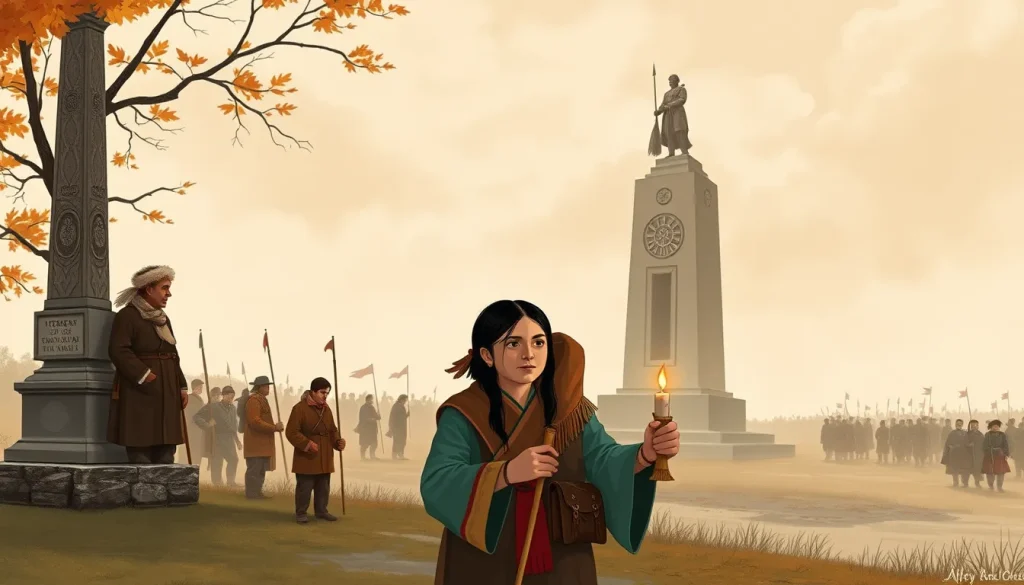
Place is another carrier of memory. The Thames River, Moraviantown, and the area near present-day Thamesville, Ontario, remain reference points. The Tecumseh Monument on Longwoods Road, east of Thamesville, marks one focal point of commemoration. The Chippewas of the Thames First Nation and the Tecumtha Ogitchada Society have organized memorial walks to the monument on the anniversary of Tecumseh’s death. These walks connect physical movement across the landscape with remembrance and with the teaching of Indigenous rights, language, and identity to younger generations.
Written records also preserve memory. Nineteenth- and twentieth-century ethnographers, missionaries, and community historians recorded some oral accounts, though often through non-Indigenous filters. Today, Indigenous scholars and community organizations are reinterpreting those records and placing oral tradition at the center of the history.
Competing Viewpoints
American accounts of the battle have often emphasized Harrison’s victory and the charge of the Kentucky mounted volunteers. A persistent American claim holds that Colonel Richard Mentor Johnson killed Tecumseh, a claim Johnson and his supporters used in his later political career, including his election as vice president. Historians have not been able to verify the claim, and it conflicts with other testimony.
British and Canadian accounts have frequently focused on Procter’s failures: his slow retreat, his decision to stand at Moraviantown, and the collapse of his regulars. Procter’s court-martial and later histories blamed him for the defeat. Some British accounts also blamed Indigenous allies for not holding the swamp, a charge that Indigenous memory often reverses by emphasizing British abandonment.
Indigenous accounts are not uniform. Some nations remember the battle as a heroic stand; others emphasize the devastating loss of Tecumseh and the end of the confederacy. Some communities maintain that Tecumseh’s body was saved; others accept that it was never found. These differences reflect distinct national histories, not simply competing evidence. Historians increasingly treat them as complementary perspectives rather than as one true account against others.
Role in the War of 1812
The Battle of the Thames was a turning point in the War of 1812 on the Detroit frontier. It secured American control of Michigan and the Old Northwest, ended major British offensive operations in the region, and made Harrison a national figure. For the British, it exposed the vulnerability of their alliance with Indigenous nations and contributed to a defensive posture in Upper Canada. For Indigenous nations, the battle was a strategic disaster: it removed the most visible leader of the confederacy, scattered allies, and opened the way for American expansion. Yet it did not end Indigenous resistance. Communities continued to defend their territories, and the memory of Tecumseh later inspired both specific national struggles and broader movements for Indigenous unity.
Consequences and Historical Interpretation
After the battle, American forces burned Moraviantown, and its Lenape residents were displaced. The wider Indigenous alliance in the Old Northwest never regained the strength it had before October 5, 1813. The Treaty of Ghent in 1814 ended the war but did not restore an Indigenous homeland; Britain’s promises to its allies were not fully honored. In the following decades, the United States negotiated a series of treaties that forced land cessions and removal, while Britain settled some Indigenous allies on reserves in Upper Canada.
Historical interpretation has shifted over time. Nineteenth-century American histories celebrated the battle as a victory over Britain and its “Indian allies,” often treating Tecumseh as a noble but doomed figure. Canadian histories sometimes portrayed the battle as a British disaster caused by Procter’s incompetence. Since the late twentieth century, historians of Indigenous history have centered the perspectives of Shawnee, Lenape, Ojibwe, Wyandot, Potawatomi, and other nations, emphasizing sovereignty, alliance, and the long-term consequences of dispossession. The battle is now understood as a site of contested memory: a military defeat for Britain and its Indigenous allies, but also a powerful symbol of Indigenous resistance and survival.
Primary Sources
Key contemporary sources include the official report of Major-General William Henry Harrison to Secretary of War John Armstrong, written after the battle. Harrison described the American charge, the British surrender, and Tecumseh’s death. The report is indispensable for American operations, but it is a commander’s account written to justify his decisions and celebrate a victory.
British sources include Major-General Henry Procter’s official correspondence and the testimony from his later court-martial. These records describe the retreat, the battle line, and the collapse of the British regulars. They are defensive in tone and often blame subordinates or Indigenous allies, so they must be read critically.
American political and military accounts also include the claims of Richard Mentor Johnson, who asserted that he had killed Tecumseh. Johnson’s claim was repeated in newspapers, biographies, and campaign literature. It is a self-interested source, and no independent verification has settled the question.
Indigenous oral accounts are primary sources in a different sense. They were transmitted across generations and sometimes recorded by ethnographers, missionaries, or community historians. They preserve knowledge about Tecumseh’s leadership, his death, and the fate of his body. Because they were often recorded long after the battle and through non-Indigenous intermediaries, they require careful contextualization, but they remain essential to understanding Indigenous memory.
Records from the Moravian Lenape community at Moraviantown and missionary archives provide evidence of civilian displacement and the destruction of the village. They are valuable for the aftermath of the battle, though they reflect the perspectives of missionaries and colonial observers.
Further Reading
- John Sugden, Tecumseh: A Life (New York: Henry Holt, 1998).
- John Sugden, Tecumseh’s Last Stand (Norman: University of Oklahoma Press, 1985).
- R. David Edmunds, Tecumseh and the Quest for Indian Leadership (Boston: Little, Brown, 1984).
- Donald R. Hickey, The War of 1812: A Forgotten Conflict (Urbana: University of Illinois Press, 2012).
- Alan Taylor, The Civil War of 1812: American Citizens, British Subjects, Irish Rebels, and Indian Allies (New York: Knopf, 2010).
- Sandy Antal, A Wampum Denied: Procter’s War of 1812 (Ottawa: Carleton University Press, 1997).
- Carl Benn, The Iroquois in the War of 1812 (Toronto: University of Toronto Press, 1998).
- “Battle of the Thames,” The Canadian Encyclopedia.
- Chippewas of the Thames First Nation, community history and Tecumseh Monument resources.
- Library and Archives Canada, War of 1812 records and British military correspondence.
References
- Canada’s History, “The Battle of the Thames” transcript, https://www.canadashistory.ca/explore/military-war/battle-of-the-thames/the-battle-of-the-thames-transcript.
- Ellwood Shreve, “Chippewas honour Tecumseh, aim to pass on Indigenous heritage,” London Free Press, October 6, 2021, https://lfpress.com/news/local-news/chippewas-honour-tecumseh-aim-to-pass-on-indigenous-heritage.
- John Sugden, Tecumseh: A Life (New York: Henry Holt, 1998).
- John Sugden, Tecumseh’s Last Stand (Norman: University of Oklahoma Press, 1985).
- R. David Edmunds, Tecumseh and the Quest for Indian Leadership (Boston: Little, Brown, 1984).
- Donald R. Hickey, The War of 1812: A Forgotten Conflict (Urbana: University of Illinois Press, 2012).
- Alan Taylor, The Civil War of 1812: American Citizens, British Subjects, Irish Rebels, and Indian Allies (New York: Knopf, 2010).
- Sandy Antal, A Wampum Denied: Procter’s War of 1812 (Ottawa: Carleton University Press, 1997).
- Carl Benn, The Iroquois in the War of 1812 (Toronto: University of Toronto Press, 1998).
- Library and Archives Canada, War of 1812 records and British military correspondence.
FAQ
What was the Battle of the Thames?
Fought on October 5, 1813, near Moraviantown in present-day Ontario, it was an American victory over British and Indigenous forces during the War of 1812. Shawnee leader Tecumseh was killed, and the British force under Henry Procter was defeated.
Why is the Battle of the Thames important in Indigenous memory?
It marks the death of Tecumseh and the fracture of his confederacy, as well as the loss of Indigenous lands and the beginning of harsher removal pressures. It is also remembered as an example of alliance, betrayal, and survival, and is commemorated by descendant communities.
Did Tecumseh’s body ever get recovered?
No verified recovery exists. American accounts and Indigenous oral traditions disagree. Some say his body was taken by his warriors and buried secretly; others say it was desecrated by American militiamen. The uncertainty remains part of the historical memory.

Leave a Reply