
Short Answer
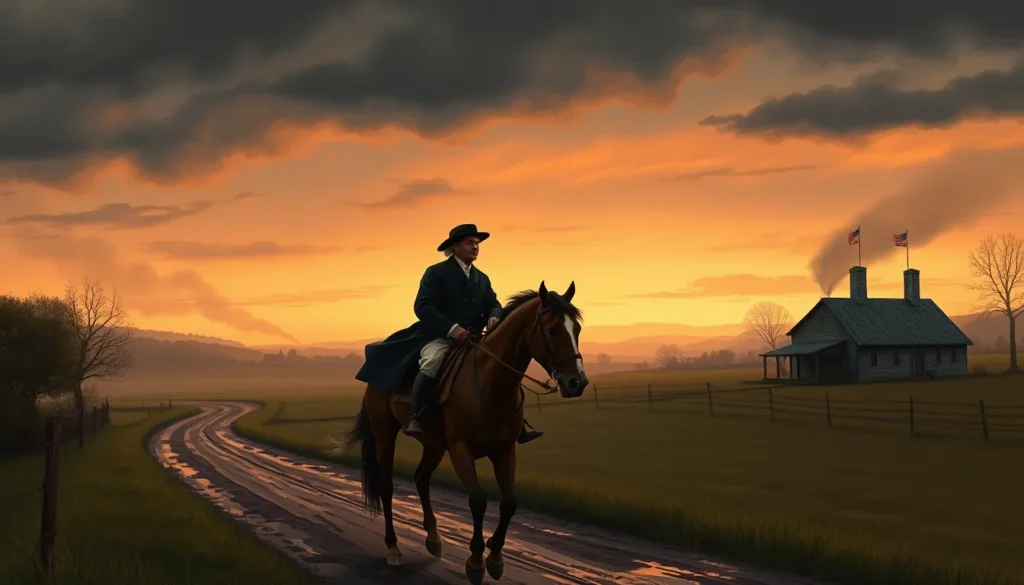
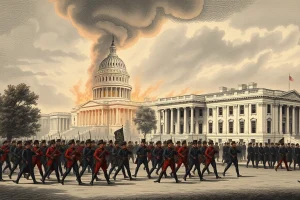
After the American defeat at the Battle of Bladensburg on August 24, 1814, President James Madison and members of his administration evacuated Washington, D.C., as British forces under Major General Robert Ross and Rear Admiral George Cockburn occupied the city and burned its public buildings. Madison did not flee as part of a single, tightly organized cabinet party; the best-documented route is his own, which ran through northern Virginia and Montgomery County, Maryland, ending at the Quaker settlement of Brookeville. There he spent the night of August 26–27, 1814, in the house of Caleb Bentley, a refuge often called the “United States Capital for a Day.” The episode mattered because it exposed the vulnerability of the young republic’s capital and became a central image of the War of 1812’s Chesapeake campaign.
Definition and Scope
This article addresses the specific question of where President James Madison and his cabinet fled during the British burning of Washington in August 1814. In this context, “cabinet” refers to the heads of the executive departments: Secretary of State James Monroe, Secretary of War John Armstrong, Secretary of the Navy William Jones, Secretary of the Treasury George W. Campbell, and Attorney General Richard Rush. The evidence does not support the idea that the president and all department heads moved together as one group. Madison’s personal route is the most fully reconstructed; the movements of individual cabinet officers were more scattered and are less consistently documented. The scope of this article is therefore the evacuation of the president and his administration, with detailed attention to Madison’s known stops and the separate flight of First Lady Dolley Madison.
Background
The burning of Washington was part of the Chesapeake campaign of the War of 1812. In early 1814, the defeat and exile of Napoleon Bonaparte freed British troops and ships for service in North America. Vice-Admiral Alexander Cochrane, commanding the Royal Navy’s North America and West Indies Station, and Rear Admiral George Cockburn, who had long operated in Chesapeake Bay, pressed for attacks along the American Atlantic coast. Cochrane suggested targets including Baltimore, Philadelphia, and Washington. Cockburn favored Washington because of the political effect a successful attack would produce. On July 18, Cochrane ordered Cockburn to destroy and lay waste to assailable towns and districts, though Major General Robert Ross, commanding the British army, was more cautious and refused to burn the entire city.
American forces were unprepared. At the Battle of Bladensburg on August 24, 1814, a British army of veterans routed a larger but poorly organized American force of militia and regulars under Brigadier General William Winder. President Madison was present at the battle, along with Secretary of State James Monroe and other officials. When the American line collapsed, the road to Washington lay open. Madison returned briefly to the President’s House, then left the city as British troops advanced.

How the Evacuation Unfolded
After leaving the Bladensburg battlefield, Madison reached the President’s House at about 4:00 p.m. on August 24. Dolley Madison had already departed, taking or arranging for the removal of important papers and valuables. Despondent and shaken, the president declined food and took only a glass of wine before leaving to avoid capture. He was accompanied by Brigadier General John Mason and Attorney General Richard Rush. Two armed cavalrymen provided by Captain George Graham served as an escort.
Madison’s first stops were in northern Virginia. He paused at Wren’s Tavern in Falls Church to gather news, then went to Minor’s Hill, a high point overlooking Falls Church. The cabin there was crowded with other refugees, so he did not stay. That night, August 24–25, he slept at Salona, a Federal-style farmhouse in what is now McLean, Virginia, owned by the Reverend William Maffitt. Dolley Madison, meanwhile, had left the President’s House and gone to Bellevue, later known as Dumbarton House, in Georgetown. From there she crossed the Potomac River into Virginia.
The president and first lady reunited at Wiley’s Tavern, located on Difficult Run in Fairfax County, Virginia. At midnight on August 25, Madison and his companions left Wiley’s Tavern and headed for Conn’s Ferry on the Potomac. Their objective was to join American troops at Montgomery Court House, now Rockville, Maryland, about sixteen miles away. A severe morning thunderstorm delayed them and made the Potomac impassable. By the time they reached Rockville early in the afternoon of August 26, the troops had already left. The party continued about eleven more miles to Brookeville, Maryland.
At Brookeville, Madison found refuge in the home of Caleb Bentley, a Quaker storekeeper and postmaster. The house served as a temporary executive mansion. On the night of August 26, Madison learned that the British had abandoned Washington, and he ordered his cabinet to return to the city. Brookeville’s brief role as the seat of American government gave it the later nickname “United States Capital for a Day.” Madison returned to Washington after the British withdrawal.
Key Locations and Route
- President’s House (now the White House), Washington, D.C.: Madison’s starting point after the Battle of Bladensburg. He arrived about 4:00 p.m. on August 24 and left soon afterward.
- Wren’s Tavern, Falls Church, Virginia: An ordinary where Madison stopped for news. The tavern no longer stands, but a historical marker identifies the site.
- Minor’s Hill, Virginia: A high elevation overlooking Falls Church. Madison paused there but found the cabin too crowded with other evacuees.
- Salona, McLean, Virginia: A Federal-style farmhouse where Madison spent the night of August 24–25, 1814. It remains a private residence.
- Wiley’s Tavern, Difficult Run, Virginia: The site where Madison reunited with Dolley Madison. The tavern no longer exists.
- Conn’s Ferry and Montgomery Court House (Rockville), Maryland: Madison attempted to join troops there but was delayed by a thunderstorm and arrived after they had left.
- Brookeville, Maryland: A Quaker settlement where Madison spent the night of August 26–27 at Caleb Bentley’s house. The building, known today as the Madison House, is a private residence, and Brookeville is a historic district.
- Bellevue (Dumbarton House), Georgetown: The refuge to which Dolley Madison was escorted on August 24 before she crossed into Virginia. It is now a historic house museum.
Competing Viewpoints
Historians and biographers differ on how to characterize Madison’s flight. Some emphasize the confusion and near-panic of August 24, noting that the president had been present at a disastrous defeat and was nearly captured. Others describe his movements as a necessary evacuation to preserve the continuity of government. The British satirical print “The Fall of Washington—or Maddy in Full Flight” mocked the president, and that image has shaped popular memory. Modern scholars generally avoid the cartoon’s tone, stressing that Madison’s departure was neither cowardly nor well organized but improvised under extreme pressure.
A second point of interpretation concerns the cabinet. The question “where did Madison and his cabinet flee” suggests a single destination, but the evidence indicates a dispersal. Attorney General Richard Rush was with Madison for part of the flight. Secretary of State James Monroe was deeply involved in the military events around Bladensburg and Washington. Other cabinet officers sought safety separately, and their exact routes are not as well documented. Historians also debate whether the British intended to capture Madison. Some accounts assume that was a goal; others emphasize that Ross and Cockburn prioritized destroying public property and avoiding a prolonged occupation.
Role in the War of 1812
The flight and the burning of Washington formed the low point of the American war effort in the Chesapeake. The British occupied the capital for roughly twenty-six hours, burned the Capitol, the President’s House, and other public buildings, and then withdrew. Madison’s escape allowed the executive branch to continue functioning. From Brookeville, he directed cabinet members to return, and within days the government began reassembling in Washington. The episode did not end the war. American forces later held at Fort McHenry in September 1814, and the war continued until the Treaty of Ghent in December 1814 and the Battle of New Orleans in January 1815. Still, the fall of Washington shocked the nation and influenced political debate for years.
Consequences and Historical Interpretation
In the immediate aftermath, Federalist critics blamed Madison and his administration for the capital’s defenselessness. The burning also prompted retaliation claims on both sides: British leaders cited earlier American destruction in Upper Canada, including the burning of York and the raid on Port Dover, as justification. Later historians have placed the raid in the broader context of British strategy, which sought to pressure the United States without occupying large territories. The flight itself became a symbol of executive vulnerability and of the war’s uncertain course.
Historical memory has focused on two enduring images: Dolley Madison saving the Washington portrait and Madison fleeing with papers. Both contain truth but have been simplified. Dolley Madison did arrange for the removal of valuables, and the president did carry or oversee important documents. Brookeville’s role as a temporary capital has also become a point of local pride and public history. The Caleb Bentley house, the Madison House, still stands as a private residence, and Brookeville markets itself as the “United States Capital for a Day.” For historians, the episode illustrates how the War of 1812 exposed the logistical and political weaknesses of the early United States while also demonstrating the resilience of its government.
Primary Sources
Several contemporary sources illuminate the flight, though each has limits. Dolley Madison’s letters from August 1814 describe her preparations to leave the President’s House, the removal of valuables, and her anxiety. They are vivid but personal and do not provide a complete route of the president’s movements. James Madison’s correspondence and official messages from August 1814 offer evidence of his whereabouts and decisions, but they are fragmentary and often written after the fact.
British military and naval dispatches, including Vice-Admiral Alexander Cochrane’s instructions to Rear Admiral George Cockburn in July 1814 and later reports by Major General Robert Ross, present the British perspective on the raid’s purpose. They are official documents shaped by military and political concerns. American newspapers, such as the National Intelligencer, reported the disaster and its aftermath, but early accounts were often incomplete or colored by partisan feeling. The British satirical broadside “The Fall of Washington—or Maddy in Full Flight” (S.W. Fores, 1814) is a visual primary source that shows how the flight was mocked in Britain. Finally, the White House Historical Association’s map and gallery, while based on later research, identify the traditional route and the surviving or lost sites associated with Madison’s flight.
Further Reading
- Anthony S. Pitch, The Burning of Washington: The British Invasion of 1814. Annapolis: Naval Institute Press, 1998.
- Donald R. Hickey, The War of 1812: A Forgotten Conflict. Urbana: University of Illinois Press, 1989.
- J.C.A. Stagg, Mr. Madison’s War: Politics, Diplomacy, and Warfare in the Early American Republic, 1783–1830. Princeton: Princeton University Press, 1983.
- White House Historical Association, “Flight of James Madison,” https://www.whitehousehistory.org/galleries/flight-of-james-madison.
- Library of Congress, “The War of 1812” digital collection, https://www.loc.gov/collections/war-of-1812/.
- National Park Service, “Burning of Washington” and related War of 1812 resources.
References
- White House Historical Association, “Flight of James Madison,” accessed via https://www.whitehousehistory.org/galleries/flight-of-james-madison.
- Wikipedia, “Burning of Washington,” https://en.wikipedia.org/wiki/Burning_of_Washington.
FAQ
Where did Madison go first after leaving Washington?
After leaving the President’s House on August 24, 1814, Madison stopped at Wren’s Tavern in Falls Church, Virginia, then paused at Minor’s Hill before spending the night at Salona in what is now McLean, Virginia.
Where did Madison spend the night in Brookeville?
He stayed at the home of Caleb Bentley, a Quaker storekeeper and postmaster. The house is known today as the Madison House.
Did the British capture President Madison?
No. Madison avoided capture, moved through Virginia and Maryland, and returned to Washington after the British withdrew.
What does “United States Capital for a Day” refer to?
It is a later nickname for Brookeville, Maryland, because Madison directed government business from there for a night during the British occupation of Washington.


Leave a Reply