Short Answer
On 24–25 August 1814, a British army and naval force under Major General Robert Ross and Vice Admiral Alexander Cochrane occupied Washington City and burned its principal public buildings, including the Capitol and the President’s House. For the roughly 8,000 people who lived in the federal city, the immediate aftermath was a mixture of physical destruction, displacement, and economic collapse, compounded by uncertainty over whether the capital would survive. It remains the only occupation of Washington by a foreign power in its history, and the experience of residents in the days and weeks after 24 August shaped both the rebuilding of the capital and American memory of the War of 1812.
Historical Context
The attack on Washington grew out of a change in British strategy in 1814. Napoleon’s abdication in April 1814 released British regulars for service in North America, and reinforcements were sent both to Canada and to the Chesapeake Bay, where a squadron under Rear Admiral George Cockburn had been raiding the coast since 1813. Vice Admiral Alexander Cochrane took command of the North American station and organized a punitive campaign in the Chesapeake, intended in part to draw American forces away from Canada and to retaliate for American destruction of towns in Upper Canada, including the provincial capital at York in 1813 and Newark later that year.
Washington City in 1814 was a small, unfinished capital. The 1810 census recorded about 8,200 residents in the city itself, a population made up of government clerks and their households, laborers, merchants, and a substantial number of enslaved and free Black people. The Capitol and the President’s House were still incomplete, and much of the city consisted of scattered boarding houses, workshops, and open lots. The local economy depended heavily on federal employment, and the city’s defense rested on a militia system whose reliability had already been questioned during the war. In July 1814 the government created the Tenth Military District under Brigadier General William H. Winder, but men, arms, and accurate intelligence remained scarce.
Madison’s administration was divided about where the British would strike and initially expected Baltimore or Annapolis to be the target. Secretary of State James Monroe rode south to observe the British advance and on 22 August warned the president that the enemy was in full march for Washington, adding in a postscript that the government had better remove the records.
What Happened
British troops landed at Benedict, Maryland, on 19–20 August 1814 and marched north through southern Maryland. On 24 August they defeated an American force at Bladensburg in a short, confused action; British casualties were roughly 250 killed and wounded, while the American line, composed largely of militia, broke and scattered with hundreds taken prisoner. Ross’s column then advanced on Washington along the Bladensburg road.
Madison, most of his cabinet, and many residents had already left the city. Dolley Madison departed the President’s House on the evening of 24 August. As British troops entered Washington in the late afternoon and evening, they found the government gone. Over the next several hours they set fire to the Capitol, gutting both wings and destroying the Library of Congress, the President’s House, and the buildings housing the Treasury, War, and State departments. Rear Admiral Cockburn ordered the destruction of the offices of the National Intelligencer, a newspaper that had attacked him. At the Washington Navy Yard, Commodore Thomas Tingey ordered his own men to burn the yard, the frigate Columbia, and the sloop Argus to prevent their capture; the arsenal at Greenleaf Point was also destroyed by American forces. The Patent Office, then housed in Blodgett’s Hotel, and the Marine Barracks were spared, according to accounts in which British officers were persuaded to leave them intact.
On 25 August a violent thunderstorm, described in some accounts as a tornado, struck the city. It tore roofs from buildings, overturned cannon, killed and injured British soldiers and horses, and extinguished much of the burning. Contemporary and later accounts differ on the number of casualties, and the episode is usually described in general terms rather than with reliable figures. The British withdrew from the city that night, marched back toward Benedict, and re-embarked by the end of the month before sailing for Baltimore.
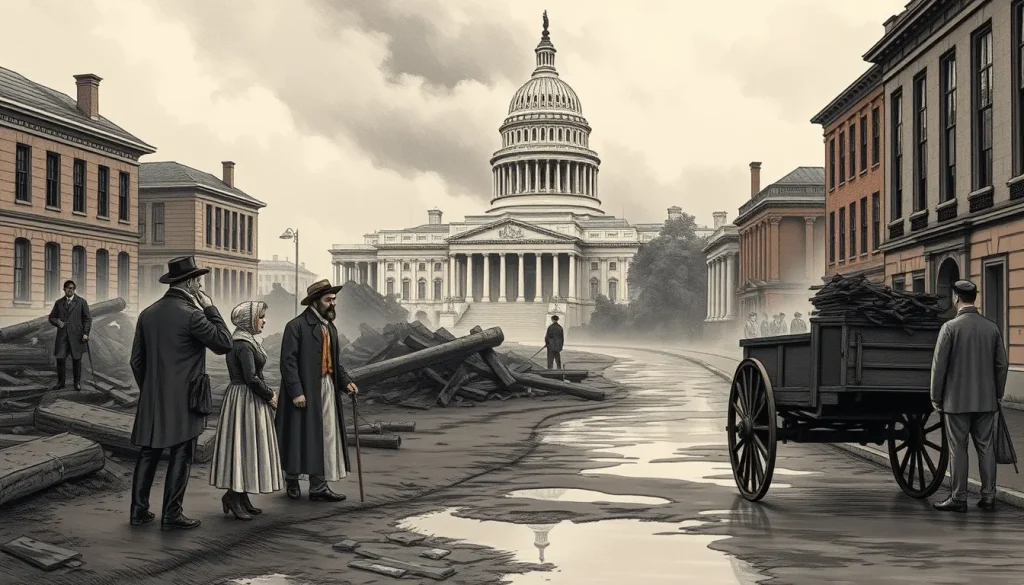
Residents who returned over the following days and weeks found a city of smoldering ruins, spoiled provisions, and no functioning government. Some private homes had been damaged or looted, food and livestock had been seized or destroyed, and the local economy, already weakened by the war, was shattered. The federal government reassembled outside the city: Madison and his cabinet met at Brookeville, Maryland, on 26 August, and the departments operated from private houses and temporary quarters because their offices no longer existed. When Congress convened in special session on 19 September 1814, it met in Blodgett’s Hotel because it was one of the few large public buildings left standing.
Why It Matters
The destruction of the public buildings raised an immediate political question: whether the capital should remain at Washington at all. Some members of Congress argued for relocating the seat of government to a place of greater security, and the loss of the Library of Congress and departmental papers prompted early calls for a national archive. Congress decided to remain, and in early 1815 it appropriated funds to rebuild the Capitol and the President’s House on their original sites.
Historians generally treat the burning as a serious blow to American morale and prestige but a limited military achievement: it did not force an American surrender, and it was followed within weeks by the successful American defense of Baltimore in September 1814. Contemporary Americans described the destruction as evidence of British barbarism, while British officers presented it as legitimate retaliation for American conduct in Upper Canada. Later scholarship has emphasized the small number of civilian deaths compared with the symbolic weight of the event, the role of the storm in ending the fires, and the extent to which the occupation exposed weaknesses in the militia system and the vulnerability of the federal government.
Definition and Scope
This article treats the immediate aftermath as the period from the British entry into Washington on 24 August 1814 through the autumn of that year, focusing on the residents of Washington City rather than on the wider Chesapeake campaign or the long-term reconstruction of the capital. It distinguishes between the experience of people who remained in the city, those who fled, and enslaved people whose circumstances changed most dramatically. Georgetown and Alexandria, across the Potomac and outside the line of the British march, were not burned, and their residents experienced the crisis mainly as refugees, militia call-ups, and disrupted trade.
Background
The city’s social geography shaped who suffered most. Government officials, diplomats, and wealthier families had the means to leave and did so, often within hours of the news from Bladensburg. Those who remained included laborers and artisans who could not abandon their work, boarding-house keepers, the sick and elderly, and enslaved people whose movements were controlled by others. Enslaved Washingtonians faced a particular dilemma: Cochrane’s proclamation of April 1814 had invited enslaved people to join British forces or seek British protection, and the arrival of the British fleet raised the possibility of escape, even as white residents feared both a slave revolt and the loss of their human property. The city also housed the Washington Navy Yard and its workers, whose livelihoods disappeared along with the yard and the ships.
How It Worked
For most residents the immediate aftermath unfolded in stages. The first was flight: roads north and west of the city filled with carts, carriages, and pedestrians on 23 and 24 August, and the government’s own documents were hauled to safety. The State Department’s records, including the Declaration of Independence and the Constitution, were packed into coarse linen bags and carted first to a gristmill in Virginia and then to Leesburg, Virginia, under the supervision of clerk Stephen Pleasonton. The second stage was confusion: during the occupation, British officers generally tried to restrict destruction to public property, but looting occurred, and residents who stayed reported the noise of explosions at the Navy Yard and the light of fires visible for miles.
The third stage was the return and the reckoning. Families came back to a city without markets, warehouses, or functioning government offices; some took in refugees and the wounded from Bladensburg. Local courts and businesses were disrupted for weeks, the price of food and lodging rose, and the destruction of the newspaper offices interrupted the flow of printed news. The fourth stage was preparation for a renewed attack. Militia units were called out, citizens volunteered for labor on fortifications, and much of the region’s energy shifted to Baltimore and to the Potomac approaches. A related and longer-lasting effect concerned enslaved people who fled to the British during the campaign and left the Chesapeake with the fleet; many were resettled in Bermuda, Nova Scotia, or Trinidad, while white authorities in the region tightened restrictions on enslaved and free Black people.
Competing Viewpoints
Accounts of the occupation diverge on how much civilians suffered. American newspapers and later reminiscences emphasized looting, destruction, and insult, while British officers such as George Robert Gleig and official dispatches presented the operation as disciplined and directed only at public property. Most modern historians accept that Ross and Cochrane intended to destroy public buildings and avoid unnecessary harm to private homes, while also documenting that looting occurred and that individual soldiers and sailors did not always obey orders. The survival of the Patent Office and the Marine Barracks is usually cited as evidence of restraint, though the reasons given in different accounts do not agree.
Historians also disagree about how many residents stayed in the city and how quickly the community recovered. Estimates of the number who fled are difficult to verify because no census or registration was taken during the crisis, and the sources are largely the letters and memoirs of people who left. The role of the 25 August storm is similarly debated: some accounts present it as a decisive intervention that saved the city from further destruction, while others treat it as a serious but not decisive event in the British decision to withdraw. The experience of enslaved people is the most heavily revised element of this history; scholarship since the late twentieth century has treated the occupation as a moment of opportunity and risk for Black Washingtonians rather than a footnote to white property losses.
Role in the War of 1812
The aftermath of the burning shaped the final months of the war. The shock of the occupation contributed to a surge of volunteering and militia mobilization in the mid-Atlantic states, and it heightened attention to the defenses of Baltimore, which held against British attack on 12–14 September 1814. The destruction also influenced American politics, strengthening arguments for a more effective regular army and a reformed militia, and it complicated the position of the Madison administration in the negotiations at Ghent, where American commissioners had to conduct talks while the capital lay in ruins. British leaders, for their part, found that burning Washington produced no decisive military advantage and did not prevent the failure of their later operations in the Chesapeake; the Treaty of Ghent, signed on 24 December 1814, contained no territorial provisions.
Consequences and Historical Interpretation
In the short term, the residents of Washington rebuilt. Congress funded the reconstruction of the Capitol and the President’s House, the Library of Congress was reestablished after the purchase of Thomas Jefferson’s personal library in 1815, and Congress met from 1815 to 1819 in a temporary brick building erected near the Capitol’s ruins. The Navy Yard was rebuilt, and the city’s population continued to grow, although the destruction reinforced a long-standing sense that Washington was a vulnerable and improvised capital.
In the longer term, the burning became one of the most remembered episodes of the War of 1812, often reduced to a few images: the flight of Dolley Madison, the rescue of Gilbert Stuart’s portrait of George Washington, and the glow of the burning President’s House. Historians have treated these stories critically. The portrait was taken down and carried off by the doorkeeper and a household worker, the enslaved teenager Paul Jennings, and its frame was broken in the process; Dolley Madison’s own letters emphasized her role in directing its preservation. The storm, the experience of ordinary residents, and the fate of enslaved people have increasingly received attention from scholars, who often argue that earlier narratives of national humiliation and recovery obscured the people who lived through the occupation.
Primary Sources
George Robert Gleig, A Narrative of the Campaigns of the British Army at Washington and New Orleans (1821). Gleig was a young British officer in Ross’s column and left one of the most detailed accounts of the march, the Battle of Bladensburg, and the entry into Washington. His memoir was written for a popular readership several years after the war and reflects a British soldier’s perspective and self-justification; it says comparatively little about American civilians.
Dispatches of Ross and Cochrane to Earl Bathurst, published in the London Gazette in 1814. These official letters report the capture of Washington and the destruction of public buildings. They are concise, formal, and concerned with justifying the operation to the British government, and they do not describe the experience of residents.
James Monroe to James Madison, 22 August 1814 (National Archives, Records of the U.S. House of Representatives). Monroe’s note warned that the British were marching on Washington and urged that the records be removed. Its value lies in showing how late the government recognized the target; it is a single, hurried message rather than a full report.
Dolley Madison’s letters to her sister Anna Cutts, 23–24 August 1814. Written in haste as the President’s House was evacuated, these letters describe the removal of papers and valuables and the pressure of the moment. They are personal correspondence, written before the outcome was known, and they emphasize the writer’s own actions.
Paul Jennings, A Colored Man’s Reminiscence of James Madison (1865). Jennings was enslaved in the Madison household and was present in Washington during the burning. His short memoir is one of the few accounts by a Black eyewitness, but it was composed roughly fifty years later and is brief and selective.
Stephen Pleasonton’s account of saving the State Department records, written in 1848. Pleasonton, a State Department clerk, described packing the archives and moving them to Leesburg, Virginia. The account was written more than three decades after the event and reflects the author’s pride in the rescue.
Newspapers: Niles’ Weekly Register (Baltimore) and the National Intelligencer (Washington). Both printed detailed reports of the attack and its aftermath in 1814. The National Intelligencer’s own offices were destroyed, and its reporting, like that of other papers, combined eyewitness testimony with rumor and partisan commentary.
Further Reading
- Anthony S. Pitch, The Burning of the White House: James and Dolley Madison and the War of 1812 (Regnery History, 2016).
- Walter Lord, The Dawn’s Early Light (W. W. Norton, 1972).
- Donald R. Hickey, The War of 1812: A Forgotten Conflict (University of Illinois Press, 1989; revised edition 2012).
- Alan Taylor, The Internal Enemy: Slavery and War in Virginia, 1772–1832 (W. W. Norton, 2013).
- Christopher T. George, Terror on the Chesapeake: The War of 1812 on the Bay (White Mane Books, 2000).
- William S. Dudley, ed., The Naval War of 1812: A Documentary History, vol. 3 (Naval Historical Center, 2002).
- U.S. Senate Historical Office, “The Burning of Washington,” senate.gov.
- National Archives, “The burning of Washington,” Pieces of History blog, 18 August 2014.
- American Battlefield Trust, “War of 1812: ‘To the Inhabitants of Washington…A Night of Terror and Dismay’” (excerpt from Gleig’s memoir).
References
- Jessie Kratz, “The burning of Washington,” Pieces of History, National Archives, 18 August 2014, https://prologue.blogs.archives.gov/2014/08/18/the-burning-of-washington/.
- American Battlefield Trust, “War of 1812: ‘To the Inhabitants of Washington…A Night of Terror and Dismay,’” https://www.battlefields.org/learn/primary-sources/war-1812-inhabitants-washington-night-terror-and-dismay.
- George Robert Gleig, A Narrative of the Campaigns of the British Army at Washington and New Orleans (London, 1821).
- U.S. Senate Historical Office, “The Burning of Washington,” United States Senate.
- Donald R. Hickey, The War of 1812: A Forgotten Conflict (Urbana: University of Illinois Press, 1989; revised edition, 2012).
- Alan Taylor, The Internal Enemy: Slavery and War in Virginia, 1772–1832 (New York: W. W. Norton, 2013).
- Anthony S. Pitch, The Burning of the White House: James and Dolley Madison and the War of 1812 (Washington, DC: Regnery History, 2016).
- Paul Jennings, A Colored Man’s Reminiscence of James Madison (1865).
- William S. Dudley, ed., The Naval War of 1812: A Documentary History, vol. 3 (Washington, DC: Naval Historical Center, 2002).
FAQ
Did the British burn private homes in Washington?
British commanders stated that their objective was public property, and the Patent Office and Marine Barracks were spared. However, contemporary accounts document looting and damage to some private buildings, particularly near the public offices and the newspaper office, and historians generally conclude that discipline was uneven rather than absolute.
How long did the British occupy Washington?
The occupation lasted less than twenty-six hours, from the evening of 24 August to the night of 25 August 1814. The British then marched back toward Benedict, Maryland, and had re-embarked by the end of the month before moving against Baltimore.
Where did the U.S. government go after the burning?
President James Madison and his cabinet met at Brookeville, Maryland, on 26 August 1814, and the departments operated from private houses and temporary quarters because their offices had been destroyed. Congress convened in special session on 19 September 1814 in Blodgett's Hotel, the building that had housed the Patent Office.


Leave a Reply