
Short Answer
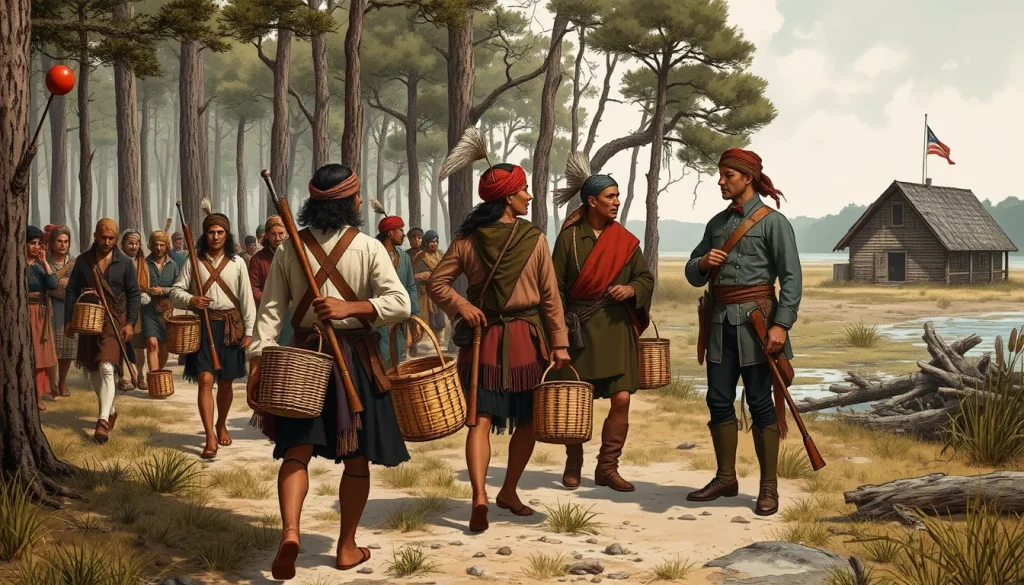
After the Creek War of 1813–1814, the Red Stick faction of the Muscogee (Creek) people did not simply disappear after its defeat at Horseshoe Bend. Large numbers of Red Stick men, women, and children fled from the burned Upper Creek towns into Spanish Florida and other borderlands, where they sought safety, British and Spanish protection, and new homes among Seminole towns. Their dispersal was a direct consequence of the Creek War and the wider War of 1812, and it reshaped the southeastern borderlands, contributing to the emergence of the Seminole people and to later United States conflicts in Florida.
Historical Context
The Creek War began as a civil conflict within the Creek Confederacy, which was divided between the Upper Towns and the Lower Towns. The Red Sticks drew mainly from Upper Creek towns and from traditionalists who opposed land cessions, assimilation, and the growing authority of the Creek National Council. That council, influenced by United States Indian agent Benjamin Hawkins, had agreed to land sales and had ordered the execution of Creek warriors accused of killing American settlers. The Red Sticks saw these actions as betrayals of Creek law and sovereignty. Their movement also drew on a broader religious revival tied to Shawnee prophet Tenskwatawa and Tecumseh, who urged Indigenous resistance to American expansion.
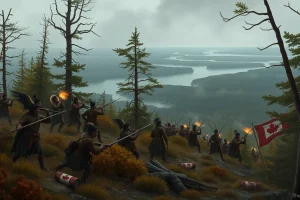
The conflict became entangled with the War of 1812 because the United States feared that Britain or Spain would use Creek discontent to threaten the southern frontier. After Red Stick warriors attacked Fort Mims in present-day Alabama on August 30, 1813, American state and territorial forces, along with Cherokee, Choctaw, and Lower Creek allies, launched a campaign to destroy Red Stick power. Major General Andrew Jackson led Tennessee militia and regulars to victory at the Battle of Horseshoe Bend on March 27, 1814. That defeat broke the Red Stick military capacity but did not end the human crisis it created.
What Happened
After Horseshoe Bend, Red Stick towns along the Tallapoosa, Coosa, and Alabama rivers were destroyed or abandoned. Survivors fled south and east, often in family groups, carrying what they could. The Treaty of Fort Jackson, imposed by Jackson on August 9, 1814, ceded roughly 23 million acres of Creek land to the United States, including territory belonging to Creek allies who had fought with the Americans. The treaty did not create a safe homeland for the defeated Red Sticks; instead, it accelerated displacement and made return to many Upper Creek towns impossible.

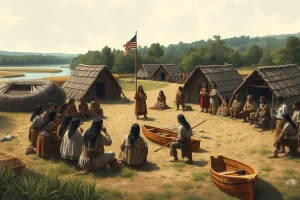
Many refugees entered Spanish Florida, which was outside United States jurisdiction. They settled along the Apalachicola, Suwannee, and other rivers, and in Seminole towns that already included Creek migrants and their descendants. Others moved toward Pensacola, Tampa Bay, and the Florida interior. Some Red Stick leaders, including Peter McQueen, Josiah Francis (Hillis Hadjo), and Homathlemico, became prominent in these refugee communities.
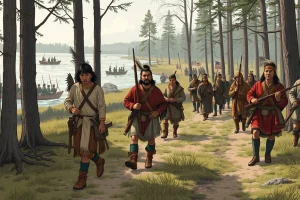
British forces in the Gulf saw the refugees as potential allies in the War of 1812. In May 1814, Captain Hugh Pigot anchored at the mouth of the Apalachicola River and began distributing arms to Creek and Seminole warriors. Major Edward Nicolls later established a British post at Prospect Bluff on the Apalachicola. From there, the British trained and supplied Red Stick and Seminole fighters, hoping to divert American forces from the Canadian border and the Gulf coast. Some refugees served as scouts, auxiliaries, or warriors in British operations, while others simply used British supplies to survive.
The Treaty of Ghent ended the War of 1812 in December 1814, and British forces withdrew from the Gulf in 1815. At Prospect Bluff, they left a fortified post and arms to Black refugees and Indigenous allies. The United States called the site Negro Fort and viewed it as a threat. In July 1816, a United States force under Colonel Duncan Lamont Clinch destroyed the fort. Many occupants were killed, and survivors fled deeper into Florida. The destruction pushed Red Stick refugees and their Seminole hosts into renewed conflict with the United States.
During the First Seminole War of 1817–1818, Andrew Jackson invaded Spanish Florida. United States forces attacked Seminole and Red Stick towns. In 1818, Jackson’s troops captured and executed the Red Stick leaders Josiah Francis and Homathlemico. Other refugees dispersed further south or joined Seminole bands. In 1819, the Adams-Onís Treaty transferred Florida from Spain to the United States, and in 1823 the Treaty of Moultrie Creek confined many Seminoles to a reservation in central Florida. During the 1830s, the United States pursued Indian Removal, leading to the Second Seminole War and the removal of many Seminoles and Creek descendants to Indian Territory. Some remained in Florida, where their descendants still live.
Why It Matters
The fate of Red Stick refugees matters because it shows that the Creek War did not end with a single battle or treaty. The war produced a refugee crisis that crossed imperial borders and continued for decades. The refugees helped form the Seminole people as a distinct confederacy in Florida, and their presence helped provoke the First Seminole War and the eventual American acquisition of Florida. Their story also complicates the familiar narrative of the War of 1812 as a conflict between the United States and Britain. For Red Stick families, the war was also a war for survival, land, and political autonomy within the Creek world.
Historians disagree about how to describe the outcome. Some emphasize United States policy as ethnic cleansing or land expropriation, especially through the Treaty of Fort Jackson. Others stress Red Stick agency, arguing that refugees made strategic choices to seek British and Spanish protection and to rebuild communities in Florida. A third interpretation focuses on the British use of Indigenous allies as a wartime expedient that ended when British interests changed. These views are not mutually exclusive: refugees could be both victims of American expansion and active agents in shaping their own futures.
Definition
Red Stick refugees were the displaced Red Stick Creeks and their families who left the Creek homeland after the military defeats of 1814 and the Treaty of Fort Jackson. The term covers warriors, women, children, elders, and African-descended people associated with Creek towns. Their exile lasted from 1814 into the 1820s and beyond, with destinations in Spanish Florida, Seminole towns, and eventually Indian Territory.
Background
The Red Stick movement grew from long-term pressures: American settlement along the Federal Road, debt and market dependence, the loss of hunting lands, and resentment of the Creek National Council’s cooperation with the United States. The War of 1812 gave Britain and Spain reasons to support Indigenous resistance, but the refugee crisis was rooted in Creek internal divisions and American expansion before British agents arrived.
How It Worked
Refugee movement depended on kinship, geography, and imperial rivalry. Creek clans and town networks provided routes and safe houses. Spanish Florida offered a legal border that United States forces could not cross without risking war with Spain. Seminole towns offered land and political alliance. British agents offered arms, supplies, and military training. After the British left, the fortified post at Prospect Bluff became a refuge until its destruction in 1816. Each wave of violence pushed survivors farther south, creating a cycle of displacement, alliance, and renewed conflict.
Competing Viewpoints
United States officials generally portrayed Red Stick refugees as hostile British auxiliaries, squatters, or fugitives who threatened the southern border. Spanish officials often saw them as a destabilizing presence but also as a buffer against American expansion. British officers viewed them as useful allies in the War of 1812. Red Stick leaders saw themselves as defenders of Creek sovereignty and as people seeking safety after defeat. Modern historians debate whether the term refugee, exile, or diaspora best captures the experience, and whether the primary cause was American policy, British manipulation, or Creek political failure.
Role in the War of 1812
Red Stick refugees became part of the Gulf Coast theater of the War of 1812 after Horseshoe Bend. British forces under Vice Admiral Alexander Cochrane and Major Edward Nicolls hoped to use Creek and Seminole warriors to threaten American positions from Florida to Louisiana. The refugees received arms and training at Apalachicola and Prospect Bluff. Some accompanied British expeditions or served as scouts. Their presence helped sustain Indigenous resistance after the Creek War and contributed to the borderland tensions that led to the First Seminole War after the War of 1812 ended.
Consequences and Historical Interpretation
In the short term, Red Stick refugees lost their towns, farms, and political standing in the Creek Nation. In the long term, they helped create the Seminole Nation in Florida, though many were later removed to Indian Territory or killed in the Seminole Wars. The refugee crisis also gave the United States a justification for invading Spanish Florida in 1818 and for pressuring Spain to cede Florida in 1819. Later historians have increasingly moved beyond Andrew Jackson’s battlefield fame to examine the refugee experience, Indigenous diplomacy, and the human cost of the Creek War and Indian Removal.
Primary Sources
Several contemporary sources illuminate the refugee story. Andrew Jackson’s official reports and letters from 1814 describe the Battle of Horseshoe Bend and the Treaty of Fort Jackson, but they present the American military perspective and often treat Creek suffering as a military problem. The Treaty of Fort Jackson itself, signed August 9, 1814, records land cessions but not the refugee experience. British Captain Hugh Pigot’s 1814 report to Vice Admiral Cochrane describes arming Creek and Seminole warriors at Apalachicola and shows British strategic calculations. Letters and journals of United States Indian agent Benjamin Hawkins document Creek politics before and during the war, though Hawkins was a biased participant. Spanish colonial records from Pensacola and St. Augustine contain reports on refugee movements and border security. Seminole and Creek oral traditions preserve memories of migration and survival, but they are not always tied to precise dates. These sources must be read critically because they were produced by officials, officers, and traders with their own interests.
Further Reading
- Claudio Saunt, A New Order of Things: Property, Power, and the Transformation of the Creek Indians, 1733–1816 (Cambridge University Press, 1999).
- Joel W. Martin, Sacred Revolt: The Muskogees’ Struggle for a New World (Beacon Press, 1991).
- Frank Lawrence Owsley Jr., Struggle for the Gulf Borderlands: The Creek War and the Battle of New Orleans, 1812–1815 (University Presses of Florida, 1981).
- H. S. Halbert and T. H. Ball, The Creek War of 1813 and 1814 (1895; University of Alabama Press reprint, 1969).
- Kenneth W. Porter, The Black Seminoles: History of a Freedom-Seeking People (University Press of Florida, 1996).
- Edwin C. McReynolds, The Seminoles (University of Oklahoma Press, 1957).
- Encyclopedia of Alabama, Creek War of 1813–14, https://encyclopediaofalabama.org/article/creek-war-of-1813-14/.
References
- Encyclopedia of Alabama, Creek War of 1813–14, https://encyclopediaofalabama.org/article/creek-war-of-1813-14/.
- Claudio Saunt, A New Order of Things: Property, Power, and the Transformation of the Creek Indians, 1733–1816 (Cambridge University Press, 1999).
- Joel W. Martin, Sacred Revolt: The Muskogees’ Struggle for a New World (Beacon Press, 1991).
- Frank Lawrence Owsley Jr., Struggle for the Gulf Borderlands: The Creek War and the Battle of New Orleans, 1812–1815 (University Presses of Florida, 1981).
- H. S. Halbert and T. H. Ball, The Creek War of 1813 and 1814 (1895; University of Alabama Press reprint, 1969).
- Kenneth W. Porter, The Black Seminoles: History of a Freedom-Seeking People (University Press of Florida, 1996).
- Edwin C. McReynolds, The Seminoles (University of Oklahoma Press, 1957).
- Treaty of Fort Jackson, August 9, 1814, in Charles J. Kappler, ed., Indian Affairs: Laws and Treaties, Vol. 2 (Washington, D.C.: Government Printing Office, 1904).
- John Spencer Bassett, ed., Correspondence of Andrew Jackson, Vol. 1 (Washington, D.C.: Carnegie Institution, 1926).
- National Park Service, Fort Gadsden Historic Site, Apalachicola National Forest, Florida.
FAQ
Where did Red Stick refugees go after the Creek War?
Many fled into Spanish Florida, settling along the Apalachicola and Suwannee rivers and in Seminole towns. Others moved toward Pensacola, Tampa Bay, and the Florida interior. Some later ended up in Indian Territory after removal.
Did the British help Red Stick refugees during the War of 1812?
Yes. In 1814 British agents such as Captain Hugh Pigot and Major Edward Nicolls armed, supplied, and trained Red Stick and Seminole warriors at Apalachicola and Prospect Bluff to use them as allies against the United States.
What happened to Red Stick leaders after the Creek War?
William Weatherford surrendered and was pardoned; Menawa survived and later became a Creek leader who opposed removal. Peter McQueen, Josiah Francis, and Homathlemico fled to Florida. Francis and Homathlemico were captured and executed by Andrew Jackson’s forces in 1818.
How did Red Stick refugees become connected to the Seminoles?
They settled among Seminole towns in Spanish Florida, intermarried, and shared resistance to United States expansion. Their descendants became part of the broader Seminole confederacy that fought in the First and Second Seminole Wars.
Leave a Reply