Short Answer
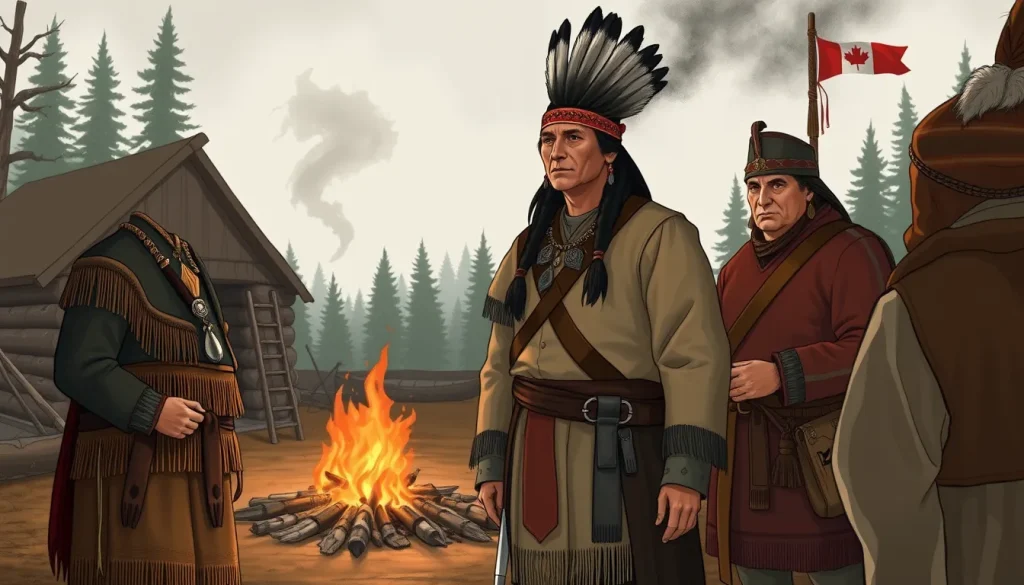
Tecumseh (c. 1768 – October 5, 1813) was a Shawnee war leader, diplomat, and orator who attempted to create a pan-Indigenous confederacy to resist United States expansion into the Ohio Valley and Great Lakes region. When the War of 1812 began, he allied the confederacy with Great Britain and became one of the most consequential Indigenous commanders in the conflict. His death at the Battle of the Thames near Moraviantown, Upper Canada, shattered the confederacy in the Old Northwest and made him an enduring symbol of Indigenous unity and sovereignty. This article focuses on Tecumseh as the visionary leader of that confederacy and on his direct role in the War of 1812.
Historical Context
The Treaty of Paris in 1783 ended the American Revolution and transferred British claims south of the Great Lakes to the new United States, but the Indigenous nations who lived in the Ohio Valley and Great Lakes region were not parties to that agreement. The United States claimed sovereignty over the region and moved to organize the Northwest Territory under the Northwest Ordinance of 1787, which nominally protected Indigenous land rights. In practice, American settlers, surveyors, and militia pressed north and west of the Ohio River, while state and federal officials negotiated treaties with individual Indigenous nations.
Many Shawnee, Miami, Delaware, Wyandot, Ottawa, Ojibwe, Potawatomi, and other leaders rejected those treaties. They argued that land was held communally and that no single chief or nation could sell territory without the consent of the others. This view had roots in earlier pan-Indigenous movements, including the mid-eighteenth-century alliance associated with Pontiac and the later Northwest Indian Confederacy. The United States defeated the confederacy at the Battle of Fallen Timbers in 1794, and the Treaty of Greenville in 1795 forced many nations to cede much of present-day Ohio. Tecumseh refused to accept that settlement.
At the same time, Britain retained influence in the region. British officials in Upper Canada maintained trading posts, supplied Indigenous communities, and viewed Indigenous military power as a buffer against American expansion. American leaders accused Britain of encouraging resistance and of violating neutral rights at sea. By 1812, these tensions had produced a war between the United States and Great Britain, creating the opening Tecumseh had long sought.
What Happened
Tecumseh was born around 1768 on the Scioto River in the Ohio Country, probably near a Shawnee town called Chillicothe or Kispoko. His father, the Shawnee chief Pukeshinwau, was killed at the Battle of Point Pleasant in 1774 during Lord Dunmore’s War. Tecumseh grew up amid the Revolutionary War and the subsequent American invasion of Shawnee territory. He became a warrior in the 1780s, fought in the Northwest Indian War, and was present at the Battle of Fallen Timbers in 1794. He rejected the Treaty of Greenville and continued to live in the contested borderlands of present-day Ohio and Indiana.
In 1805, Tecumseh’s younger brother Lalawethika experienced a spiritual transformation and became known as Tenskwatawa, the Prophet. Tenskwatawa preached a return to traditional ways, rejected alcohol and white customs, and predicted divine deliverance from American expansion. In 1808, the brothers established Prophetstown at the confluence of the Wabash and Tippecanoe rivers in what is now Indiana. Tecumseh used Prophetstown as a base while traveling widely to recruit followers from the Shawnee, Miami, Kickapoo, Winnebago, Potawatomi, Ottawa, Ojibwe, Creek, and other nations.
In 1811, Tecumseh journeyed south to meet with Creek, Choctaw, Chickasaw, and Cherokee leaders. While he was away, Indiana Territory governor William Henry Harrison marched on Prophetstown. On November 7, 1811, Tenskwatawa’s followers attacked Harrison’s camp near the Tippecanoe River. The battle was costly for both sides, but Harrison’s force held the field and then destroyed Prophetstown. The defeat damaged the confederacy, though Tecumseh returned and continued to rebuild it.
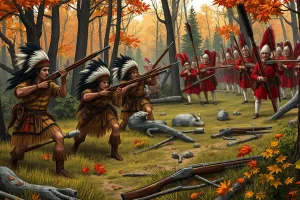
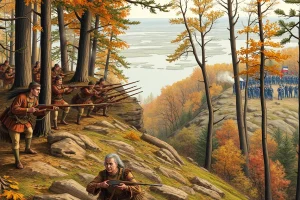
When the United States declared war on Great Britain in June 1812, Tecumseh took his followers to Amherstburg in Upper Canada and allied with British forces. He worked closely with Major-General Isaac Brock, and in August 1812 their combined show of force helped compel American Brigadier-General William Hull to surrender Detroit without a major battle. In 1813, Tecumseh fought alongside British Major-General Henry Procter in the Ohio and Michigan campaigns, including the sieges of Fort Meigs and Fort Stephenson. After American naval victories on Lake Erie cut British supply lines, Procter retreated eastward into Upper Canada. Tecumseh reluctantly followed. On October 5, 1813, American forces under Harrison defeated the British and Indigenous force at the Battle of the Thames near Moraviantown. Tecumseh was killed in the fighting.
Why It Matters
Tecumseh’s death had immediate military and political consequences. The pan-Indigenous confederacy in the Old Northwest lost its most capable organizer and diplomat. British power in the region collapsed, and American forces gained control of much of the Detroit frontier. In the years that followed, the United States negotiated a series of treaties that forced Indigenous nations to cede vast areas, and within a generation many nations east of the Mississippi were subjected to removal. The confederacy’s defeat did not end Indigenous resistance, but it ended the specific project of a broad, British-supported Indigenous buffer in the Old Northwest.
For later generations, Tecumseh became a powerful and contested symbol. In the United States, he was sometimes portrayed as a noble but doomed warrior, a framing that could obscure his political skill and the justice of his cause. In Canada, he is remembered as a key ally who helped save Upper Canada in 1812. For many Indigenous nations, he remains a model of unity, diplomacy, and resistance to dispossession. Historians continue to debate how unified his confederacy actually was, how much authority he held over distant nations, and whether British promises of an Indigenous homeland were ever realistic. Scholars such as John Sugden and Peter Cozzens emphasize his strategic intelligence and the fragility of the coalition he built.
Early Life
Tecumseh was born into the Kispoko division of the Shawnee. His name is commonly translated as Shooting Star or Celestial Panther, and traditions link it to a meteor or comet seen around his birth. His mother, Methoataske, was of Creek and Shawnee descent according to some accounts; after his father’s death, she migrated west with part of the tribe. Tecumseh was raised partly by his older sister Tecumapease and trained as a warrior by his older brother Cheeseekau. He learned Shawnee hunting, diplomacy, and warfare during a period when American settlement was steadily reducing Shawnee hunting grounds.
As a young man, Tecumseh fought in frontier skirmishes and in the Northwest Indian War. He gained a reputation for courage and composure, but he also saw the limits of separate tribal resistance. The defeat at Fallen Timbers and the Treaty of Greenville convinced him that only a broad intertribal alliance could check American expansion. He did not sign the Treaty of Greenville and continued to argue that land cessions made by individual chiefs were invalid.
Role Before the War
After 1795, Tecumseh lived with a band of followers in Ohio and Indiana. He became a respected war leader and speaker, and he worked with his brother’s spiritual movement to build a new confederacy. Prophetstown became the political and religious center of that effort. Tecumseh’s message combined practical grievances—land loss, broken treaties, alcohol, and dependence on American trade—with a call for Indigenous peoples to unite and reject American ways. He did not claim to be a prophet, but he used Tenskwatawa’s religious authority to attract followers.
Tecumseh’s diplomatic travel was central to the confederacy. In 1810, he met with Harrison at Vincennes and challenged American claims to Indigenous land. In 1811, he traveled south to invite the Creek, Choctaw, Chickasaw, and Cherokee to join the alliance. The comet and earthquakes that accompanied this period were interpreted by some Indigenous communities as signs of his power. Although the southern nations did not fully join before the War of 1812, the mission showed the geographic reach of his vision.
Role During the War
When war broke out, Tecumseh saw an opportunity to secure British support for an Indigenous homeland. He moved to Amherstburg and forged an alliance with Brock. The British needed Indigenous warriors to defend Canada, and Tecumseh needed British arms, supplies, and diplomatic backing. Their partnership was practical, but it was also unequal: British officials prioritized imperial interests, while Tecumseh sought recognition of Indigenous sovereignty and land rights.
Tecumseh’s warriors played a decisive psychological and military role in the Detroit campaign of 1812. Their presence helped convince Hull that his position was hopeless, and Detroit surrendered on August 16. In 1813, Tecumseh fought at Fort Meigs and other actions. Some later accounts describe him intervening to stop the killing of American prisoners after Fort Meigs, though the details of such episodes are difficult to verify. As the British position deteriorated, Tecumseh criticized Procter’s retreat and argued for a stand. At the Thames, he fought on foot with his warriors and was killed.
Major Actions
- Rejection of the Treaty of Greenville, 1795: Tecumseh refused to accept land cessions that he believed no single nation had the right to make.
- Founding of Prophetstown, 1808: With Tenskwatawa, he established a multi-national settlement and base of resistance in present-day Indiana.
- Southern diplomatic mission, 1811: He traveled to the Creek, Choctaw, Chickasaw, and Cherokee nations to broaden the confederacy.
- Alliance with Britain, 1812: He brought Indigenous forces to Amherstburg and cooperated with Isaac Brock.
- Siege of Detroit, August 1812: His warriors helped force the surrender of an American army and fort.
- Fort Meigs and Ohio campaigns, 1813: He fought with Procter’s British and Indigenous force against Harrison’s army.
- Battle of the Thames, October 5, 1813: He was killed in battle near Moraviantown, Upper Canada.
Contemporary Accounts
No writings by Tecumseh survive in his own hand, and no verbatim transcript of his speeches is known. The most important contemporary sources are British and American military documents, letters, and reports. British officers, including Isaac Brock and Henry Procter, wrote about Tecumseh’s influence and military value. A frequently quoted remark attributed to Brock says that “a more sagacious or a gallant warrior does not, I believe, exist.” Such comments reflect British dependence on Indigenous allies, but they also reveal genuine respect.
American sources include William Henry Harrison’s letters and reports, which describe Tecumseh as a formidable opponent. These documents are essential but biased: they were written by officials seeking to justify military action and land policy. Indigenous oral traditions, later interviews, and ethnohistorical accounts preserve additional perspectives, but they were often recorded by outsiders and shaped by translation. Historians therefore treat all accounts of Tecumseh’s speeches and personal encounters with caution, distinguishing between contemporary evidence and later legend.
Later Life
Tecumseh had no later life after the War of 1812; he was killed during the conflict at about the age of forty-five. His final months were spent trying to hold the British-Indigenous alliance together as American forces advanced. After the British defeat on Lake Erie, he opposed Procter’s withdrawal into Upper Canada but eventually followed. At the Thames, he refused to flee and died in the battle. The exact location of his grave is uncertain, and various traditions dispute what happened to his body. The absence of a verified burial site has contributed to his legendary status.
Historical Legacy
Tecumseh is remembered as one of the most gifted Indigenous leaders of the early nineteenth century. He combined military skill with diplomatic persistence and a vision of Indigenous unity that crossed language, kinship, and national boundaries. His confederacy did not survive his death, but his example influenced later Indigenous political movements and remains central to discussions of sovereignty and treaty rights.
Commemoration is widespread but varied. Towns and cities in the United States and Canada bear his name, as do monuments, schools, and military vessels. In Canada, he is honored as a defender of Upper Canada; in the United States, he is often treated as a tragic figure of frontier history; among Indigenous nations, he is remembered as a leader who fought for the land and for the principle that it belonged to all. Historians continue to assess whether his goal was an independent Indigenous state, a British-protected homeland, or a broad confederacy strong enough to force the United States to respect Indigenous rights.
Primary Sources
- British military correspondence, 1812–1813: Letters and reports by Isaac Brock, Henry Procter, and other British officers in Upper Canada describe the alliance and Tecumseh’s role. These documents are held in British and Canadian archives, including Library and Archives Canada, and are shaped by British imperial priorities.
- William Henry Harrison papers and reports: Harrison’s letters to the War Department and his accounts of Tippecanoe and the Thames provide an American military perspective. They are indispensable but partisan and self-justifying.
- Treaty of Greenville, 1795: The treaty text records the land cessions Tecumseh rejected. It represents the American and signatory Indigenous positions but not Tecumseh’s dissent.
- Shawnee and other Indigenous oral traditions: Oral histories, later interviews, and ethnohistorical records preserve memory of Tecumseh and Tenskwatawa. They are essential correctives to Euro-American sources, though recording and translation introduce limitations.
- Later reminiscences and newspaper accounts: Nineteenth-century memoirs and newspaper stories often blend eyewitness testimony with myth. They should be used alongside contemporary documents, not as transparent records.
Further Reading
- John Sugden, Tecumseh: A Life (Henry Holt, 1997).
- Peter Cozzens, Tecumseh and the Prophet: The Shawnee Brothers Who Defied a Nation (Alfred A. Knopf, 2020).
- R. David Edmunds, The Shawnee Prophet (University of Nebraska Press, 1983).
- R. David Edmunds, Tecumseh and the Quest for Indian Leadership (Little, Brown, 1984).
- Colin G. Calloway, The Shawnees and the War for America (Viking, 2007).
- Glenn Tucker, Tecumseh: Vision of Glory (Bobbs-Merrill, 1956).
- U.S. National Park Service, “Tecumseh.”
- The Canadian Encyclopedia, “Tecumseh.”
References
- U.S. National Park Service, “Tecumseh,” https://www.nps.gov/people/tecumseh.htm.
- The Canadian Encyclopedia, “Tecumseh,” https://thecanadianencyclopedia.ca/en/article/tecumseh.
- Encyclopaedia Britannica, “Tecumseh,” https://www.britannica.com/biography/Tecumseh-Shawnee-chief.
- Erin Blakemore, “How Tecumseh fought for Native lands—and became a folk hero,” National Geographic, November 4, 2022, https://www.nationalgeographic.com/history/article/how-tecumseh-fought-for-native-lands-and-became-a-folk-hero.
- History.com Editors, “Tecumseh,” HISTORY, https://www.history.com/articles/tecumseh.
- John Sugden, Tecumseh: A Life (New York: Henry Holt, 1997).
- Peter Cozzens, Tecumseh and the Prophet: The Shawnee Brothers Who Defied a Nation (New York: Alfred A. Knopf, 2020).
FAQ
Who was Tecumseh?
Tecumseh was a Shawnee war leader, orator, and diplomat born around 1768 in the Ohio Country. He organized a pan-Indigenous confederacy to resist United States expansion and later allied with Britain during the War of 1812.
What was Tecumseh's role in the War of 1812?
He brought Indigenous warriors into alliance with British forces in Upper Canada, helped compel the surrender of Detroit in August 1812, and fought in the Ohio and Thames campaigns. He was killed at the Battle of the Thames on October 5, 1813.
Did Tecumseh's confederacy achieve its goals?
No. The confederacy won early victories with the British, but Tecumseh's death at the Thames shattered it. The United States subsequently expanded its control in the Old Northwest, and many Indigenous nations were forced to cede land or face removal.


Leave a Reply