
Short Answer
Major-General Sir Edward Michael Pakenham (19 March 1778 – 8 January 1815), a British Army officer and the brother-in-law of the Duke of Wellington, was killed while leading the British assault on the American line at the Battle of New Orleans on 8 January 1815. His remains were carried back across the Atlantic and interred in the Pakenham family vault at Killucan in County Westmeath, Ireland, which is consistently identified in reference and heritage sources as his burial place. The Louisiana battlefield where he fell preserves his name in oaks and street names but contains no grave, and the monument in St Paul’s Cathedral, London, is a memorial rather than a burial. The question of where Pakenham is buried therefore separates two distinct sites of memory: the ground on which he died and the family ground to which he was returned.
Historical Context
Pakenham’s burial belongs to the final phase of the War of 1812, when British strategy shifted southward after Napoleon’s abdication in April 1814 released reinforcements for North America. Vice-Admiral Alexander Cochrane, commanding on the North American station, pressed the Admiralty for an expedition against New Orleans, arguing that control of the entrance to the Mississippi River would weaken American resolve and challenge the legality of the Louisiana Purchase. The campaign was placed under Major-General Robert Ross, who had commanded the force that burned Washington in August 1814. Ross was killed near Baltimore on 12 September 1814, and Pakenham, then a major-general with a distinguished Peninsular War record, was appointed to succeed him.
The expedition was assembled slowly and arrived in the Gulf piecemeal. A brigade under Major-General John Keane and Cochrane’s squadron reached the Louisiana coast in December 1814, and Pakenham himself did not join the army until Christmas Day. On 24 December 1814 British and American commissioners signed the Treaty of Ghent, but ratification in Washington had not yet occurred and word of the peace did not reach the Gulf until February 1815. The campaign therefore continued in fact while it had already been ended on paper.
Burial practice in the British Army of the period was not uniform. Some senior officers who died in North America were buried where they fell or in nearby garrison towns; Sir Isaac Brock, killed at Queenston Heights in 1812, was buried in Upper Canada. Others, particularly officers of high rank and family standing, were returned home. Pakenham’s family seat was Pakenham Hall in County Westmeath, later known as Tullynally Castle, and the family had a vault at Killucan, a short distance away. That family connection shaped what happened to his body.

What Happened
The Battle of New Orleans on 8 January 1815 was fought against a fortified American line, commonly called Line Jackson, behind a canal on the east bank of the Mississippi below the city. Pakenham’s plan combined a main assault on the American centre-left under Major-General Samuel Gibbs, a flanking effort on the American right under Major-General John Keane, and a crossing of the river by Lieutenant-Colonel William Thornton to seize American batteries that could enfilade the advance. The river crossing was delayed and the assault force, carrying fascines and scaling ladders, fell into confusion. Deprived of ladders, the infantry could not climb the earthworks and were exposed to massed artillery and musket fire across open ground.
Pakenham rode forward to rally the troops and was struck by grapeshot. Accounts agree that he was wounded more than once: his horse was killed and he was hit in the knee, then in the arm, and finally in the body. He was carried from the field and, according to the most widely repeated accounts, laid beneath oak trees on the battlefield that still bear his name. He died that morning at the age of 36. Major-General Gibbs was mortally wounded and Keane was wounded; command passed to Major-General John Lambert, who called off the attack and withdrew the army to the fleet.
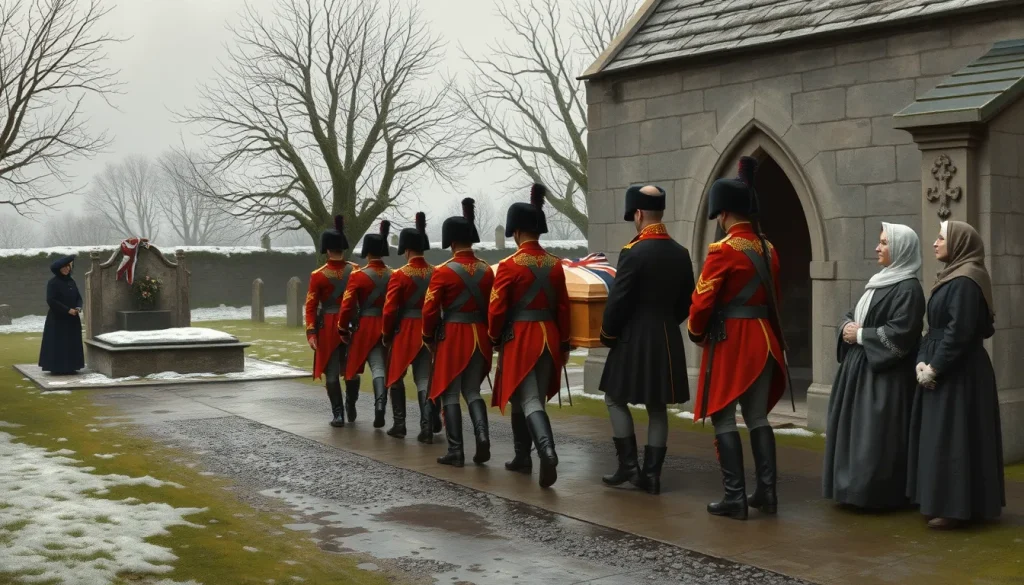
The body was prepared for the Atlantic passage and sent home. According to a widely repeated tradition, it was preserved in a cask of rum for the voyage. Once in Ireland, Pakenham was interred in the Pakenham family vault at Killucan, County Westmeath, the resting place identified in the standard reference summaries of his life and in the Canadian Encyclopedia’s entry on his career. Contemporary British reporting concentrated on his death in action rather than on the details of the interment, so the burial itself is documented chiefly through family, local, and later biographical record.
Why It Matters
The burial is historically significant because it illustrates how the British Army handled the bodies of its senior commanders and how families with landed estates reclaimed their dead from distant campaigns. It also marks a clear boundary between two competing landscapes of commemoration. In Louisiana, Pakenham is remembered as the general who died attacking Andrew Jackson’s line; in Ireland, he is a member of a local landed family returned to its vault. Neither site tells the whole story alone.
The death had immediate consequences. It removed Wellington’s trusted subordinate and former adjutant-general from the army at a moment when his reputation was still rising, and it left the New Orleans expedition leaderless in its decisive hour. Wellington reportedly wrote that he took some consolation that Pakenham “fell as he lived, in the honourable discharge of his duty,” and he placed responsibility for the failed enterprise on the naval commander rather than on his brother-in-law. For the British Army, the battle became an example of what happens when a well-trained force attacks a prepared position without the means to breach it. For the United States, Jackson’s victory became a national touchstone, which in turn shaped how Pakenham’s death was remembered.
Definition
Where Edward Pakenham is buried is answered by the evidence as follows: he was interred in the Pakenham family vault at Killucan, County Westmeath, Ireland, the burial place associated with St Etchen’s Church in that village. Sources describe the location in slightly different words — a family vault, a family cemetery — but they agree that the interment took place in Ireland and not in Louisiana. The battlefield site in St. Bernard Parish, Louisiana, holds the place where he died and where his body lay immediately after the action, and it has been marked by the oaks that carry his name. The memorial in St Paul’s Cathedral, London, commemorating Pakenham and Major-General Samuel Gibbs, is a monument, not a grave. Two related distinctions matter to the question: a monument can be erected far from a burial, and a battlefield memorial may mark where a person fell rather than where that person rests.
Background
Pakenham was born on 19 March 1778 at Pakenham Hall in County Westmeath, the son of Edward Pakenham, 2nd Baron Longford, and Catherine Rowley. His family were part of the Anglo-Irish landed class, and his career followed the pattern of purchase and patronage common to his station: a lieutenant’s commission in the 92nd Regiment of Foot at sixteen, rapid promotion, and service in Ireland during the 1798 rebellion, in the West Indies, and in the Danish campaign of 1807. He was wounded in the Caribbean and again at Martinique. His sister Catherine married Arthur Wellesley, the future Duke of Wellington, in 1806, and Pakenham later served with him in the Peninsular War as adjutant-general, commanding at Bussaco, Fuentes de Oñoro, Salamanca, and later actions, and earning the Army Gold Cross with several clasps.
In September 1814 he was promoted major-general and accepted command in North America after Ross’s death. He was not enthusiastic about the posting. The campaign he inherited was already in motion, with the fleet and an advanced brigade committed to a landing on the Louisiana coast before he could reach the rendezvous. His arrival on Christmas Day 1814 gave him only two weeks to reorganize scattered brigades, probe the American defences, and attempt an artillery bombardment before launching the assault of 8 January.
How the Body Was Returned to Ireland
The practical steps were those used for other officers who died far from home: the body was treated for preservation, placed aboard a ship of the returning squadron or a transport, and consigned to the family. The detail most often repeated — that Pakenham’s remains were carried home in a cask of rum — appears in popular and local accounts of the campaign rather than in formal military documentation, and it should be treated as a tradition rather than a firmly documented fact. What is well attested is the outcome: the body was sent to Ireland and placed in the family vault at Killucan in County Westmeath, near the Pakenham estate at Pakenham Hall, now Tullynally Castle near Castlepollard.
Because no large public ceremony was recorded, the burial left a thinner documentary trail than the battle itself. The evidence rests on family and local knowledge of the vault, on the identification of the burial place in biographical and reference works, and on the existence of the family monument and estate as a continuing focus of commemoration. Researchers seeking confirmation would look to Church of Ireland parish registers for the Killucan area, held in Irish ecclesiastical archives, and to the Pakenham family papers, rather than to British army records, which document the death rather than the interment.
Competing Viewpoints
Most disagreement about Pakenham concerns his death, not his burial. The standard account describes multiple grapeshot wounds, including a wound to the knee that killed his horse and a final wound to the body or spine. Andrew Jackson later claimed, in a recollection attributed to a letter to James Monroe, that he believed a single rifle shot from a free man of colour from the Attakapas region had brought Pakenham down. That claim rests on Jackson’s memory and has been questioned by historians, who generally accept the artillery explanation while acknowledging that the exact sequence of wounds cannot be reconstructed with certainty.
A second point of uncertainty is the number and wording of his last orders, which tradition assigns to his aide-de-camp, Major Duncan MacDougall, and which concern bringing forward the reserves and informing General Lambert of the situation. Such deathbed accounts were often shaped by later reminiscence and should be read cautiously.
Regarding burial itself, confusion arises from three distinct places: the battlefield oaks in Louisiana beneath which the body was laid after he was carried from the line; the memorial in St Paul’s Cathedral in London; and the family vault at Killucan. Only the last is a burial. Sources occasionally describe the Irish site as a family cemetery rather than a vault, but no credible source places Pakenham’s remains anywhere other than County Westmeath.
Role in the War of 1812
Pakenham commanded the British land force in the Louisiana campaign from Christmas Day 1814 until his death, and that command is his principal connection to the War of 1812. His task was to take New Orleans, secure the mouth of the Mississippi, and disrupt American control of the Gulf coast. He inherited a plan that had already been set in motion, was overruled by Cochrane on the choice of approach, and attacked a fortified line with roughly 5,400 men against about 4,000 defenders in a strong position. British casualties on 8 January were approximately two thousand; American losses were under one hundred.
His death, together with the wounding of Gibbs and Keane, removed the expedition’s senior leadership in the space of half an hour and contributed directly to Lambert’s decision to break off the attack. The campaign ended with the British withdrawal to the Gulf, and the news of the Treaty of Ghent arrived in the following weeks. Pakenham’s body and reputation were the most conspicuous British losses of the southern campaign.
Consequences and Historical Interpretation
Pakenham’s burial in an Irish family vault has had a quiet afterlife. It reinforced the family’s standing, gave the estate a continuing connection to a general killed in a celebrated action, and left the New Orleans battlefield to develop its own commemorative traditions. A memorial statue by Richard Westmacott, commemorating Pakenham and Gibbs, stands in the south transept of St Paul’s Cathedral in London, and the village of Pakenham in Ontario and other places named for him reflect the wider commemorative geography of British military figures of the period.
Historians have generally treated Pakenham as a capable officer placed in an impossible position. Wellington’s own assessment blamed the naval leadership for the scheme; later studies of the campaign have emphasized the piecemeal concentration of the force, the strength of Jackson’s defences, the absence of ladders and fascines at the point of assault, and the fact that the battle was fought after the peace had been signed. The burial question matters within that literature chiefly as a reminder that battlefield deaths in the War of 1812 produced different outcomes: some men were buried on the ground they fought over, and others, like Pakenham, were sent home.
Primary Sources
The most direct contemporary documentation of Pakenham’s death is the official despatch written by Major-General John Lambert, who assumed command on the field, to Earl Bathurst, the Secretary of State for War; it reports the action and the death of the commanding general. Its limitation is that it is an operational report by the officer who replaced him, concerned with the conduct of the battle and framed in formal military language, and it says nothing about the disposition of the body.
American official correspondence of January 1815, including Andrew Jackson’s reports to Washington, documents the battle from the defending side and confirms the death of the British commander, but it offers no reliable information about the burial. British casualty returns and army lists record the officers killed and wounded on 8 January.
Later testimony includes recollections attributed to Jackson about the shot that killed Pakenham and traditional accounts of his final orders passed through his aide-de-camp. These are retrospective and contested, and are useful mainly as evidence of how the death was remembered rather than as a factual record. Wellington’s published correspondence contains his reaction to the news; the relevant letters survive in the editions of his dispatches and supplementary despatches rather than in a single contemporary news report.
For the burial itself, there is no equivalent single document. The interment in the Pakenham family vault at Killucan is supported by family and local record and by subsequent biographical summaries. Verified transcripts of any burial entry are not reproduced here because no wording has been confirmed; readers seeking documentary confirmation should consult Church of Ireland parish registers for the Killucan area and the Pakenham family papers, and should consult the local heritage record for Tullynally Castle and its family vault.
Further Reading
- The Canadian Encyclopedia, “Edward Pakenham,” article by John R. Grodzinski, updated by Tabitha de Bruin.
- U.S. National Park Service, “Sir Edward Pakenham” biography, Jean Lafitte National Historical Park and Preserve / Chalmette Battlefield.
- Robin Reilly, The British at the Gates: The New Orleans Campaign in the War of 1812.
- Wilburt S. Brown, The Amphibious Campaign for West Florida and Louisiana, 1814–1815.
- John William Fortescue, A History of the British Army, volume X.
- Gene A. Smith, ed., A British Eyewitness at the Battle of New Orleans: The Journal of Robert Aitchison (The Historic New Orleans Collection).
- The Historic New Orleans Collection, research holdings on the Louisiana campaign of 1814–1815.
- Church of Ireland parish registers for the Killucan area, held in Irish ecclesiastical archives, and the Pakenham family papers relating to Tullynally Castle, County Westmeath.
References
- The Canadian Encyclopedia, “Edward Pakenham,” by John R. Grodzinski, updated by Tabitha de Bruin. https://thecanadianencyclopedia.ca/en/article/edward-pakenham
- U.S. National Park Service, “Sir Edward Pakenham.” https://www.nps.gov/people/edward-pakenham.htm
- Wikipedia, “Edward Pakenham.” https://en.wikipedia.org/wiki/Edward_Pakenham
FAQ
Where is Edward Pakenham buried?
He was interred in the Pakenham family vault at Killucan, County Westmeath, Ireland, associated with St Etchen's Church. Reference and heritage sources consistently place his burial there rather than in Louisiana or England.
Is Edward Pakenham buried at the battlefield in Louisiana?
No. He died at Chalmette, Louisiana, on 8 January 1815 and his body was reportedly laid beneath oaks on the battlefield that still bear his name, but his remains were then shipped back to Ireland for burial in the family vault.
What is the memorial to Pakenham in St Paul's Cathedral?
It is a monument by the sculptor Richard Westmacott commemorating Pakenham and Major-General Samuel Gibbs, who was mortally wounded in the same attack. It marks their memory, not their burial.
Was Pakenham's body preserved in rum for the voyage home?
That detail appears in popular and local accounts of the campaign and is often repeated, but it rests on tradition rather than on firm contemporary documentation. What is well attested is that his remains were returned to Ireland and interred in the family vault at Killucan.
Leave a Reply