Short Answer
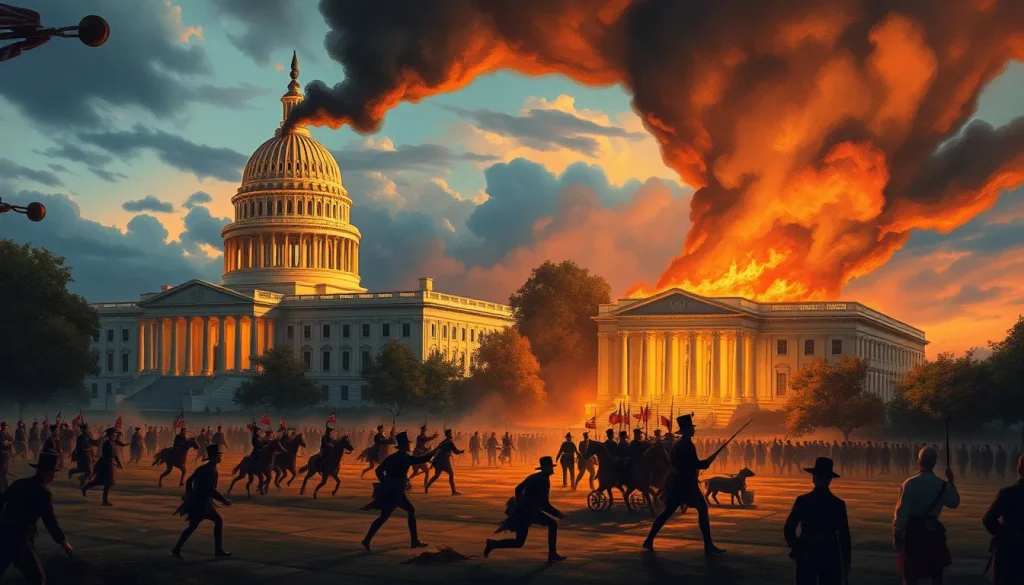
The Burning of Washington, also known as the Capture of Washington, occurred on August 24–25, 1814, during the War of 1812. A British force under Major-General Robert Ross and Rear-Admiral George Cockburn occupied the U.S. capital and set fire to multiple public buildings, including the Capitol and the President’s House. It was the only time since the American Revolution that a foreign power captured and occupied the United States capital, and it left an enduring mark on American national memory.
Historical Context
The War of 1812 (1812–1815) pitted the United States against the United Kingdom. A central American war aim was the conquest of Canada, and American forces had invaded Upper Canada in 1813. During that campaign, American troops burned the parliament buildings at York (modern Toronto) on April 27, 1813, and later destroyed the town of Newark (Niagara-on-the-Lake) in December 1813, leaving hundreds of civilians homeless in winter. These acts enraged the British and were cited as justifications for retaliation.
By April 1814, Napoleon had been defeated and exiled to Elba, freeing large numbers of British regulars and naval assets for service in North America. The British high command, under Secretary of State for War and the Colonies Earl Bathurst, planned a series of coastal raids to distract American forces from the Canadian front and to punish the United States. Vice-Admiral Alexander Cochrane commanded the North America and West Indies Station from Bermuda, and Rear-Admiral George Cockburn had been operating in Chesapeake Bay since 1813. Cockburn identified Washington as a vulnerable and symbolically significant target. In June 1814, he wrote to Cochrane stressing the weakness of the capital’s defenses. On July 18, Cochrane ordered Cockburn to “deter the enemy from a repetition of similar outrages” and authorized the destruction of towns and districts as retaliation.
What Happened
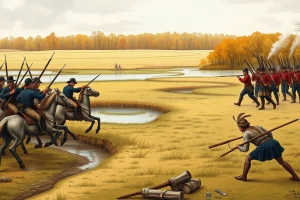
On August 19, 1814, a British force of about 4,500 men—veterans from the Peninsular War—landed at Benedict, Maryland, on the Patuxent River. They advanced overland toward Washington, meeting American defenders at Bladensburg, Maryland, on August 24. At the Battle of Bladensburg, despite outnumbering the British roughly two to one, the American forces were routed, earning the retreat the derisive nickname “the Bladensburg Races.”

The British entered Washington that evening. President James Madison and most government officials had already fled; Dolley Madison supervised the removal of the Gilbert Stuart portrait of George Washington from the President’s House before leaving. The British systematically set fire to the Capitol (including the Library of Congress), the President’s House, the Treasury, the War Office, the State Department, and the Washington Navy Yard, which the Americans themselves had partially burned to prevent capture. Private property was largely spared, per orders from Ross, though some homes adjacent to public buildings caught fire. British soldiers also burned the great bridge across the Potomac. A severe thunderstorm—possibly a tornado—struck the city late on August 25, extinguishing some fires, but the destruction had already been accomplished. The British occupied the city for roughly 26 hours before withdrawing to their ships.
Why It Matters
The burning of Washington was a humiliating blow to the Madison administration and the United States. It exposed the nation’s military weakness and the inadequacy of its defenses. Politically, the event energized Federalist critics and contributed to the Hartford Convention of December 1814. However, it also sparked a wave of patriotic resolve, culminating in the successful defense of Baltimore a few weeks later, which inspired Francis Scott Key to write “The Star-Spangled Banner.”
Long-term consequences included a determination to rebuild the capital and the eventual selection of Washington as the permanent seat of government, despite calls to relocate. The survival of the Declaration of Independence, the Constitution, and other key documents—saved by clerks from the State Department—allowed the young nation to preserve its foundational texts. Historians view the event as a turning point that demonstrated the costs of the war and helped foster a national identity, though the memory of the burning has been interpreted differently on both sides.
Prelude
Following the American invasions and burnings in Upper Canada, British commanders in North America sought retaliation. Governor-General Sir George Prevost wrote to Admiral Cochrane on June 2, 1814, calling for measures against American destruction of private property. Cochrane then instructed Cockburn to “destroy and lay waste such towns and districts as you may find assailable,” specifically citing the American action at Port Dover. In July 1814, Cockburn recommended Washington as a target because it was poorly defended and its capture would have a great political effect. The British expedition assembled in Bermuda, with Major-General Robert Ross commanding the army brigade.
Forces and Commanders
British: Major-General Robert Ross led a brigade of about 4,500 men, including Royal Marines and soldiers from the Peninsular War. Rear-Admiral George Cockburn commanded the naval squadron and coordinated the amphibious operation. Admiral Alexander Cochrane, the overall naval commander, remained in Bermuda but provided strategic direction. Ross initially doubted the feasibility of capturing Washington but was persuaded by Cockburn.
American: President James Madison was the nominal commander-in-chief but was not a military professional. Secretary of State James Monroe personally scouted the British advance. Brigadier General William Winder commanded the American forces at Bladensburg, which included a militia force of roughly 9,000 men, though they were poorly trained and equipped.
Battlefield and Map Context
The landing occurred at Benedict, Maryland, on the Patuxent River. The British marched northeast through Marlborough and then toward Bladensburg, which lay about five miles northeast of Washington. The American defenders occupied a ridge across the Anacostia River at Bladensburg, but they were overwhelmed. The route then led to the Capitol and down Pennsylvania Avenue to the President’s House. The city was laid out with wide avenues and public buildings separated by open ground, making it difficult to defend but easy to burn.
Battle Chronology
August 19–20: British land at Benedict.
August 21–23: British advance; American reconnaissance fails to stop them.
August 24, morning: Battle of Bladensburg; British rout the American forces.
August 24, afternoon/evening: British enter Washington; burning of public buildings begins.
August 25, early hours: Fires continue; a violent storm extinguishes many, but the damage is done.
August 25, evening: British begin withdrawal from the city, returning to their ships.
Casualties and Losses
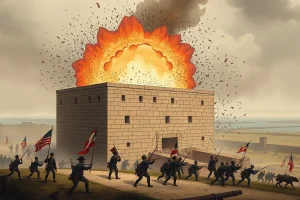
The British suffered minimal combat casualties, but about thirty were killed or wounded when an accidental explosion occurred at a magazine near Greenleaf Point while they were destroying American munitions. American military casualties were light in the field, but the destruction of public property was extensive—estimated at $1 million (over $17 million today). The loss of the Library of Congress (about 3,000 volumes) was a cultural blow.
Result
The British achieved their objective: the capture and burning of the U.S. capital. The occupation lasted about 26 hours, and the British withdrew in good order. The raid succeeded in humiliating the American government and demonstrating British reach, but it had no lasting strategic effect on the war’s outcome; the Treaty of Ghent was signed that December, and the war ended in a stalemate.
Strategic Consequences
The burning of Washington forced the United States to confront its military unpreparedness. It contributed to the resignation of Secretary of War John Armstrong and increased pressure for a more professional army. The British subsequently shifted their attention to Baltimore, where their attack was repulsed, ending the Chesapeake campaign. The event also hardened American resolve, helping to sustain the war effort until peace was negotiated. In the longer term, it influenced U.S. military planning and the decision to create more permanent fortifications for the capital.
Primary Accounts
Contemporary accounts include the report of Major-General Robert Ross to Earl Bathurst, dated August 30, 1814, describing the destruction of public buildings. Rear-Admiral Cockburn’s correspondence to Admiral Cochrane provides details of the operation. On the American side, Stephen Pleasonton, a State Department clerk, wrote a memoir (taken in 1848) describing the salvage of the national archives. Dolley Madison’s letter to her sister (August 23, 1814) is a famous account of the evacuation. These sources offer different perspectives but generally agree on the facts.
Battlefield Today
Washington, D.C., retains the sites of the 1814 events. The White House (rebuilt and painted white to cover the fire damage) and the Capitol (rebuilt and expanded) stand as the principal monuments. The streets and landmarks associated with the British march—such as Pennsylvania Avenue—are still present. The National Archives displays the original Declaration of Independence, Constitution, and Bill of Rights, which were saved from the fire. The U.S. Army Corps of Engineers maintains a monument at the Bladensburg battlefield. The burning is commemorated in various markers and at the National Park Service’s Star-Spangled Banner National Historic Trail.
Primary Sources
The most important primary sources include:
- Robert Ross’s report to Earl Bathurst (August 30, 1814): Official British account of the operation and its objectives.
- James Monroe’s letter to James Madison (August 22, 1814): Provides critical warning of the British advance toward Washington.
- Thomas Tingey’s letter to the Secretary of War (August 1814): Describes the American decision to destroy the Navy Yard.
- Stephen Pleasonton’s memoir (1848): Narrative of the successful evacuation of the Declaration of Independence and other archives.
- Dolley Madison’s letter to her sister (August 23, 1814): Firsthand testimony of events at the President’s House.
Each source has its own bias: British reports justify the destruction as retaliation; American accounts emphasize the heroism of saving documents and the shock of the attack.
Further Reading
- Walter Lord, The Dawn’s Early Light (1972)
- Anthony Pitch, The Burning of Washington (1998)
- Steve Vogel, Through the Perilous Fight: Six Weeks That Saved the Nation (2013)
- Charles C. Muller, The Darkest Hour (1963)
- National Park Service, “Burning the Capital” (2016)
- National Archives, “The Burning of Washington” (Prologue, 2014)
References
- “Burning of Washington,” Wikipedia, accessed 2023, https://en.wikipedia.org/wiki/Burning_of_Washington.
- “Complete the destruction of the public buildings with the least possible delay,” U.S. National Park Service, last modified May 24, 2016, https://www.nps.gov/articles/burning-the-capital.htm.
- “The Burning of Washington – War of 1812,” The War of 1812 resource, https://thewarof1812.org/battles/the-burning-of-washington/.
- Jessie Kratz, “The burning of Washington,” Pieces of History, National Archives, August 18, 2014, https://prologue.blogs.archives.gov/2014/08/18/the-burning-of-washington/.
- William T. Weber, “The British Capture of Washington, DC, 1814,” Studies in Intelligence, CIA, 2014, https://www.cia.gov/resources/csi/static/British-Capture-Washington-DC.pdf.
FAQ
Why did the British burn Washington?
The British attacked Washington as retaliation for American destruction of public and private property in Upper Canada, including the burnings at York and Newark. They also sought to demonstrate military power and force the United States to divert resources from the Canadian front.
What did the British spare in Washington?
The British explicitly spared private residences, commercial buildings, and churches. The Patent Office was saved when its superintendent argued that its contents were private intellectual property. Looting was forbidden, though some unauthorized looting occurred.
How were the Constitution and Declaration of Independence saved?
State Department clerks Stephen Pleasonton and others hastily removed the documents, including the Declaration of Independence, Constitution, and Bill of Rights, just before the British arrived. They transported them to a vacant gristmill in Virginia and later to Leesburg for safekeeping.
Leave a Reply