
Short Answer
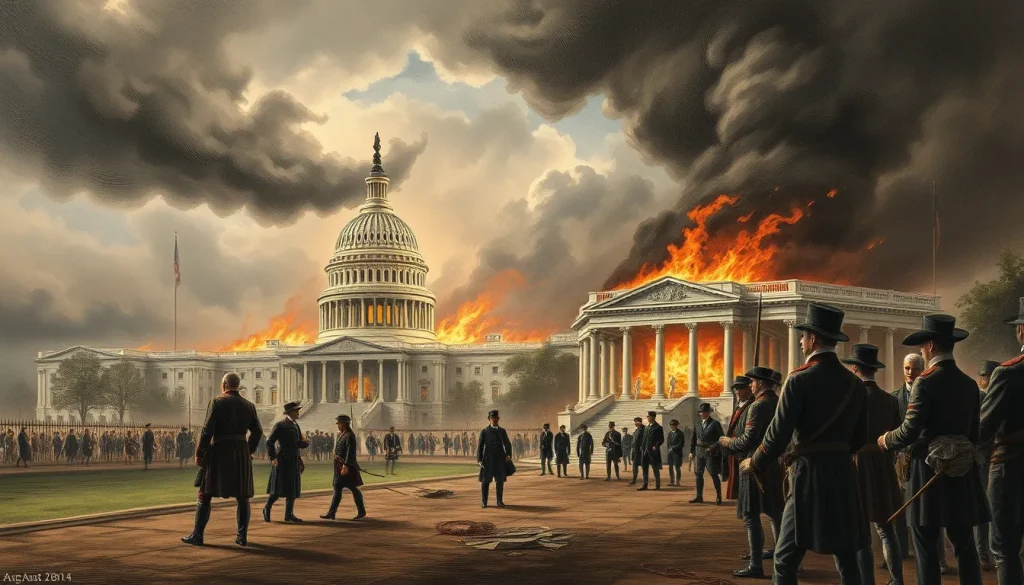
The burning of Washington, D.C., on August 24–25, 1814, was a dramatic British attack during the War of 1812 that saw the capture and deliberate destruction of the young republic’s public buildings. It had a complex and profound effect on American morale—initially causing shock and humiliation, but ultimately galvanizing the population to resist more fiercely. This event, still the only time a foreign power has occupied the U.S. capital, is historically significant for its immediate psychological impact and its role in shaping American national identity during the war.
Historical Context
The War of 1812 (1812–1815) arose from long-standing tensions between the United States and Great Britain, including the Royal Navy’s impressment of American sailors, trade restrictions, and British support for Indigenous resistance to American expansion. By 1814, the Napoleonic Wars in Europe had ended with Napoleon’s abdication, allowing Britain to shift veteran troops and naval resources to North America. A key objective was to divert American forces from Canada by striking at the U.S. coast, and the British also sought to retaliate for American burning of public buildings at York (Toronto) in 1813 and the destruction of Newark and other Canadian towns.
The Chesapeake Bay region, with its proximity to the capital, became the theater of operations. British Rear Admiral George Cockburn had spent months raiding the Chesapeake, gathering intelligence and weakening American defenses. In August 1814, a fleet under Vice Admiral Alexander Cochrane and a 4,500-man army under Major General Robert Ross landed at Benedict, Maryland, and marched toward Washington. The American capital was poorly defended: its fortifications were inadequate, and Secretary of War John Armstrong had dismissed the threat.
What Happened
On August 19, 1814, British troops landed at Benedict, Maryland. They met little initial resistance, but the scorching heat and lack of supplies slowed their march. Meanwhile, the American forces, comprising mainly untrained militia under Brigadier General William H. Winder, were assembled at Bladensburg, Maryland, to block the British advance. On August 24, the Battle of Bladensburg ended in a decisive American defeat, with militia breaking under the disciplined British regulars. With the road open, Ross and Cockburn entered Washington that evening, finding a largely deserted city; government officials, including President James Madison, had fled.
Over the next two days, the British systematically burned the principal government buildings: the Capitol (including the Library of Congress), the President’s House (the White House), the Treasury, the War and State Departments, and the Washington Navy Yard, which was set alight by Americans to prevent capture. British policy explicitly targeted public property, sparing private residences and churches as an act of retaliation for American destruction in Canada. The Patent Office was saved after superintendent William Thornton convinced the British that its contents—models of inventions—were private property. A violent thunderstorm and tornado on August 25 extinguished some fires and contributed to the death of about thirty British soldiers from a magazine explosion, but the destruction was done. The British withdrew the following night, marching back to their ships.
Why It Matters
The immediate impact on American morale was devastating. The capture of the capital and the burning of its symbols of government humiliated the Madison administration and shook public confidence. The Federalist Party, already critical of the war, gained ammunition, and the Hartford Convention of December 1814 reflected growing discontent. However, the event also provoked a powerful sense of outrage and unity. In the weeks that followed, Americans rallied to defend Baltimore, and the successful resistance at Fort McHenry (which inspired “The Star-Spangled Banner”) fueled a wave of patriotic determination.
In the longer term, the burning of Washington did not break American morale; it arguably strengthened it. Historians note that the event became a symbol of British aggression and American resilience, contributing to a collective national memory that helped define the post-war era. Reconstruction of the capital, beginning with the rebuilding of the White House and Capitol, became a testament to American persistence. The effect on morale was thus twofold: immediate humiliation followed by a lasting resolve that shaped the war’s outcome and the nation’s identity.
Definition
In the context of the War of 1812, “morale” refers to the emotional and psychological state of the American public, its military, and its political leadership—specifically, their confidence, determination, and willingness to continue the war effort. The “burning of Washington” denotes the British expeditionary force’s capture and deliberate destruction of the U.S. capital’s public buildings on August 24–25, 1814. Together, they represent a pivotal moment when the physical destruction of symbols of national authority intersected with the collective psyche of a young republic.
Background
The morale of Americans in 1814 was already strained after two years of unresolved conflict. The war had seen a series of setbacks on the Canadian frontier, economic disruptions from the British blockade, and persistent political divisions between the Democratic-Republicans and the Federalists. The British decision to target Washington was calculated to deliver a psychological blow, as Admiral Cockburn argued that the fall of a capital was always a severe blow to a government’s prestige. The American public had been assured of their security, and the capital was seen as a sanctuary. When the British struck, it shattered this complacency, causing panic and self-doubt.
How It Worked
The psychological impact of the burning operated on multiple levels. Symbolically, the destruction of the Capitol, White House, and other institutions represented an assault on the nation’s very identity. For a country that had fought a revolution to establish its independence, such an attack felt existential. It generated fear of capture, occupation, and the collapse of government. President Madison’s flight and the temporary loss of executive authority undermined confidence in leadership. In the immediate aftermath, reports of the burning spread rapidly, creating a sense of vulnerability and anger.
Yet the same event also triggered a defiant response. The spectacle of Dolley Madison saving the Gilbert Stuart portrait of George Washington—the revolutionary father—framed the destruction as a threat to the nation’s founding principles. The media and public figures condemned the burning as an act of barbarism, comparing it to the actions of a tyrannical monarchy. This outrage channeled popular energy into military enlistments and support for the war. The defense of Baltimore, just weeks later, became proof that American morale could rebound and stand firm.
Competing Viewpoints
Historians disagree on the net effect of the burning on American morale. One interpretation, emphasized by contemporaries like Federalist critics, holds that the event was a severe demoralizing blow that exposed the nation’s weakness and fueled anti-war sentiment. This view points to the Hartford Convention and the peace negotiations at Ghent as evidence that the Madison administration was compelled to seek a favorable settlement partly due to low public morale.
Conversely, a more recent historical perspective argues that the burning, rather than depressing morale, galvanized the nation. Anthony S. Pitch, in his study of the event, contends that the attack on Washington, like the later September 11 attacks, “galvanized the nation and strengthened its commitment to unity, freedom, and democracy.” The very destruction of symbols created a resolve to rebuild and overcome, turning a military defeat into a moral triumph. This view emphasizes the outpouring of patriotism that followed, including the rapid reconstruction efforts and the symbolic importance of the rebuilt capital.
Role in the War of 1812
The burning of Washington played a strategic role in the war’s final months. It did not force the United States to negotiate a separate peace, but it demonstrated Britain’s capacity to strike the American coast. The immediate reaction among Americans was a mixture of horror and determination. The successful defense of Baltimore in September 1814 was partly fueled by the rage and shame of Washington’s fall. Moreover, the event influenced the British decision to attack New Orleans later that year, though the ultimate failure there underscored the resilience of American forces. In the peace talks that concluded with the Treaty of Ghent (signed December 24, 1814), the burning did not have a decisive effect, but it shaped the war’s legacy and the sense of having survived a great trial.
Consequences and Historical Interpretation
The direct consequences of the burning were both physical and psychological. Physically, the capital’s buildings were destroyed, requiring years of reconstruction. Psychologically, the event has been interpreted as a crucible that hardened American resolve. In popular memory, it became a story of survival and defiance, rather than defeat—a narrative that contributed to the postwar “Era of Good Feelings” and the rise of American nationalism. Modern historians view the burning as a pivotal moment that revealed both the republic’s vulnerabilities and its capacity to recover, influencing subsequent debates about national defense, federal authority, and the meaning of American independence.
Primary Sources
Contemporary accounts provide crucial evidence about the morale effect. Dolley Madison’s letters, especially her correspondence with her sister Lucy Todd, vividly describe the flight from the White House and her determination to save the Washington portrait. British officers, such as Admiral Cockburn, wrote reports detailing their orders and the disciplined nature of the destruction. American newspapers, like the National Intelligencer, printed accounts of the events, though censorship and wartime propaganda colored some reports. The written testimonies of residents who remained in Washington, such as the patent office superintendent William Thornton, offer insights into British behavior and civilian reactions. Each source carries biases: American accounts tend to emphasize British cruelty, while British accounts stress retaliation and restraint.
Further Reading
- Pitch, Anthony S. The Burning of Washington: The British Invasion of 1814. Naval Institute Press, 1998.
- Hickey, Donald R. The War of 1812: A Forgotten Conflict. University of Illinois Press, 1989.
- Lambert, Frank. The Barbary Wars: American Independence in the Atlantic World (includes relevant context).
- The American Battlefield Trust’s article on the Burning of Washington (online resource).
- World History Encyclopedia’s article on the Burning of Washington (online resource).
References
- American Battlefield Trust, “The Capture and Burning of Washington, D.C.” (accessed 2026). Available at: https://www.battlefields.org/learn/articles/burning-washington-dc
- American Battlefield Trust, “The Burning of Washington” (video). Available at: https://www.battlefields.org/learn/videos/untold/burning-washington
- Pitch, Anthony S. “Patriotism and the Reconstruction of Washington, D.C., after the British Invasion of 1814,” in The Burning of Washington: A Study in Symbolism (Oxford University Press, 2005). Available at: https://doi.org/10.1093/oso/9780195175844.003.0010
- World History Encyclopedia, “Burning of Washington.” Available at: https://www.worldhistory.org/article/2631/burning-of-washington/
FAQ
Did the burning of Washington lower American morale?
Initially, the burning of Washington caused severe shock and humiliation, lowering morale. However, it also sparked anger and a determination to fight back, ultimately strengthening American resolve and contributing to the successful defense of Baltimore and a sense of victory.
How did the burning affect public opinion about the war?
The burning intensified political divisions: Federalists used it to criticize the war, while Democratic-Republicans rallied support by condemning British brutality. In the long run, it fostered a common sense of national identity and pride that helped unify the country after the war.
What was the immediate reaction to the burning?
The immediate reaction was a mix of panic, outrage, and grief. Citizens fled the city, government operations were disrupted, and newspapers reported the destruction with alarm. But within days, calls for revenge and defense mobilization emerged, indicating a rebound in public determination.



Leave a Reply