Short Answer
The British occupation of Detroit from August 1812 to September 1813 was a significant episode in the War of 1812, when a major American frontier post fell to a combined British and Indigenous force and remained under enemy control for over a year. Life in occupied Detroit was shaped by martial law, disrupted trade, and the presence of British regulars and Native American allies. This period is historically important because it illustrates the vulnerability of the American frontier and the complex loyalties of the region’s diverse inhabitants.
Historical Context
Detroit was a strategic village on the Detroit River, key to controlling the upper Midwest and the Great Lakes trade. At the outbreak of war, it was the capital of the Michigan Territory, with a mixed population of French-Canadian fur traders, American settlers, and a garrison of the U.S. Army. The American invasion of Canada failed when General William Hull surrendered Detroit to British Major General Isaac Brock and Shawnee leader Tecumseh on 16 August 1812. This opened a period of British military occupation of the territory, as the British aimed to hold the region and secure the allegiance of its inhabitants.
What Happened
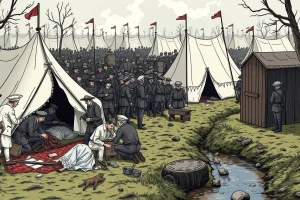
After Hull’s surrender, the British occupied Detroit and the surrounding region. Colonel Henry Procter was appointed civil governor on 24 August 1812. The occupation initially aimed to maintain order and secure the loyalty of the population. Procter declared martial law on 4 February 1813, as the threat of American counterattack increased. During the occupation, the British relied on Indigenous allies, including Potawatomi, Ojibwa, and Shawnee warriors, who camped near the town. Many American residents were required to swear oaths of allegiance to the Crown, while others left or were expelled. The economy suffered as trade routes were severed and currency lost value; the town’s reliance on furs and farm produce was disrupted by military demands. After the American naval victory on Lake Erie on 10 September 1813, the British evacuated Detroit, and American forces under William Henry Harrison reoccupied it on 29 September 1813.
Why It Matters
The occupation demonstrated the fragility of American control over the Northwest and the impact of Indigenous alliances. For the inhabitants, it meant a year of uncertainty, military rule, and economic disruption. The recapture of Detroit was a turning point in the war, leading to the Battle of the Thames and the collapse of Tecumseh’s confederacy. Historians view the occupation as a case study of frontier warfare and the role of civilians in wartime. It also foreshadowed the American determination to secure the region after the war, as evidenced by later economic development cited in studies like Floyd Dain’s 1943 thesis, which notes the town’s difficult recovery.
Historical Map Context
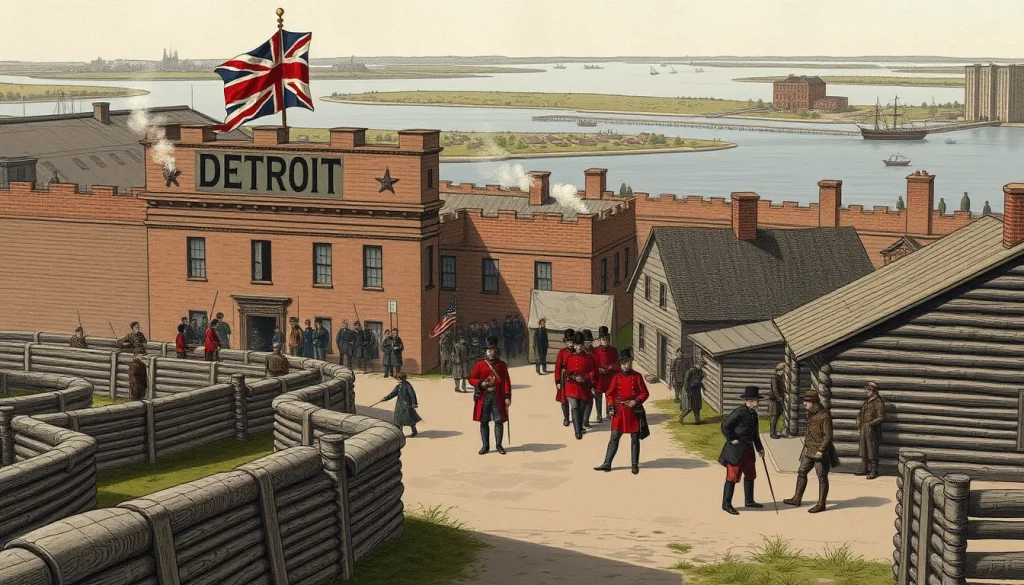
Detroit sat on the north bank of the Detroit River, with Fort Detroit (originally Fort Lernoult) overlooking the settlement. The fort had been built by the British in 1779 and surrendered to the United States in 1796. The town was laid out in a grid pattern, with the fort at its center, and was surrounded by a stockade. Maps from the era show the river, the fort, and the surrounding farms, as well as the Canadian shoreline with Fort Amherstburg opposite. The river served as a crucial artery for both trade and military movement.
Modern Location
Detroit, Michigan, now occupies the site. The fort’s location corresponds to present-day downtown Detroit, near Jefferson Avenue and Washington Boulevard. The fort was dismantled in 1827, and the site is now marked by a historical plaque at the intersection of Washington Boulevard and Lafayette Street. The surrounding area has been redeveloped, but the historical layout is preserved in maps and city plans.
Events at the Site
The occupation period saw British administration from the fort, with Procter using it as his headquarters. Martial law was proclaimed, and the town was subjected to curfews and restrictions. The fort was also the gathering point for British forces and their Indigenous allies. The American reoccupation in September 1813 returned the fort to U.S. control; it was renamed Fort Shelby in 1813. The fort remained in American hands for the rest of the war.
Associated People
Key figures during the occupation included British Major General Isaac Brock, who captured the town but died soon after at Queenston Heights; Colonel Henry Procter, the civil governor; Shawnee chief Tecumseh, who led Indigenous forces; and American General William Hull, who surrendered. Civilian residents included French-Canadian inhabitants, American settlers, and others who had to navigate the changing governance. Notably, Augustus B. Woodward, the American chief justice, stayed in the town and refused British requests to collaborate, later being expelled.
Surviving Monuments and Site
The fort no longer stands, but the site is marked by a Michigan Historic Marker. Several institutions, like the Detroit Historical Museum, interpret the War of 1812 and the occupation. The adjacent riverfront has been developed, but archaeological findings from the fort’s ruins have been studied. The Detroit Historical Society and the Burton Historical Collection preserve documents and artifacts from the period.
Primary Sources
Primary sources for life during the occupation include British military correspondence, such as General Brock’s reports to Sir George Prevost, and Henry Procter’s proclamations. American accounts, like William Hull’s defense of his surrender, provide the American perspective. Some civilian diaries and letters survive in archives, including the Burton Historical Collection of the Detroit Public Library. These sources, however, are filtered through military and political viewpoints and may not fully capture the daily experiences of ordinary residents. For example, Procter’s martial law declaration of February 4, 1813, is a key document, but its full text is not widely reproduced in accessible sources.
Further Reading
- Dain, Floyd Russell. “An Economic Study of Detroit, 1815-1825.” Wayne State University Thesis, 1943. Available online at DigitalCommons@WayneState.
- Hickey, Donald R. The War of 1812: A Forgotten Conflict. University of Illinois Press, 1989.
- Gilpin, Alec R. The War of 1812 in the Old Northwest. Michigan State University Press, 1958.
- American Battlefield Trust. “The Detroit Frontier in the War of 1812.” Accessed online.
References
- American Battlefield Trust, “The Detroit Frontier in the War of 1812,” https://www.battlefields.org/learn/articles/detroit-frontier-war-1812
- Wikipedia contributors, “British occupation of the Michigan Territory,” https://en.wikipedia.org/wiki/British_occupation_of_the_Michigan_Territory
- World History Encyclopedia, “Siege of Detroit,” https://www.worldhistory.org/article/2569/siege-of-detroit/
- Dain, Floyd Russell, “An Economic Study of Detroit, 1815-1825,” Wayne State University Thesis, 1943, https://digitalcommons.wayne.edu/oa_theses/541
FAQ
How long did the British occupation of Detroit last?
The British occupied Detroit from August 16, 1812, to September 29, 1813, a period of about 13.5 months.
Who was in charge of occupied Detroit?
Colonel Henry Procter was appointed civil governor on August 24, 1812, and administered the town under martial law.
What was life like for civilians in occupied Detroit?
Civilians faced martial law, mandatory oaths of allegiance to the Crown, economic disruption, and the presence of British and Indigenous forces. Many left or were expelled, while others attempted to adapt to the new rule.


Leave a Reply