Short Answer
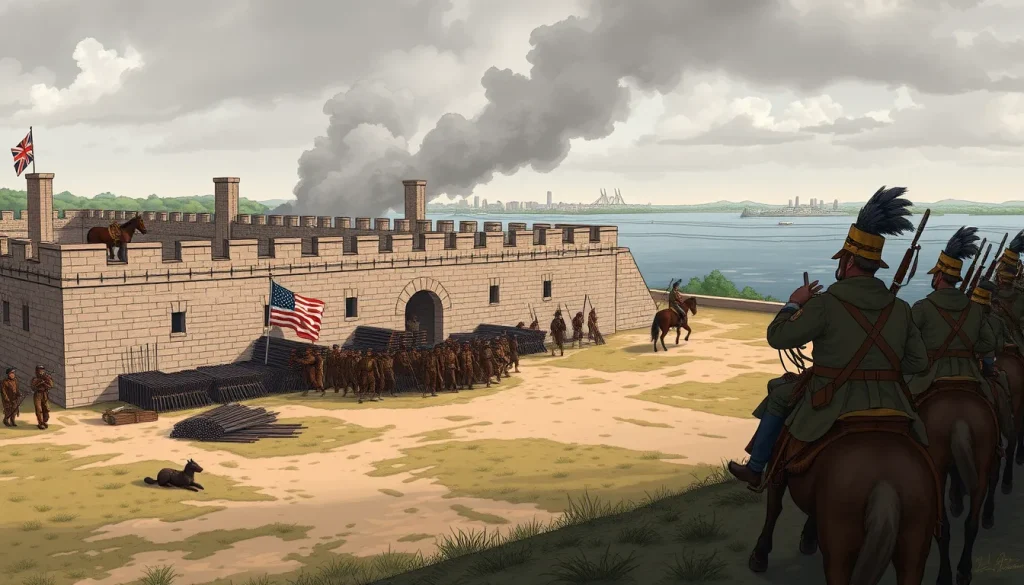
On August 16, 1812, Brigadier General William Hull surrendered Fort Detroit to a combined British and Indigenous force commanded by Major General Isaac Brock and the Shawnee leader Tecumseh, without a shot fired in defense. The surrender, which occurred early in the War of 1812, was one of the most humiliating American defeats of the conflict and had immediate strategic consequences for the Northwest frontier. It also raised enduring questions about Hull’s leadership and the reasons why a fortified position with more than 2,000 troops capitulated to a smaller enemy force.
Historical Context
The War of 1812 began on June 18, 1812, but news of the declaration did not reach the frontier until early July. William Hull, the 59-year-old governor of Michigan Territory, had lobbied the Madison administration for command of an invasion of Upper Canada from the west, arguing that Fort Detroit could serve as a base. Despite his concerns about British naval dominance on the Great Lakes, Hull was appointed brigadier general and given command of the Army of the Northwest. He arrived at Detroit in early July with about 2,200 men, a mixed force of regulars and state militia.
Detroit was a key American outpost on the Detroit River, fortified with a palisade and a fort that overlooked the town. However, its artillery could not easily respond to British batteries on the opposite shore. The British held Fort Malden (Amherstburg) across the river, defended by a small garrison and supported by an alliance of Indigenous nations led by Tecumseh. The British feared an American invasion would encourage Canadian militia to defect, while Tecumseh sought to block American expansion into Indigenous lands. Hull’s orders from Secretary of War William Eustis were to capture Fort Malden and advance into Upper Canada, but his supply line stretched back to Ohio and was vulnerable to attack.
What Happened
On July 12, Hull crossed the Detroit River unopposed and occupied Sandwich (present-day Windsor, Ontario), issuing a proclamation urging Canadians to join the American cause. Although initial advances were promising, Hull paused, waiting for heavy cannon and reassessing the risks. His scouts encountered hostile Indigenous parties, and Hull—fearful of attacks on his supply line—reduced his reconnaissance efforts. He also learned that British and Indigenous forces had captured the American outpost at Mackinac Island on July 17, further isolating his army.

British and Indigenous forces struck at Hull’s supply convoys. On August 5, Tecumseh and Captain Adam Muir ambushed an American supply force at Brownstown. A second, larger attempt to re-open communications was made on August 9, at the Battle of Maguaga, where the Americans forced a retreat but suffered significant casualties. Hull, unnerved, withdrew from Sandwich to Fort Detroit on August 11, despite his officers’ urging to advance. A captured letter from Hull revealed his anxieties to the British.
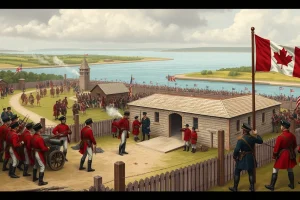
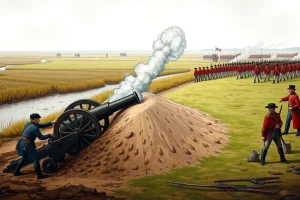
Isaac Brock, the acting governor of Upper Canada, arrived at Fort Malden on August 13 with about 300 reinforcements. Determined to act aggressively, he coordinated with Tecumseh and developed a deception plan. The British dressed local militia in discarded red uniforms, inflated reports of British strength with a fake letter, and parodied Indigenous warriors to appear far more numerous. On August 15, a British battery at Sandwich opened fire on Fort Detroit, and Tecumseh’s warriors crossed the river that night. The next morning, Brock landed with infantry, militia, and artillery south of the fort, while Tecumseh’s forces moved through the woods to the north. Brock sent a summons demanding surrender, warning that once the battle began he could not control the Indigenous warriors. Hull, believing the enemy numbered far greater than the actual force of about 1,500, and fearing an Indian massacre of the garrison and the 700 civilian residents—including his daughter and grandchildren—hoisted the white flag at 10 a.m. on August 16.
The terms of surrender allowed the American militia to return home; regular troops became prisoners of war. The British seized 39 cannons, large quantities of arms, ammunition, and supplies, and the nearly completed American warship Adams, which they renamed Detroit.
Why It Matters
The surrender of Fort Detroit was a catastrophic defeat for the United States. It gave the British control of Michigan Territory and a vital staging point for operations in the Northwest, while encouraging Indigenous raids against American settlements. The loss shattered American morale and provoked outrage across the country. Hull was court-martialed in 1814, convicted of cowardice and neglect of duty, and sentenced to death; President James Madison remitted the sentence due to Hull’s Revolutionary War service. The defeat also demonstrated the effectiveness of British-Indian cooperation and the importance of psychological warfare. The Americans did not regain Detroit until September 1813, after Oliver Hazard Perry’s victory on Lake Erie forced the British to evacuate the fort.
Historians have debated Hull’s actions ever since. Some view him as a coward or an incompetent commander; others suggest he may have suffered a mental breakdown under stress. A more recent interpretation emphasizes the successful British deception campaign, the lack of reliable intelligence available to Hull, and the real danger posed by Indigenous allies—a threat Hull genuinely feared, even if he overstated it. The surrender fundamentally altered the early course of the war, undermining American confidence and helping to solidify British control over the Upper Canada frontier.
Definition
In military history, the surrender of Fort Detroit refers to the capitulation of the American garrison at Detroit to British forces on August 16, 1812, without a formal battle. It is often called “the surrender without a fight” because the American commander, Brig. Gen. William Hull, accepted terms after only a brief artillery exchange, despite holding a numerically superior force behind fortifications.
Background
The surrender came after a poorly executed American invasion attempt. Hull’s army occupied Sandwich in Upper Canada for over a month, but supply interruptions and the loss of Fort Mackinac convinced him that his position was untenable. His decision to retreat to Detroit left his army disheartened and exposed. Meanwhile, Brock capitalized on Hull’s indecision, assembling a small but aggressive force and forming a crucial strategic partnership with Tecumseh. The British also intercepted American correspondence that revealed Hull’s anxiety and his underestimation of his own strength.
How It Worked
Brock’s victory rested on a deliberate campaign of deception and psychological pressure. He inflated his apparent numbers by marching troops in loops, dressing militia in red coats, and allowing Tecumseh’s warriors to be visibly present. He fabricated a letter suggesting that thousands of Indigenous warriors were gathering. He also exploited Hull’s well-known fear of Native Americans, warning that the “numerous body of Indians” would be “beyond control” once fighting began. Combined with the psychological impact of losing his supply lines and the capture of personal letters revealing his fears, Brock’s tactics persuaded Hull that resistance would lead to a massacre of troops and civilians. Hull accepted surrender terms that he believed saved lives, even though his force outnumbered the British and Indigenous attackers.
Competing Viewpoints
Hull’s own defense was that he surrendered to prevent “the horrors of an Indian massacre.” Many of his subordinate officers and soldiers directly disputed this, calling him a coward. Captain Thomas Jessup famously wrote, “He is a coward…and will not risk his person.” At his court martial, Hull was charged with treason, cowardice, and neglect of duty, but only the latter two were proven. Some contemporaries, and later historians, have suggested that Hull suffered a collapse of nerve or a form of mental breakdown under the combined pressures of command. Others stress that Hull’s decision, while disastrous, was based on genuine (if inflated) fears about Indigenous warfare, and that Brock’s deception was the decisive factor. The debate remains unresolved, though most modern scholarship argues that Hull’s failures as a commander, not just his personal fear, were responsible for the loss.
Role in the War of 1812
The fall of Detroit drastically changed the strategic situation in the Northwest. It opened the door for British and Indigenous offensives, including Tecumseh’s raids against American settlements in Ohio and Indiana. The United States was forced to divert scarce resources to recover the lost territory. The defeat also damaged American diplomatic credibility and raised fears of a British counter-invasion. The recapture of Detroit in September 1813, after the Battle of Lake Erie, was a turning point that restored American control and led to the Battle of the Thames, where Tecumseh was killed. In that sense, the surrender of 1812 set in motion a chain of events that ultimately secured the Northwest for the United States by the end of the war.
Consequences and Historical Interpretation
The immediate consequence was British domination of the Upper Great Lakes for more than a year. The longer-term historical interpretation has focused on Hull’s responsibility and the effectiveness of Brock’s leadership. In American memory, the surrender is often treated as an example of cowardice and incompetence; in Canadian history, it is celebrated as a heroic success that protected Canada from invasion. Modern historians emphasize the complex interplay of factors: Hull’s age and lack of readiness, the deficiencies of the American supply system, the strength of Indigenous alliances with the British, and Brock’s audacity. The event also illustrates the importance of intelligence and deception in wartime, as well as the psychological impact of threats of violence on commanders. The debate over Hull’s decision continues, but most agree that the surrender was not inevitable and was shaped by a combination of individual and systemic failures.
Primary Sources
- Terms of Capitulation (August 16, 1812): The signed agreement between Brock and Hull, held at the Archives of Ontario. It outlines the terms of surrender, including the release of militia and the treatment of regulars as prisoners.
- Brock’s Official Report (August 1812): Brock’s dispatch to the British government detailing the campaign and the psychological tactics he used. It is a key source for understanding the British perspective, though it reflects Brock’s self-serving narrative.
- Hull’s Letters and Court Martial Proceedings: Hull’s correspondence, including intercepted letters, and the full transcripts of his 1814 court martial provide his justifications and the accusations against him. They are biased by the legal context.
- Captain Thomas Jessup’s quotation: Recorded in several contemporary accounts, this quote illustrates the morale problems among American troops but must be interpreted with caution as a partisan statement.
Further Reading
- Donald R. Hickey, The War of 1812: A Forgotten Conflict (University of Illinois Press, 1989). A comprehensive overview.
- Wesley B. Turner, The War of 1812: The War That Both Sides Won (Dundurn Press, 1990). A balanced account of the conflict, including the Detroit campaign.
- Robert Malcomson, Historical Dictionary of the War of 1812 (Scarecrow Press, 2006). Useful for verifying facts and participants.
- The National Park Service, “He is a coward” (article), and the Canadian Encyclopedia entries on the Capture of Detroit and William Hull.
References
- U.S. National Park Service, “He is a coward,” https://www.nps.gov/articles/surrender-of-detroit.htm
- HISTORY.com Editors, “U.S. surrenders Fort Detroit to the British,” https://www.history.com/this-day-in-history/august-16/detroit-surrenders-without-a-fight
- U.S. Army Intelligence Center of Excellence, “Deception Campaign Leads to Surrender at Fort Detroit (16 AUG 1812),” https://www.dvidshub.net/news/printable/478238
- James H. Marsh, “Capture of Detroit, War of 1812,” The Canadian Encyclopedia, https://thecanadianencyclopedia.ca/en/article/capture-of-detroit-war-of-1812
- Jason Ridler, “William Hull,” The Canadian Encyclopedia, https://thecanadianencyclopedia.ca/index.php/en/article/william-hull
FAQ
Why did Hull surrender without a fight?
Hull surrendered due to a combination of factors: his belief that the British and Indigenous forces were vastly superior in number, his fear of an Indian massacre of the garrison and civilians, his loss of nerve after his supply lines were cut, and the effectiveness of Brock's deception campaign.
Was Hull a coward?
Many of his subordinates and the public considered him a coward, and he was court-martialed and sentenced to death, though the sentence was commuted. Some historians suggest he may have suffered a mental breakdown or made a rational but flawed decision based on his intelligence and fears.
What were the consequences of the surrender?
The British gained control of Michigan Territory and a large quantity of supplies and weapons. It encouraged Indigenous resistance and devastated American morale. The Americans recaptured Detroit in September 1813 after the Battle of Lake Erie.


Leave a Reply