
Short Answer
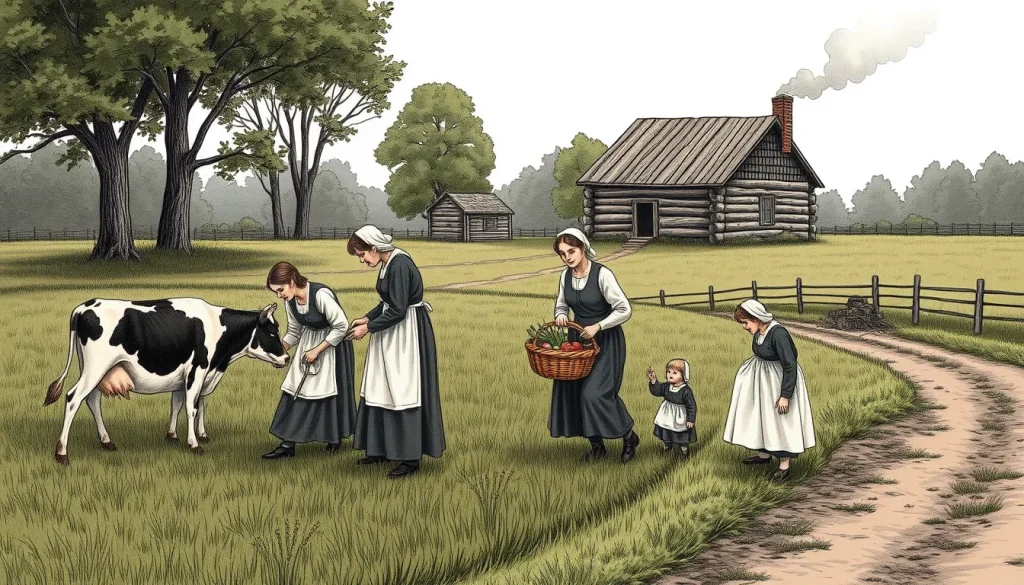
Women on the Canadian home front during the War of 1812 (1812–1815) refers to the civilian women of Upper Canada (today’s southern Ontario) who bore the primary responsibility for sustaining households, farms, and businesses while male relatives served in the militia or regular army. Their actions—from managing isolated farmsteads to providing intelligence to British forces—were essential to the colony’s survival and postwar recovery, yet for generations they were largely absent from military histories.
Historical Context
Upper Canada was a sparsely settled frontier province with a population of roughly 95,000 in 1812, concentrated along the St. Lawrence River, Lake Ontario, and the Niagara Peninsula. The province was largely agrarian, with most families living on isolated farmsteads. Men were expected to serve in the local militia, which was organized by district; the Niagara District, bordering the United States, saw the heaviest fighting. When war broke out in June 1812, British regulars, Canadian militia, and Indigenous allies defended the colony against American invasions. The absence of men for long campaigns—sometimes for months—forced women to take on all aspects of farm work, from planting and harvesting to managing livestock and equipment. The war also brought plundering by both American and British forces, battles on or near farmland, and the occupation of towns such as Newark (now Niagara-on-the-Lake). Women’s domestic labour and economic management became central to the province’s resilience.
What Happened
From the first months of the conflict, women across Upper Canada faced the sudden loss of male labour. Militia officers in Niagara were ordered to grant harvest leave to men whose farms needed attention, implicitly acknowledging that women would take over the work. Sophia Hainer of Grantham Township, left with six children after her husband died of disease in early 1813, tended the farm herself; she later lost crops and a firearm to American plunderers. Ann Butler of Newark, a Loyalist widow, managed a fifty-acre farm for seven months before her home was burned during a clash between American-allied and British-allied warriors. Women also supported the military directly. Laura Secord, the most famous, walked from Queenston to Beaver Dams in June 1813 to warn British lieutenant James FitzGibbon of a planned American attack, a story verified by later documents. Others, like tavern keeper Deborah Willson of Niagara Falls, served both armies to remain neutral; her tavern became a hospital after the Battle of Lundy’s Lane in July 1814. Rebecca Green Biggar, whose husband fought in that battle, spent the night listening to cannon fire and anxiously sought him afterward. In addition to these visible acts, women formed community networks, merged households, applied for private charity, and cooperated with occupying forces to obtain food. After the war, many submitted war loss claims to the British government, documenting lost property, crops, and livestock—a crucial record of their wartime experiences.
Why It Matters
The immediate consequence of women’s efforts was the continued functioning of the province during a destructive war. Farms produced food for civilian and military use, and households remained viable despite constant threat. In the longer term, women’s management of property and farms positioned them as key participants in the postwar reconstruction of Upper Canada. War loss claims gave them a formal voice in official records, and many used compensation awards to rebuild homes and purchase land. Historians have often depicted women as passive victims, but recent scholarship, particularly Spencer W. Roberts’s dissertation on the Niagara District, demonstrates that they were active agents who shaped both the wartime experience and the province’s development. The memory of women like Laura Secord became national icons, but the everyday labour of hundreds of unnamed women was equally vital, though long overlooked.

Definition
The “home front” in this context refers to the civilian sphere in Upper Canada during the War of 1812, encompassing the daily activities and responsibilities of women who remained in the colony while men fought. It includes farm labour, household management, childcare, medical care, provisioning, and the maintenance of property and businesses.
Background
Before the war, women in Upper Canada already bore heavy responsibilities. They worked alongside men in the fields, managed gardens and domestic animals, and contributed to the local economy through barter and the sale of butter, eggs, and textiles. They petitioned for land in their own names, as Roberts shows, and some ran taverns or shops. The war intensified these roles because it removed male labour and exposed communities to invasion, plundering, and occupation.
How It Worked
Women’s wartime work varied by circumstance and class. On farms, they planted, weeded, and harvested; tended livestock; and repaired fences and buildings. They also maintained the household: cooking, cleaning, laundering, and caring for children and the elderly. When male kin were absent or killed, women became heads of households, managing finances and supervising hired labour if they could afford it. Some women followed the army as cooks, laundresses, or nurses, though official records often omit them. Others gathered and passed intelligence—Laura Secord’s warning is the most famous example—or provisioned troops by selling food and supplies. Women also engaged in survival strategies: merging households, relying on neighbours, and cooperating with occupying forces to obtain food, as Roberts documents for Niagara.
Competing Viewpoints
Traditional histories depicted women as victims or as quiet supporters, emphasizing their suffering and domesticity. Modern historians, particularly feminist and social historians, argue that women were active participants whose labour and decisions were crucial to the war effort and community survival. The debate also touches on agency: did women act within patriarchal constraints, or did the war expand their sphere? Roberts contends that women worked within existing structures but also shaped them, using claims and petitions to assert their rights. Other scholars caution against overstating women’s autonomy, noting that legal and social limitations remained in place.
Role in the War of 1812
Women’s contributions directly affected military operations and the colony’s ability to continue. Their farm production supplied food for troops and civilians. Their management of households allowed men to serve. Their intelligence gathering warned British forces of American movements. Their care for the wounded, often in makeshift hospitals like Deborah Willson’s tavern, mitigated casualties. Women’s cooperation with occupying forces, while sometimes condemned, was a pragmatic survival tactic. Their war loss claims later provided financial resources for rebuilding, which was essential for the province’s postwar stability.
Consequences and Historical Interpretation
In the postwar era, women’s roles were often downplayed as the province returned to peacetime norms, yet their wartime experiences likely influenced their expectations and petitioning practices. The loss claims created a rich archive that historians now use to reconstruct women’s lives. Scholarly interpretation has shifted from a focus on exceptional individuals like Laura Secord to a broader understanding of ordinary women’s labour as a form of resistance and community building. This has opened new questions about gender, war, and society in the early nineteenth-century British Empire.
Primary Sources
The most valuable primary sources are the war loss claims submitted to the British government after the war. These claims, often witnessed by neighbours, list stolen or destroyed property, providing insight into women’s possessions, farming operations, and household economies. For example, the claim of Elizabeth Skinner, who lost property during the Battle of Lundy’s Lane, includes testimony from a relative. Also useful are contemporary letters and diaries—Laura Secord’s own account was written later and is subject to debate. Official military records, such as orders granting harvest leave, indirectly document women’s farm work. Newspapers occasionally mention women’s actions, though not extensively. These sources must be used critically: claims were filed after the fact and might exaggerate losses, while memoirs reflect memory and self-presentation.
Further Reading
- Roberts, Spencer W. “Fortitude and Resolution”: Women of Niagara and the War of 1812. Digital dissertation and website, George Mason University, 2021. Available at https://swroberts.ca/far/.
- Oosterom, Nelle. “Women of 1812.” Canada’s History, 17 July 2013. https://www.canadashistory.ca/explore/women/women-of-1812.
- Niagara Falls Museums. “Niagara Falls Women in the War of 1812.” The Exchange Niagara Falls. https://nfexchange.ca/museum/discover-our-history/history-notes/niagara-falls-women-in-the-war-of-1812.
- Benn, Carl. The War of 1812. Oxford: Osprey Publishing, 2002.
- Graves, Dianne. “Women and the War of 1812.” Canada’s History, August–September 2012.
References
- Roberts, Spencer W. “Fortitude and Resolution”: Women of Niagara and the War of 1812. George Mason University, 2021. DOI: 10.13021/mars/5089.
- Roberts, Spencer W. “Fortitude and Resolution”: Women of Niagara and the War of 1812. Project website, https://swroberts.ca/far/.
- Oosterom, Nelle. “Women of 1812.” Canada’s History, July 17, 2013. https://www.canadashistory.ca/explore/women/women-of-1812.
- Niagara Falls Museums. “Niagara Falls Women in the War of 1812.” The Exchange Niagara Falls. https://nfexchange.ca/museum/discover-our-history/history-notes/niagara-falls-women-in-the-war-of-1812.
FAQ
What roles did women play on the Canadian home front during the War of 1812?
Women managed farms and businesses, cared for families, provided food and shelter to troops, gathered intelligence (e.g., Laura Secord), worked as nurses, and submitted compensation claims for property losses.
How are women’s experiences documented in the historical record?
The most detailed records are war loss claims filed by women after the war, which list property and sometimes include testimony. Diaries, letters, and military orders also provide indirect evidence. These sources must be read carefully because claims may be overstated and memoirs are written with hindsight.
Why is Laura Secord the most famous woman of the War of 1812?
Laura Secord is celebrated for her 20-mile walk to warn British forces of an impending American attack, which helped secure a victory at Beaver Dams. Her story gained legendary status in the 19th century, partly through candy company marketing, making her the most remembered woman of the conflict.

Leave a Reply