Short Answer
U.S.–Canadian border relations after 1815 describe the diplomatic process by which the United States and British North America—later the Dominion of Canada—transformed a contested war frontier into a stable, largely undefended boundary. Rooted in the Treaty of Ghent (1814), which ended the War of 1812 with no territorial changes, the subsequent agreements, including the Rush-Bagot Agreement (1817) and the Convention of 1818, established principles that prevented further armed conflict and shaped modern North American security and trade.
Historical Context
The War of 1812 concluded with the Treaty of Ghent, signed December 24, 1814, and ratified in February 1815. The treaty restored pre-war boundaries and left unresolved many issues that had fueled the conflict, including maritime rights, impressment, and Indigenous land claims. The border between the United States and British North America stretched from the Atlantic to the Lake of the Woods and beyond, but its precise location remained unclear in several regions. Both nations, exhausted by the Napoleonic Wars and the War of 1812, sought to avoid further costly wars. The demilitarization of the Great Lakes emerged as a priority, as did the need to define the boundary westward through the territories of Indigenous peoples. The diplomatic efforts that followed set the stage for a century of peaceful coexistence.
What Happened
In 1817, the Rush-Bagot Agreement limited naval armaments on the Great Lakes to a few small vessels, effectively demilitarizing the lakes. The Convention of 1818 extended the border from the Lake of the Woods to the Rocky Mountains along the 49th parallel and established joint control of the Oregon Territory for ten years. Boundary commissions appointed under the Treaty of Ghent resolved disputes in the east, though the Maine–New Brunswick boundary remained contentious. The 1837–38 Canadian Rebellions led to border incidents, including the Caroline Affair and the formation of American-based Hunter societies. British and American forces cooperated to suppress these threats, demonstrating a shared commitment to regional stability. The Webster-Ashburton Treaty (1842) finally settled the northeastern boundary, and the Oregon Treaty (1846) extended the 49th parallel to the Pacific, resolving the last major continental dispute. These agreements established a clear, stable boundary that no longer required fortification or large military forces.
Why It Matters
The immediate effect of these arrangements was the avoidance of another Anglo-American war, which both nations recognized as mutually destructive. In the longer term, the peaceful resolution of border disputes facilitated trade, migration, and cultural exchange. The demilitarized boundary became a symbol of international cooperation, culminating in the 20th century as the world’s longest undefended border. Historians argue that the peaceful outcome reflected pragmatic interests, British naval dominance elsewhere, and American preoccupation with westward expansion. For Indigenous peoples, however, the border solidified the division of their territories and led to displacement. The legacy of these post-1815 agreements continues to shape Canadian–American relations, which remain grounded in negotiation and shared sovereignty.
Definition
U.S.–Canadian border relations after 1815 refer to the diplomatic, legal, and military arrangements between the United States and British North America—later Canada—that determined the boundary line, regulated the use of border waters, and established rules for non-military interaction. These relations evolved from a state of armed tension to one of peaceful coexistence and mutual cooperation.
Background
The War of 1812 had demonstrated that the border region was a zone of instability, with raids, supply lines, and Indigenous alliances crossing the line. The Treaty of Ghent, however, did not address the underlying boundary ambiguities, leaving them for future negotiation. The British maintained military posts in the Northwest, and the Americans sought to assert control over the Great Lakes. The demobilization of both armies and the financial costs of war encouraged both sides to seek permanent solutions. Economic interests, particularly the fur trade and frontier settlement, also demanded defined boundaries.
How It Worked
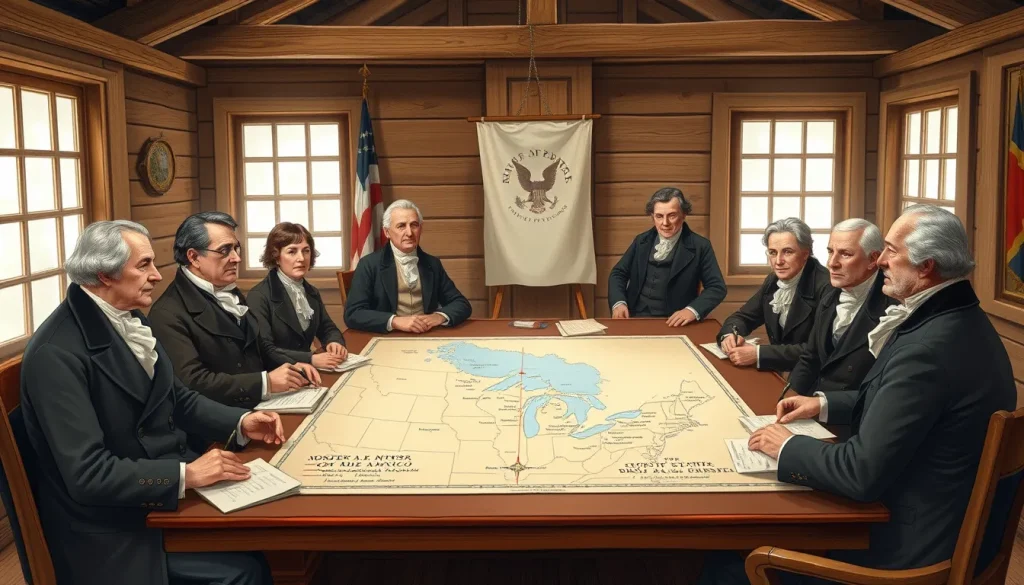
The process operated through bilateral treaties, joint commissions, and arbitration. The Rush-Bagot Agreement (1817) limited armed vessels on the Great Lakes to four small craft per nation, effectively demilitarizing the waterway. The Convention of 1818 established the 49th parallel boundary to the Rockies, created joint claims over Oregon, and affirmed fishing rights. Boundary commissions, such as those under the Treaty of Ghent, surveyed and marked the lines, with disputes referred to neutral arbitration. The Webster-Ashburton Treaty (1842) resolved the Maine boundary and other lingering issues, while the Oregon Treaty (1846) extended the 49th parallel to the Pacific, making the border continuous. These mechanisms proved durable, as both nations had a shared interest in preventing conflict that could disrupt trade and expansion.
Competing Viewpoints
American politicians and settlers often harbored expansionist ambitions, viewing British North America as a potential annexation that would extend U.S. influence. British colonial administrators prioritized security and the preservation of ties with Indigenous allies, fearing American encroachment. Canadian colonists, both English and French, developed a distinct identity and were wary of American republicanism, as evidenced during the 1837 Rebellions. Indigenous peoples, caught between the two powers, saw the border as an artificial division of their homelands; their rights and territories were often disregarded in diplomatic negotiations. These differing perspectives produced tension, but the eventual agreements reflected a compromise: the Americans gained clear boundaries and access to markets, the British secured a stable frontier, and Canadians maintained independence from the United States.
Role in the War of 1812
The War of 1812 itself was a direct catalyst for post-1815 border relations. The war had arisen partly from unresolved boundary disputes and maritime grievances, and its outcome—a return to the status quo ante bellum—demonstrated that neither side could easily conquer the other. This stalemate convinced both governments that a negotiated boundary was preferable to continued conflict. The war also highlighted the strategic importance of the Great Lakes, leading to the Rush-Bagot Agreement, and the need to control the northern frontier, prompting the boundary commissions. Without the war’s costly lesson, the border might have remained a source of recurring crises rather than becoming a model of peaceful resolution.
Consequences and Historical Interpretation
The immediate consequence was a stable political order that allowed both nations to focus on westward expansion and economic growth. The demilitarization of the border reduced military expenditures and enabled free movement of goods and people, fostering deep social and economic ties. Later historians have interpreted this outcome in various ways: some see it as a triumph of diplomacy and mutual interest, others as a result of British strategic withdrawal and American dominance. The role of Indigenous peoples, whose lands were divided and whose alliances were disregarded, is now recognized as a tragic outcome of the border’s creation. The legacy of the post-1815 arrangements endures in the modern U.S.–Canada partnership, epitomized by the International Joint Commission (1909) and the NORAD agreement, which underscore the peaceful, cooperative management of the boundary. The “undefended border” is today a metaphor for the deep trust between the two countries, yet it is a managed trust, shaped by the lessons of the War of 1812 and its aftermath.
Primary Sources
Key primary sources include the Treaty of Ghent (1814), which laid the foundation for boundary commissions; the Rush-Bagot Agreement (1817), which limited naval forces; the Convention of 1818, which established the 49th parallel; and the Webster-Ashburton Treaty (1842). Diplomatic correspondence between U.S. and British officials, such as the letters of John Quincy Adams and Albert Gallatin, reveal the negotiating positions. The journals of boundary commissions and maps from the early 19th century detail the surveying process. These sources are limited by their official, elite perspective, often excluding the voices of Indigenous peoples and frontier settlers. Researchers can access these documents in the U.S. National Archives, Library and Archives Canada, and published collections such as American State Papers.
Further Reading
- English, John R., and Stephen Azzi. “Canadian-American Relations.” The Canadian Encyclopedia, 2020.
- Bothwell, Robert. “Canada-US Relations, 1759–2019.” Oxford Research Encyclopedia of American History, 2019.
- Lacroix, Patrick. “Choosing Peace and Order: National Security and Sovereignty in a North American Borderland, 1837–42.” The International History Review, 2015.
- “A Good and Wise Measure: The Search for the Canadian-American Boundary, 1783-1842.” University of Toronto Press, 2014.
References
- English, John R., and Stephen Azzi. “Canadian-American Relations.” The Canadian Encyclopedia, 2020. https://prod-front.thecanadianencyclopedia.ca/en/article/canadian-american-relations.
- Bothwell, Robert. “Canada-US Relations, 1759–2019.” Oxford Research Encyclopedia of American History, 2019. https://doi.org/10.1093/acrefore/9780199329175.013.609.
- Lacroix, Patrick. “Choosing Peace and Order: National Security and Sovereignty in a North American Borderland, 1837–42.” The International History Review, 2015. https://doi.org/10.1080/07075332.2015.1070892.
- “A Good and Wise Measure: The Search for the Canadian-American Boundary, 1783-1842.” JSTOR, 2014. https://www.jstor.org/stable/10.3138/9781442670327.
FAQ
What were the main border issues after 1815?
The primary issues were the precise location of the boundary, especially in Maine and the West, the level of military presence on the Great Lakes, and navigation and fishing rights.
How did the Rush-Bagot Agreement impact border relations?
It limited naval armaments on the Great Lakes, reducing the potential for armed conflict and paving the way for a demilitarized boundary.
Why is the U.S.–Canada border called undefended?
Because after the 1817 agreement and later treaties, both nations removed major military forces and fortifications, relying on diplomatic cooperation rather than armed defense to manage the border.


Leave a Reply