Short Answer
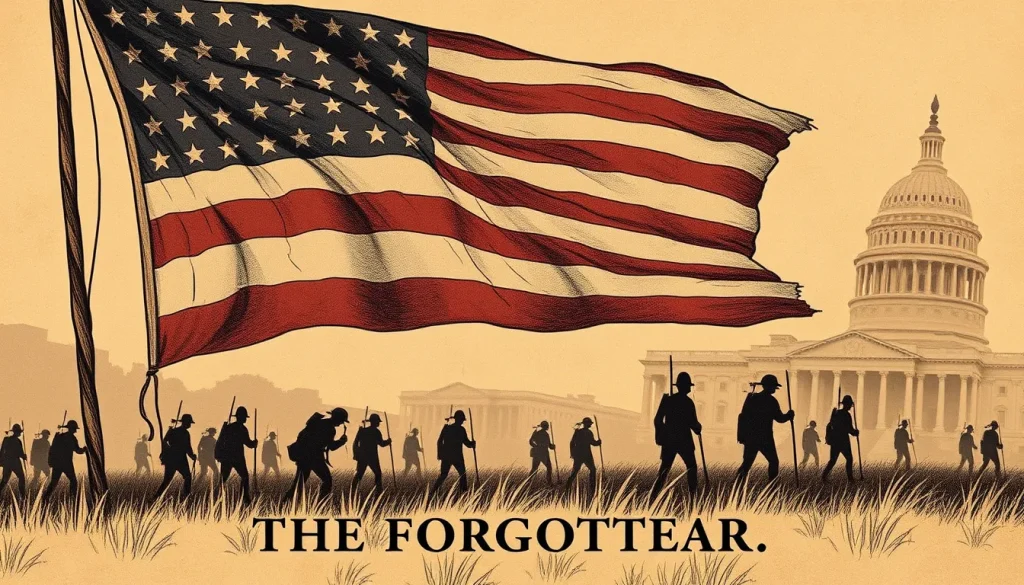
The War of 1812 (1812–1815) is often called the Forgotten War because of its unusually low profile in American public memory when compared with the Revolutionary War and the Civil War that flank it. Though it involved the United States and Great Britain, with significant participation by Indigenous nations, Canadian militia, and African Americans, its causes and outcomes remain obscured to many. This article examines why the conflict earned that label and what the label reveals about historical memory and interpretation.
Historical Context
The War of 1812 grew out of long-standing disputes between the United States and Great Britain, primarily over British maritime practices during the Napoleonic Wars. These included impressment of American sailors into the Royal Navy, restrictions on neutral trade, and blockades. Additionally, Britain was accused of supporting Indigenous peoples resisting American expansion into the Northwest Territory. On June 18, 1812, President James Madison signed a declaration of war approved by Congress, the first time the United States had declared war on another nation. The conflict unfolded on multiple fronts: the Atlantic Ocean, the Great Lakes, the Canadian border, and the Gulf Coast. It also involved Spain, which controlled Florida, and numerous Native nations. The war ended with the Treaty of Ghent on December 24, 1814, but the Battle of New Orleans was fought on January 8, 1815, after the peace had been signed but before news reached the troops.
What Happened
The United States initially aimed to conquer Canada, hoping to pressure Britain into maritime concessions. However, American invasions of Canada in 1812 and 1813 largely failed due to poor planning, inadequate logistics, and strong resistance from British regulars, Canadian militia, and Indigenous warriors led by leaders such as Tecumseh. The U.S. Navy scored notable victories on the high seas, including the capture of HMS Guerriere by USS Constitution in August 1812, which gave rise to the nickname “Old Ironsides.” On Lake Erie, Commodore Oliver Hazard Perry’s fleet defeated the British in September 1813. In 1814, as British forces were freed from the Napoleonic wars, they launched a counteroffensive. British troops drove into Washington, D.C., and burned the Capitol and the White House in August 1814. A subsequent British attack on Baltimore was repelled, inspiring Francis Scott Key to write “The Star-Spangled Banner.” A British invasion from Canada was stopped at the Battle of Plattsburgh in September 1814, and the war concluded with Andrew Jackson’s decisive victory at New Orleans. The Treaty of Ghent restored all territory to its pre-war boundaries but did not settle the disputes over impressment or trade, which were moot after the defeat of Napoleon.
Why It Matters
The War of 1812 had significant consequences. It marked the last time the United States faced a major military threat from Britain and helped to secure American independence in the international arena. Canadians, who had repelled American invasions, emerged with a stronger national identity. For Indigenous peoples, the war was catastrophic: the defeat of Tecumseh’s confederacy and the collapse of British military support opened the door to accelerating American westward expansion and the eventual forced removal of Native nations. The war also produced enduring national symbols and phrases, such as the national anthem and “Don’t give up the ship.” Yet, despite these legacies, the war occupies a peripheral place in American historical consciousness. Its causes—maritime rights and impressment—seem foreign to modern sensibilities, and its result, a stalemate, lacks the clear narrative arc of victory or defeat.
Definition
The label “Forgotten War” is a shorthand used to describe the War of 1812’s relatively small presence in American collective memory. The conflict is the only war in United States history officially named simply by the year of its beginning. For many decades after 1815, it was often referred to vaguely as the “Late War,” and even that term fell out of use as new wars demanded distinct names. The descriptor “forgotten” became common in the late twentieth century, popularized by historian Donald R. Hickey’s 1989 book, The War of 1812: A Forgotten Conflict.
Background
The forgetting of the War of 1812 stems from several factors. It lacked the grand existential stakes of the American Revolution, which had created the nation, or the moral clarity of the Civil War, which had torn it apart. The war’s achievements were modest: the pre-war boundaries were restored, and none of the specific grievances that prompted the declaration of war were addressed in the Treaty of Ghent. As historian Matthew Dennis notes, the war’s accomplishments were “meager,” and general historical knowledge of it is thin. The causes—impressment, trade restrictions, and maritime rights—do not resonate with modern audiences, unlike issues of liberty or slavery. Additionally, the war was sandwiched between two transformative conflicts that dominated national narrative and memory, leaving it little cultural space.
How It Worked
The process by which the war became “forgotten” was not a single event but a gradual fading from public consciousness. During the nineteenth century, the conflict was overshadowed by the rapid expansion of the United States, the Mexican-American War, and then the Civil War. The name itself was generic—“war of 1812” appeared in print with lower-case letters as late as the early twentieth century. Popular memory focused on isolated heroic episodes, such as the defense of Fort McHenry or the battle of New Orleans, rather than on a coherent narrative. The war inspired only a handful of films and few major literary works, further cementing its obscurity. Museums and historic sites existed, but they often emphasized local or personal stories rather than a connected national story. The centennial celebrations in 1912–1915 were relatively muted compared to other commemorations, and the bicentennial received mixed attention.
Competing Viewpoints
Historians and national traditions offer differing perspectives on the war and its memory. Many Americans consider the war a draw, since neither side gained territory or achieved its stated aims. Some historians, including Donald Hickey, argue that the United States actually lost, because its invasions of Canada failed, and it did not attain its maritime goals. Canadians tend to view the war as a victory, emphasizing the successful defense of their homeland against American incursions. The British, facing a massive global conflict with France, largely overlooked the North American theatre and remember it little. Indigenous peoples, who allied with Britain and suffered great losses, experienced the war as a devastating defeat that led to their displacement. These competing narratives complicate any simple assignment of “victory” and contribute to the war’s inconsistent place in national memories.
Role in the War of 1812
The label “Forgotten War” has had a tangible impact on how the conflict is studied and remembered. It has influenced funding for historic preservation, academic research, and educational efforts. Sites like Fort McHenry and the USS Constitution are preserved as iconic symbols, but the wider battlefield landscape and archival records have not always received equal attention. The label can also lead to oversimplification, reducing the war to a few famous episodes rather than acknowledging the involvement of diverse peoples—African Americans who fought for both sides, Indigenous nations whose homelands became battlegrounds, and civilian experiences. In recent decades, scholars have worked to expand the story, emphasizing the war’s significance for Canada’s national identity and for the fate of Native peoples.
Consequences and Historical Interpretation
The “forgotten” designation has consequences for national identity and historical understanding. It obscures the war’s role in confirming American sovereignty and fostering a distinct sense of nationhood separate from Europe. It also hides the darker consequences—the disruption of Indigenous societies and the extension of slavery into newly acquired territories. Historians have reinterpreted the war as more than a footnote, viewing it as a pivotal moment in the rise of the United States as a continental power and in the transformation of British-American relations from hostility to cooperation. The label itself is now challenged by scholarship that seeks to give the conflict its due, even as the name “Forgotten War” persists in popular usage.
Primary Sources
Key primary sources for understanding the war and its memory include: President James Madison’s war message to Congress (June 1, 1812), which enumerated British grievances; the Treaty of Ghent (signed December 24, 1814), which ended the war; and the manuscript of Francis Scott Key’s “The Star-Spangled Banner” (1814), which became the national anthem. For the memory of the war, an important source is Helen W. Pierson’s History of the United States in Words of One Syllable (1884), which described the war as the “Late War” and exemplified its generic naming. The accounts of participants, such as the journal of Lieutenant John Le Couteur of the British army or the letters of American soldiers, offer contemporary perspectives, though they are often biased by nationality and experience.
Further Reading
- Hickey, Donald R. The War of 1812: A Forgotten Conflict. Chicago: University of Illinois Press, 1989.
- Taylor, Alan. The Civil War of 1812: American Citizens, British Subjects, Irish Rebels, and Indian Allies. New York: Alfred A. Knopf, 2010.
- Stagg, J.C.A. The War of 1812: Conflict for a Continent. Cambridge: Cambridge University Press, 2012.
- Benn, Carl. The War of 1812. Oxford: Osprey Publishing, 2002.
- National Park Service. “Legacies of the War of 1812.” https://www.nps.gov/subjects/warof1812/legacies-of-the-war-of-1812.htm.
References
- Dennis, Matthew. “A war that looms small in American memory.” U.S. National Park Service. https://www.nps.gov/articles/a-war-that-looms-small.htm.
- National Park Service. “Legacies of the War of 1812.” https://www.nps.gov/subjects/warof1812/legacies-of-the-war-of-1812.htm.
- Dotinga, Randy. “Why America forgets the War of 1812.” Christian Science Monitor, June 8, 2012. https://www.csmonitor.com/Arts-Culture/Books/chapter-and-verse/2012/0608/Why-America-forgets-the-War-of-1812.
- “The Forgotten War.” Encyclopedia.com.
- Constitution Center. “America’s ‘forgotten war’ ended on this day, and few people knew.” December 24, 2022. https://constitutioncenter.org/blog/americas-forgotten-war-ended-on-this-day-and-few-people-knew.
FAQ
Why is the War of 1812 called the Forgotten War?
Due to its low profile in American memory, its generic name, and the overshadowing by the Revolution and Civil War. Historian Donald Hickey popularized the label in his 1989 book.
Did the War of 1812 have a clear winner?
No. Americans often see it as a draw, Canadians as a victory for defending their land, and some historians argue the U.S. actually lost because invasions of Canada failed.
How is the War of 1812 remembered in Canada?
In Canada, the war is seen as a successful defense against American invasion, celebrated prominently in Ontario, and contributes to Canadian national identity.


Leave a Reply