
Short Answer
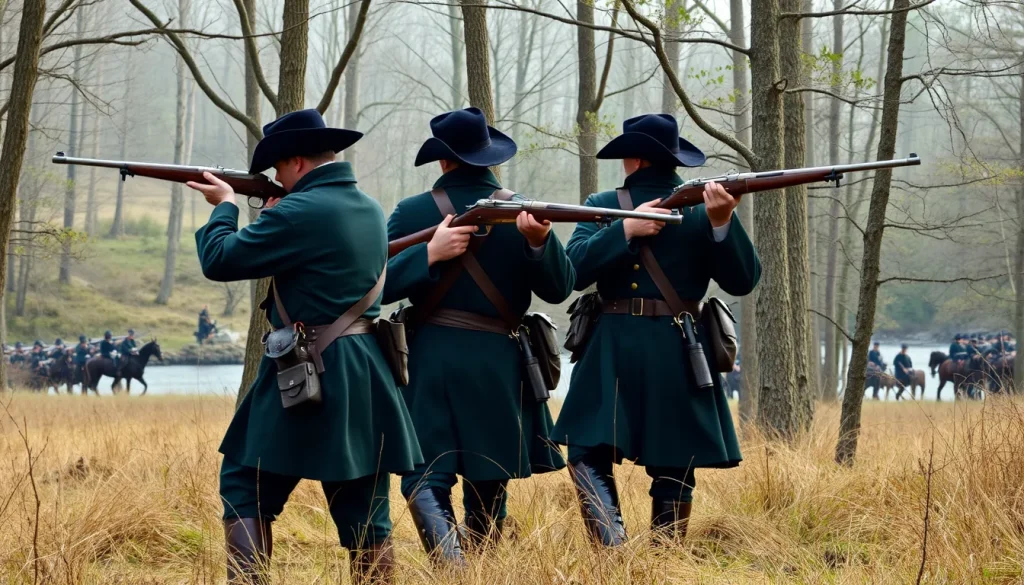
Riflemen in the War of 1812 were soldiers of the United States Army who served as light infantry, armed with rifled firearms and trained to fight as skirmishers. Originally organized as the Regiment of Riflemen in 1808, they were the first American rifle units since the Revolutionary War and were later expanded to four regiments during the conflict. They fought on the Niagara and St. Lawrence frontiers, participating in prominent engagements such as the Battle of York, the Battle of Crysler’s Farm, and the Battle of Big Sandy Creek, and left a lasting impact on American military practice.
Historical Context
The creation of the U.S. Regiment of Riflemen in 1808 was a direct response to rising tensions with Great Britain, particularly the Chesapeake–Leopard affair of 1807. Congress, at President Thomas Jefferson’s request, expanded the regular army to protect seacoast fortifications and the newly acquired Louisiana Territory, and included a regiment of riflemen as part of a trio of light troops (alongside light dragoons and light artillery). The riflemen were intended to operate in rough terrain, conduct reconnaissance, and skirmish with enemy forces, building on the legacy of American riflemen who had served in the Revolution and in Anthony Wayne’s Legion in the 1790s.
By the time war was declared in June 1812, the Regiment of Riflemen had gained limited experience in frontier constabulary duties and in the Battle of Tippecanoe (1811) and the occupation of West Florida. The regiment’s companies were widely scattered, serving from the Great Lakes to the Gulf Coast. When war began, the War Department assigned many of these companies to the Northern armies, where the riflemen became known for their distinctive green uniforms and sharpshooting.
What Happened
During the War of 1812, the original Regiment of Riflemen was designated the 1st Regiment of Riflemen, and three additional rifle regiments were authorized in 1814, each drawn from specific recruiting areas. The 1st operated primarily along the New York–Ontario frontier and the Niagara River. Under officers such as Major Benjamin Forsyth and Captain Daniel Appling, riflemen conducted successful raids, including the capture of Gananoque in 1812 and the raid on Elizabethtown (Brockville) in February 1813. They also served in major actions: at the Battle of York (April 1813), they spearheaded the American landing and were credited with heavy fire on British defenders; at the Battle of Fort George they formed part of the assault; and at the Battle of Crysler’s Farm (November 1813) they fought as skirmishers.
The riflemen were frequently employed in detached companies, seldom concentrating as a regiment. They saw action at the Battle of Ogdensburg (February 1813) where they were routed, and later redeemed themselves at the Battle of Big Sandy Creek (May 1814), where Captain Appling’s command ambushed a British-Canadian force and captured almost 200 prisoners. After Forsyth’s death in June 1814, the riflemen continued to serve in the Niagara campaign and at the Siege of Fort Erie. The newly formed 2nd, 3rd, and 4th Rifle Regiments also saw service, though their histories are less prominent.
The riflemen were never concentrated as a regimental unit; instead, companies were attached to larger brigades or operated independently. Their effectiveness varied, but their reputation for marksmanship and aggressive skirmishing was established in engagements such as the Battle of Plattsburgh and the skirmish at Conjocta Creek.
Why It Matters
The riflemen demonstrated the value of light infantry and aimed fire in the conditions of the war, influencing subsequent American military organization and tactics. Their presence raised expectations for marksmanship as a battlefield skill and contributed to a national image of the ‘frontier rifleman.’ However, the riflemen also gained a mixed reputation: praised for courage and efficiency, yet criticized for plundering and irregular discipline. Historians have debated their overall effectiveness, with some seeing them as elite troops and others as undisciplined and overrated. The war’s outcome led to the post-war disbandment of most rifle units, but the concept persisted, eventually evolving into the U.S. Mounted Riflemen and later the sharpshooter units of the Civil War.
Definition
In the War of 1812, riflemen were U.S. Army soldiers armed with the Harper’s Ferry Model 1803 or U.S. Model 1814 rifle, rather than smoothbore muskets. They were trained for skirmishing: fighting in open order, taking cover, and firing aimed shots at long range. They wore distinctive dark green uniforms, which offered concealment in woods, and often carried tomahawks and scalping knives. The term also included militia and ranger units, but this article focuses on the regular rifle regiments.
Background
American riflemen emerged from the frontier culture of the 18th century, where rifles were used for hunting and warfare. In the Revolutionary War, rifle companies from Virginia, Pennsylvania, and Maryland served as skirmishers and scouts, such as Daniel Morgan’s Corps of Rangers. After the war, the U.S. Army disbanded its rifle units, but the idea persisted. In 1792, Anthony Wayne’s Legion included a battalion of riflemen, which fought at Fallen Timbers in 1794, but it was disbanded in 1796. The 1808 act that created the Regiment of Riflemen was a revival of this concept, prompted by international tensions and a need for light troops to defend the expanding western territories.
How It Worked
Rifle companies were authorized about 80 men each, with officers, non-commissioned officers, and two musicians. They were meant to be self-sufficient and capable of rapid movement. Their training emphasized marksmanship and open-order tactics. A post-war manual described the rifleman’s goal: ‘to make a shot that will take effect; and to make that shot without being discovered.’ In combat, riflemen would advance in loose order, use cover, and fire at officers and artillery crews, disrupting enemy formations. They were often employed as advance guards, rear guards, and on raids. Because rifles had no bayonets, riflemen were vulnerable in close combat, so they relied on terrain and mobility. They were also used in conjunction with regular infantry, as at Fort Erie, where they provided sharpshooting support.
Competing Viewpoints
During the war, American officers often praised riflemen for their skill and courage, while British and Canadian soldiers viewed them as effective but unconventional. Some contemporaries criticized the riflemen for their propensity to loot and their lack of discipline. For example, a British observer described them as ‘the wickedest corps in the army’ after Fort George. Modern historians have offered differing assessments: John Fredriksen in his study ‘Green Coats and Glory’ portrays them as ‘the best troops’ but acknowledges their plundering, while other scholars emphasize the tactical limitations of rifles, which were slower to reload than muskets and more susceptible to fouling. The debate centers on whether the riflemen’s impact was primarily psychological or tactical, and whether their achievements justified their higher cost and logistic requirements.
Role in the War of 1812
The riflemen served in nearly every major campaign of the northern theater. Their key actions included: the raid on Gananoque (September 1812); the raid on Elizabethtown (February 1813) where they freed American prisoners; the Battle of Ogdensburg (February 1813) which ended in a British victory; the Battle of York (April 1813) where they led the assault; the Battle of Fort George (May 1813); the Battle of Crysler’s Farm (November 1813); and the ambush at Big Sandy Creek (May 1814). They also fought at the Siege of Fort Erie and the Battle of Plattsburgh. In addition to combat, they performed reconnaissance and served as skirmishers during the St. Lawrence campaign. The rifle regiments suffered high officer casualties, with Benjamin Forsyth killed in 1814. Their contributions were recognized by Congress, which authorized three additional rifle regiments in 1814, although these were raised too late to see extensive service.
Consequences and Historical Interpretation
The war ended with the Treaty of Ghent, and the rifle regiments were reduced. The 2nd, 3rd, and 4th Rifle Regiments were disbanded in 1815, and the original regiment reverted to its pre-war designation. The Regiment of Riflemen was finally inactivated in June 1821. In the longer term, the riflemen’s performance helped establish the value of light infantry and sharpshooting in the U.S. Army, leading to the creation of the U.S. Mounted Rifles in 1846 and the sharpshooter regiments of the Civil War. Historians see the War of 1812 riflemen as a transitional force between linear tactical systems and modern skirmishing, embodying a distinctly American style of warfare. Their green uniforms and rifles became symbols of national identity, but their legacy is complicated by their role in the displacement of Indigenous peoples and their often-disorderly conduct.
Primary Sources
The most important primary sources include the official reports and correspondence of officers such as Benjamin Forsyth and Daniel Appling, housed in the National Archives and Records Administration. William Duane’s ‘A Handbook for Riflemen’ (1812) was a privately published manual used by the regiment. Contemporary letters and memoirs, such as Major Bennet Riley’s letter praising the riflemen, provide insight. These sources offer tactical details and personal observations, but they are often biased by the writers’ perspectives, and many are fragmentary. For a comprehensive collection, researchers can consult the compiled service records of the rifle regiments at the National Archives.
Further Reading
- Fredriksen, John C. Green Coats and Glory: The United States Regiment of Riflemen, 1808–1821. Old Fort Niagara Association, 2000.
- Weaver, John B. Rifles and Riflemen: Material Culture, Violence, and Early American Identity, 1720–1820. Dissertation, West Virginia University, 2025.
- Brenner, James T. “The Green Against the British Red: U.S. Rifle Regiments in the Northwestern Army.” Ohio War of 1812.
- FamilySearch Wiki. “United States War of 1812 Rifle Units.” Accessed 2025.
- Ray, Fred. “Sharpshooting in the War of 1812.” Blog post, 2011.
References
- “Regiment of Riflemen.” Wikipedia. https://en.wikipedia.org/wiki/Regiment_of_Riflemen.
- Weaver, John B. “Rifles and Riflemen: Material Culture, Violence, and Early American Identity, 1720–1820.” Dissertation, West Virginia University, 2025. https://doi.org/10.33915/etd.12828.
- Brenner, James T. “US Rifle Regiments in the Northwestern Army – Ohio War of 1812.” https://www.yumpu.com/en/document/view/19398031/us-rifle-regiments-in-the-northwestern-army-ohio-war-of-1812.
- FamilySearch Wiki. “United States War of 1812 Rifle Units.” https://www.familysearch.org/en/wiki/United_States_War_of_1812_Rifle_Units.
- Ray, Fred. “Sharpshooting in the the War of 1812.” Blog, 2011. https://www.brettschulte.net/CWBlog/2011/07/18/sharpshooting-the-the-war-of-1812/.
FAQ
What role did riflemen play in the War of 1812?
Riflemen served as skirmishers and sharpshooters, conducting raids, providing cover, and engaging British and Canadian troops at long range. They were used in key battles such as York, Fort George, and Crysler's Farm, and were known for their accuracy and toughness.
How were the riflemen different from regular infantry?
Riflemen used rifled firearms that were more accurate but slower to load than muskets. They wore green uniforms and fought in loose formation, using cover and aimed fire, whereas regular infantry typically fought in line with muskets.
Why were the riflemen disbanded after the war?
After the war, the U.S. Army reduced its size. The additional rifle regiments were disbanded, and the original regiment was inactivated in 1821 because the army no longer needed as many light infantry units in peacetime.
Leave a Reply