
Short Answer
The War of 1812, fought between the United States and Great Britain from June 1812 to February 1815, was the first U.S. declaration of war against another nation. Yet the decision to go to war provoked intense political divisions that nearly tore the young republic apart. The conflict was as much a domestic political struggle as a foreign war, with Federalist opposition in New England and the Mid-Atlantic standing against the Republican war aims of President James Madison and the War Hawks. These divisions shaped the war’s conduct, its military failures, and its eventual outcome.
Historical Context
The United States entered the nineteenth century with a two-party system: the Federalist Party, based largely in New England, and the Democratic-Republican Party, strongest in the South and West. The Federalists favored commercial interests, a strong central government, and generally pro-British foreign policy, while Republicans, led by Thomas Jefferson and James Madison, were pro-French and agrarian. The Napoleonic Wars (1803–1815) created immense pressure on American neutrality. Both Britain and France imposed trade restrictions, with Britain’s Orders in Council (1807) blockading European ports and authorizing seizure of neutral ships. Additionally, the Royal Navy impressed American sailors, claiming they were British deserters. To pressure the belligerents, Jefferson and Madison implemented embargoes, but these hurt American trade more than they hurt Britain. Meanwhile, on the frontier, British support for Indigenous nations resisting American expansion fueled Western fears. By 1811, a group of young, aggressive Republican congressmen known as the War Hawks—led by Henry Clay and John C. Calhoun—pushed for war to end British interference and expand into Canada.
What Happened
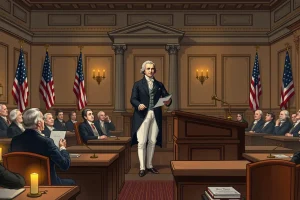
On June 1, 1812, President Madison sent a war message to Congress listing grievances: impressment, the Orders in Council, and British incitement of Indian warfare. After heated debates, the House voted 79 to 49 in favor of war on June 4, and the Senate passed it 19 to 13 on June 17. President Madison signed the declaration on June 18. The vote was the closest of any U.S. declaration of war. Every Federalist in Congress voted against the war, while about a quarter of Republicans joined them or abstained. Opposition was especially strong in New England, where federalists saw the war as a Republican scheme to destroy their commercial economy and possibly to aid Napoleon. Riots against Federalist editors erupted in Baltimore in July 1812. The 1812 presidential election saw a faction of Republicans and Federalists support DeWitt Clinton, Madison’s rival, though Madison won re-election with the South and West. As the war progressed, New England governors refused to commit their militia to federal service, and Federalist merchants traded with the enemy. In December 1814, delegates from New England met at the Hartford Convention to consider constitutional amendments and even secession, though the convention’s moderate proposals were overshadowed by news of peace.
Why It Matters
The political divisions significantly hindered the war effort. The refusal of New England to support the war contributed to the U.S. military’s unpreparedness and early defeats, such as the surrender of Detroit. The Hartford Convention, though it ended without drastic action, raised the specter of disunion. Yet the war also helped unify the country afterward. The Treaty of Ghent (December 1814) restored pre-war boundaries, and the American successes in late battles, especially at New Orleans in January 1815, fueled a surge of nationalism. Historians have debated whether the war was necessary or avoidable, and whether it was a ‘second war of independence’ or a blunder. The political divisiveness of 1812 became a cautionary tale about the dangers of partisanship during wartime.
Definition: Political Divisiveness over the War of 1812
Political divisiveness in this context refers to the sharp partisan and sectional splits within the United States over the decision to declare war on Great Britain and over the war’s prosecution. It encompassed disagreements about foreign policy, national honor, economic interests, and even the legitimacy of the federal government’s war-making authority. The war was not a united national effort but a deeply contested enterprise that tested the strength of the early republic.
Background: The Party System and Foreign Policy
The Federalist and Republican parties held fundamentally different visions for the country. Federalists, rooted in commercial New England, valued trade with Britain and feared French revolutionary radicalism. They believed that war with Britain would ruin American commerce and potentially lead to invasion or disunion. Republicans, especially in the South and West, resented British maritime practices and saw the war as a defense of American sovereignty and republican values. They also hoped to expand territory into Canada and to curtail British influence over Indigenous peoples. The earlier embargo policies, which had ruined many New England merchants, deepened the divide.
How It Worked: The Division in Congress and the Nation
The congressional votes were the most visible manifestation of the split. The House vote of 79–49 showed significant opposition—38% of representatives voted no. In the Senate, the vote was 19–13, a margin of just six votes. All Federalists opposed, and about a quarter of Republicans either voted no or abstained. Opposition was concentrated in New England, New York, and New Jersey, while support was strongest in the South and West. The war hawks, mostly young Republicans from the frontier, used nationalist rhetoric and cited British outrages to whip up support. Federalist critics, such as John Lowell writing as ‘A New England Farmer,’ published pamphlets like ‘Mr. Madison’s War’ that called the conflict an ‘offensive and ruinous war.’ Riots in Baltimore against Federalist newspapers showed that violence could erupt between factions. In the 1812 election, the divisions were evident: Madison won re-election but lost New England and some Mid-Atlantic states.
Competing Viewpoints: Federalist and Republican Arguments
Republicans, and especially war hawks, argued that the United States had to defend its national honor and sovereignty against British violations. They pointed to impressment, the Orders in Council, and British support for Indian raids as unacceptable infringements. They believed that a quick conquest of Canada would force Britain to negotiate and also eliminate British influence among the Indians. Many Republicans also hoped that war would unify the nation and discredit the Federalists once and for all. Federalists countered that the war was unnecessary and unwise. They argued that the Orders in Council were about to be repealed (indeed, they were revoked in June 1812 just after the U.S. declaration), that impressment disputes could be settled diplomatically, and that a land war in Canada would be a disaster given the weak U.S. army. They feared the war would aid Napoleon, whom they saw as a greater threat. Some Federalists even believed that the war was a Republican ploy to distract from domestic policy failures and to increase executive power.
Role in the War of 1812: Effects on the War Effort
The divisions directly affected the war’s execution. New England governors, such as Federalist Caleb Strong of Massachusetts, refused to provide militia for federal service outside their own states, citing constitutional limits. This hindered invasions of Canada. Federalist merchants traded with the enemy, supplying British forces. The lack of national consensus also led to low enlistment and a demoralized army. The American failures early in the war, including the surrender of Detroit and the defeats at Queenston Heights and other points, were partly due to poor coordination and lack of support. In 1814, when the British went on the offensive after Napoleon’s defeat, the divisions remained, though the burning of Washington and the defense of Baltimore temporarily galvanized national resolve. The Hartford Convention in December 1814–January 1815, driven by radical Federalists, considered secession but ultimately proposed moderate constitutional amendments, which were soon forgotten after the Treaty of Ghent and the Battle of New Orleans.
Consequences and Historical Interpretation
The war’s outcome, a return to status quo, seemed to vindicate neither side fully. Yet the conflict had significant consequences. It ended the Federalist Party as a national force, as their wartime dissent looked unpatriotic after American successes. Conversely, the war strengthened American nationalism and gave rise to the ‘Era of Good Feelings’ under James Monroe. Historians have debated the wisdom of the war. Donald Hickey and others argue it was a foolish venture that the nation was unprepared for, while others like J.C.A. Stagg see it as a necessary assertion of republican sovereignty. The political divisiveness of 1812 remains a classic example of the tension between sectionalism and nationalism in early American history. It also highlights the challenges of waging an unpopular war in a democracy.
Primary Sources
- President James Madison’s War Message, June 1, 1812 – The formal list of grievances against Britain, laying out the administration’s case for war.
- Annals of Congress (12th Congress, 1st Session) – Records of the debates and votes in the House and Senate, showing the stark party-line split.
- John Lowell, ‘Mr. Madison’s War’ (Boston: Russell and Cutler, 1812) – A Federalist pamphlet written under the pseudonym ‘A New England Farmer,’ calling the war an ‘offensive and ruinous war.’
- Report of the Hartford Convention (January 1815) – A document outlining New England Federalists’ grievances and proposed constitutional amendments, reflecting their opposition to the war’s conduct.
- Columbian Sentinel (Boston), June 24, 1812 – A newspaper editorial lamenting the declaration of war and capturing Federalist despair.
Further Reading
- Hickey, Donald R. The War of 1812: A Forgotten Conflict. Urbana: University of Illinois Press, 1989.
- Stagg, J.C.A. Mr. Madison’s War: Politics, Diplomacy, and Warfare in the Early American Republic, 1783–1830. Princeton: Princeton University Press, 1983.
- Taylor, Alan. The Civil War of 1812: American Citizens, British Subjects, Irish Rebels, & Indian Allies. New York: Alfred A. Knopf, 2010.
- National Park Service. Articles on the War of 1812, including ‘Summer 1812: Congress stages fiery debates over whether to declare war on Britain,’ ‘Federalists oppose Madison’s War,’ and ‘Stark alternatives: War or compromise?’
References
- National Park Service. ‘Summer 1812: Congress stages fiery debates over whether to declare war on Britain.’ Accessed 2023. https://www.nps.gov/articles/mr-madison-s-war.htm
- National Park Service. ‘Driven by distraction: Political dissent and military unpreparedness.’ Accessed 2023. https://www.nps.gov/articles/driven-by-distraction.htm
- National Park Service. ‘Federalists oppose Madison’s War.’ Accessed 2023. https://www.nps.gov/articles/federalist-opposition-to-the-war.htm
- National Park Service. ‘Stark alternatives: War or compromise?’ Accessed 2023. https://www.nps.gov/articles/stark-alternatives.htm
- National Park Service. ‘The price of sovereignty: Debating the costs of defending American honor.’ Accessed 2023. https://www.nps.gov/articles/price-of-sovereignty.htm
FAQ
Why did the Federalists oppose the War of 1812?
Federalists opposed the war because they believed it would harm American commerce, aid Napoleon, and result from Republican partisan scheming. They preferred peaceful trade with Britain and feared the military power of the Royal Navy.
How did the political divisions affect the war effort?
The divisions led New England states to refuse militia for federal service, hindered invasion plans, and allowed Federalist merchants to trade with the enemy, weakening military readiness and contributing to early defeats.
Was the War of 1812 truly 'Mr. Madison's War'?
Critics called it that because President Madison and the Republican party pushed for war, but the term oversimplifies; many Republicans also opposed it, and the war had broad sectional and economic causes.



Leave a Reply