Short Answer
The Battle of Sackett’s Harbor (also spelled Sackets Harbor) was a British amphibious raid conducted on 29 May 1813 against the principal American naval base on Lake Ontario during the War of 1812. Although the attacking British and Canadian troops were repulsed by American regulars, militia, and sailors, the raid succeeded in destroying large quantities of naval stores and caused temporary damage to American warships. The battle is historically significant for its impact on the naval race on Lake Ontario and for the leadership shown by American Brigadier General Jacob Brown, who received a regular army commission as a result.
Historical Context
During the early months of the War of 1812, the Great Lakes emerged as a vital strategic theater. The lakes served as highways for troop movements, supplies, and naval power in the largely wilderness region of the Old Northwest. Both the United States and Britain recognized that control of Lake Ontario was essential for securing their respective positions in Upper Canada and northern New York. As a result, a naval arms race developed, with both sides constructing and refitting warships at major dockyards.
Sackett’s Harbor, located on the eastern shore of Lake Ontario, became the principal American naval base and shipbuilding yard for the lake. By 1813, Commodore Isaac Chauncey had established a sizable squadron there, and master shipbuilder Henry Eckford was overseeing the construction of new vessels, including the corvette General Pike. Across the lake, the British maintained their main naval station at Kingston, where Captain James Lucas Yeo had recently arrived with reinforcements. The strategic balance on the lake was delicate, and both sides sought to gain an advantage by striking at each other’s shipyards.
In April 1813, American forces under Major General Henry Dearborn and Commodore Isaac Chauncey had successfully attacked York (present-day Toronto), the provincial capital of Upper Canada, temporarily occupying and looting the town. This attack alarmed British officials and exposed the vulnerability of their own naval installations. When Chauncey’s squadron subsequently moved to the western end of Lake Ontario to support operations against Fort George on the Niagara Peninsula, the British at Kingston saw an opportunity to strike at Sackett’s Harbor, which was left temporarily weakened.
What Happened
On 27 May 1813, a British expedition composed of about 800 soldiers from the Kingston garrison, including light companies of several regiments, Canadian Voltigeurs, and a detachment of Royal Artillery, was hastily assembled. The force sailed from Kingston under the overall command of Lieutenant General Sir George Prevost, Governor General of Canada, who delegated tactical command ashore to Colonel Edward Baynes. The naval flotilla was commanded by Captain James Lucas Yeo and consisted of five warships and 33 bateaux, carrying the troops.
The expedition made slow progress due to light winds, and by the morning of 28 May it was still 16 kilometers from its objective. An American schooner spotted the force and alerted Sackett’s Harbor, eliminating any chance of surprise. The British continued, capturing 115 American reinforcements traveling by boat to the harbor on 28 May. On the evening of 28 May, the British came to anchor off Sackett’s Harbor, and at dawn on 29 May they began landing troops on Horse Island, a small island about a mile west of the mainland.
The American garrison at Sackett’s Harbor consisted of about 500 regular U.S. Army troops, 900 New York militia, and a few sailors and marines, supported by field guns and fortifications. Brigadier General Jacob Brown of the New York militia was the senior American officer on the scene. Brown deployed the regulars in the main defenses around the navy yard, while militia were positioned to oppose the British landing.
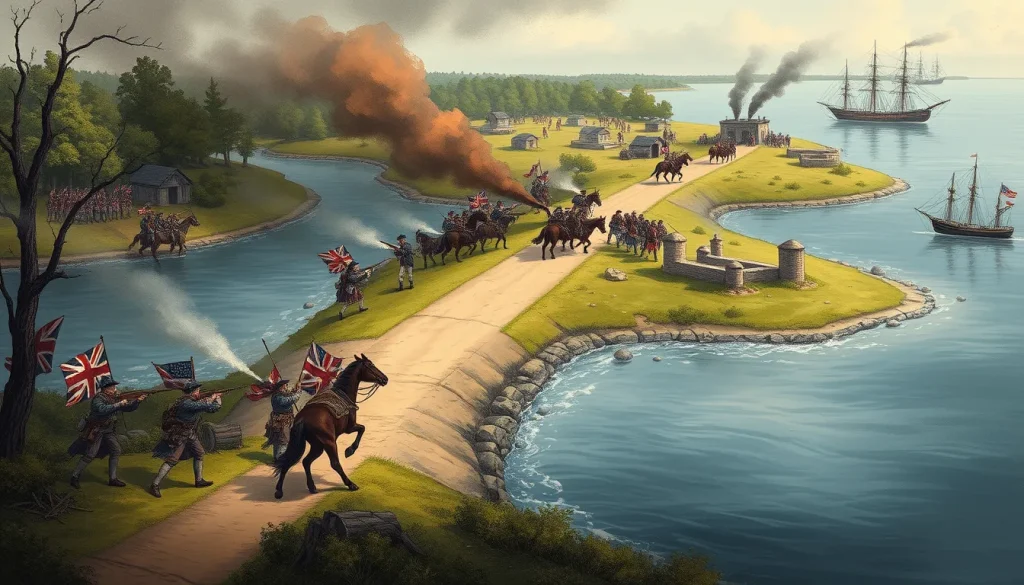
The British landing at Horse Island encountered militia fire but pushed them back. The Americans withdrew across a causeway connecting Horse Island to the mainland, and the British followed. Once ashore, Baynes divided his force into two columns and advanced toward the naval yard. However, contrary winds prevented most of Yeo’s squadron from bringing their heavy guns into action; only a few vessels could provide fire support. The British columns attacked the main American defensive line, which was anchored on three blockhouses and earthworks. The fighting was intense, and casualties mounted on both sides. After about an hour, with his troops beginning to run low on ammunition and three key officers wounded, Colonel Baynes consulted with Prevost, who ordered a withdrawal back to the boats. The British re-embarked and returned to Kingston, leaving behind a small number of dead and wounded.
During the battle, fearing that the British might capture the naval yard, the Americans set fire to storehouses and the nearly completed ship General Pike. The ship’s flames were extinguished before serious damage, but the loss of naval stores—timber, rigging, sails, and provisions—was considerable. A number of small watercraft and a blockhouse also burned. The British did not achieve their primary objective of destroying the warship, but they did set back American naval construction.
Why It Matters
The Battle of Sackett’s Harbor is often viewed as a tactical American victory because the British were repulsed, and the naval yard and main ship were saved. However, strategically the raid was a partial success for the British. The destruction of naval stores and the temporary disruption of shipbuilding delayed the completion of the General Pike and reinforced American caution. Commodore Chauncey, upon learning of the raid, felt compelled to keep his squadron near Sackett’s Harbor to protect the base, which allowed the British to shift reinforcements to the Niagara Peninsula. This contributed to the American stalemate on Lake Ontario, where the two squadrons remained evenly matched for the rest of 1813.
Historians have interpreted the battle as a demonstration of the difficulty of amphibious operations and the importance of naval superiority on the Great Lakes. The raid also highlighted the leadership abilities of Jacob Brown, whose calm direction of the defense earned him a commission as a brigadier general in the regular army. In British historiography, Prevost’s decision to withdraw has often been criticized, but some scholars note that the raid achieved its operational goal of relieving pressure on British forces in Upper Canada while risking only a modest force.
Prelude
In the weeks before the battle, the American squadron under Chauncey had transported an army to Fort George, which was captured on 27 May 1813. The absence of Chauncey’s ships from Sackett’s Harbor, combined with intelligence that the garrison was relatively weak, convinced Prevost and Yeo to attempt a raid. The British had just completed the sloop Wolfe and were preparing for a naval confrontation, but they recognized that destroying the American shipyard could delay the launch of the General Pike and tip the naval balance in their favor.
Forces and Commanders
British: Lieutenant General Sir George Prevost (expeditionary commander), Colonel Edward Baynes (landing force commander), Captain James Lucas Yeo (naval force). Approximate strength: 870 soldiers (including regulars, Canadian Voltigeurs, and Glengarry Light Infantry), accompanied by a small party of Indigenous warriors, and 5 naval vessels with 84 guns overall. The naval squadron included the ships Wolfe, Royal George, and others.
American: Brigadier General Jacob Brown (New York militia) as senior commander, Commodore Isaac Chauncey (absent with the main squadron), Captain Woolcott Chauncey (not present). Approximate strength: about 500 regular U.S. Army infantry, 900 militia, and a detachment of sailors and marines, with 2 field guns and 17 fixed guns in the fortifications. Two small schooners were also in the harbor.
Battlefield and Map Context
Sackett’s Harbor lies on the eastern shore of Lake Ontario, near the mouth of the St. Lawrence River. The main defensive line ran from the harbor along a series of earthworks and blockhouses protecting the navy yard. Horse Island, located about a mile west, was separated from the mainland by a narrow strait, across which a causeway connected to the mainland. The terrain was wooded and uneven, with an abatis (felled trees) constructed outside the defenses. A modern map shows the layout of the battlefield, including the landing site on Horse Island, the causeway, and the principal fortifications around the town.
Battle Chronology
28 May 1813: British expedition sights and captures American reinforcements near Sacket’s Harbor. American lookouts spot the British and send a warning.
29 May 1813, early morning: British troops land on Horse Island; American militia skirmish and fall back across the causeway.
Mid-morning: British columns advance across the causeway and attack the main American line; fighting is heavy, casualties mount. American defenders set fire to stores and the General Pike.
Late morning: Colonel Baynes, with three officers wounded and ammunition exhausted, requests orders from Prevost, who orders withdrawal. British re-embark and return to Kingston.
Casualties and Losses
Casualty figures vary slightly among sources. The American Battlefield Trust gives American losses of 307 total (69 killed, 84 wounded, 154 captured) and British losses of 265 total (30 killed, 200 wounded, 35 wounded prisoners). The Canadian Encyclopedia indicates about 300 American casualties and about 400 British. Other accounts may include additional captured. The British also lost some guns. It is important to note that both sides may have inflated or deflated numbers for public consumption.
Result
The battle ended as a tactical American victory: the British were repelled and failed to destroy the naval yard or the General Pike. However, the Americans suffered significant self-inflicted damage by burning stores and a blockhouse. The British considered the raid a strategic success because it disrupted American shipbuilding and forced Chauncey to adopt a defensive posture, allowing Yeo to reinforce the western end of Lake Ontario.
Strategic Consequences
The immediate consequence was that the General Pike was launched later that summer, but the delay gave Yeo time to establish a naval presence. The raid reinforced American caution, and for the remainder of 1813 the two squadrons avoided a decisive fleet action. The British did not again threaten Sackett’s Harbor. Historians argue that the raid, combined with the Battle of Stoney Creek (6 June 1813), saved Upper Canada from a possible American conquest in the summer of 1813. The destruction of naval stores also delayed American operations on the lake.
Primary Accounts
Contemporary official reports include the dispatch of Lieutenant General Prevost to the Colonial Office describing the raid, and the report of Brigadier General Brown to Major General Dearborn. Both are available in American and British archival collections. The diary of a British sergeant or the letters of American militia officers provide additional personal perspectives. A well-known lithograph by Hiram Peabody Flagg depicts the battle, but written accounts are essential. The National Archives of Canada and the U.S. National Archives hold relevant documents.
Battlefield Today
Sackets Harbor Battlefield State Historic Site preserves portions of the battlefield and the 19th-century navy yard. Visitors can see earthworks, the Commandant’s House, and a small museum. Horse Island is now owned by the state and is accessible by a causeway. The site is listed on the National Register of Historic Places and is part of the Great Lakes Seaway Trail. Interpretive signage outlines the battle’s course, and annual living-history events reenact the engagement.
Primary Sources
Key primary sources include the official dispatches of Prevost and Brown, published in the American State Papers: Military Affairs and the British Colonial Office Records. The Naval Chronicle carried contemporary reports. A letter from Major General Henry Dearborn to Secretary of War John Armstrong describes the aftermath. These sources must be read critically, as each commander sought to justify his actions and protect his reputation.
Further Reading
- Hitsman, J. Mackay. The Incredible War of 1812: A Military History. Toronto: University of Toronto Press, 1965.
- Hickey, Donald R. The War of 1812: A Forgotten Conflict. Urbana: University of Illinois Press, 1989.
- Malcomson, Robert. Lords of the Lake: The Naval War on Lake Ontario, 1812–1814. Toronto: Robin Brass Studio, 1998.
- American Battlefield Trust, “Sackets Harbor Battle Facts and Summary.” Available at www.battlefields.org.
- New York State Parks, “Sackets Harbor Battlefield State Historic Site.” Available at parks.ny.gov.
- Grodzinski, John R. “Battle of Sackets Harbor.” The Canadian Encyclopedia, 2011.
- Martin, Tyrone G. “Lake Ontario’s Little-Known Gem.” Naval History Magazine, February 2007.
References
- “Sackets Harbor Battle Facts and Summary,” American Battlefield Trust, https://www.battlefields.org/learn/war-1812/battles/sackets-harbor
- “Sackets Harbor Battlefield State Historic Site,” New York State Parks, https://parks.ny.gov/visit/historic-sites/sackets-harbor-battlefield-state-historic-site
- John R. Grodzinski, “Battle of Sackets Harbor,” The Canadian Encyclopedia, https://thecanadianencyclopedia.ca/index.php/en/article/raid-on-sackets-harbor
- Tyrone G. Martin, “Lake Ontario’s Little-Known Gem,” Naval History Magazine, February 2007, https://www.usni.org/magazines/naval-history-magazine/2007/february/lake-ontarios-little-known-gem
- “Second Battle of Sacket’s Harbor,” Wikipedia, https://en.wikipedia.org/wiki/Second_Battle_of_Sacket%27s_Harbor (accessed for corroboration of details)
FAQ
Was the Battle of Sackett's Harbor an American or British victory?
Tactically it was an American victory because the British were repelled and failed to destroy the shipyard. Strategically, however, the British achieved part of their goal by destroying naval stores and disrupting American shipbuilding, which helped balance naval power on Lake Ontario.
Why did the British attack Sackett's Harbor?
The British attacked to destroy the American naval shipyard and the new corvette General Pike, thereby securing naval superiority on Lake Ontario. The opportunity arose when the American fleet was away supporting operations at Fort George.
What happened to the General Pike after the battle?
The General Pike was set on fire by the Americans but the flames were extinguished. It was launched later in the summer of 1813 and served in Commodore Chauncey's squadron.



Leave a Reply